Key takeaways
- Bluefish AI is enterprise-only with quote-based pricing estimated at $4,000+/month. Trakkr.ai starts free and tops out at $399/month. These tools are not competing for the same buyer.
- Trakkr.ai is self-serve and accessible in minutes. Bluefish AI requires a sales demo before you can even see the product.
- Bluefish AI is designed around brand influence and how AI "thinks" about your brand, going beyond share-of-voice metrics. Trakkr.ai focuses on visibility tracking, site health scoring, and actionable quick wins.
- Trakkr.ai includes a site health audit with specific page-level fixes and AI readiness checks (robots.txt, llms.txt, sitemap). Bluefish AI's optimization is more workflow-oriented and less prescriptive on the technical side.
- Bluefish AI has passed enterprise infosec reviews and is built for Fortune 500 data governance requirements. Trakkr.ai has no public mention of enterprise security certifications.
- Neither tool offers the full content generation loop (gap analysis + AI writing + traffic attribution) that platforms like Promptwatch provide, but both are solid for monitoring and optimization in their respective market segments.
Overview
Bluefish AI
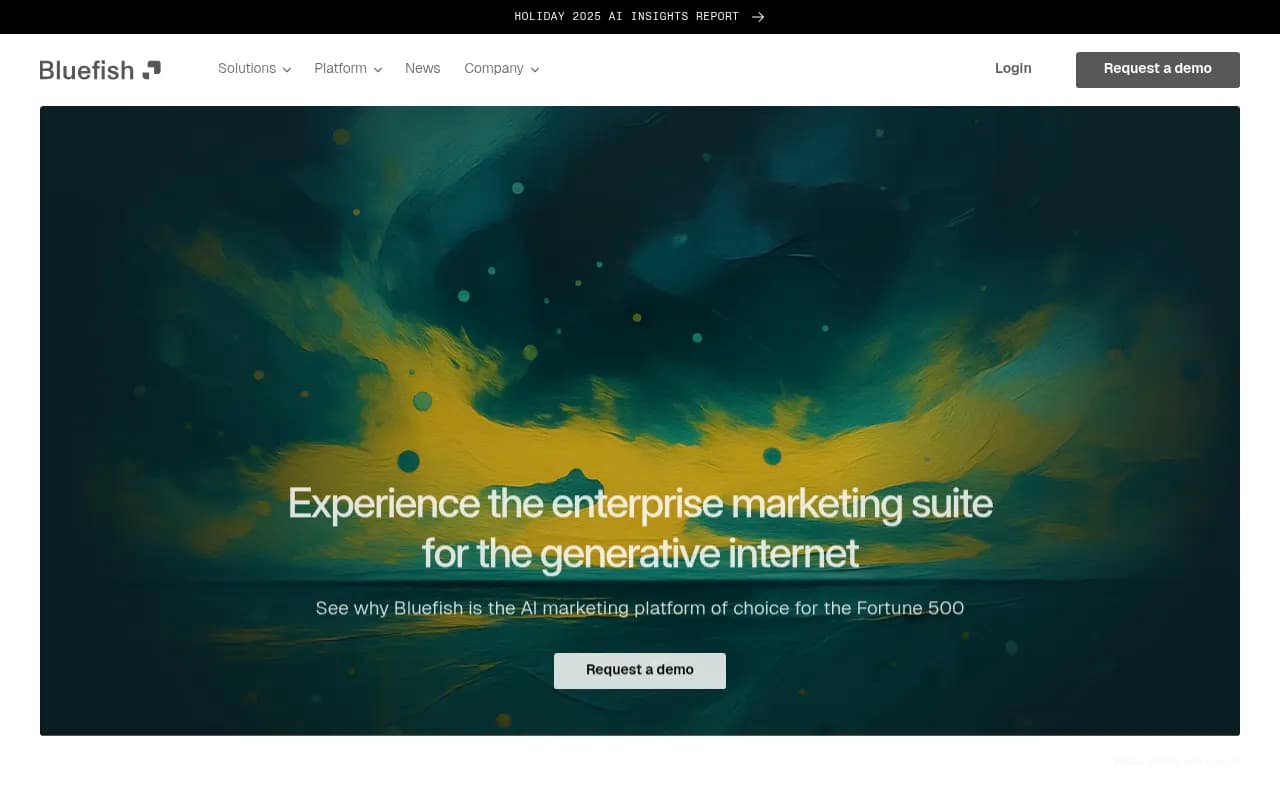
Bluefish AI positions itself as the enterprise GEO platform for Fortune 500 brands. The pitch is authority and control: not just knowing where you appear in AI results, but understanding how AI models form opinions about your brand and influencing that at scale. Their "Collections" feature (launched February 2026) lets marketers measure the ROI of digital campaigns specifically in the AI channel, which is a genuinely interesting angle most competitors haven't tackled. The trade-off is that everything about Bluefish is gated behind a sales process. No pricing page, no free trial, no self-serve signup.
Trakkr.ai
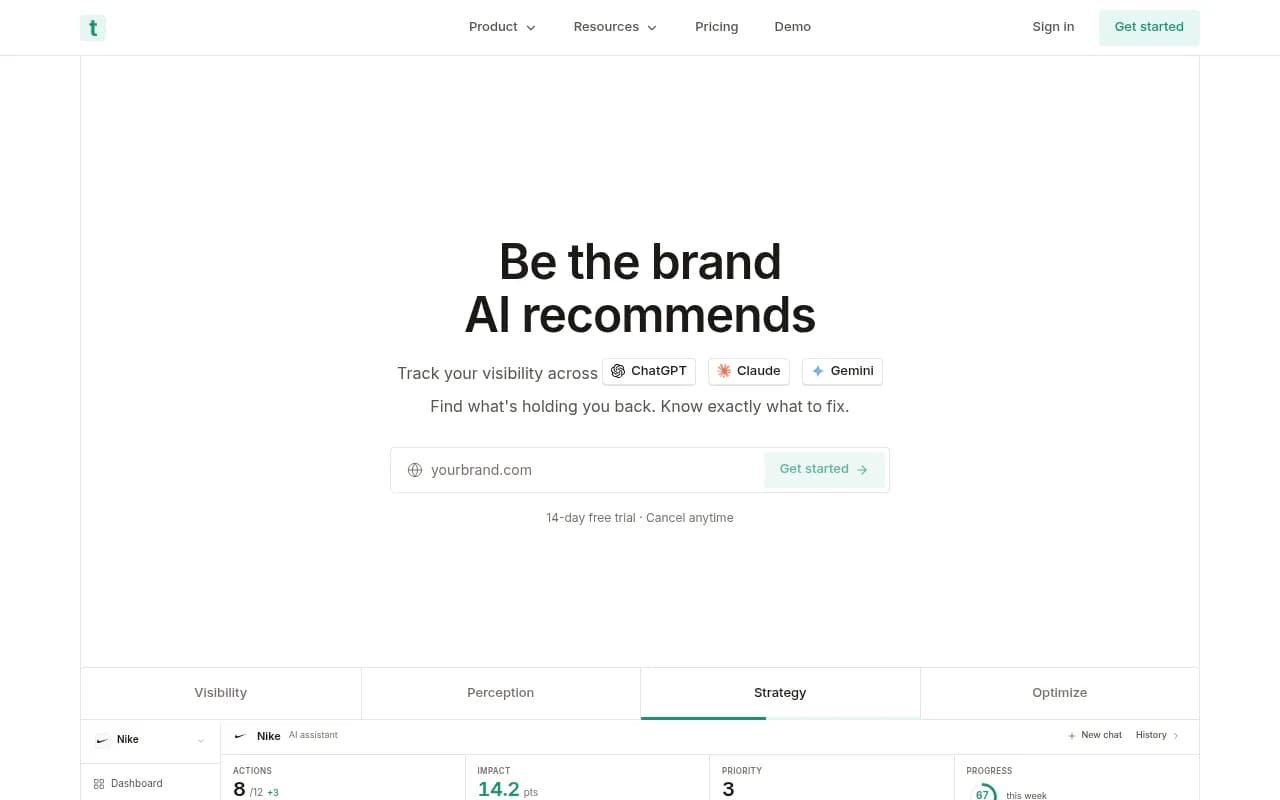
Trakkr.ai takes the opposite approach: get in, start tracking, see results fast. The free plan lets you monitor one brand across five queries with no credit card required. The product leans into actionability -- a site health score with specific page-level issues, AI readiness checks for llms.txt and structured data, and a "quick wins" list that tells you exactly what to fix and how many visibility points you'll gain. It covers ChatGPT, Claude, Gemini, Perplexity, and Grok. The Scale plan at $399/month adds API access and 10 brands, which is where it starts to overlap with mid-market use cases.
Side-by-side comparison
| Feature | Bluefish AI | Trakkr.ai |
|---|---|---|
| Target audience | Fortune 500 / enterprise | SMB, startups, mid-market |
| Pricing model | Quote-based | Freemium + fixed tiers |
| Starting price | ~$4,000+/month (estimated) | Free (limited) |
| Free trial | No | 14-day free trial |
| Self-serve signup | No (demo required) | Yes |
| AI models tracked | Not publicly listed | ChatGPT, Claude, Gemini, Perplexity, Grok |
| Site health audit | Not mentioned | Yes (page-level scoring) |
| AI readiness checks | Not mentioned | Yes (llms.txt, robots.txt, sitemap, schema) |
| Campaign ROI measurement | Yes (Collections feature) | Not mentioned |
| Competitor tracking | Yes | Yes |
| API access | Not publicly confirmed | Yes (Scale plan, $399/mo) |
| Enterprise infosec compliance | Yes (passes reviews) | Not publicly confirmed |
| Content optimization | GEO workflows | Quick-win recommendations |
| Agentic commerce tracking | Yes | Not mentioned |
Head-to-head feature deep-dive
Pricing and accessibility
This is where the two tools diverge most sharply. Bluefish AI has no public pricing. You request a demo, talk to sales, and eventually get a quote. Based on available market research, enterprise clients are looking at $4,000+ per month. That's not a criticism -- enterprise software with custom infosec reviews, dedicated support, and Fortune 500 SLAs costs money. But it means Bluefish is simply not an option for most teams.
Trakkr.ai publishes its pricing openly. The free plan is genuinely useful for a single brand with five queries. Growth at $79/month covers 50 queries across all AI models. Scale at $399/month adds 10 brands and API access.
Verdict: Trakkr.ai wins on accessibility by a wide margin. Bluefish AI isn't trying to compete here -- it's priced for a completely different buyer.
AI model coverage
Trakkr.ai publicly lists ChatGPT, Claude, Gemini, Perplexity, and Grok. That's a solid set covering the models most brands actually care about in 2026.
Bluefish AI doesn't publish a list of supported models. Their website references "all AI native experiences" and "major AI channels" without specifics. You'd need a sales conversation to get the actual list, which is frustrating when you're trying to evaluate the product.
Verdict: Trakkr.ai is more transparent. Bluefish AI likely covers comparable or broader models at enterprise scale, but the lack of public information is a real friction point during evaluation.
Site optimization and technical AI readiness
Trakkr.ai's site health feature is one of its more distinctive capabilities. It scans your pages and produces a health score (0-100), breaks down issues by critical/warning/passed, and gives you specific fixes with estimated visibility point gains. The AI readiness check covers robots.txt, sitemap.xml, llms.txt, llms-full.txt, and mcp.json. That's genuinely practical -- most brands haven't thought about whether their llms.txt is configured correctly.
Bluefish AI talks about "actionability" and "automate optimization workflows" but doesn't describe a site audit or technical readiness check in any public-facing material. Their optimization angle is more about GEO strategy and brand influence than crawlability and schema markup.
Verdict: Trakkr.ai is more hands-on for technical optimization. Bluefish AI operates at a higher strategic level.
Campaign measurement and ROI
Bluefish AI's "Collections" feature, launched in early 2026, is worth paying attention to. It's designed to measure the ROI of digital marketing campaigns specifically in the AI channel -- so if you run a Super Bowl ad or a content push, you can see whether it moved the needle on how AI models talk about your brand. Their February 2026 blog post even analyzed Super Bowl ads' influence on AI recommendations. That's a genuinely novel capability.
Trakkr.ai doesn't appear to have an equivalent campaign attribution feature. It tracks visibility over time, which lets you see trends, but connecting that to specific marketing spend isn't something the product currently addresses.
Verdict: Bluefish AI has a meaningful edge here for brands running large campaigns and needing to justify AI channel investment to leadership.
Enterprise readiness
Bluefish AI explicitly calls out that it "consistently passes infosec reviews with ease" and is built for enterprise data governance, custom segmentation, and security requirements. For a Fortune 500 marketing team that needs to get a vendor through procurement, this matters a lot.
Trakkr.ai doesn't mention SOC 2, GDPR compliance, SSO, or any enterprise security features in its public materials. That doesn't mean they're absent, but they're not positioned as a selling point.
Verdict: Bluefish AI is the clear choice if your procurement team needs to sign off on a vendor.
Competitor analysis
Both tools offer competitor tracking. Trakkr.ai shows competitor rankings and positioning across AI models. Bluefish AI includes competitor benchmarking as part of its broader GEO measurement suite.
Neither tool's public materials give enough detail to declare a winner here. Trakkr.ai's competitor features are visible in the product UI screenshots; Bluefish AI's are described at a high level.
Verdict: Roughly comparable based on available information, with Bluefish AI likely offering more depth at enterprise scale.
Pricing comparison
| Plan | Bluefish AI | Trakkr.ai |
|---|---|---|
| Free / entry | None | Free (1 brand, 5 queries) |
| Starter | Not available | Growth: $79/mo (50 queries, all AI models) |
| Mid-tier | Not available | Scale: $399/mo (10 brands, API access) |
| Enterprise | Quote-based (~$4,000+/mo) | Custom (not listed) |
| Free trial | No | 14-day free trial |
| Self-serve | No | Yes |
The pricing gap here is not a rounding error. Trakkr.ai's most expensive public plan ($399/month) is roughly 10x cheaper than Bluefish AI's estimated entry point. These are different products for different budgets.
Pros and cons
Bluefish AI
Pros:
- Built specifically for enterprise scale and governance requirements
- Campaign ROI measurement in the AI channel (Collections feature) is genuinely differentiated
- Focuses on brand influence and how AI models "think," not just surface-level visibility scores
- Passes enterprise infosec reviews -- important for Fortune 500 procurement
- Agentic commerce tracking for brands selling through AI-powered shopping experiences
Cons:
- No public pricing, no free trial, no self-serve access -- high friction to evaluate
- Estimated $4,000+/month puts it out of reach for most teams
- Technical AI readiness features (llms.txt, schema, crawlability) not publicly described
- AI model coverage not disclosed publicly
- Small teams or agencies will find it overkill and unaffordable
Trakkr.ai
Pros:
- Free plan available with no credit card required
- Transparent, affordable pricing ($79-$399/month)
- Specific, actionable site health scoring with page-level fixes and visibility point estimates
- AI readiness checks for llms.txt, structured data, and other technical factors
- Self-serve -- you can be up and running in minutes
- 14-day free trial on paid plans
Cons:
- No campaign ROI measurement or attribution to marketing spend
- No mention of enterprise security certifications or compliance
- Scale plan ($399/mo) may feel limited for large brands with many properties
- Agentic commerce and AI shopping tracking not mentioned
- Less depth on how AI models form brand perceptions vs. just tracking mentions
Who should pick which tool
Pick Bluefish AI if:
- You're at a large enterprise or Fortune 500 brand with a real budget for AI marketing infrastructure
- You need to pass infosec and procurement reviews before onboarding a vendor
- You want to measure the ROI of specific marketing campaigns in the AI channel
- You're tracking AI commerce and agentic shopping experiences
- You need custom audience segmentation and enterprise-grade data controls
Pick Trakkr.ai if:
- You're a startup, SMB, or mid-market brand that needs to start tracking AI visibility without a big budget
- You want to get started today without a sales call
- You need specific, technical guidance on what to fix on your site to improve AI visibility
- You're an agency managing multiple client brands (Scale plan covers 10 brands)
- You want a free plan to test the concept before committing
Consider Promptwatch if you need the full optimization loop:

If you're looking for something between "basic tracker" and "enterprise-only black box," Promptwatch covers the gap. It tracks 10+ AI models, includes content gap analysis to show which prompts competitors rank for that you don't, has a built-in AI writing agent to create content engineered for AI citations, and closes the loop with traffic attribution. Plans start at $99/month with a free trial -- more capable than Trakkr.ai for optimization, and far more accessible than Bluefish AI.
Final verdict
Bluefish AI and Trakkr.ai are not really competing for the same customer. Bluefish AI is a serious enterprise platform for brands that have the budget, the procurement process, and the need for campaign-level AI attribution. Trakkr.ai is a practical, affordable tool for teams that want to start tracking and improving their AI visibility without a six-figure annual commitment.
If you're a Fortune 500 marketing director with budget to spend and a need to prove AI channel ROI to your CMO, Bluefish AI is worth the demo. If you're anyone else, Trakkr.ai's free plan lets you find out what AI models are saying about your brand in the next five minutes.