Key takeaways
- Scrunch's Shopping analytics ("Product Observability") is locked behind its custom Enterprise tier, and its public pricing page has no named ads-tracking feature at all
- ChatGPT ads now appear in roughly 20-32% of web-search responses depending on the trailing window, per Promptwatch's own tracking, up from zero before May 27, 2026
- ChatGPT Shopping triggers unevenly: Profound's analysis of 260 million prompt results found shopping fires on only about 8.8% of prompts overall, and open-ended queries trigger it roughly 4x more than brand-direct searches
- Promptwatch bundles Shopping Insights and Ads Radar on its $579/month Business plan alongside crawler logs and content publishing; LLM Pulse offers a cheaper entry point with a dedicated public ChatGPT Ads Library
- If you only need monitoring without shopping or ads, cheaper tools like Peec AI or Otterly.AI cover the basics, but neither tracks commerce or paid placements
Why Scrunch alone won't cut it for shopping and ads
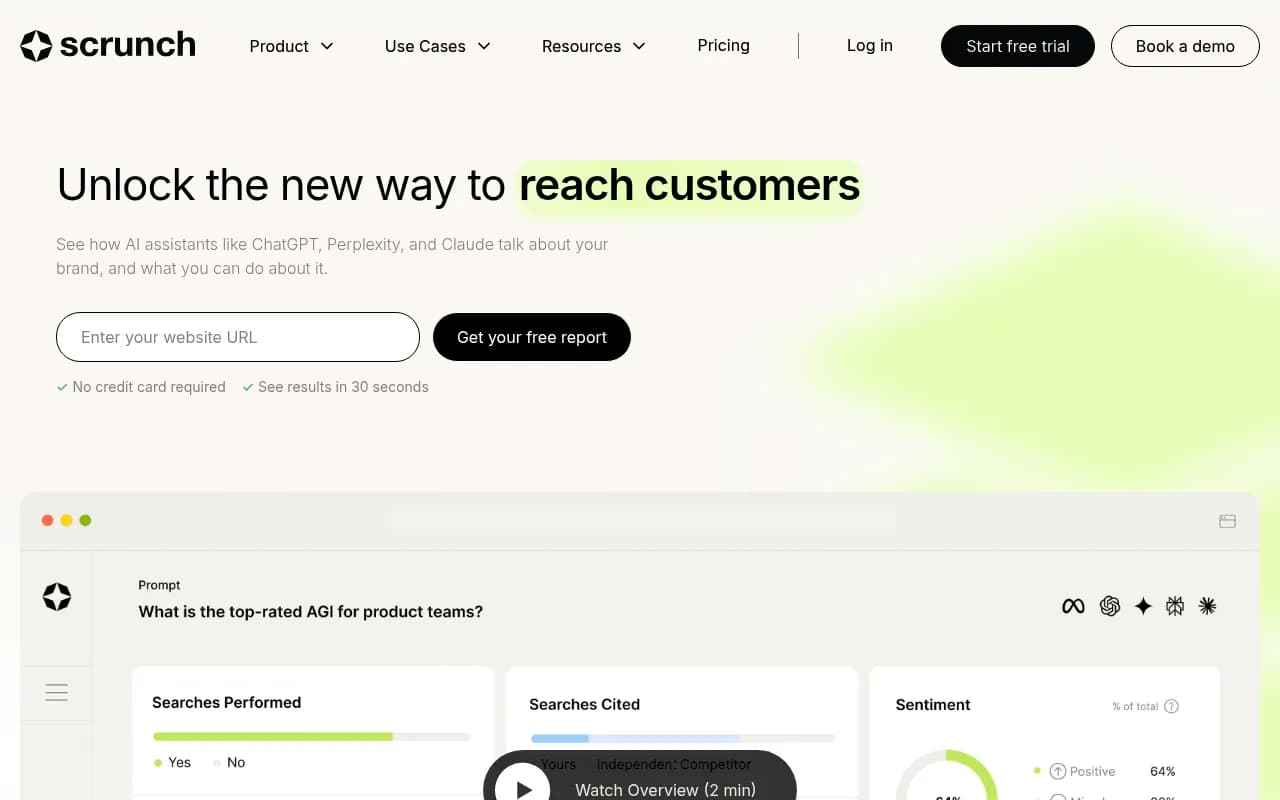
Scrunch built a real reputation as one of the more technically serious AI visibility platforms, especially around crawler-level agent traffic. But if what you actually need is visibility into ChatGPT Shopping results and who's buying ads in AI answers, Scrunch leaves a gap.
Its Core plan, around $250 a month, tracks four engines (ChatGPT, Perplexity, Google AI Overviews, Microsoft Copilot) with 125 prompt credits. Scrunch does have a Shopping module, launched in March 2026, that tracks Share of Shelf, Retailer Share, and first-position win rates across ChatGPT and Copilot (with Perplexity "coming soon" at the time of that announcement). The problem is that Scrunch's own pricing table lists "Product Observability," the analytics layer behind Shopping, as an Enterprise-only line item. Core customers don't get it. And Enterprise pricing is custom, typically starting well north of $1,000 a month once you add the other Enterprise-gated engines (Claude, Gemini, Meta AI, Google AI Mode, Grok).
Ads tracking is a bigger gap. Scrunch's public feature tables across Monitor, Analyze, and Optimize don't list any ad-tracking capability at all, as of the current pricing snapshot. If competitors are buying placement inside ChatGPT's ad-serving answers and you want to know about it, Scrunch simply isn't built for that today.
That's before you get to the prompt-credit math. Scrunch's 125 prompts on Core deplete per engine tracked, so tracking four engines against the same question set works out to roughly 31 unique questions in practice, according to Promptwatch's own breakdown of the Scrunch pricing model.
What's actually happening with ChatGPT ads and shopping right now
Before picking a tool, it helps to know what you're tracking and why it moves so much.
Ads inside ChatGPT are new and volatile. Promptwatch's own data shows ChatGPT served zero ads until May 27, 2026, when they started showing up in about 1.7% of web-search responses. By July 1 the rate crossed 30% and stuck there, with the trailing 7-day average recently sitting around 32%, and daily spikes as high as 43.9%. Of the responses that carry ads, about 73% are organic queries, 18% are brand-specific searches, and 8.6% are competitor-comparison prompts. You can see the day-by-day movement in Promptwatch's ChatGPT ads data.
LLM Pulse ran its own study analyzing 137,038 ChatGPT answers collected between July 25 and August 4, 2026, with 36,153 served to US users. 71.9% of those carried at least one ad. Interestingly, commercial questions had the highest ad rate (74.6%), informational questions came in at 69.5%, and transactional queries, the ones closest to an actual purchase, had the lowest rate at 66.4%. There were 3,033 distinct advertisers in that sample, and the top advertiser (ZoomInfo) showed up in only 2% of ad-carrying answers, so this is a wide, shallow ad market, not a few brands dominating. Ads are also currently limited to ChatGPT's Free and Go tiers; Plus and Enterprise users don't see them.
Shopping behaves differently again. Profound's analysis of 260 million prompt-level results across 13,000 product categories found shopping features trigger on only about 8.8% of prompts overall, but open-ended prompts like "best business laptops with strong battery life" trigger it at 12.1%, roughly four times the rate of brand-direct searches (3.1%). There's also a sticky-state effect: if a prompt triggered shopping yesterday, there's an 83% chance it does again today; if it didn't, there's only a 1.7% chance it starts tomorrow. Shopping is a discovery surface that locks into stable patterns, not something that fires randomly every time someone searches.
One caveat worth flagging: reporting via The Information suggests OpenAI may be scaling back plans for in-ChatGPT checkout in favor of lighter product-recommendation tracking. Treat that as a single secondary source for now, but it's a reason not to over-invest in transactional shopping tracking specifically.
The alternatives that actually cover shopping and ads
Promptwatch
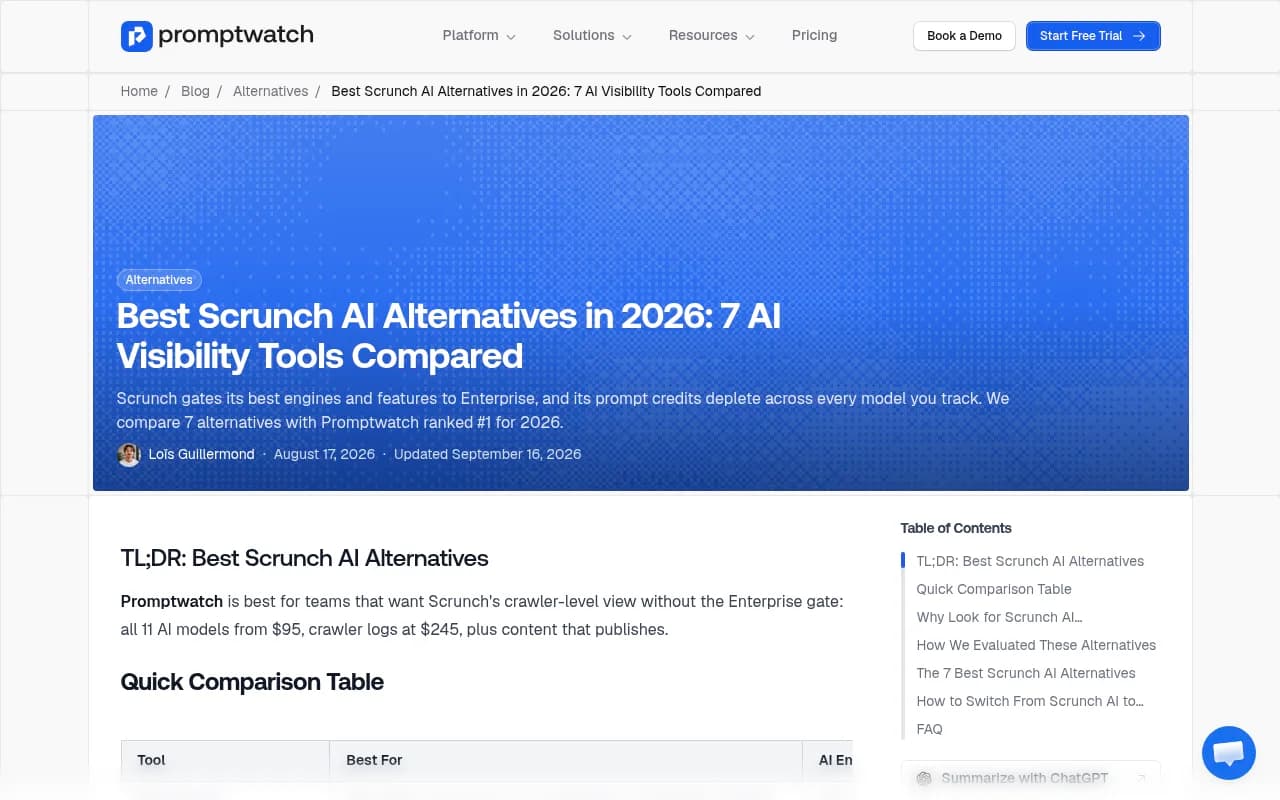
Promptwatch is the most complete option here if you want shopping, ads, and everything else, monitoring, crawler logs, content generation, in one platform rather than stitching together three tools.

Shopping Insights and Ads Radar sit on the $579/month Business plan, alongside state and city-level tracking and 100M crawler log events. That's a real jump from the $95 Essential and $245 Professional tiers, which don't include shopping or ads at all, so budget for Business if commerce visibility is the point of buying this. What you get for it: tracking across all 11 supported AI models (though only 4 per project at a time), AI crawler logs showing exactly when ChatGPTBot, ClaudeBot, and 400+ other bots hit your site, Reddit and YouTube citation tracking that Scrunch doesn't offer, and a Content Agent that writes and publishes GEO content directly to Webflow, Framer, or WordPress. Unified Actions turns all of that into a prioritized to-do list instead of a dashboard you have to interpret yourself.
It's the pick for teams that want Scrunch's crawler-level rigor without the Enterprise price gate, and who also want the content and action layer that pure trackers skip entirely.
LLM Pulse
LLM Pulse is the budget-friendly commerce specialist. Its Starter plan runs €49/month for 50 prompts across five standard models (ChatGPT, Perplexity, Gemini, Google AI Mode, Google AI Overviews). Ads and shopping are add-ons rather than bundled in, but they're available from the Starter tier, not gated to a top plan the way Scrunch and Promptwatch gate theirs.
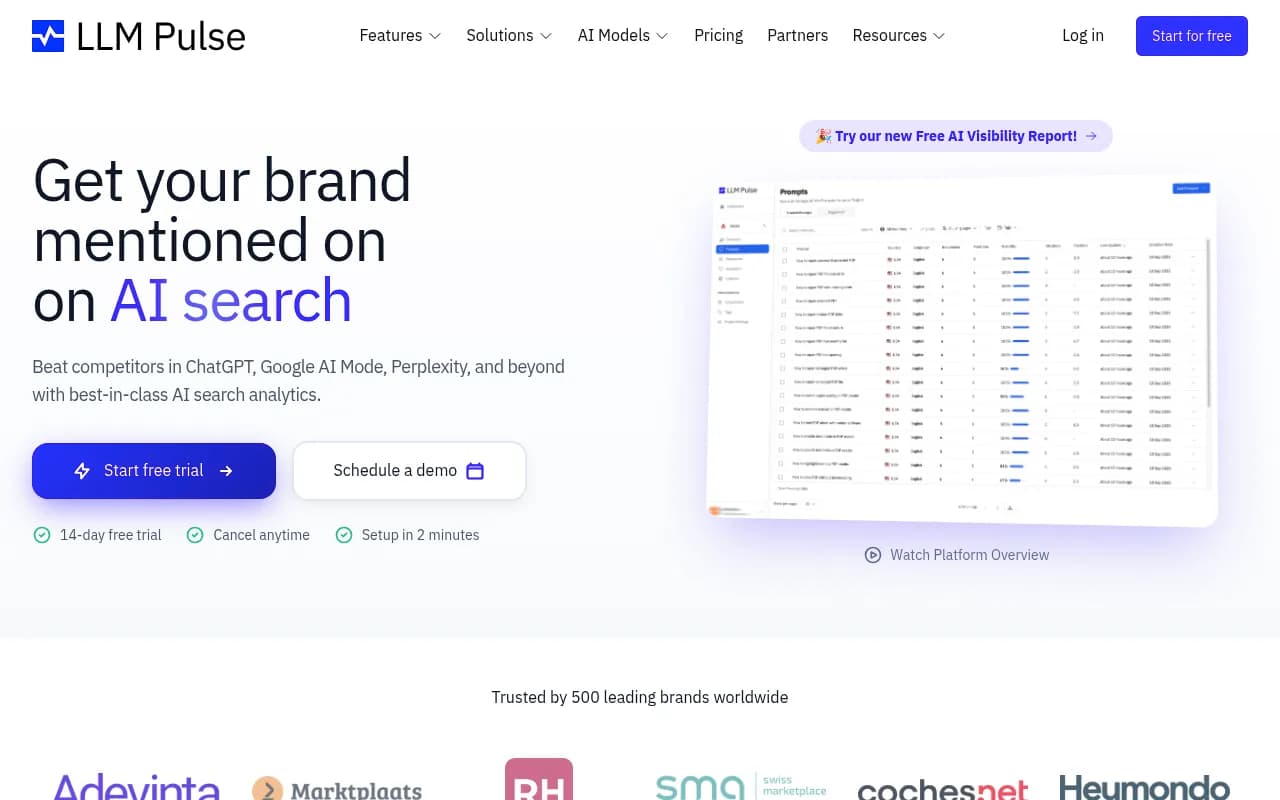
LLM Pulse maintains a public ChatGPT Ads Library, capturing advertiser, creative, and position against tracked brands and competitors, which is the kind of granular ad intelligence you won't find in most monitoring tools. It also tracks "Alexa for Shopping" (formerly Amazon Rufus) as a shopping surface, something none of the other tools on this list cover. If your budget can't stretch to $579/month for Promptwatch's Business tier but you still want ads and shopping data, this is the realistic entry point.
Profound
Profound is the enterprise research name in this space, and its ChatGPT Shopping analysis (260M prompts, 13,000 categories) is genuinely the deepest public research on how shopping triggers work.
The catch is pricing has been in flux. Through most of 2026 Profound ran self-serve Starter ($99/month, ChatGPT only) and Growth ($399/month, three engines) plans, but reporting around its $180M Series D in mid-September 2026 suggests those self-serve plans were pulled in favor of a fully custom sales process. If you're evaluating Profound now, confirm current pricing directly rather than trusting older screenshots, since it looks like it's moving toward an enterprise-only model.
Ranketta
Ranketta is worth a look if you're purely an e-commerce or D2C brand. It tracks ChatGPT, including ChatGPT Shopping, Google AI Overviews, and Perplexity starting on its Starter plan (€79/month), with product data enrichment baked in rather than sold separately.
It doesn't have an ads-tracking feature comparable to LLM Pulse or Promptwatch, so it's a narrower tool, but for teams whose only question is "how do my products show up in AI shopping results" it's more focused than the bigger platforms.
Scrunch (for context)
Included here because it's the tool you're moving away from, but worth keeping if your priority is agent-traffic analytics and you're already paying for Enterprise. Its Shopping module tracks Share of Shelf and Retailer Share across ChatGPT and Copilot, which is solid data, just not available below the custom tier.
Comparison table
| Tool | Shopping tracking | Ads tracking | Starting price | Best for |
|---|---|---|---|---|
| Promptwatch | Yes, Business plan | Yes, Ads Radar on Business plan | $95/mo (shopping/ads at $579/mo) | All-in-one monitoring + content execution |
| LLM Pulse | Yes, paid add-on from Starter | Yes, public Ads Library, add-on | €49/mo | Budget-conscious teams wanting ads data early |
| Profound | Yes, deep research, pricing shifting to custom | Not a named feature | Custom (self-serve plans recently removed) | Enterprises wanting rigorous shopping research |
| Ranketta | Yes, product-level, from Starter | No | Custom/€79/mo tier | D2C and e-commerce-only teams |
| Scrunch | Yes, Enterprise-only | Not listed as a feature | ~$250/mo (Shopping requires Enterprise) | Teams already on Scrunch Enterprise |
How to pick between them
Start with what you actually need to answer. If the question is "are we losing customers to AI shopping results" and you're an e-commerce brand, Ranketta or Promptwatch's Business tier both work, but Promptwatch adds crawler logs that explain why a product page isn't getting picked up in the first place. If the question is "who's buying ads against our brand name in ChatGPT," LLM Pulse's public Ads Library is the fastest and cheapest way to see actual creative and positioning.
If you want one platform instead of three separate subscriptions, and you're willing to pay for the Business tier, Promptwatch is the option that doesn't force a tradeoff between shopping, ads, crawler visibility, and the content work needed to fix what you find. Everything else on this list either does shopping or ads well but not both together at a sub-Enterprise price.
One practical note before you commit to any of these: pricing across this whole category moved fast in 2026. Scrunch's own pricing page reportedly served two different plan structures to different visitors earlier this year, and Profound pulled its self-serve tiers in September. Check the live pricing page for whichever tool you're considering before signing an annual contract. For a broader look at the category beyond shopping and ads specifically, the GEO software directory at bestgeosoftware.com is a reasonable place to keep tabs on what else is out there.