Key takeaways
- AI hallucinations about brands are a real, measurable problem -- models like ChatGPT, Perplexity, and Gemini regularly generate inaccurate product details, wrong pricing, outdated features, and false claims about companies
- Most traditional SEO tools don't track what AI says about you -- you need a dedicated AI visibility platform
- The best platforms go beyond monitoring: they help you identify content gaps, create content that corrects the record, and track whether AI models update their responses
- Promptwatch is the only platform rated "Leader" across all categories in a 2026 comparison of 12 GEO platforms, largely because it closes the loop from detection to content creation to result tracking
- Free or entry-level tools exist for smaller brands, but enterprise teams need crawler logs, prompt volume data, and content generation to actually fix the problem
Why AI hallucinations about your brand actually matter
Here's something that should make any marketing or PR team uncomfortable: right now, someone is asking ChatGPT about your company, and the answer might be completely wrong.
Not slightly off. Wrong. Made-up pricing. Incorrect product features. A description of a service you discontinued two years ago. Sometimes a confident summary of a lawsuit that never happened.
This isn't a fringe edge case. AI models are trained on data with cutoff dates, they fill gaps with plausible-sounding text, and they have no real-time fact-checking mechanism. When a user asks "Is [your brand] good for X?" the model generates an answer based on whatever patterns it learned during training -- which may include outdated blog posts, forum discussions, or simply nothing at all about your company.
The problem compounds because AI search is growing fast. Search Engine Journal reported that 37% of users now start their searches in AI tools rather than traditional search engines. That's a massive portion of potential customers getting their first impression of your brand from a system that might be hallucinating.
Traditional SEO tools can't help here. Google Search Console shows you what people searched and clicked. Semrush tracks your keyword rankings. None of them tell you what ChatGPT says when someone asks about your pricing, your competitors, or whether you're trustworthy.
That's what this guide is for.
What hallucination tracking actually involves
Before picking a tool, it helps to understand what you're actually trying to measure. "Hallucination tracking" in the AI visibility context covers a few distinct problems:
Factual inaccuracies: The model states something false about your brand -- wrong founding year, wrong headquarters, wrong product capabilities.
Outdated information: The model describes a version of your product or service that no longer exists. This is especially common for companies that have rebranded, pivoted, or significantly updated their offering.
Competitor confusion: The model attributes a competitor's feature to you, or vice versa. This happens more often than you'd think, especially in crowded categories.
Missing citations: The model answers a question your content directly addresses, but cites a competitor or a generic source instead of you.
Sentiment distortion: The model frames your brand negatively based on old reviews, forum posts, or news coverage that's no longer representative.
Tracking all of this requires querying AI models at scale, analyzing the responses, and comparing them against what's actually true about your brand. That's not something you can do manually across 10 different AI platforms.
The platforms worth considering in 2026
Promptwatch -- the full-loop option
Promptwatch is the platform that comes up most often when marketing teams need to go beyond just knowing they have a problem. It monitors 10 AI models -- ChatGPT, Perplexity, Google AI Overviews, Google AI Mode, Claude, Gemini, Meta/Llama, DeepSeek, Grok, and Mistral -- and tracks not just whether you're mentioned, but what's being said and whether it's accurate.
What separates it from most competitors is the action loop. When you find a hallucination or a gap, Promptwatch's Content Agents help you generate content specifically designed to correct the record -- articles, comparisons, and briefs grounded in real prompt data. Then the platform tracks whether that new content gets crawled and cited, so you can see whether the fix actually worked.
The crawler logs feature is particularly useful for hallucination work. You can see exactly which pages AI crawlers are reading (and which they're ignoring), which explains why models might be pulling outdated information -- they may simply not be reading your current pages.

Pricing runs from $99/month for a single site up to $579/month for five sites with full features. There's a free trial available.
Profound -- enterprise-grade monitoring
Profound is a strong option for larger teams that need depth of data. It covers major AI platforms and provides detailed citation analysis. The trade-off is price -- it sits at a higher price point than most alternatives -- and it's more monitoring-focused than action-oriented. You'll get excellent data on what's being said about your brand, but the path from "we found a hallucination" to "we fixed it" requires more manual work.
Otterly.AI -- lightweight and affordable
If you're a smaller brand or just getting started with AI visibility tracking, Otterly.AI is worth a look. It covers the main AI platforms and gives you a reasonable view of your brand mentions and citation frequency. It won't give you crawler logs, content generation, or deep prompt analytics, but it's a low-friction way to start monitoring.

Scrunch AI -- mid-market monitoring
Scrunch AI focuses on tracking how AI assistants like ChatGPT and Claude describe your brand. It's a solid mid-market option with decent coverage and a cleaner interface than some of the enterprise tools. Like most monitoring-only platforms, it shows you the problem but doesn't help you solve it.
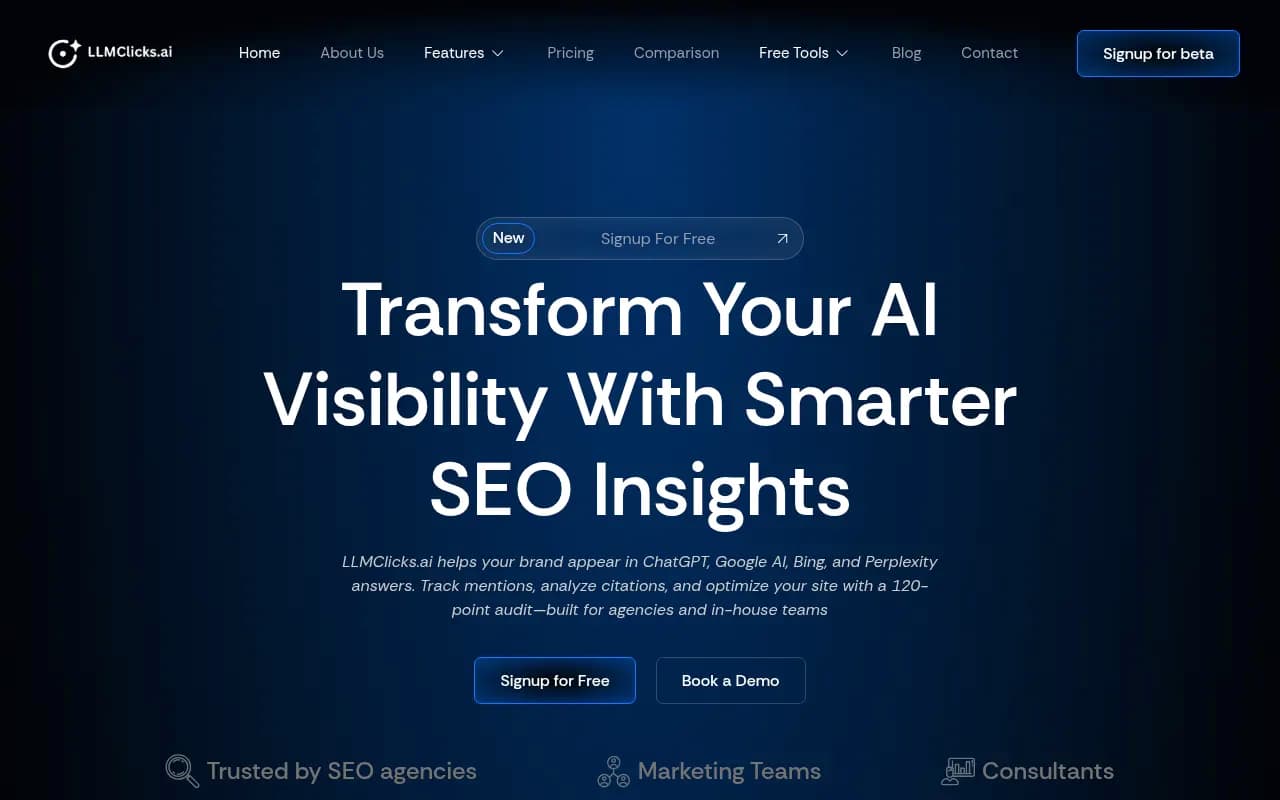
LLMClicks -- hallucination detection focus
LLMClicks is one of the few tools that explicitly calls out hallucination detection as a core feature. It tracks brand visibility across AI search results and flags responses that appear inaccurate or inconsistent with your actual brand information. Worth evaluating if hallucination detection specifically is your primary concern.
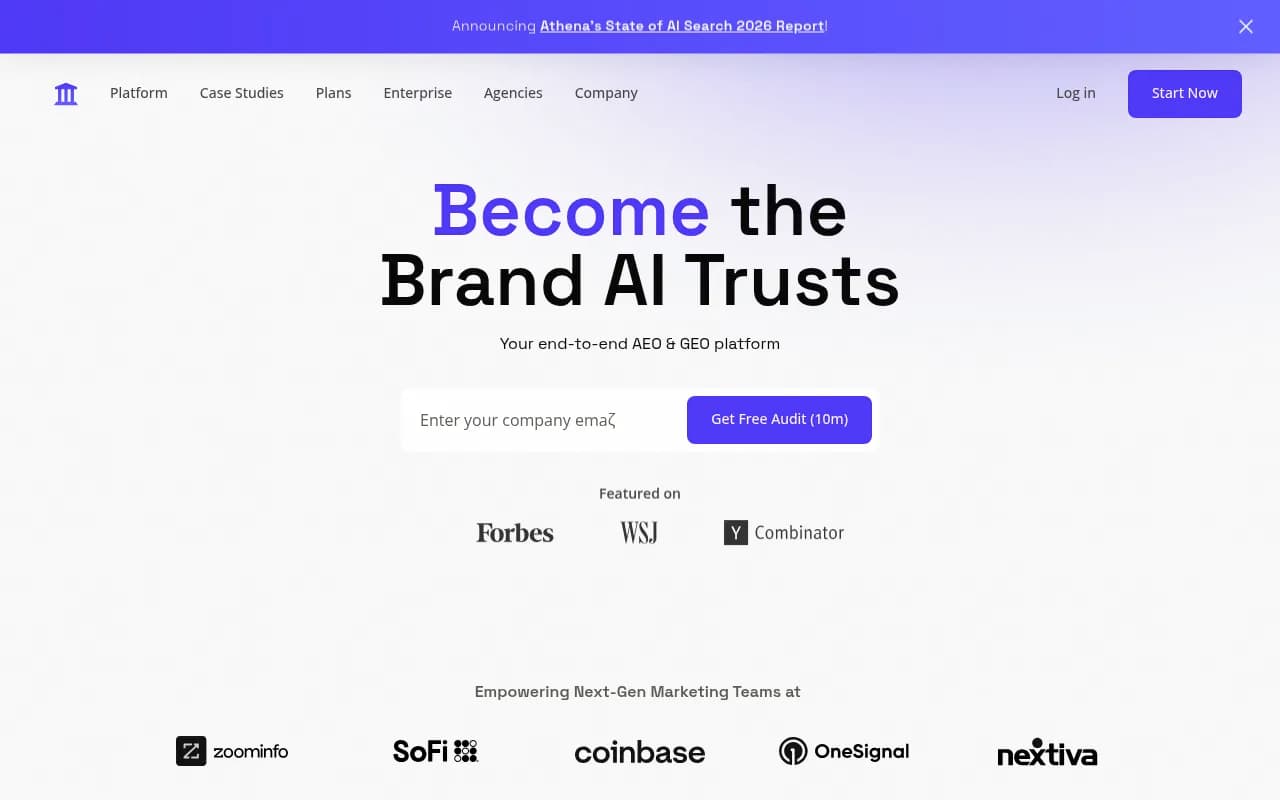
Athena HQ -- monitoring across 8+ AI engines
AthenaHQ covers a wide range of AI search engines and gives you a clear view of your brand's visibility scores. It's monitoring-focused, which means it's good at telling you where you stand but doesn't offer the content optimization tools you'd need to actually improve your position or correct inaccuracies.
Peec AI -- simple tracking without optimization
Peec AI is a straightforward monitoring tool. It tracks your brand mentions across AI search platforms and gives you visibility scores. The interface is clean and the setup is fast. If you just want a dashboard that shows you what AI models are saying, it works. If you want to do something about it, you'll need additional tools.

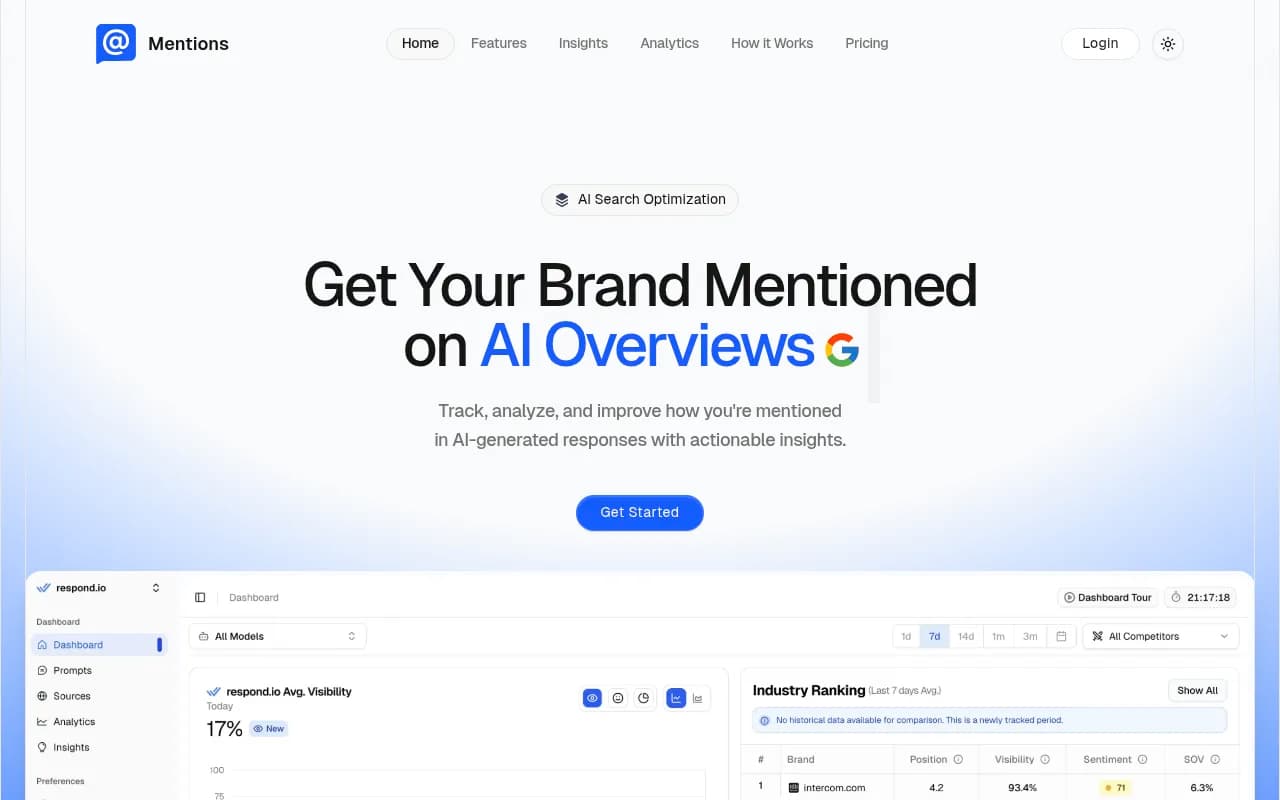
Mentions.so -- brand mention tracking in AI search
Mentions.so focuses specifically on tracking when and how your brand is mentioned in AI-generated responses. It's a narrower tool than the full-platform options, but it does that specific job well and is accessible for teams that don't need a comprehensive GEO platform.
Trakkr.ai -- multi-model tracking
Trakkr.ai tracks brand visibility across ChatGPT, Claude, Perplexity, and other major models. It's a newer entrant in the space but covers the core use case of monitoring what AI engines say about you.
Rankscale -- scaling AI visibility
Rankscale positions itself as an AI visibility scaling platform, with tracking and optimization features aimed at teams that need to manage visibility across multiple brands or sites.
How the platforms compare
Here's a direct comparison across the dimensions that matter most for hallucination tracking and brand accuracy work:
| Platform | AI models covered | Hallucination/accuracy alerts | Content generation | Crawler logs | Prompt volume data | Starting price |
|---|---|---|---|---|---|---|
| Promptwatch | 10 | Yes | Yes (Content Agents) | Yes | Yes | $99/mo |
| Profound | 6+ | Partial | No | No | Limited | Higher |
| Otterly.AI | 4-5 | Basic | No | No | No | Low |
| Scrunch AI | 4-5 | Basic | No | No | No | Mid |
| LLMClicks | 5+ | Yes (core feature) | No | No | No | Low-mid |
| AthenaHQ | 8+ | Basic | No | No | No | Mid |
| Peec AI | 4-5 | Basic | No | No | No | Low |
| Mentions.so | 4-5 | Basic | No | No | No | Low |
| Trakkr.ai | 5+ | Basic | No | No | No | Low-mid |
The pattern is clear: most tools stop at monitoring. Promptwatch is the outlier that connects detection to correction.
What to actually do when you find a hallucination
Finding out that ChatGPT is saying something wrong about your brand is step one. Here's what the correction process looks like in practice:
Step 1: Document the specific inaccuracy
Screenshot the AI response, note which model produced it, and record the exact prompt used. You need this to track whether corrections eventually take effect.
Step 2: Identify why the model is getting it wrong
This is where crawler logs become valuable. If an AI crawler hasn't visited your key product pages recently, or is encountering errors when it tries to, that explains why the model is working from old or incomplete information. Platforms like Promptwatch surface this directly.
Step 3: Create or update content that directly addresses the inaccuracy
If the model is saying your product doesn't support a feature you added 18 months ago, you need a page that clearly, authoritatively describes that feature. Not buried in a changelog -- a proper, well-structured page that an AI model can read and cite.
This is where content generation tools grounded in real prompt data make a difference. Generic AI writing tools produce generic content. What you need is content specifically engineered to answer the prompts where you're currently getting misrepresented.
Step 4: Track the correction
After publishing, monitor whether AI crawlers visit the new page and whether model responses start changing. This can take weeks. The timeline from publish to crawl to citation is something platforms like Promptwatch track explicitly -- you can see the progression rather than guessing.
Step 5: Monitor for recurrence
Hallucinations can come back, especially after model updates. Set up ongoing monitoring for the specific prompts where you've been misrepresented.
Choosing the right tool for your situation
The right choice depends on your scale and what you actually need to do with the data.
If you're a small brand or just starting to pay attention to AI visibility, a lightweight monitoring tool like Otterly.AI or Peec AI gives you a starting point without a big investment. You'll see what's being said, even if you have to figure out the fixes yourself.
If you're a mid-market brand with a dedicated marketing or SEO team, you need something with more depth -- prompt volume data so you can prioritize which inaccuracies matter most, citation analysis to understand why models are pulling from competitors instead of you, and ideally some content tooling to help you create the right responses.
If you're an enterprise brand or agency managing multiple clients, the calculus shifts toward platforms that offer crawler logs, multi-site management, and the ability to connect visibility data to actual traffic and revenue. The monitoring-only tools start to feel inadequate when you need to show stakeholders that your AI visibility work is producing results.
For teams that need the full picture -- detection, diagnosis, content creation, and result tracking -- Promptwatch is the most complete option currently available. The fact that it processes real user-interface queries rather than just API calls also matters: what ChatGPT shows a real user can differ from what the API returns, and you want to track what users actually see.
A note on Reddit and YouTube as AI sources
One thing most brands miss: AI models don't just cite official websites. They cite Reddit threads, YouTube videos, forum posts, and third-party review sites. If someone on Reddit wrote a scathing (and inaccurate) post about your brand three years ago, that post might be influencing what AI models say about you today.
This is why offsite citation analysis matters. Knowing that a particular Reddit thread or YouTube video is being cited in AI responses about your brand gives you options -- you can respond to the thread, create content that addresses the same question more accurately, or at minimum understand why the model has a particular impression of you.
Most monitoring tools ignore this channel entirely. It's worth factoring into your platform choice.
The bottom line
AI hallucinations about your brand aren't a hypothetical future problem. They're happening now, at scale, across every major AI platform. And because AI search is increasingly where buying decisions start, an inaccurate AI response about your brand has real commercial consequences.
The tools to address this exist. The question is whether you pick one that just shows you the problem or one that helps you fix it.