Peasy Review 2026
Tracks real-time performance metrics and visibility across AI search engines with comprehensive analytics.
Summary
- What it does best: Deepsona simulates massive synthetic audiences (up to 1M AI personas) to predict how real consumers will respond to ads, products, pricing, and messaging before you spend a dollar on live campaigns. Claims 74-90% predictive alignment with actual campaign outcomes.
- Core differentiator: Unlike survey tools or AI chatbots, Deepsona uses agentic AI (Persona Factory, Exposure, Debate, Scoring agents) to model psychographic depth -- Big Five personality traits, price sensitivity, category familiarity -- not just demographics. Each persona responds based on behavioral patterns, not social desirability bias.
- Who it's for: Marketing teams, growth marketers, agencies, and product teams who need to validate concepts, test creative, or discover optimal pricing without burning budget on failed A/B tests.
- Honest limitation: The platform is new (launched 2025), so long-term validation data is limited. Predictive accuracy depends heavily on input quality and audience definition. Not a replacement for real-world testing, but a pre-launch filter to eliminate weak variants.
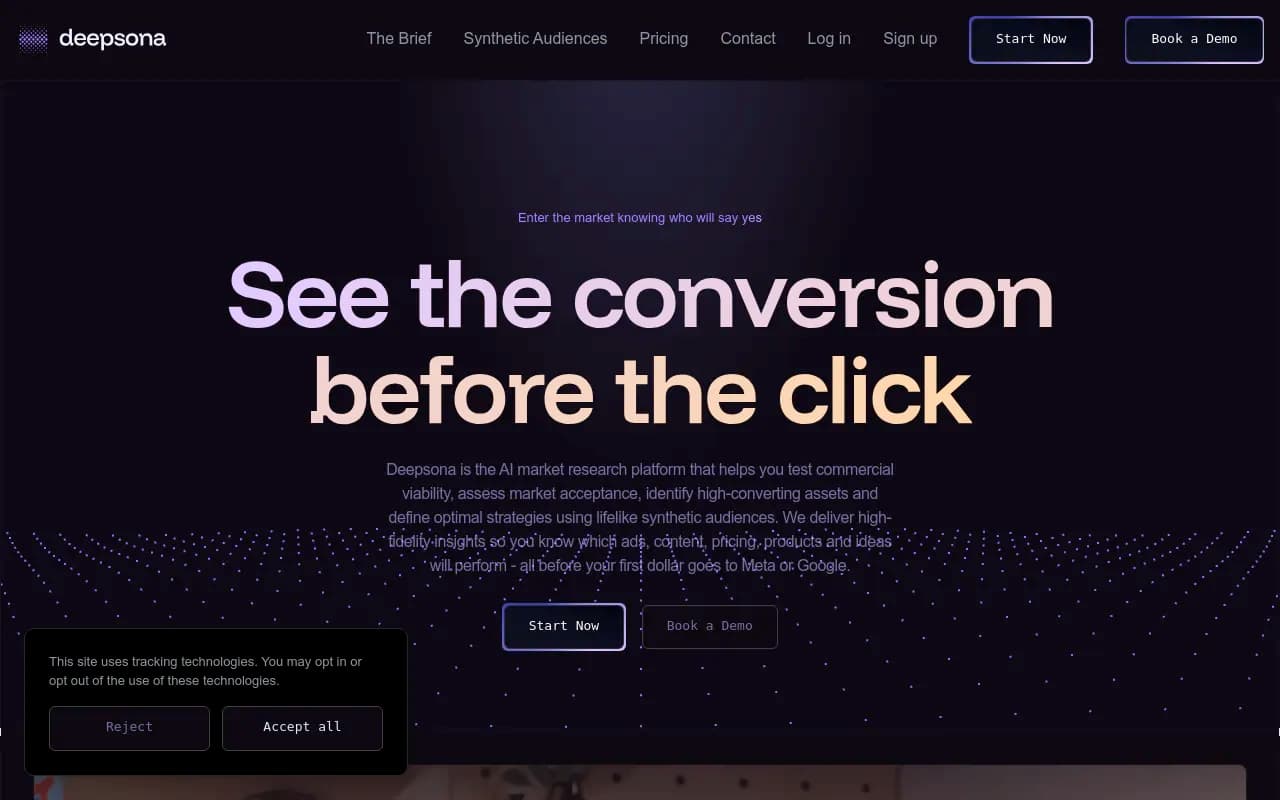
Deepsona positions itself as the AI market research platform that replaces expensive, slow traditional research (surveys, focus groups, live A/B tests) with instant, scalable simulations. The pitch is compelling: instead of spending weeks and thousands of dollars discovering what doesn't work, you run simulations in 2-5 minutes and launch only the winners. The platform was built by Deepserp Limited, a UK company (London-based, GDPR compliant), and claims to have processed simulations with predictive alignment rates of 74-90% when measured against real campaign outcomes and human responses from YouGov and GWI. That's a bold claim for a new platform, but the underlying concept -- using AI personas modeled on real behavioral data to predict market response -- is gaining traction across the industry. Jane Ostler (EVP at The Drum) and publications like HBR, Forbes, and Marketing Week have covered the shift toward synthetic data in market research.
The platform is designed for marketers who are tired of the traditional research trap: surveys lie (social desirability bias), focus groups are tiny and expensive, and live A/B tests burn budget proving what doesn't work. Deepsona's answer is synthetic audiences at scale. You define your target segment (age, income, location, role), and the Persona Factory agent generates up to 1 million unique AI personas, each with psychographic depth: Big Five personality traits (Openness, Conscientiousness, Extraversion, Agreeableness, Neuroticism), lifestyle values, category familiarity, price sensitivity, and behavioral patterns. These aren't generic chatbot responses -- each persona evaluates your content through their modeled lens and outputs numeric scores (click probability, conversion intent, trust, clarity, novelty, brand fit) plus written reactions explaining what excites them, what concerns them, and what would push them to convert. The platform aggregates these into segment-level heatmaps showing which demographics and psychographics respond strongest.
Key Features
Custom Audience Builder: Define synthetic audiences with full control over size (from small test groups to 1M+ personas), demographics (age, income, education, location), and roles (e.g. "urban design professionals", "suburban families", "STEM students"). Deepsona automatically applies advanced psychographic modeling, including Big Five personality distributions, category familiarity, and price sensitivity. Each persona is unique and mirrors real population patterns. The platform enforces complexity across traits so you're not just testing against a monolithic "millennial" bucket -- you see how introverted tech-savvy urbanites respond differently than extroverted suburban families despite sharing an age bracket. This depth is what separates Deepsona from basic demographic targeting.
Ad Campaign Simulations: Enter your ad creative components (offer text, primary copy, visual descriptions, CTA, budget parameters, target CPA) and run the simulation against your chosen audiences. Each AI persona evaluates your ad as a real consumer would, considering their income, lifestyle, personality, and purchase behaviors. They output numeric scores for click probability, conversion intent, trust, clarity, novelty, and brand fit, along with written reactions and blocking objections. The platform aggregates these into segment-level heatmaps showing which demographics and psychographics respond strongest. Compare multiple ad variants side by side and see predicted lift percentages between versions. Identify which creative elements drive engagement and which create friction -- all before your first dollar goes to Meta or Google. This is the core use case: test five ad variations against three segments in minutes, see the winner, then allocate media spend only to proven campaigns.
Email Campaign Optimization: Configure your email elements (campaign name, goal, subject line, preheader text, body copy, CTA) and select target audiences that mirror your subscriber segments. AI personas evaluate each component based on their personality traits, communication preferences, and behavioral patterns. Introverted personas might prefer direct, no-fluff subject lines. Extroverted personas might respond better to playful, social language. Price-sensitive segments scrutinize value propositions more intensely. The simulation surfaces these preferences explicitly, showing you which subject lines generate curiosity, which body copy builds trust, and which CTAs convert -- segmented by demographic and psychographic profile. Optimize every element before hitting send to your real list.
Product Proposition Testing: Describe your product concept, value proposition, key features, and target outcomes. Select which audiences will evaluate it. Within minutes, you receive segment-level reactions showing which groups connect with your messaging and which remain skeptical. AI personas generate authentic responses (not survey checkboxes) explaining what excites them, what concerns them, and what would push them to convert. One segment might love your innovation angle while another prioritizes affordability. Another might question your credibility or need stronger social proof. You see these patterns immediately, along with recommendations for repositioning messages by segment. This is particularly useful for early-stage startups validating MVP concepts before building.
Price Discovery: Define your product name, description, and current price if applicable. Set minimum and maximum price bounds or specify exact price points to evaluate. The simulation tests each price across your selected audience segments, measuring willingness to pay, perceived value, conversion thresholds, and price sensitivity by demographic and psychographic group. High-income early adopters might barely notice a premium price while budget-conscious families hit a hard ceiling at a lower point. You see these patterns visualized across segments with confidence scores. The system recommends optimal pricing by segment and suggests tiered pricing strategies when data shows distinct willingness-to-pay clusters. This eliminates the guesswork from pricing decisions.
Idea Validation: Describe your product or feature idea (name, type, detailed description, problem being solved, target outcome, key features) and choose which market segments should evaluate it. AI personas assess your concept through their personal lens: their pain points, priorities, existing solutions, and psychological profiles. A time-starved parent evaluates productivity tools differently than a solo entrepreneur. A privacy-focused techie scrutinizes data handling differently than a convenience-seeking casual user. You receive explicit demand signals segmented by audience type, along with the reasoning behind positive and negative reactions. See objections you never anticipated. Discover which audiences show genuine enthusiasm versus polite indifference. Make build-versus-kill decisions backed by predictive data rather than founder intuition.
Debate Feature: This is where Deepsona's agentic AI architecture shows up. The Debate agent simulates internal deliberation within personas, modeling how real consumers weigh pros and cons before deciding. This isn't a single chatbot response -- it's a multi-agent process where Exposure agents present your content, Debate agents simulate internal conflict ("I like the innovation but the price feels high"), and Scoring agents aggregate the final verdict. This process increases result stability and statistical confidence compared to a single AI chatbot output. The platform claims 3x higher result stability versus ChatGPT, Gemini, Claude, or Perplexity when tested at 1M audience scale.
Segment Performance Heatmaps: After each simulation, you get visual heatmaps showing which segments respond strongest. See confidence scores by demographic and psychographic group. Identify high-converting segments you didn't expect. Discover cold segments that require different messaging or aren't worth targeting. This visual layer makes it easy to spot patterns and prioritize go-to-market strategies around segments that already want the offer.
Rapid Iteration: Need to tweak your headline? Adjust pricing? Test a new CTA? Run another simulation in minutes. No waiting for panel availability, recruitment cycles, or budget approval. Iterate as fast as you type. Refine your messaging through rapid simulation cycles until segment responses converge on optimal configurations, then launch knowing what works for whom. This speed is the operational advantage -- traditional A/B tests require weeks to reach statistical significance, Deepsona delivers insights in minutes.
Who Is It For
Deepsona is built for marketing teams, growth marketers, digital agencies, and product teams who need to validate concepts, test creative, or discover optimal pricing without burning budget on failed experiments. The primary user personas are performance marketers at SaaS companies, e-commerce brands, and agencies managing multiple client campaigns. These are teams running $10K-$500K/month in ad spend across Meta, Google, and LinkedIn who are tired of wasting 30-50% of their budget discovering what doesn't work. A typical user might be a growth marketer at a Series A SaaS startup testing five ad variations for a new product launch, or an agency creative director validating email subject lines for a client's Black Friday campaign. The platform is also useful for early-stage founders validating MVP concepts before building, or product managers testing feature ideas before committing engineering resources.
Team size: Best for small to mid-sized marketing teams (2-10 people) at startups, scale-ups, or agencies. Enterprise teams with dedicated research budgets might still prefer traditional methods for final validation, but Deepsona works as a pre-launch filter. Solo founders and freelancers can use it, but the pricing (see below) suggests it's optimized for teams with real ad budgets.
Industries where it shines: E-commerce, SaaS, DTC brands, digital agencies, consumer apps, and any business running paid acquisition campaigns. If you're spending money on Meta or Google ads, Deepsona helps you spend it smarter. It's less relevant for B2B enterprise sales (long sales cycles, relationship-driven deals) or industries where human relationships trump messaging (real estate, high-touch consulting).
Who should NOT use this: Teams that don't run paid campaigns or test creative regularly won't get value. If you're not iterating on ads, emails, or product messaging, you don't need synthetic audience simulations. Also, if you're in a highly regulated industry (pharma, finance) where claims must be validated with real human data, synthetic personas won't replace compliance requirements. Finally, if you're skeptical of AI-generated insights or prefer traditional research methods, Deepsona won't convince you -- the platform assumes you trust the underlying models.
Integrations & Ecosystem
Deepsona is a standalone platform with no native integrations mentioned on the website. You export simulation results manually and apply insights to your campaigns in Meta Ads Manager, Google Ads, email platforms (Mailchimp, Klaviyo, etc.), or wherever you run campaigns. There's no API documented publicly, no Zapier integration, no direct connection to ad platforms. This is a research tool, not a campaign execution tool. You use it to validate ideas, then implement the winners in your existing stack. The lack of integrations isn't a dealbreaker -- the value is in the insights, not automation -- but it does mean manual workflows. You run a simulation, screenshot or export the results, then manually adjust your campaigns based on the data. For teams used to integrated platforms (like HubSpot or Salesforce), this might feel disconnected.
The platform is web-based (app.deepsona.ai), no mobile app, no browser extension. You access it from any browser. Data is processed in secure UK-based environments (GDPR compliant), and the company explicitly states your simulations, audiences, and content are never used for model training or shared with third parties. This is important for agencies handling sensitive client data or brands testing unreleased products.
Pricing & Value
Pricing is not publicly listed on the website. The site has a "Pricing" link in the footer, but it wasn't included in the scraped content. Based on the "Get Started" and "Book a Demo" CTAs, it appears Deepsona uses a freemium or trial model with paid tiers. The platform is positioned as a premium research tool, so expect pricing in the $99-$500+/month range depending on simulation volume, audience size, and team seats. The value proposition is clear: if you're spending $10K/month on Meta ads and Deepsona helps you eliminate one losing variant (saving $3K-$5K in wasted spend), it pays for itself immediately. The ROI case is strongest for teams with real ad budgets who are currently testing blind or using expensive traditional research.
Compared to traditional research: A single focus group costs $5K-$10K and takes weeks. A survey panel with 500 responses costs $2K-$5K. Deepsona simulates 1M personas in minutes for (presumably) a fraction of that cost. The value is in speed and scale, not just price. You can run 10 simulations in a week for the cost of one focus group.
Compared to live A/B testing: If you're spending $20K/month testing five ad variants and three of them fail, you've burned $12K learning what doesn't work. Deepsona filters those losers before launch, so your $20K goes entirely to proven winners. The platform claims 10x faster decision cycles and 30-50% reduction in exploratory media spend. If those numbers hold, the ROI is obvious.
Strengths & Limitations
Strengths:
- Scale and speed: Simulate up to 1M personas in 2-5 minutes. No other research method comes close to this combination of scale and speed. Traditional surveys cap at hundreds of responses and take weeks. Deepsona delivers segment-level insights before your coffee gets cold.
- Psychographic depth: Big Five personality modeling, price sensitivity, category familiarity, and behavioral patterns create personas that respond like real consumers, not demographic buckets. This depth is what makes the predictions credible.
- Honest reactions without bias: Synthetic personas don't perform for researchers. They respond based on modeled traits, not social desirability. You get authentic reactions uncorrupted by survey dynamics. This is a real advantage over traditional research where participants claim preferences that make them look rational.
- Risk-free testing: Test ten ad variations before spending a dollar on media. Kill the losers in simulation, launch the winners in reality. Your first real campaign runs with confidence. This eliminates the "learning tax" of live A/B testing.
- Segment discovery: The heatmaps show you which audiences respond strongest, often revealing high-converting segments you didn't expect. This helps you find product-market fit faster by targeting segments that already want the offer.
Limitations:
- New platform, limited validation data: Deepsona launched in 2025. The 74-90% predictive alignment claim is based on internal testing against YouGov and GWI data, but there's no independent third-party validation yet. Long-term accuracy across diverse industries and use cases is still being proven. Early adopters are taking a bet on the methodology.
- Accuracy depends on input quality: Garbage in, garbage out. If you define your audience poorly or write vague product descriptions, the simulation results will be meaningless. The platform requires thoughtful setup -- you need to know your target segments, articulate your value proposition clearly, and design your tests carefully. This isn't a magic button.
- No integrations or automation: Deepsona is a research tool, not a campaign execution platform. You manually export insights and apply them in your ad platforms. For teams used to integrated workflows, this feels disconnected. There's no API, no Zapier, no direct connection to Meta or Google Ads.
- Not a replacement for real-world testing: Synthetic personas are predictive, not definitive. You still need to validate winners with real audiences. Deepsona is a pre-launch filter, not a substitute for live campaigns. If you skip real-world testing entirely, you're flying blind.
- Pricing opacity: No public pricing makes it hard to evaluate ROI upfront. The "Book a Demo" CTA suggests custom pricing, which can be a barrier for small teams or solo founders who want to try before committing.
Bottom Line
Deepsona is a powerful pre-launch research tool for marketing teams who want to validate creative, pricing, and product concepts before spending on live campaigns. If you're running $10K+/month in ad spend and tired of burning budget on failed A/B tests, Deepsona's synthetic audience simulations can filter losers before launch and focus your budget on proven winners. The psychographic depth (Big Five modeling, price sensitivity, behavioral patterns) and scale (up to 1M personas per simulation) are genuinely differentiated from traditional research or AI chatbots. The 74-90% predictive alignment claim is compelling, but the platform is new (2025 launch) and long-term validation is still being proven. Best use case: Growth marketers at SaaS companies, e-commerce brands, or agencies who need rapid, scalable insights to optimize ad creative, email campaigns, or pricing strategies before committing real budgets. Not a replacement for real-world testing, but a smart filter that eliminates weak variants and accelerates decision cycles. If you're spending serious money on paid acquisition, Deepsona is worth evaluating.
Tags:
Similar and alternative tools to Peasy