Key takeaways
- Most AI visibility tools in 2026 are monitoring dashboards that show you data but don't help you act on it -- and that's the core problem.
- The fundamental technical challenge is real: AI models don't publish a feed of their outputs, so any tool claiming perfect tracking is overstating what's possible.
- The tools worth paying for go beyond brand-level charts -- they track at the prompt level, show you content gaps, and help you close them.
- Before you pay, ask five specific questions. If a vendor can't answer them clearly, walk away.
- AI visibility is a revenue conversation, not a vanity metric -- sites that AI engines crawl and cite generate 3.2x more human traffic than those they ignore.
The AI visibility tool market has exploded. Dozens of platforms launched in the past 18 months, all promising to tell you whether ChatGPT, Perplexity, Claude, or Google AI Overviews are mentioning your brand. The pitch is compelling. The fear of missing out is real. And the tools are expensive.
The problem is that a lot of them don't work the way they claim to.
This isn't a fringe opinion. Digiday ran a piece in early 2026 documenting marketers' growing skepticism, with complaints about inconsistent results and a complete absence of benchmarks. Reddit threads from practitioners who've actually paid for these tools tell a similar story: brand-level charts that look impressive, prompt-level tracking that's vague or missing, and no clear path from "your visibility score is 42" to "here's what you do about it."
Before you sign up for another trial or renew a subscription you're not sure about, it's worth understanding why so many of these tools fall short -- and what to look for in one that doesn't.
The fundamental technical problem nobody talks about
Here's something vendors rarely explain upfront: AI models don't publish their outputs. There's no feed you can subscribe to, no index you can query, no equivalent of a Google SERP that a tracker can monitor in real time.
What most tools actually do is send their own queries to AI models -- essentially asking ChatGPT or Perplexity a prompt and recording whether your brand appears in the response. That's a legitimate approach, but it has serious limitations.
AI responses are non-deterministic. Ask the same question twice and you might get different answers. Ask it from a different location, with a slightly different phrasing, or at a different time of day, and the response changes again. This means any "visibility score" is really a snapshot of a sample of queries at a moment in time -- not a comprehensive picture of how often your brand actually appears across all the prompts your potential customers are typing.
That's not a reason to dismiss these tools entirely. Sampling is how a lot of measurement works. But it does mean you should be skeptical of any tool that presents its numbers with false precision, or that doesn't explain its methodology clearly.
The honest framing: AI visibility tools give you directional signal, not exact measurement. The good ones are transparent about this and compensate with volume, methodology rigor, and -- critically -- actionable output. The bad ones hide behind impressive-looking dashboards.
Why "monitoring only" is the wrong product category
The bigger issue isn't technical. It's strategic.
Most AI visibility tools are built around a single question: "Is my brand showing up?" That's a reasonable starting point, but it's not a complete product. Knowing you have low visibility doesn't tell you what to do about it. And if a tool can't help you improve your visibility, you're paying for a dashboard that makes you feel informed while your competitors pull ahead.
Think about it this way. If a traditional SEO tool showed you keyword rankings but couldn't tell you which content to create, which gaps to fill, or how to fix your technical issues, you'd stop using it. The same logic applies here.
A lot of the tools flooding the market right now -- Otterly.AI, Peec.ai, basic brand monitoring platforms -- stop at step one. They show you a score. They might show you competitor scores. And then they leave you to figure out the rest.
Promptwatch is one of the platforms that takes a different approach, built around what it calls an action loop: find the gaps, create content that fills them, then track whether that content actually gets cited. That cycle -- from diagnosis to execution to measurement -- is what separates an optimization platform from a monitoring dashboard.

The distinction matters because AI visibility is a revenue conversation. Data from a study of 858,000 real websites found that AI-crawled sites generate 3.2 times more human traffic than sites AI engines ignore. They pull 2.7 times more form submissions and 2.5 times more click-to-call events. Those aren't soft metrics. A 2.7x lift in form submissions is the difference between a busy quarter and a slow one.
If your tool can show you that you're invisible but can't help you become visible, you're not getting value for your money.
The five red flags to watch for
1. Brand-level charts with no prompt-level detail
A tool that shows you a single "AI visibility score" for your brand is hiding the complexity of the problem. Your brand might appear frequently for some queries and never for others. The queries where you're invisible are the ones that matter most -- they represent real customer intent you're not capturing.
Any tool worth using should show you visibility at the prompt level. Which specific questions is your brand answering? Which ones are your competitors answering that you're not? That gap is where the opportunity lives.
2. No explanation of methodology
How does the tool sample queries? How often? Across which AI models? From which locations? With what persona or context? If a vendor can't answer these questions clearly, their numbers are unverifiable. Directional signal is fine. Unverifiable numbers dressed up as precision are not.
3. No traffic attribution
Impressions in AI search are interesting. Traffic and conversions are what matter. If a tool can't connect AI citations to actual website visits -- through a code snippet, a Google Search Console integration, or server log analysis -- you have no way to know whether your AI visibility is generating any real business impact.
This is a surprisingly common gap. Many tools track citations but have no mechanism for connecting those citations to downstream behavior.
4. No content gap analysis
If you can't see which prompts your competitors are winning that you're not, you can't prioritize what to fix. Content gap analysis -- showing you the specific topics, questions, and angles that AI models want answers to but can't find on your site -- is one of the most valuable things an AI visibility platform can offer. Tools that lack it are leaving you to guess.
5. No crawler log access
AI models crawl websites to gather the information they use in responses. Knowing which pages they're reading, how often they return, and what errors they encounter is genuinely useful for understanding how AI engines discover your content. Most tools don't offer this at all. The ones that do give you a meaningful technical advantage.
A practical vetting checklist
Before you commit to any AI visibility tool, run through these questions. Ask them directly in a demo. If the answers are vague, that's your answer.
Prompt-level tracking
- Can I see visibility broken down by individual prompt, not just brand-level aggregates?
- Can I filter by AI model, location, and persona?
Methodology transparency
- How many prompts does the tool monitor, and how often?
- Which AI models are covered? (ChatGPT, Perplexity, Claude, Gemini, Google AI Overviews, Grok, DeepSeek, Copilot, Meta AI, Mistral?)
- How does the tool handle non-deterministic responses?
Competitive intelligence
- Can I see which prompts my competitors are visible for that I'm not?
- Can I see which sources -- pages, Reddit threads, YouTube videos -- AI models are citing in responses?
Content and optimization
- Does the tool help me create content to fill visibility gaps, or does it only show me the gaps?
- Is the content generation grounded in real citation data, or is it generic AI writing?
Traffic attribution
- Can the tool connect AI citations to actual website traffic?
- What attribution methods are supported (code snippet, GSC integration, server logs)?
Technical depth
- Does the tool provide AI crawler logs?
- Can I see which pages AI bots are reading and how often?
Pricing honesty
- What's included at each tier? (Prompt limits, site limits, article generation limits)
- Is there a free trial with enough functionality to actually evaluate the product?
How to compare what's out there
The market has a lot of options. Here's a rough breakdown of how the main categories stack up:
| Category | Examples | What they do well | What they miss |
|---|---|---|---|
| Monitoring-only | Otterly.AI, Peec.ai, Mentions.so | Easy setup, affordable | No content gap analysis, no optimization, no traffic attribution |
| Enterprise monitoring | Profound, AthenaHQ, Scrunch | Deeper data, more models | High price, limited content generation, no Reddit/YouTube tracking |
| Traditional SEO with AI add-ons | Semrush, Ahrefs Brand Radar | Familiar interface, broad SEO data | Fixed prompts, no AI traffic attribution, shallow AI coverage |
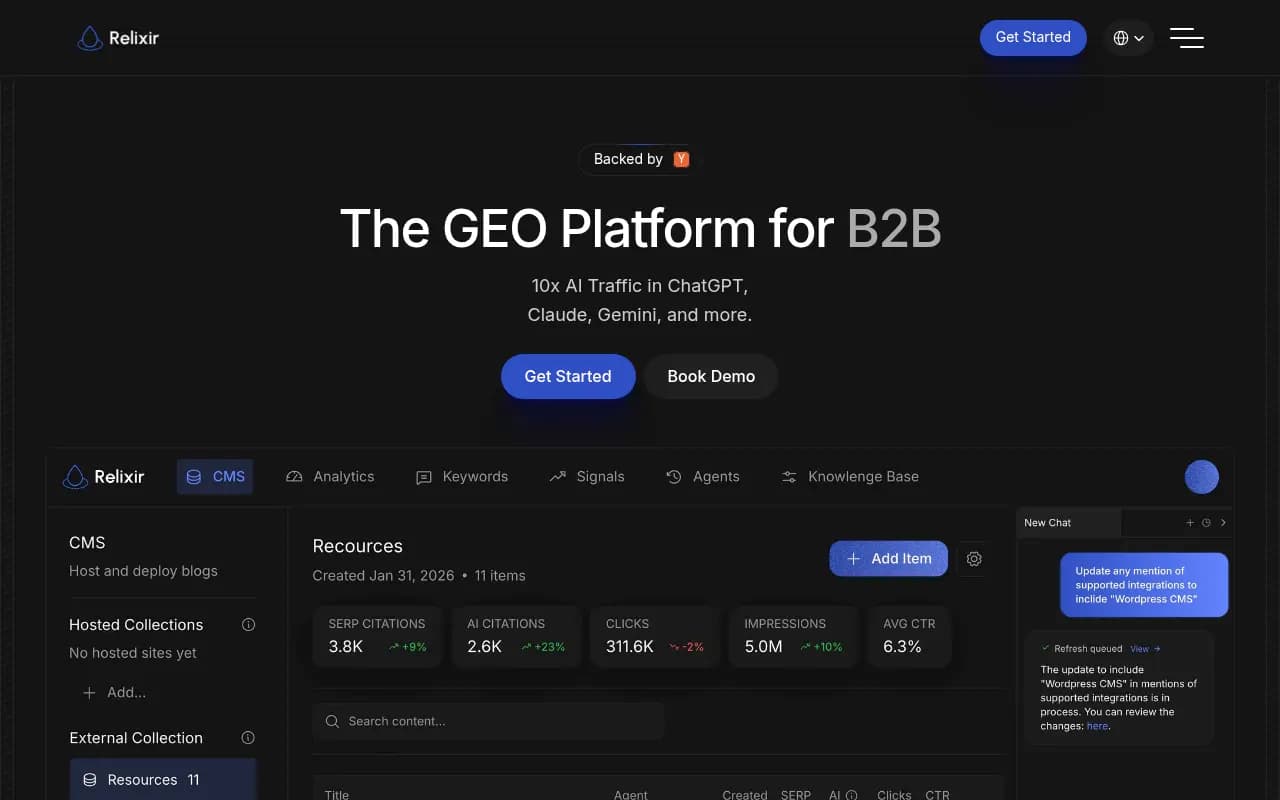
| Full optimization platforms | Promptwatch, Relixir | Gap analysis + content generation + tracking | Higher learning curve, more to configure |
| Niche/early-stage | Peasy, Ranksmith, Airefs, LLM Pulse | Affordable entry points | Feature gaps, smaller datasets, less proven |
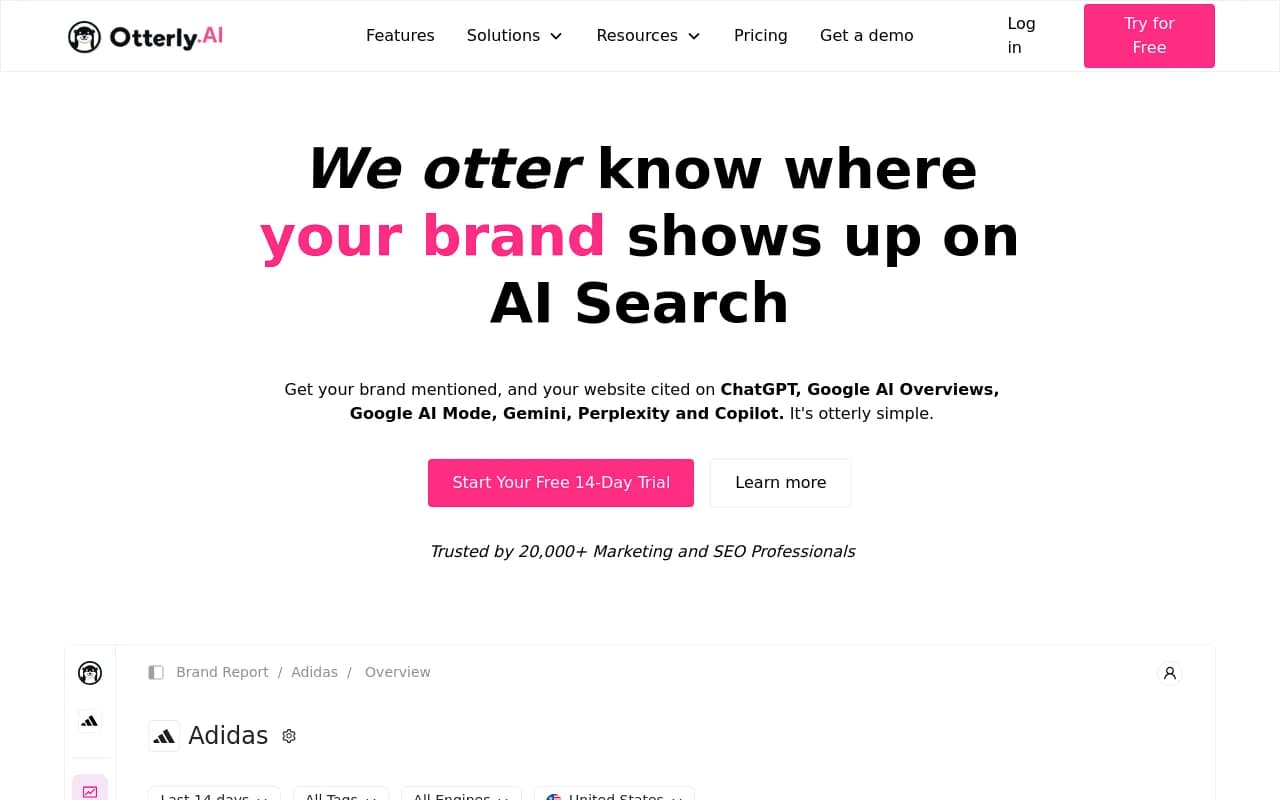
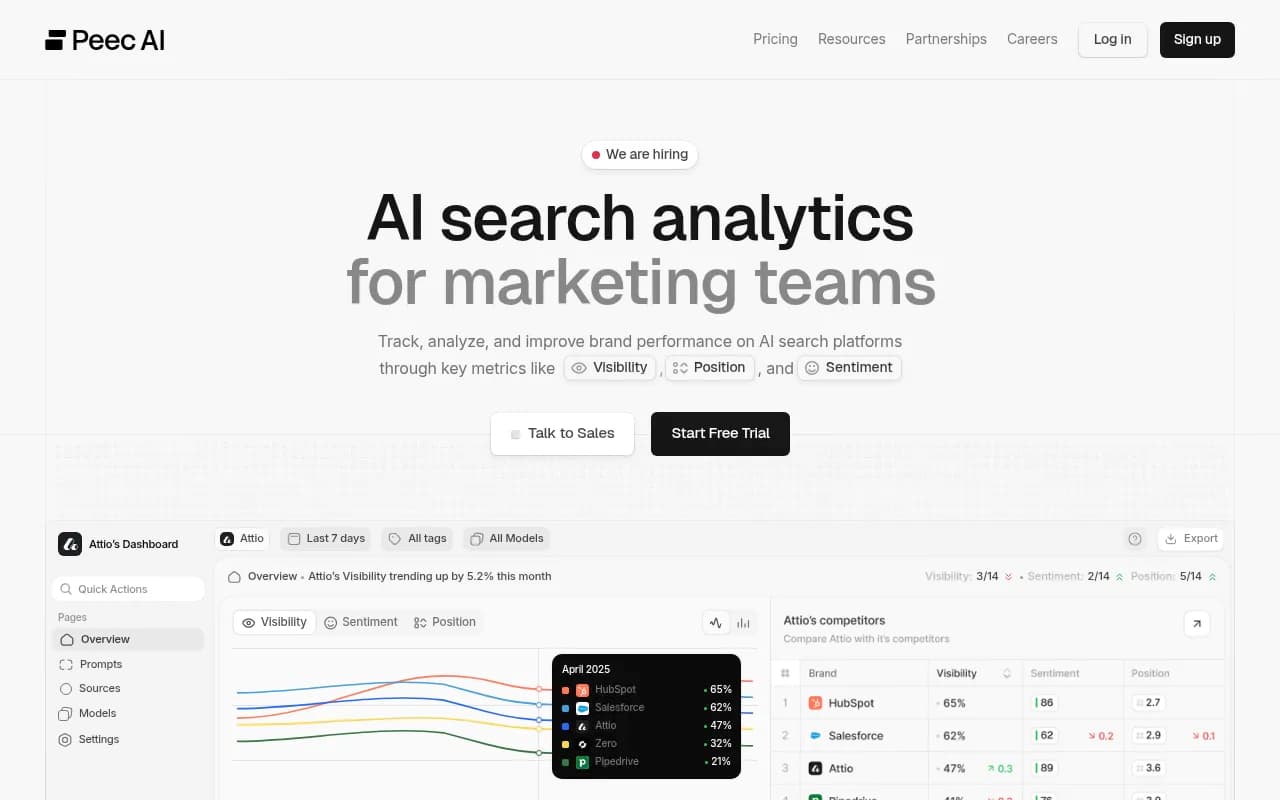
The right choice depends on what you actually need. If you're a solo marketer who just wants to know whether your brand shows up in ChatGPT occasionally, a lightweight monitoring tool might be enough. If you're running a marketing team for a brand that competes in a crowded category, you need something that helps you act -- not just observe.
What good looks like in practice
A useful AI visibility workflow looks something like this:
- You identify the prompts your target customers are actually typing into AI models -- not just branded queries, but category-level questions like "best project management tool for agencies" or "which CRM integrates with Slack."
- You see which of those prompts your competitors are winning and you're not.
- You understand why -- which pages they have that you don't, which sources AI models are citing.
- You create content specifically designed to fill those gaps, grounded in what AI models actually want to cite.
- You track whether that content gets picked up -- which models cite it, how often, and whether those citations drive real traffic.
That's the loop. Most tools cover step 1 at best. The ones worth paying for cover all five.
The unpopular opinion worth taking seriously
There's a contrarian view circulating in marketing circles: AI visibility tools are a waste of money because impressions don't pay bills. The argument is that you should track what actually converts, not what shows up in AI responses.
This view has a kernel of truth. If you're paying for a tool that only shows you impressions and brand mentions with no path to revenue attribution, you're right to be skeptical. Visibility scores that can't be connected to business outcomes are just vanity metrics with a new coat of paint.
But the conclusion -- that AI visibility doesn't matter -- doesn't follow from the premise. The data from 858,000 websites is pretty clear: AI visibility correlates strongly with real business outcomes. The problem isn't that AI visibility is unimportant. The problem is that most tools measure it badly and do nothing to help you improve it.
The right response isn't to ignore AI visibility. It's to demand tools that connect visibility to revenue and help you act on what they find.
Before you sign anything
A few practical notes for the buying process:
Take the free trial seriously. Most platforms offer one. Use it to run your actual prompts, not demo prompts. See whether the data matches your intuition about where you're visible and where you're not.
Ask for methodology documentation. Any reputable vendor should be able to explain how they sample queries, how often, and across which models. If they can't, the numbers aren't trustworthy.
Check what's included at your tier. Prompt limits, site limits, and article generation limits vary significantly. A tool that looks affordable at first glance might require a higher tier to actually be useful for your volume of queries.
Talk to a current customer in your industry. Not a case study the vendor wrote -- an actual user you can ask direct questions. What does the tool do well? What are its blind spots? Has it driven any measurable business impact?
The AI visibility tool market will keep maturing. The platforms that survive will be the ones that close the loop between measurement and action. For now, the vetting process above should help you separate the ones that are genuinely useful from the ones that are selling dashboards dressed up as strategy.