Nudge Review 2026
Helps ecommerce brands become visible and cited in AI-driven answer engines as part of a broader agentic commerce platform.
Key takeaways
- Nudge is an agentic commerce platform for DTC and ecommerce brands that combines AI visibility tracking, catalog enrichment, and generated shoppable funnels in one product.
- Its AI visibility module tracks brand and product mentions across ChatGPT, Perplexity, Gemini, and Rufus on shopping-intent prompts, and ties them to revenue through Shopify and Google integrations.
- Compared with Promptwatch, Nudge lacks AI crawler logs, Reddit and YouTube citation tracking, ChatGPT Shopping and Ads Radar, prompt volume and difficulty scoring, and query fan-out data.
- Pricing is opaque: the site only says plans scale with "opportunities, prompts tracked, and usage," with enterprise quotes via demo.
- Best fit: Shopify-first consumer brands that want one vendor for AI discovery and conversion. Weak fit: agencies, B2B SaaS, or teams that need deep diagnostic visibility data.

What Nudge does
Nudge sits in a category that didn't exist two years ago: agentic commerce. The pitch is that shopping decisions increasingly happen inside AI chat before a shopper ever reaches your site, so a commerce brand needs two things at once. It needs to show up when someone asks ChatGPT or Perplexity for product recommendations, and it needs a destination that converts the click when that shopper does arrive.
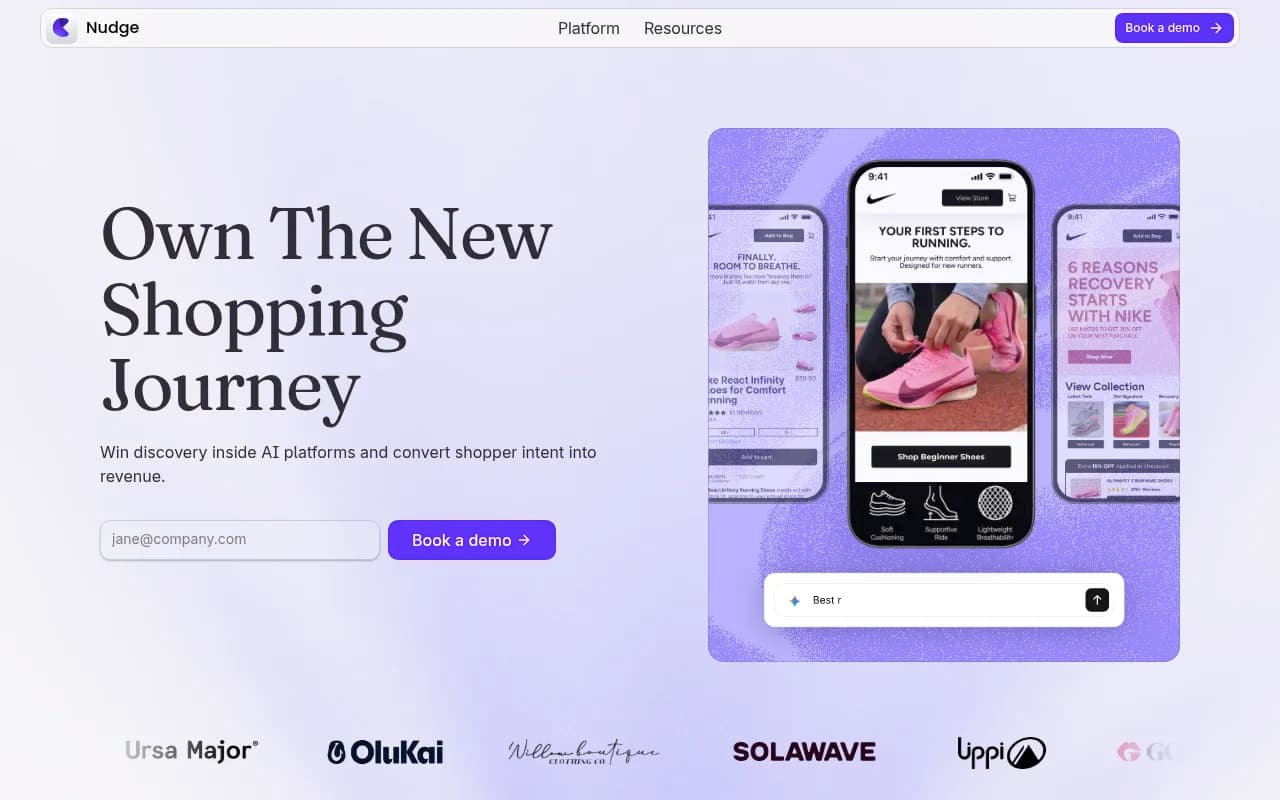
Nudge tries to own both ends of that journey. The platform has three main pieces: AI visibility tracking, catalog enrichment, and shoppable funnels. The visibility side monitors how AI platforms describe your brand and products across shopping-intent queries, flags citation gaps, and tracks product mentions per prompt and per platform in real time. The enrichment side scans your catalog and rewrites product pages for how shopping agents evaluate and recommend products. The funnels side generates intent-matched landing pages and funnel variations for traffic from AI, ads, and organic, with built-in experimentation.
This is a coherent product thesis, and I like that Nudge frames everything around revenue rather than vanity visibility. The dashboard screenshots on the site show funnel orders and revenue attributed to Nudge-generated pages, CTR and impression lift on enriched product pages, and product mention counts. Connecting the storefront means the "you got mentioned" metric eventually becomes a "you got paid" metric. That's the right instinct, and it's what separates Nudge from pure monitoring tools.
The AI visibility module, examined
The visibility tracking covers ChatGPT, Perplexity, Gemini, and Amazon's Rufus, focused specifically on shopping queries. You define a set of high-value AI shopping prompts, and Nudge analyzes the generated answers to see where your brand appears, how it's described, and where the gaps are.
That commerce focus is a real strength. Product-level mention tracking is genuinely useful for a brand with 200 SKUs, because "our brand got cited" and "our best-selling product got recommended" are very different outcomes. Per-prompt, per-platform mention counts in real time is the right granularity for a merchandising team.
But the diagnostic layer is thin compared to what full GEO platforms offer. Nudge tells you that you were or weren't mentioned. It doesn't show you why. There are no AI crawler logs telling you which of your pages ChatGPTBot or GPTBot actually read, whether they hit errors, or which pages have a healthy crawl-to-citation rate. There's no query fan-out data showing how AI expands a shopping prompt into sub-queries. And there's no prompt volume or difficulty scoring, so you're picking your tracked prompts on intuition rather than demand data.
The platform coverage is also narrower. Nudge tracks a handful of shopping-relevant assistants. It doesn't monitor Claude, Grok, DeepSeek, Mistral, Copilot, Meta Llama, Google AI Overviews, or Google AI Mode, all of which surface product recommendations. Google's AI surfaces matter for commerce specifically: Promptwatch's June 2026 data on Google AI Overview citation share shows product pages overtook listicles as the most-cited content format in late July, which means AI Overviews are actively shaping product discovery. A commerce visibility tool that ignores Google's AI surfaces is missing a large slice of the journey.
Catalog enrichment and funnels
This is where Nudge earns its "agentic commerce" label, and honestly, it's the most interesting part of the product. The catalog enrichment scans your product pages and optimizes them for how shopping agents evaluate products: structured attributes, comparison-friendly copy, the signals an agent needs to recommend you over a competitor. Given that product pages are now the dominant cited format in AI shopping answers, per Promptwatch's ChatGPT citation type data, this is aimed at the right target.
The funnels piece generates shoppable, prompt-specific landing pages and funnel variations, then runs experiments to prove what converts. If someone asks Perplexity "best running shoes for flat feet wide feet" and clicks through, Nudge builds the page that matches that exact intent. It's a smart application of generative AI to a real merchandising problem, and the revenue attribution closes the loop.
The limitation is lock-in. These pages live on Nudge's infrastructure or as Nudge-generated content in your stack, and the quality of generated funnels depends heavily on how good the underlying visibility data is. If your prompt set is wrong or incomplete, you're generating funnels for the wrong intents. Garbage in, shoppable garbage out.
Integrations and setup
Nudge connects to Shopify, Google Analytics, Google Search Console, and Meta, which covers the core commerce stack. Setup is pitched as fast: create a workspace, connect your store and catalog, define your prompts, and you're seeing AI answer data within days. The Shopify-first orientation is clear throughout, and I'd guess non-Shopify brands (BigCommerce, WooCommerce, custom stacks) will have a rougher time, though the site doesn't say explicitly.
Compare this to the integration depth of a dedicated GEO platform: Promptwatch, for instance, pulls crawler logs from Cloudflare, Fastly, Vercel, Netlify, Akamai, and other CDNs, publishes to Webflow, Framer, and WordPress, and exposes an MCP server, REST API, and Looker Studio connector. Nudge's integration surface is commerce-shaped, which fits its audience, but it means SEO and content teams can't pipe the data into their existing workflows.
Pricing
Here's my biggest complaint. Nudge's pricing page doesn't publish numbers. The FAQ says pricing is "based on opportunities, number of prompts you want to track, and usage," with enterprise plans for larger brands and a demo-gated quote. "Opportunities" as a pricing axis is vague enough that two similar brands could get wildly different quotes, and there's no free tier or self-serve trial mentioned anywhere.
For context, established AI visibility platforms publish their pricing openly. Promptwatch's Professional tier is $245/month with 150 prompts and 18,000 tracked responses. Nudge asking you to book a demo before knowing whether this costs $300 or $3,000 a month is a friction point that will filter out smaller brands, which is perhaps intentional.
Strengths and limitations
Strengths
- Genuine revenue attribution: funnel orders and revenue tied to Nudge pages, not just mention counts.
- Product-level (SKU-level) mention tracking across shopping prompts, which most visibility tools don't offer.
- Catalog enrichment aimed at how shopping agents evaluate products, targeting the content format AI actually cites most.
- One platform spans discovery and conversion, so the visibility data directly feeds the funnel generation.
- Commerce-native integrations with Shopify, GA, GSC, and Meta.
Limitations
- No published pricing, no self-serve trial, demo-gated onboarding.
- Narrow model coverage: ChatGPT, Perplexity, Gemini, Rufus only. No Claude, Grok, Copilot, AI Overviews, or AI Mode.
- No AI crawler logs, so you can't diagnose why you're invisible, only that you are.
- No prompt volumes or difficulty scores; you pick prompts blind.
- No Reddit or YouTube citation tracking, even though social platforms meaningfully shape AI shopping recommendations.
- No ChatGPT Shopping or ads tracking, despite ChatGPT shopping being core to Nudge's own thesis. Promptwatch's data on ChatGPT shopping feature usage shows how often product cards actually appear, and its Ads Radar shows which competitors bid on your prompts.
- No query fan-outs, sentiment analysis, or offsite mention tracking.
- Agency story is weak: no white-label, no multi-client workflows mentioned.
Who it's for
Nudge is best for Shopify-based consumer brands, roughly $1M to $50M in revenue, with in-house growth teams that want a single vendor for AI discovery and conversion. Think a DTC skincare brand, a specialty food company, or a mid-size apparel retailer that has a merchandising team but no dedicated SEO function. If your mental model is "we need to win AI recommendations and we don't care about the diagnostics," Nudge fits.
It's a poor fit for agencies managing multiple client sites (no agency tier, no white-labeling), B2B SaaS companies (the entire funnel thesis is commerce-specific), and brands that want to understand the mechanics of their AI visibility rather than just outsource the fix. It's also a poor fit for anyone who needs to budget without a sales call.
The bottom line
Nudge is a legitimately interesting product with a clear thesis: commerce brands don't need another dashboard, they need the recommendation and the conversion connected. The funnel generation and catalog enrichment are more than most visibility tools attempt, and the revenue attribution is honest accounting.
But the visibility layer underneath is shallow, and that's a problem because everything else is built on it. If you want to actually understand your AI presence, with crawler logs explaining why you're invisible, prompt volumes telling you what to track, coverage across ten-plus models including Google's AI surfaces, and Reddit, YouTube, and ChatGPT Shopping tracking, Promptwatch is the stronger choice, and its Content Agents and CMS publishing cover the "then fix it" half of the equation too. Nudge is worth a demo if you're a Shopify brand that wants discovery and conversion bundled. If visibility intelligence is the priority, look elsewhere first.
If you're weighing options in this category, the GEO software directory at bestgeosoftware.com is a good next stop for comparing the full field.
Tags:
Frequently asked questions
How much does Nudge cost?
Which AI platforms does Nudge track?
Does Nudge offer a free trial?
Is Nudge only for Shopify stores?
How is Nudge different from a standard AI visibility tool?
Similar and alternative tools to Nudge