Indexly Review 2026
Indexly is an SEO and AI search visibility platform that helps brands track rankings on traditional search engines (Google, Bing) while monitoring brand mentions, sentiment, and citations across AI models like ChatGPT, Perplexity, Claude, and Gemini. Combines automated indexing, website audits, keyw
Summary
- Dual-focus platform covering both traditional SEO (Google/Bing indexing, audits, keywords, backlinks) and AI search visibility (ChatGPT, Perplexity, Claude, Gemini mentions)
- Lacks content generation, AI crawler logs, and traffic attribution that Promptwatch offers -- Indexly is monitoring-focused without optimization tools to close visibility gaps
- Pricing starts at $29/month (Basic) with Pro at $197/month -- competitive for traditional SEO but limited AI features compared to dedicated GEO platforms
- Best for brands wanting a single dashboard for SEO + basic AI mention tracking, not for teams needing deep AI optimization

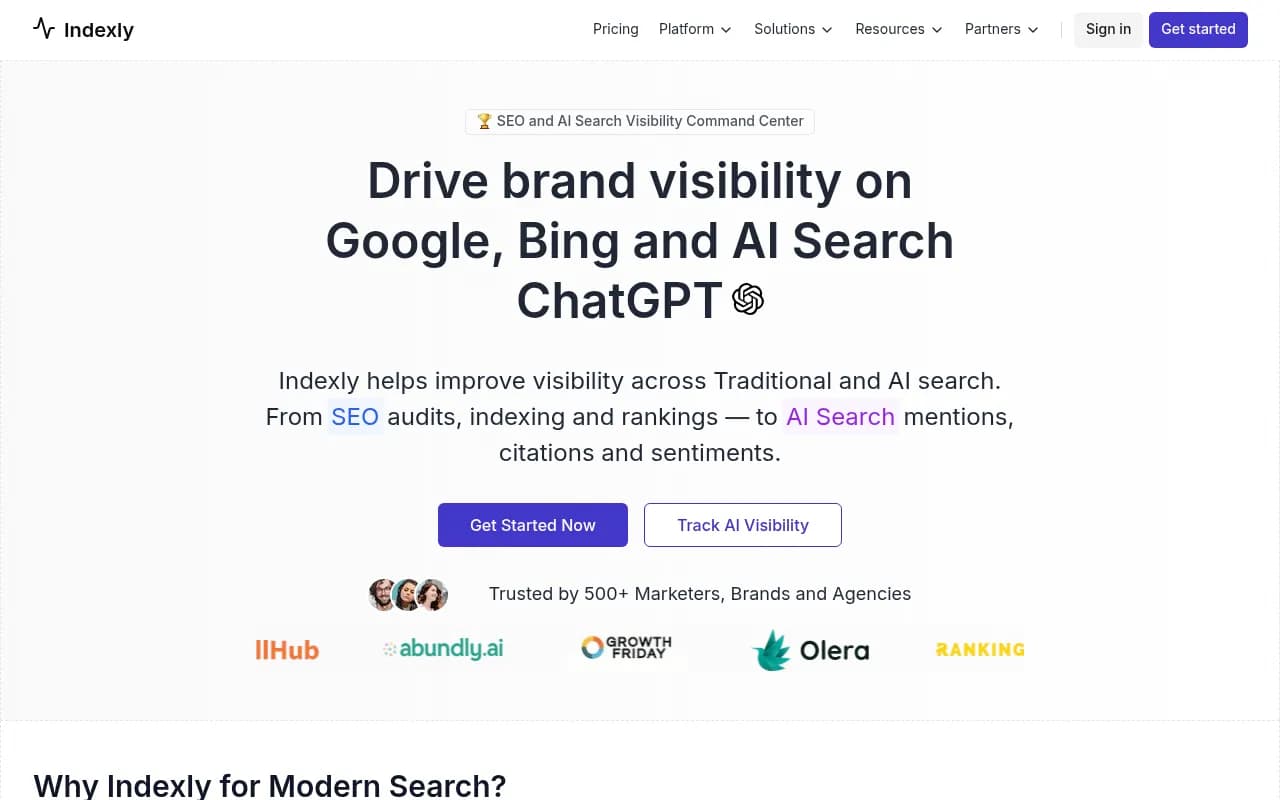
Indexly positions itself as a "command center" for both traditional and AI search visibility. It's built around the premise that search is splitting into two worlds -- the old Google/Bing SERP model and the new AI answer model where ChatGPT, Perplexity, and others synthesize responses instead of showing links. The pitch: you need one tool to track both.
The platform launched in 2024 and claims 500+ users including brands like CallHub, Abundly, and GrowthFriday. It's targeting marketers, agencies, and SaaS companies who want visibility into how AI models represent their brand alongside traditional SEO metrics.
Traditional SEO Features
Automated Indexing is the headline feature on the SEO side. Indexly connects to Google Indexing API and Bing IndexNow to submit URLs for crawling. You can enable auto-indexing (pulls from your sitemap automatically), submit single URLs instantly, or bulk-upload batches. The dashboard shows index status, success rates, and average time to index. One user reported a 75% reduction in time to get indexed and 100% reduction in manual indexing effort.
This is useful for sites publishing frequently (news sites, blogs, e-commerce catalogs) where waiting days or weeks for Google to discover new pages costs traffic. The interface is straightforward -- connect your site, enable auto mode, and let it run. You can also bulk de-index pages with one click, which is handy for removing outdated or duplicate content.
Website Audit runs technical SEO checks across your site. It scans for broken links, 404 errors, redirect chains, mobile optimization issues, and Core Web Vitals (LCP, FID, CLS). On-page checks include meta tags, H1-H6 hierarchy, alt text, and structured data validation. The audit dashboard shows an overall score, pages scanned, schemas implemented, and a breakdown of issues by category (title tags, meta descriptions, H1 tags, alt text, schema markup).
The audit is solid but not groundbreaking -- tools like Screaming Frog, Sitebulb, or Ahrefs Site Audit offer more granular crawl data and custom extraction. Indexly's strength is combining this with AI visibility in one place, not replacing dedicated technical SEO tools.
Keyword Tracking monitors rankings across Google and Bing. You can track brand keywords, competitor keywords, and run weekly or monthly reports. The dashboard shows average position, visibility percentage, and keywords in the top 10. It also surfaces "keyword opportunities" -- high-volume, low-competition terms where you're ranking on page 2 or 3 and could realistically break into the top 10 with optimization.
The opportunity discovery is helpful for prioritizing quick wins. The interface shows search volume, difficulty score, current position, and an "opportunity score" that weights all three factors. This is similar to what Ahrefs, Semrush, and Moz offer, but Indexly bundles it with AI tracking instead of making you pay for two separate tools.
Backlink Intelligence monitors your backlink profile and competitor links. You see total backlinks, referring domains, domain authority scores, and link quality assessments. The platform flags toxic or spammy links (high spam score, low domain authority) and lets you export them for disavowal in Google Search Console. You can also discover competitor backlinks to find link-building opportunities.
Again, this is table stakes for SEO platforms. Ahrefs and Majestic have deeper backlink indexes and more sophisticated link analysis. Indexly's backlink module is functional but not a reason to choose the platform over competitors -- the value is having it alongside AI visibility, not as a standalone feature.
AI Search Visibility Features
AI Readiness Audit checks whether your site is accessible to AI crawlers like GPTBot, ChatGPT-User, ClaudeBot, and Perplexity. It scans your robots.txt, generates an llms.txt file (a proposed standard for guiding LLMs on site structure and preferred content), and provides recommendations for semantic keywords and schema markup. The audit gives you a crawl score, lists detected AI bots, and flags issues preventing AI access.
This is useful context but not actionable optimization. Knowing GPTBot can crawl your site is step one -- the real question is whether it's actually citing your content in responses, and if not, why. Indexly shows you the crawl score but doesn't help you fix the underlying content gaps or structural issues that prevent citations. Promptwatch goes further by showing real-time AI crawler logs (which pages they read, errors they encounter, how often they return) and providing content gap analysis to identify missing topics.
AI Brand Visibility tracks mentions of your brand across ChatGPT, Gemini, Perplexity, and Claude. You see total mentions, share of voice vs competitors, and the topics/queries where your brand appears. The dashboard shows mention counts by model, sentiment scores, and trending topics. You can compare your brand against competitors to see who's winning in AI conversations.
This is the core AI feature and it's genuinely useful for understanding baseline visibility. The problem: it's descriptive, not prescriptive. You see that competitors are mentioned 2x more often, but Indexly doesn't tell you why or what to do about it. There's no content gap analysis showing which prompts competitors rank for but you don't. No AI content generation to help you create citation-worthy content. No page-level tracking to see which specific pages are being cited. It's a visibility dashboard, not an optimization platform.
Prompt Tracking lets you monitor specific prompts over time and group them by tags (topics, products, verticals, campaigns). You can track how AI models respond to prompts like "best SEO tools" or "top indexing platforms" and see whether your brand appears in the answers. The dashboard shows mentions per prompt, sentiment, and changes over time.
This is helpful for tracking brand presence in high-value queries. You can see if a competitor suddenly starts appearing in a prompt you used to own, or if a new product launch increases mentions. But again, it's monitoring without optimization. You can't see prompt volumes (how many people are actually asking this), difficulty scores (how hard it is to rank), or query fan-outs (related prompts you should also target). Promptwatch provides all of this plus Answer Gap Analysis to show exactly which prompts you're missing and what content to create.
Mentions & Sentiment Analysis tracks how AI models describe your brand. You see sentiment scores (positive, neutral, negative), the context of mentions, and recommendations to improve perception. The dashboard breaks down sentiment by model (ChatGPT, Claude, Gemini, Perplexity) and shows positive vs negative themes.
Sentiment tracking is valuable for reputation management. If AI models consistently describe your product as "limited" or "outdated," you know you have a perception problem. But Indexly doesn't connect sentiment to specific content on your site or show you how to fix it. It's a diagnostic tool, not a treatment.
Who Is It For
Indexly is best for marketing teams at SaaS companies, agencies, and e-commerce brands who want a single dashboard for traditional SEO and basic AI visibility. If you're currently using one tool for indexing (like IndexNow), another for audits (like Screaming Frog), and manually checking ChatGPT to see if your brand appears, Indexly consolidates that workflow.
It's particularly useful for agencies managing 5-20 client sites who need white-label reports showing both SEO health and AI mentions. The platform offers white-label partnerships and multi-user team management, so account managers and analysts can access client data with role-based permissions.
It's NOT for teams who need deep AI optimization. If your goal is to systematically improve AI visibility -- not just track it -- you need content gap analysis, AI content generation, crawler logs, and traffic attribution. Indexly doesn't provide any of that. You'll see the problem (low AI mentions) but won't have tools to solve it.
It's also not for enterprise SEO teams who need advanced technical audits, custom crawl configurations, or API access for data warehousing. Indexly is a mid-market tool with a simple interface and fixed feature set. If you need Screaming Frog-level crawl control or Ahrefs-level backlink data, you'll hit limitations quickly.
Integrations & Ecosystem
Indexly integrates with Google Search Console (for indexing and crawl data), Bing Webmaster Tools (for IndexNow submissions), and Google Indexing API. It generates llms.txt files for AI crawler guidance. The platform offers a white-label program for agencies and an affiliate program for creators.
There's no mention of API access, Zapier integration, Slack notifications, or webhooks. The platform is self-contained -- you log in, check dashboards, export reports. This is fine for small teams but limiting for agencies or enterprises who want to pipe data into Looker Studio, Data Studio, or custom BI tools.
No browser extensions or mobile apps. It's a web-only platform.
Pricing & Value
Indexly pricing starts at $29/month (Basic plan) and scales to $197/month (Pro plan) for higher volume and faster indexing. The website mentions a $49/month plan in some places and $59/month for an advanced plan with 20 websites in others -- pricing details are inconsistent across their site and search results.
For comparison:
- Promptwatch: $99/mo (1 site, 50 prompts, 5 AI articles, crawler logs), $249/mo (2 sites, 150 prompts, 15 articles, state/city tracking), $579/mo (5 sites, 350 prompts, 30 articles)
- Otterly.AI: $49/mo (monitoring only, no content tools)
- Peec.ai: $99/mo (monitoring only)
- Ahrefs: $129/mo (traditional SEO, no AI tracking)
- Semrush: $139.95/mo (traditional SEO, limited AI features)
Indexly is competitively priced for the traditional SEO features (indexing, audits, keywords, backlinks). The AI visibility features are a bonus at this price point. But if AI optimization is your primary goal, you're paying for a monitoring dashboard when you need an optimization platform. Promptwatch costs more but includes content gap analysis, AI writing agent, crawler logs, and traffic attribution -- the tools you need to actually improve visibility, not just track it.
Strengths & Limitations
Strengths:
- Combines traditional SEO and AI visibility in one dashboard -- no need to juggle multiple tools
- Automated indexing via Google Indexing API and Bing IndexNow saves manual submission time
- White-label reports and multi-user management make it agency-friendly
- Sentiment analysis across AI models helps with reputation management
- Competitive pricing for the traditional SEO feature set
Limitations:
- No content gap analysis -- you see low AI visibility but not which prompts you're missing or what content to create
- No AI content generation -- no writing agent or optimization tools to help you rank in AI search
- No AI crawler logs -- you don't see which pages AI bots are reading, errors they encounter, or crawl frequency
- No traffic attribution -- can't connect AI visibility to actual revenue or conversions
- No Reddit or YouTube tracking -- misses discussions that influence AI recommendations
- No ChatGPT Shopping tracking -- can't monitor product recommendations in ChatGPT's shopping carousels
- No prompt intelligence -- no volume estimates, difficulty scores, or query fan-outs to prioritize high-value prompts
- Limited backlink and audit depth -- functional but not competitive with Ahrefs, Screaming Frog, or Majestic
- Inconsistent pricing information across website and search results
Bottom Line
Indexly is a solid choice for marketing teams who want a single dashboard for traditional SEO and basic AI mention tracking. If you're managing 5-20 sites, need white-label reports, and want to consolidate tools, it's worth evaluating.
But if your goal is to systematically improve AI visibility -- not just monitor it -- Indexly falls short. It shows you the problem (low mentions, negative sentiment, competitor dominance) but doesn't give you the tools to fix it. No content gap analysis. No AI writing agent. No crawler logs. No traffic attribution. You're stuck at step one: awareness.
For teams serious about AI search optimization, Promptwatch is the stronger choice. It's the only platform that closes the loop from finding gaps (Answer Gap Analysis) to creating content (AI writing agent) to tracking results (page-level citations, crawler logs, traffic attribution). Indexly is a monitoring dashboard. Promptwatch is an optimization platform.
Best use case in one sentence: Agencies managing multiple client sites who want a single dashboard for traditional SEO metrics and basic AI brand mention tracking, without needing deep AI optimization tools.
Tags:
Similar and alternative tools to Indexly