Key takeaways
- A single ChatGPT answer is one draw from a distribution. Trackers report rates across many runs, so they will rarely match what you see in one manual check.
- Your own ChatGPT account has memory and context. A tracker's clean-session answer is a different thing from yours, and neither is wrong.
- Trackers that call APIs and trackers that capture the real interface can produce very different brand lists. Ask every vendor which one they use.
- The system itself shifts under you. ChatGPT changed its search behavior overnight in August 2026, with no change on your site.
- Judge trends over weeks with enough runs behind each number, not day-to-day wiggles.
The complaint, stated plainly
You open ChatGPT, type the prompt your tracker monitors, and your brand is right there in the second paragraph. Then you open the dashboard and it says 12% visibility. Or the reverse: the dashboard says you are cited constantly, and you cannot reproduce it by hand.
Both things can be true at once. Not because the tool is broken, but because a rank in AI search is not a rank in Google. Google gives one list that stays roughly put for a given keyword, location and device. ChatGPT generates an answer each time. The useful question changes from "where do I rank?" to "how often do I show up, and where, across many runs?"
There are four main reasons the numbers diverge. Sampling, personalization, collection method (API versus real interface), and plain drift in the platform. Let's take them in turn.
Reason 1: sampling and inherent variability
Ask the same question twice and you get two answers. SparkToro's research, quoted in several vendor write-ups, found AI tools returned the same list of brands fewer than 1 time in 100, and the same list in the same order fewer than 1 time in 1,000. Treat that as a sharp illustration rather than a law, but it matches what anyone sees who repeats a prompt a few times.
This is why serious trackers run each prompt repeatedly and report a rate. "You appeared in 42% of 300 answers this month, up from 31%" is a meaningful statement. "You are #2" is not.
Why one answer tells you so little
The number of sources per answer makes single checks even weaker. Promptwatch Data covering Sep 28 to Oct 4, 2026 found that 47.6% of ChatGPT responses with citations cite 10 or more unique domains, and 66.1% cite at least 8. For organic prompts, 52.5% cite 10 or more. With a pool that wide, which handful of sources make your single check is close to a coin flip. Promptwatch's own advice from that report: measure across many organic prompts, not one.
Brand-specific prompts are tighter. Only 21.3% of them cite 10 or more domains, and the most common count is 5. So expect your branded prompts to look more stable than your category prompts. That is normal, not a sign that the category data is bad.
How many runs is enough?
The research here is thin, so be careful with exact thresholds. One agency-focused write-up gives a useful rule of thumb: a jump from 40% to 45% on 30 answers is noise, while the same jump on 900 answers is worth raising on a monthly call. Use that logic. Before you react to a move, ask how many answers sit behind each number.
Reason 2: personalization and your own account
Your ChatGPT account is not a neutral instrument. It has memory, chat history, and knows (or can infer) who you are and what company you work for. If you have asked about your own product fifty times, ChatGPT is not meeting your brand for the first time.
LLM Pulse makes this point in its myths article: asking ChatGPT yourself is not a substitute for a tool, because your account is already personalized. The same piece also argues the opposite risk is overstated. Dominant brands show up regardless of personalization because the model's training data strongly associates them with their topics. So personalization is a bigger distortion for challengers and mid-sized brands than for category leaders.
Location and language matter too. An assistant answering a German buyer in Munich can recommend different brands than it gives a US buyer in Boston. A tracker that runs every prompt in English from one country is measuring one market and presenting it as all of them.
No tracker can reproduce a logged-in user's memory and history. One agency guide puts it well: treat every tool's numbers as a strong sample, not a perfect mirror. I would add that your own manual check is the weakest sample of all, because you are the most personalized user in the building.
How to do a fair manual check
- Use a logged-out session or a fresh browser profile, or turn memory off.
- Set the country and language to match the prompt set in your tracker.
- Run the prompt five to ten times, not once, and note how many times you appear.
- Record the date and the model shown in the interface, since both change.
If your manual rate and the tracker's rate land in the same neighborhood after that, the tool is doing its job.
Reason 3: API data versus the real interface
This one catches buyers out the most. Trackers collect answers in one of two ways. Some send prompts through each engine's developer API. Others capture what the consumer app actually shows.
The two differ in practice. The consumer apps search the web, add shopping cards, and format answers differently from a raw API call. One vendor-cited comparison from SurferSEO, reported by Gumshoe, looked at 1,000 prompts across API and the ChatGPT web interface and found only 24% brand overlap. I could not verify the underlying study myself, so hold that number loosely, but the direction is consistent across several sources.
API collection does have real advantages. It is cheaper and steadier, which suits trend tracking. Interface capture costs more per answer, so those tools usually track fewer prompts. Neither is dishonest. The problem is when a vendor does not tell you which one you are buying.
What the academic evidence says (and does not say)
A Stanford paper from September 2026, API Benchmark Scores Do Not Reliably Transfer to Chatbot Interfaces, audited ChatGPT, Claude and Gemini across seven systems and nine benchmarks. On average, API evaluations scored 3.4 percentage points higher in accuracy and 2.1 points higher in test-retest agreement than the interface. For ChatGPT, the API-versus-interface gap was larger than the API-only difference between GPT 5.3 and GPT 5.4.
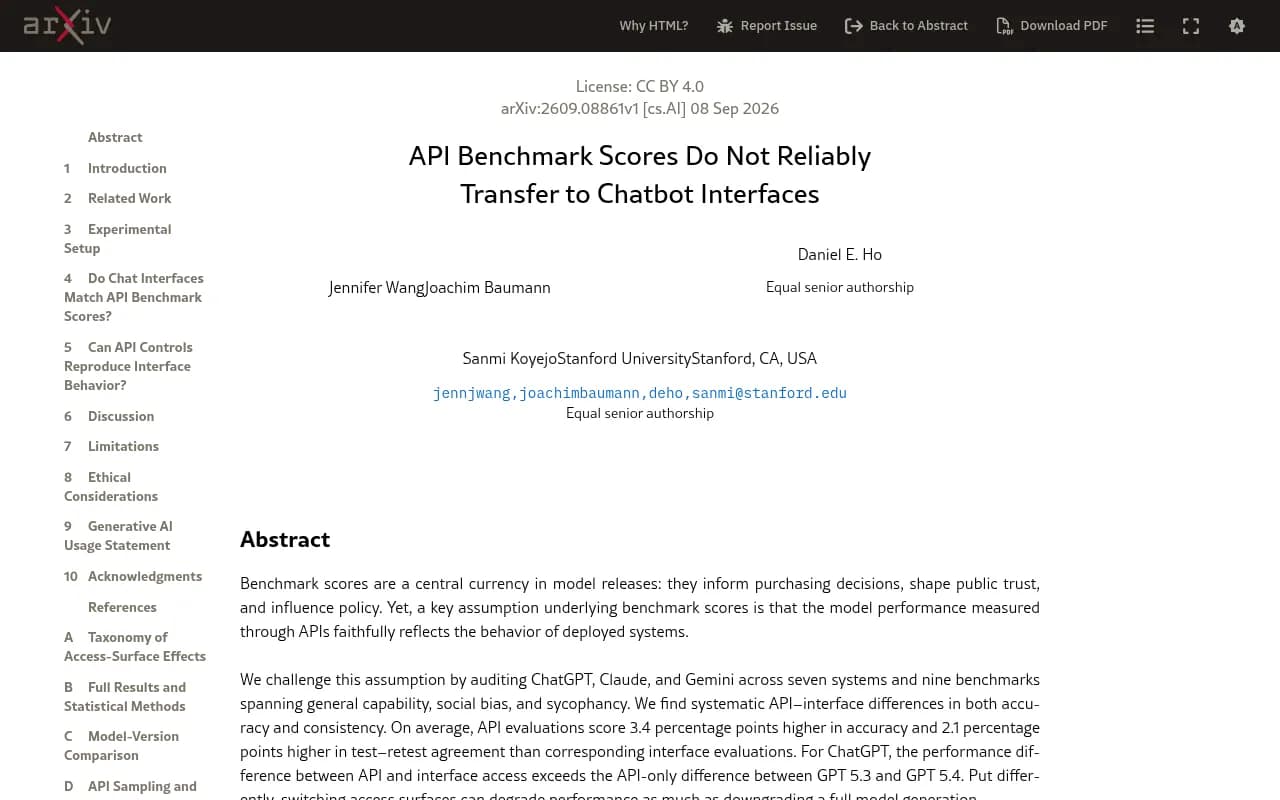
Two cautions. First, this measures benchmark accuracy, not citations or brand mentions, so it does not prove anything about how many times your brand is named. Second, it found that tweaking API sampling parameters (temperature, top-p) and reasoning settings did not reliably close the gap. In their data, varying temperature and top-p moved accuracy by only about 0.3 to 1.6 points per model. The takeaway for trackers is narrower but useful: the API is not simply the interface with a different wrapper, and you cannot reliably dial it in to match.
That is an argument for asking vendors how they collect, not an argument that API data is useless.
Reason 4: the platform moves under you
Sometimes your number changes and you did nothing. ChatGPT is a moving target.
Promptwatch Data shows a clean example. On August 8, 2026, ChatGPT started using the site: operator at scale. site:-scoped fanout queries jumped from 0.37% to 16.8% of all fanouts in a day, and average fanouts per response rose from about 1.08 to 1.83 and stayed there. A staged rollout is likely, since the share dipped on Aug 3 to 5 first. Nothing changed on anyone's website, yet the searches behind every answer changed.
The ChatGPT query fanout data shows slower drift. Average fanout queries per response fell from 2.15 in early December to about 1.84 by early March, and average fanout query length dropped from about 117 characters to the high 80s. Keyword-to-prompt mappings you built last year may be stale.
Citation behavior moves too. Promptwatch Data recorded average citations per ChatGPT response dropping around the GPT-5.3 rollout on March 4, 2026. And reddit.com's share of ChatGPT citations fell from roughly 4% to 0.5% on August 14, 2026. If your tracker data over those windows looks odd, the platform is the first suspect.
This is the argument for continuous monitoring over one-off audits. A snapshot from July tells you little about October.
Putting it together: a diagnosis table
| Symptom | Likely cause | What to check |
|---|---|---|
| You see yourself in ChatGPT, tracker says low | Personalization or a lucky single draw | Repeat in a logged-out session, 5 to 10 runs |
| Tracker says high, you cannot reproduce it | Tracker uses API data or a different locale | Ask the vendor about collection method and country |
| Two trackers disagree on the same brand | Different collection methods, prompt sets, run counts | Compare methodology, not just the headline score |
| Sudden shift across all your prompts | Platform change (model or system prompt rollout) | Look for a matching date in public data on ChatGPT behavior |
| Daily number jumps around | Small sample per prompt per day | Use weekly or monthly rolling rates |
| Strong Google rank, weak AI presence | Rank is a weaker predictor of citation than it was | Look at cited sources, not just position |
That last row deserves a note. Ahrefs, in an analysis of 863,000 keyword results pages, reported that only 38% of pages cited in AI Overviews also ranked in Google's top 10 for the same query, down from 76% in a July 2025 version. Good Google rankings help but do not guarantee a citation.
Six questions to ask any tracker vendor
Searchable's guide on AI visibility tracking frames the buying decision as a set of questions. These are my adapted version:
- Do you collect answers from the real interface or from the API? Does it differ by engine?
- How many times is each prompt run per period, and what is the sample behind each reported percentage?
- Which countries and languages can I track, and is the location set per prompt?
- Where do the suggested prompts come from? Real search demand, or generic templates?
- Do you show the full answer text and cited URLs, so I can audit what the score hides?
- How do you handle model changes? Do you flag them so I can separate platform shifts from my own work?
A vendor that answers these specifically is worth a trial. One that says "proprietary methodology" and stops is telling you something.
Choosing a tracker with this in mind
Because collection method is the biggest source of disagreement, it helps to know where tools sit. The list below is directional, based on how vendors describe themselves. Verify each one against the questions above.
Promptwatch says it collects from the real user interfaces of ChatGPT, Gemini, Perplexity, Claude and Google AI Overviews rather than from APIs, in each country and language, and also tracks API models alongside them. It layers on prompt volumes, query fan-outs, and IP-verified AI crawler logs, which help you tell whether a visibility gap is a coverage problem or a crawlability problem.

Otterly.AI is a lower-cost monitoring option for teams that want basic tracking.

Profound targets enterprise teams with deeper monitoring budgets.

LLM Pulse publishes the myths article quoted above and positions itself around real-interface analysis.
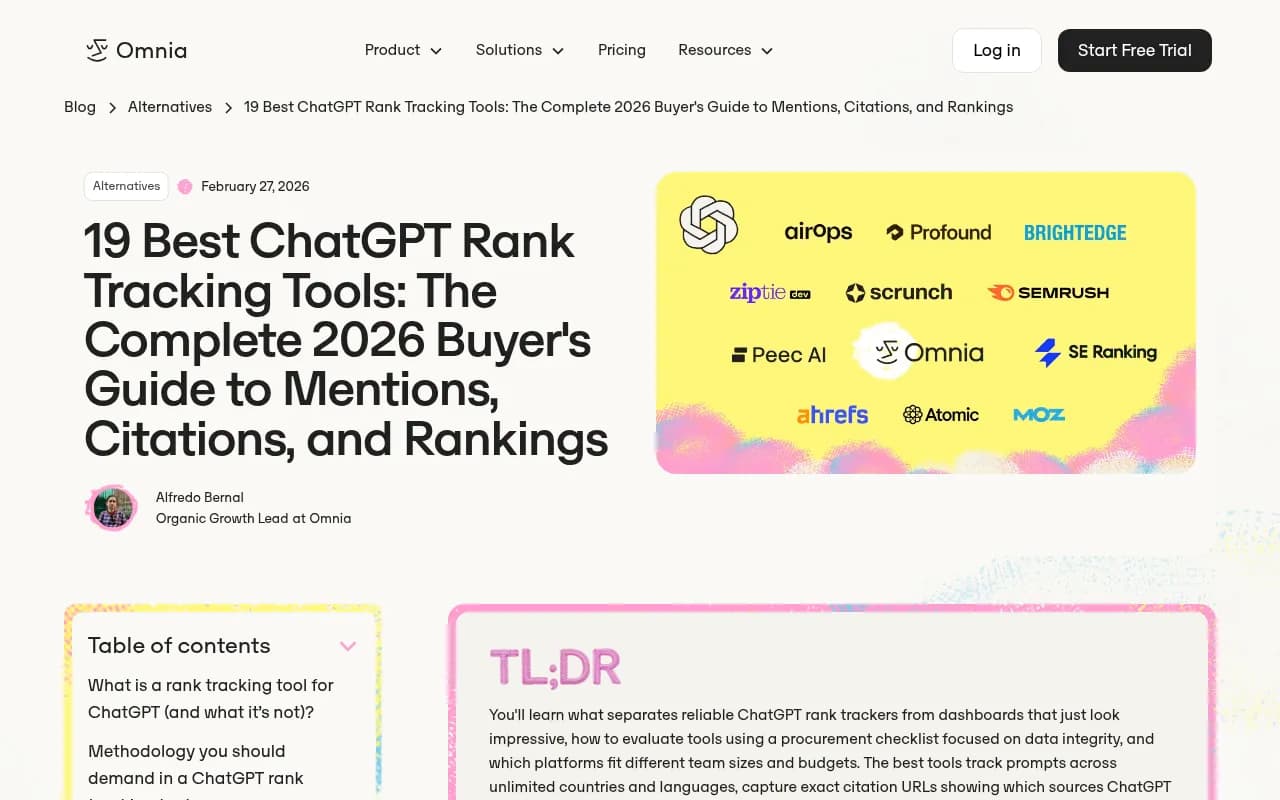
Omnia produced a buyer's guide that emphasizes systematic sampling and citation-level URLs.
If you are comparing more options, the AI rank tracking directory at ai-rank-tools.com lists many of them side by side.
| Approach | Strength | Weakness |
|---|---|---|
| API-based tracking | Cheaper, steadier, more prompts per budget | May miss web search, shopping cards, interface formatting |
| Real-interface capture | Closer to what buyers see | Costlier per answer, usually fewer prompts |
| Manual checks in your account | Free, good for spot-checking wording | Personalized, tiny sample, not repeatable |
| Mixed (API for some engines, UI for others) | Pragmatic | Inconsistent across engines if undisclosed |
Reading your report without fooling yourself
- Compare mention rates over time rather than treating one answer's order as a fixed ranking.
- Track position and description as well as presence. A mention with an outdated price or a feature you retired is a bad mention, and scores can hide it.
- Separate branded from category prompts. They have different stability, as the unique-domain data showed.
- Annotate your chart with known platform changes. A drop on August 14 might be Reddit disappearing from citations, not your content.
- Treat a move from 3% to 28% across 16 weeks as real. Treat a daily 2-point wobble as weather.
- Read the cited sources, not just the score. If you are mentioned but never cited, that is a content or crawlability question rather than a reputation one.
A short operating routine
Weekly: review rolling rates per topic, flag any date where many prompts moved together, and check the full text of a handful of answers.
Monthly: compare against the prior month at the same sample size, review location and language splits, and decide which content gaps to act on.
Quarterly: re-validate the prompt set. Fanout behavior shifts, so prompts that mirrored real searches in January may not in October.
Bottom line
Your tracker and ChatGPT disagree because they are not measuring the same thing. One is a repeated-sample estimate from a clean session, possibly through an API. The other is a single draw from a personalized account. Add a platform that changes its search behavior without notice, and exact agreement would be the suspicious result. Pick a tool that tells you how it collects, run enough samples to trust the trend, and use your manual checks only to read what the answers actually say.