Key takeaways
- "Vibe coding" -- building software by prompting AI instead of writing code -- has made it trivially easy to launch a convincing-looking SaaS product in days, including AI visibility tools
- Many AI visibility platforms in 2026 are monitoring-only dashboards with no real data infrastructure behind them; they show numbers but can't explain where those numbers come from
- Red flags include vague prompt methodology, no citation data, no crawler logs, no content gap analysis, and pricing that seems too cheap to support real LLM query costs
- Legitimate platforms are transparent about which AI models they query, how often, at what volume, and what they do with the results beyond showing you a score
- The best tools close a loop: find gaps, help you create content, then track whether it worked
There's a LinkedIn post that's been quietly circulating among SEO teams this year. It goes something like this: "You can vibe-code your own AI visibility tracker over a weekend. Just send prompts to an LLM via API and save the output in a spreadsheet."
The person who posted it meant it as a fun experiment. The problem is that dozens of founders read it as a product roadmap.
In 2026, vibe coding -- the practice of building software by describing what you want to an AI and iterating through prompts rather than writing actual code -- has gone from a curiosity to a genuine development methodology. According to ZeeFrames, 92% of US developers now use AI coding tools daily, and 46% of all new code written in 2026 is AI-generated. That's not inherently bad. Some excellent tools have been built this way.
But it has also flooded the market with products that look like platforms and function like prototypes. Nowhere is this more visible than in the AI search visibility space, where the category itself is new enough that most buyers don't yet know what "good" looks like.
This guide is about how to tell the difference.
Why AI visibility tools are especially vulnerable to vibe-coded hype
The AI visibility category is barely two years old. Most marketing teams are still figuring out what GEO (Generative Engine Optimization) even means, let alone what a serious platform should do. That information asymmetry is a gift to anyone who wants to ship a dashboard, slap "track your brand in ChatGPT" on the homepage, and start charging $49/month.
The core technical requirement for a basic AI visibility tool is genuinely low. You need an API key, a list of prompts, a way to parse responses for brand mentions, and somewhere to store the results. A competent developer can build that in a weekend. A vibe-coder with Claude or GPT-4o can probably do it in a day.
What you cannot build in a weekend is the infrastructure that makes visibility data actually useful: a large citation database, crawler log analysis, prompt volume estimates, query fan-out modeling, content gap analysis, and traffic attribution. Those things require months of data collection, real engineering, and ongoing LLM query costs that scale with usage.
The problem is that from the outside, a weekend prototype and a serious platform can look identical. Both have dashboards. Both show you a "visibility score." Both have a pricing page.
The anatomy of a vibe-coded visibility tool
Before getting into red flags, it helps to understand what these tools typically look like under the hood.
The standard vibe-coded AI visibility tool works roughly like this:
- You enter your brand name and a list of competitor names
- The tool sends a fixed set of pre-written prompts to one or two LLM APIs (usually OpenAI)
- It checks whether your brand appears in the response
- It aggregates those checks into a "visibility score" or "share of voice" percentage
- It shows you a chart over time
That's it. There's no real citation database. There's no understanding of why your brand was or wasn't mentioned. There's no way to act on the data. And crucially, there's often no transparency about which prompts were used, how many, at what frequency, or whether the methodology is consistent week to week.
Some of these tools have genuinely nice UI. Some have impressive-sounding names. A few have gotten press coverage because the category is hot and journalists are covering anything with "AI" and "visibility" in the same sentence.
Red flags: how to spot a platform built on hype
The prompt methodology is vague or hidden
Every serious AI visibility platform should be able to tell you exactly how it generates its data. How many prompts does it run? How were those prompts selected? Are they static or do they evolve? How often are they refreshed? Which AI models are queried?
If a platform's documentation or sales team can't answer these questions specifically, that's a problem. "We run thousands of prompts across all major AI models" is not an answer. "We run 350 prompts per site, refreshed weekly, across ChatGPT, Perplexity, Claude, Gemini, and seven other models" is an answer.
Vague methodology usually means one of two things: the prompts are fixed and limited (making the data unrepresentative), or the vendor doesn't want you to know how thin the coverage actually is.
There's no citation data -- just mention counts
Knowing that your brand was mentioned in an AI response is the starting point, not the destination. What matters is why you were mentioned -- which source pages the AI cited, which domains it drew from, whether it cited a Reddit thread or a competitor's blog post.
Citation data is expensive to collect and hard to analyze at scale. A platform with real citation infrastructure can tell you: "ChatGPT cited your competitor's FAQ page 847 times this month, and it cited nothing from your domain for this category of query." That's actionable. A platform without citation data can only tell you: "Your brand appeared in 23% of responses." That's a number with nowhere to go.
No AI crawler logs
This one is a reliable signal. AI crawler logs -- real-time records of when AI bots like GPTBot, ClaudeBot, and PerplexityBot crawl your website -- require actual server-side infrastructure. You can't fake them, and you can't build them over a weekend.
A platform that offers crawler log analysis is telling you something real: they've built the infrastructure to intercept and interpret bot traffic at the page level. Most vibe-coded tools don't have this at all, and many monitoring-only platforms skip it entirely because it's technically demanding.
If a tool can tell you that GPTBot crawled your /pricing page three times last week but hasn't touched your /blog in 30 days, that's a platform with real data. If the tool can only show you aggregate visibility scores, you're working with much less.
The pricing is suspiciously cheap
Running LLM queries at scale is not free. If a platform is monitoring 10 AI models across hundreds of prompts per site, the API costs alone are meaningful. A tool charging $9/month for "unlimited AI visibility monitoring" is either running very few queries, using a single cheap model, or subsidizing losses in hopes of a quick exit.
This doesn't mean expensive tools are always better. But it does mean you should ask: at this price point, how many prompts are actually being run, on which models, and how often? The math has to work somewhere.
It monitors but doesn't help you act
This is the biggest one, and it's worth spending a moment on.
Monitoring is not optimization. Knowing that your brand appears in 18% of AI responses for your category is interesting. Knowing which specific prompts your competitors are visible for that you're not, which content gaps on your site are causing the absence, and what to write to close those gaps -- that's optimization.
A lot of tools stop at monitoring because monitoring is easy to build and easy to demo. The action layer -- content gap analysis, AI-native content generation, page-level tracking, traffic attribution -- is much harder. It requires not just LLM queries but a content intelligence layer, a writing system grounded in citation data, and a feedback loop that connects new content to visibility changes.
When you're evaluating a platform, ask: "If I find out my visibility is low, what does this tool help me do about it?" If the answer is "you can export the data and figure it out yourself," you have a monitoring dashboard, not an optimization platform.
What a legitimate platform actually looks like
Serious AI visibility platforms share a few characteristics that are hard to fake.
They have large, proprietary datasets. Promptwatch, for example, has processed over 1.1 billion citations, clicks, and prompts -- data that takes sustained infrastructure investment to accumulate, not a weekend sprint.

They cover multiple AI models with real query volume. Ten models is the current standard for comprehensive coverage: ChatGPT, Perplexity, Claude, Gemini, Grok, DeepSeek, Copilot, Meta AI, Mistral, and Google AI Overviews. A platform covering two or three models is giving you a partial picture.
They provide prompt-level intelligence, not just brand-level scores. This means volume estimates for each prompt, difficulty scores, and query fan-outs that show how a single prompt branches into related sub-queries. Without this, you can't prioritize which prompts to target.
They close the loop between visibility and revenue. Traffic attribution -- whether through a code snippet, Google Search Console integration, or server log analysis -- connects AI citations to actual website visits and conversions. Without this, you're optimizing for a metric that may or may not correlate with business outcomes.
A practical evaluation framework
When you're assessing an AI visibility tool, here are the questions worth asking before you sign up for anything:
| Question | What a strong answer looks like | What a weak answer looks like |
|---|---|---|
| How many prompts do you run per site? | Specific number (e.g., 50-350+) | "Thousands" or vague |
| Which AI models do you monitor? | Named list of 8+ models | "All major AI models" |
| How often are prompts refreshed? | Weekly or more frequent | Monthly or unclear |
| Do you have citation data? | Yes, with source-level detail | No, or mention counts only |
| Do you offer crawler log analysis? | Yes, with page-level data | No |
| Can you help me create content? | Yes, with AI writing tools | No, export and figure it out |
| How do you attribute AI traffic? | GSC integration, snippet, or logs | We don't |
| What's your prompt methodology? | Transparent, documented process | Proprietary / can't share |
Run any tool you're considering through this table. The answers will tell you a lot.
Tools worth knowing about
The market has a wide range right now, from serious platforms to monitoring-only dashboards to things that are essentially weekend projects with a Stripe integration.
On the more capable end of the spectrum, a few tools stand out for specific use cases:
Promptwatch is the most complete platform in the category right now -- it covers the full loop from gap analysis to content generation to traffic attribution, with crawler logs and citation data backing it up. It's the right choice if you want to actually move the needle on AI visibility, not just measure it.
For teams that want enterprise-grade monitoring with strong data infrastructure, Profound is worth evaluating.
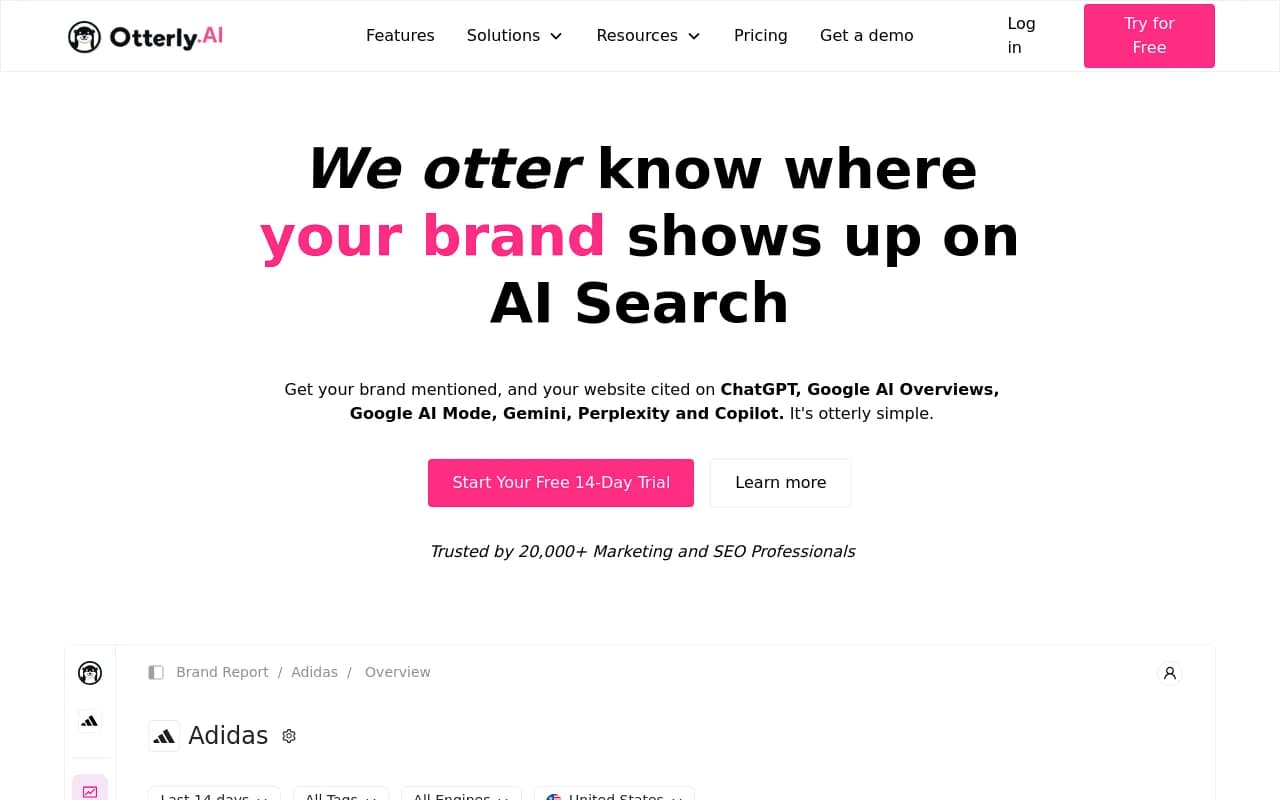
Otterly.AI is a reasonable starting point for smaller teams that just want basic monitoring without complexity -- but understand that it stops at monitoring.
Scrunch AI has solid monitoring features and is worth a look for brands that prioritize tracking over optimization.
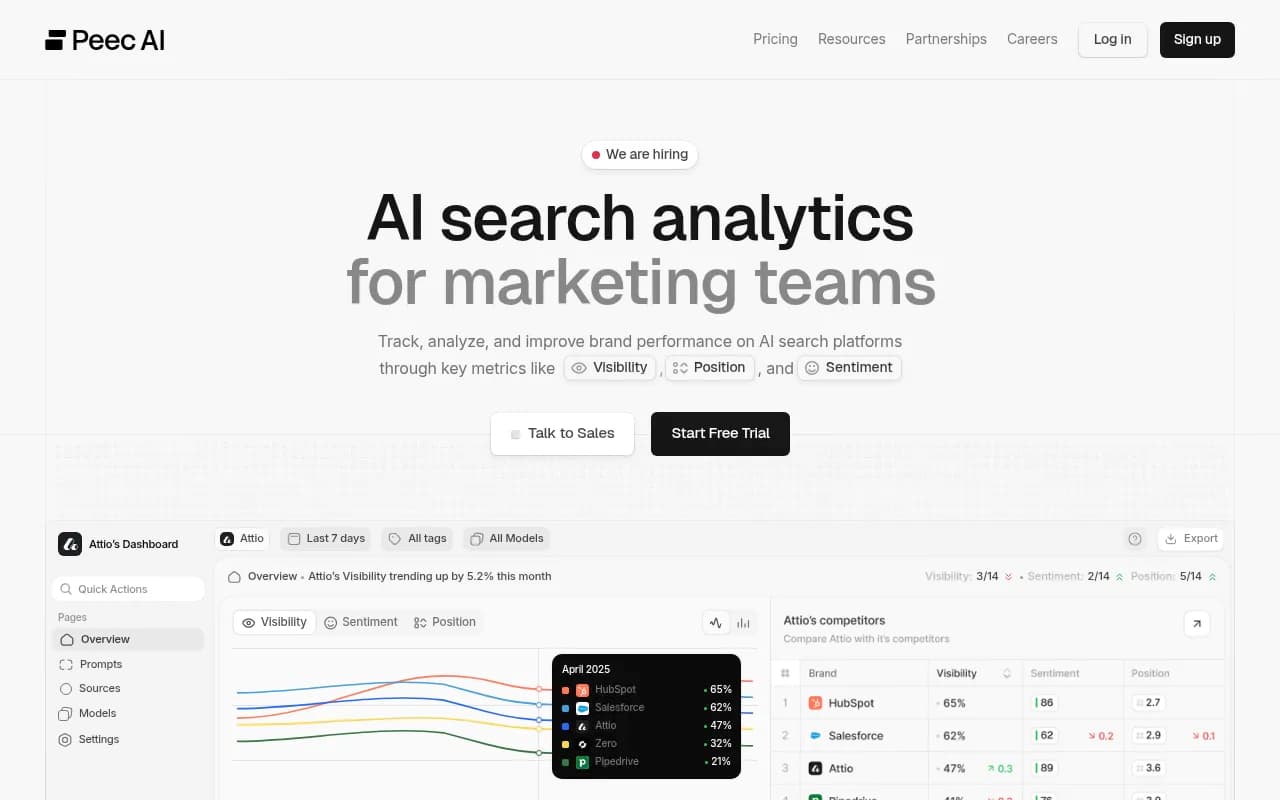
Peec AI is another monitoring-focused option, clean and simple, but again: it won't tell you what to do with the data.
For teams that want to track AI visibility alongside traditional SEO metrics in one place, SE Ranking has added AI visibility features to its existing platform.
And if you're an agency managing multiple clients, Slate is built with that workflow in mind.
The vibe-coded tool isn't always the bad guy
One thing worth saying clearly: vibe-coded doesn't automatically mean bad. Some genuinely useful tools have been built quickly with AI assistance. The problem isn't the development method -- it's when the development method produces a product that looks more capable than it is, and when buyers don't have the context to tell the difference.
The AI visibility space is moving fast enough that a tool built in April 2026 might be meaningfully better than one built in October 2025. What matters is whether the team behind it is investing in real data infrastructure, real methodology, and real product development -- or whether they shipped a weekend project and are now coasting on category hype.
The signals described in this guide -- citation data, crawler logs, prompt methodology transparency, the action loop -- are good proxies for that underlying question. A team that has built those things has done real work. A team that hasn't is probably hoping you won't notice.
One more thing about the "build your own" argument
That LinkedIn post about building your own AI visibility tracker over a weekend? It's technically accurate. You can do it. You can send prompts to an API, parse the responses, and save the results.
What you'll end up with is a tool that tells you whether your brand appeared in a handful of responses to a handful of prompts on a handful of days. It won't tell you about citation patterns across 880 million data points. It won't show you which pages AI crawlers are actually reading on your site. It won't generate content engineered to get cited. It won't connect visibility to revenue.
Building a visibility tracker is easy. Building a visibility platform is not. That distinction is worth keeping in mind every time you see a new tool launch with a slick landing page and a $29/month price tag.
The category is real. The need is real. But not every tool in it is.