Key takeaways
- Surfer SEO and NeuronWriter are content editors built around scoring a page against the Google SERP. Both have added light AI-visibility tracking, but it is a side feature.
- Promptwatch is the opposite shape: an AI visibility and GEO platform that tracks real AI answers, then helps you fix the gaps.
- Promptwatch Data shows ChatGPT citations depend on content type, page type, freshness and prompt intent, not NLP term scores.
- NeuronWriter is the cheapest entry (from $23/mo). Surfer sits in the middle. Promptwatch starts at $95/mo but tracks far more prompts.
- Most teams will want one tool from each camp, not a single winner.
Why this comparison is awkward
These three tools are not direct competitors, and pretending they are would be a bit dishonest. Surfer SEO and NeuronWriter solve the same problem: you have a keyword, you want a page that looks like what Google already rewards, and you want a score telling you how close you are. Promptwatch solves a different one: when someone asks ChatGPT, Perplexity or Google AI Overviews a question in your category, are you named, are you cited, and what do you do about it if you are not?
Both Surfer and NeuronWriter now market themselves as AI visibility platforms. Surfer's homepage talks about being "the answer" in Google and LLMs, and NeuronWriter's tagline is "Rank Higher, Appear Everywhere." Fair enough. But the depth is very different, and that is what this guide is about.
A disclosure: this site is run by 1001 SEO Media, which uses Promptwatch as its GEO platform. I will try to be straight about where Surfer and NeuronWriter are the better pick.
The quick comparison
| Surfer SEO | NeuronWriter | Promptwatch | |
|---|---|---|---|
| Core job | Google on-page optimization | Google on-page optimization, budget friendly | AI search visibility and GEO |
| Main output | Content Score, briefs, SERP analysis | NLP term scoring, content structure suggestions | Visibility Score, citations, crawler logs, action list |
| AI tracking | Included on newer plans, 25 prompts weekly on Standard (verify on live page) | 5 to 20 AI-monitored questions by plan, add-on from $9/mo | 50 to 350 prompts by plan, real-UI tracking, daily |
| Writes content | Yes, Surfer AI | Yes, AI credits | Yes, Content Agent grounded in citation data |
| Entry price | Around $49 to $99/mo depending on plan | $23/mo | $95/mo (free Explore tier) |
| Best for | Content teams and agencies shipping for Google | Solo creators and small teams | Brands that want AI search as a revenue channel |
Surfer's pricing has changed several times, and third-party summaries conflict. Check surferseo.com/pricing before you buy.
Surfer SEO: the mature Google workflow
Surfer SEO built its reputation on the Content Editor and SERP Analyzer. You enter a keyword, it looks at the pages ranking, and it hands you term targets, structure suggestions and a live score as you write. It works. Writers with no SEO background get a clear direction, which is a big reason agencies like it.
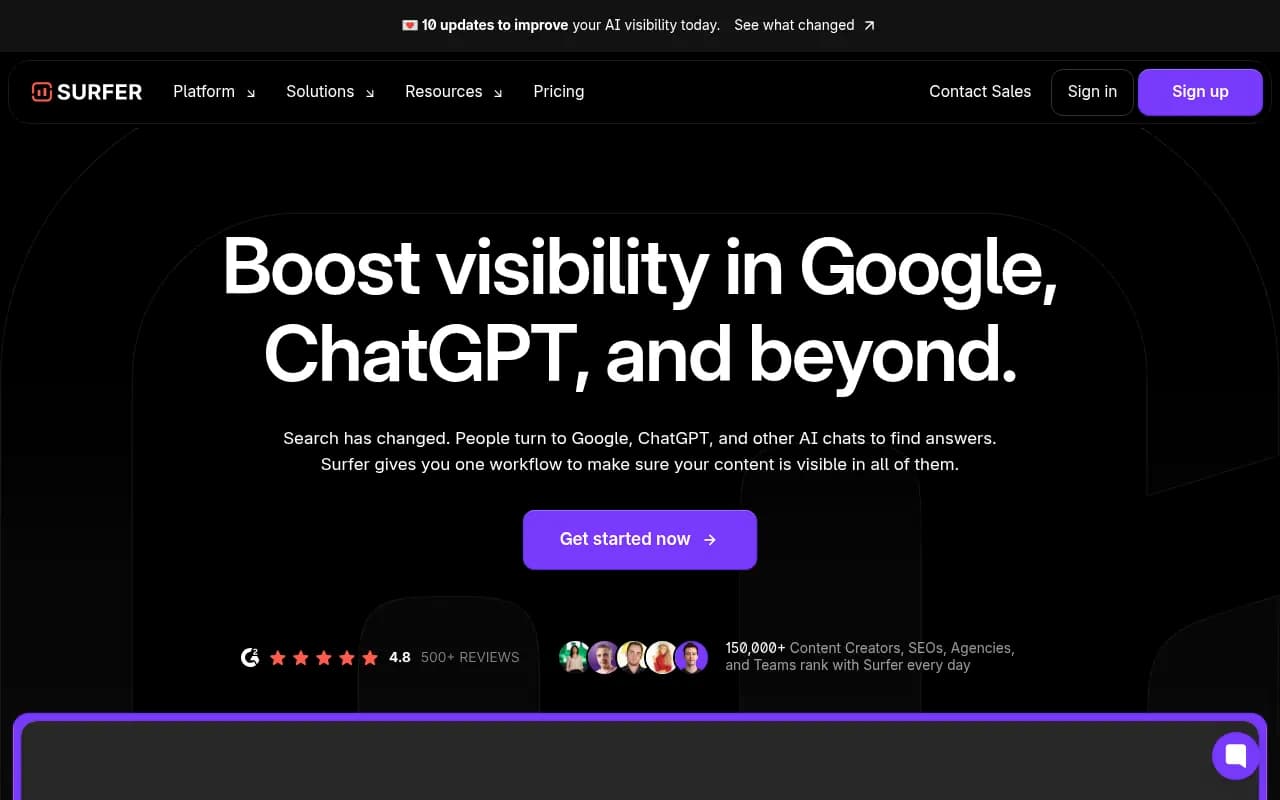
Surfer has also pushed hard into AI. It now offers an AI tracker, a Topical Map, and brand-voice and competitor workflows. Per third-party pricing roundups, the Standard plan tracks ChatGPT only with 25 prompts refreshed weekly, while Pro tracks ChatGPT, Perplexity, AI Mode, AI Overviews and Gemini with 50 prompts refreshed daily. Surfer also claims content optimized with it is 25% more likely to be cited by AI, though that is a vendor study and I would treat it as a hypothesis rather than a fact.
Where Surfer is strong
- Deep SERP analysis and a polished editor.
- Google Docs and WordPress integrations that fit editorial workflows.
- Topical maps for planning clusters.
Where it is limited
- Prompt allowances are small compared with a dedicated tracker.
- The score is still anchored to what ranks on Google today.
- Seat caps and document limits climb with price.
NeuronWriter: the budget Surfer-style editor
NeuronWriter does something close to the same job at a fraction of the price. Ryze AI's roundup calls it the best value Surfer-style editor, and I agree with the framing, with one caveat: its own comparison article against Surfer is vendor-written, so ignore the verdicts there.
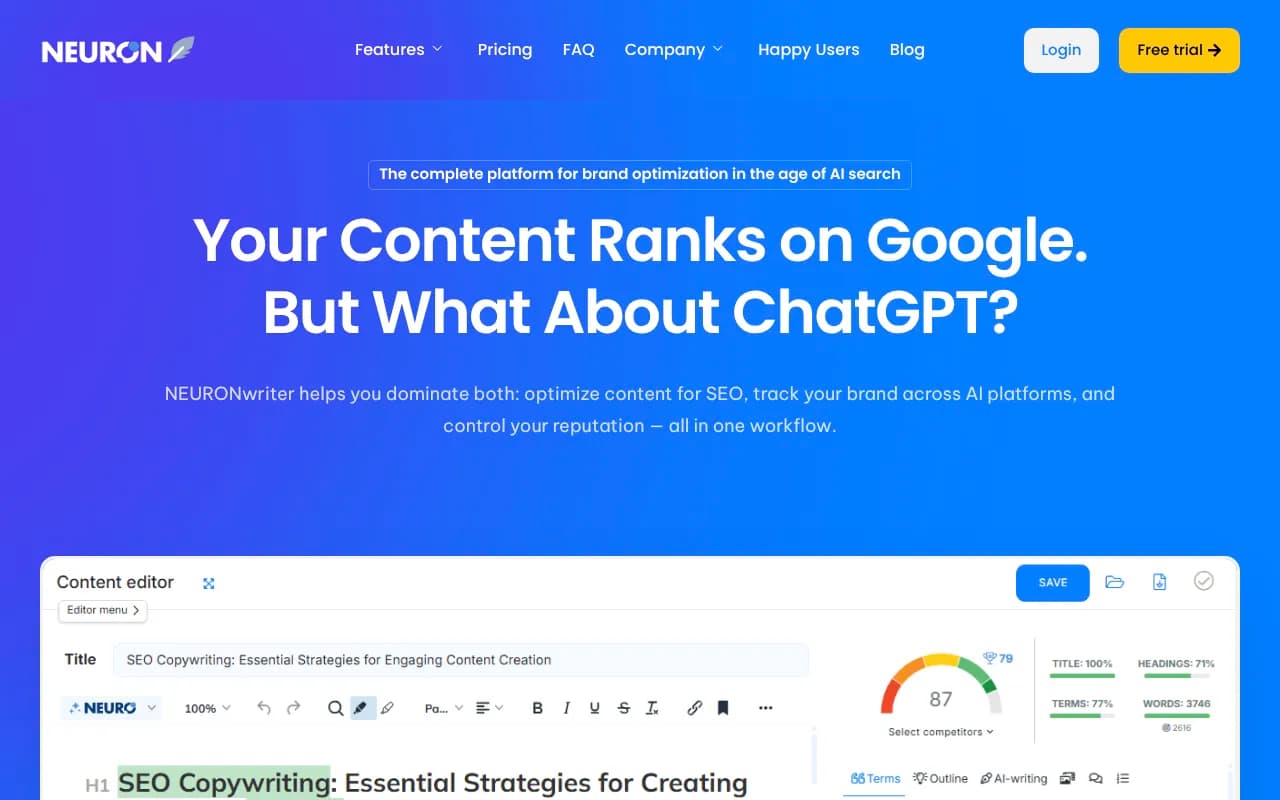
Published plans run Bronze at $23/mo (25 documents), Silver $45, Gold $69 (the popular tier, with unlimited team members, GSC, WordPress and Shopify integrations, and API/MCP access), Platinum $93 and Diamond $117. Annual billing gives two months free. AI monitoring covers Google, AI Overviews, AI Mode, ChatGPT and Perplexity, but only 5 to 20 monitored questions depending on plan, with an add-on at $9/mo for 10 more. Claude and Gemini are not listed.
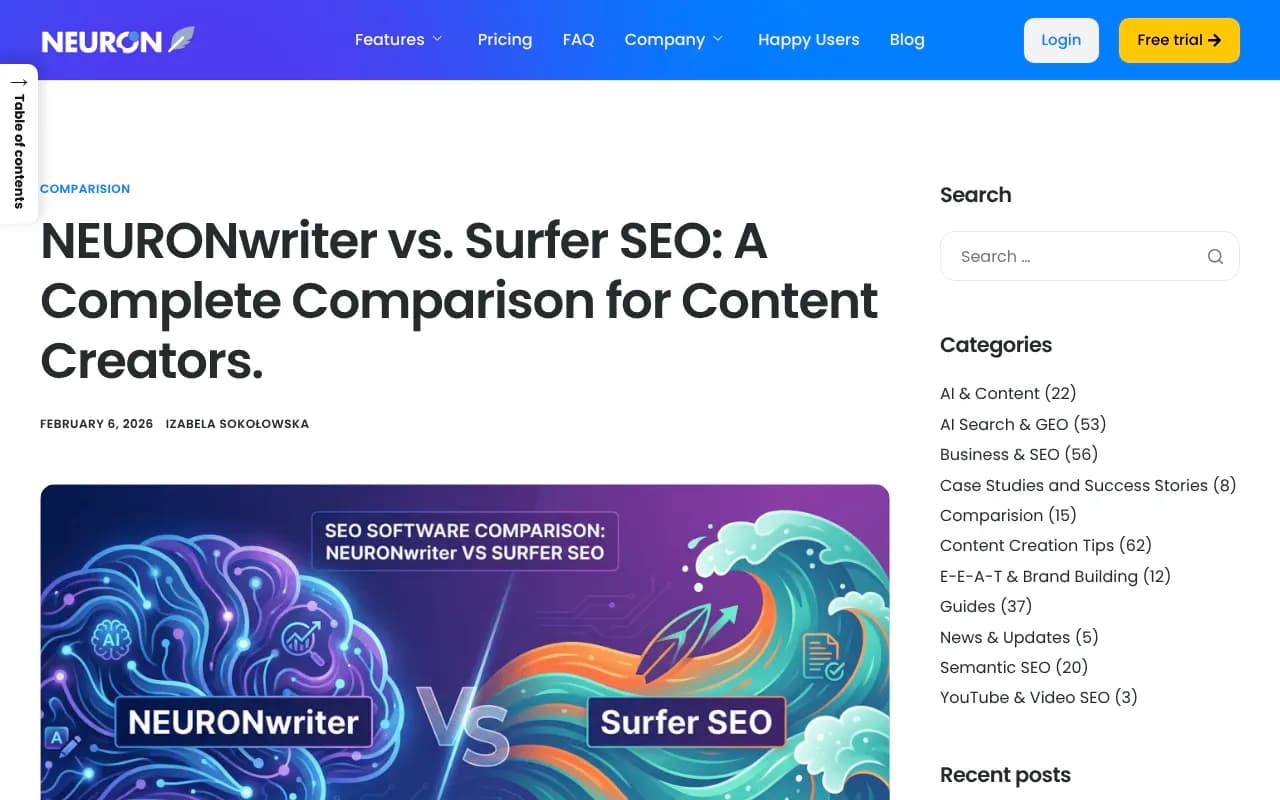
The interface is denser and less polished than the premium tools. Most solo writers will not care.
Promptwatch: tracking and fixing AI visibility
Promptwatch starts from a different question. It monitors the actual user interfaces of ChatGPT, Google AI Overviews, AI Mode, Gemini, Perplexity, Copilot and others, because the answers people see can differ from API outputs. Then it tries to explain why you are or are not showing up.

The parts that matter for a content team:
- IP-verified AI crawler logs, so you can see whether GPTBot or ClaudeBot actually reads your pages and hits errors.
- Prompt volumes, difficulty and query fan-outs, which show the web searches an AI runs for a prompt.
- Citation analytics, including Reddit, YouTube and LinkedIn sources.
- Content gap analysis, an Action Board of prioritized tasks, and a Content Agent that writes and publishes to WordPress, Webflow or Framer.
- Visitor analytics that tie AI traffic to conversions.
Pricing, per promptwatch.com/pricing: Essential $95/mo (50 prompts), Professional $245/mo (150 prompts, 5 AEO articles), Business $579/mo (350 prompts, 10 articles, the automated Content Agent), with agency plans from $199/mo and a free Explore tier. All paid monthly tiers have a 7-day trial. It is not a classic SERP rank tracker or a page-scoring editor, so it does not replace Surfer's job.
Why a Google score does not predict AI citations
I could not find independent evidence that NLP-term or content-score optimization raises AI citation rates. What the first-party data does show is that other factors dominate.
Content type matters more than term coverage
In Promptwatch's data on ChatGPT citations by content type (Sep 28 to Oct 4, 2026), product pages made up 22.4% of citations, landing pages 16.8% and listicles 13.6%. How-to guides were 8.7% and documentation 7.5%. For commercial prompts like "best CRM for small businesses," product pages, landing pages, listicles and comparisons covered almost 70% of citations. Branded prompts cited reviews at about three times their overall share.
A blog post with a perfect content score is still a blog post. If the prompt wants a comparison page or a product page, the score will not rescue you.
Freshness behaves differently by page type
Promptwatch's content half-life report tracked every page ChatGPT cited on July 6, 2026 for 90 days. After 60 days, ChatGPT still cited 69% of landing pages and 67% of docs, but only 55% of product pages. News lost half its pages within 36 days. A one-time optimization score has no concept of this. Product pages and listicles need a refresh cadence, while landing pages and docs behave like long-term assets.
Authority works differently too
According to Promptwatch's domain rank data, sites with domain rank 46 to 75 earned almost half of ChatGPT citations in August 2026, while DR 91 to 100 fell to about 3%. And almost half of ChatGPT responses cite 10 or more unique domains, which means being one of many sources matters, not winning a single top spot.
Even the channels shift
Reddit's share of ChatGPT citations fell from about 4% to 0.5% on August 14, 2026, and in the week of Sep 28 to Oct 4, ChatGPT drew 0.46% of its citations from social platforms while AI Overviews drew 12.2%. Strategy differs per engine. A Google-only tool will not tell you that.
What each tool is good at, by task
| Task | Best fit |
|---|---|
| Write a brief for a Google-ranking blog post | Surfer SEO or NeuronWriter |
| Optimize a draft against SERP competitors | Surfer SEO (deeper) or NeuronWriter (cheaper) |
| Plan topical clusters | Surfer Topical Map |
| See which prompts name your brand in ChatGPT and Gemini | Promptwatch |
| Check if AI crawlers can read your pages | Promptwatch crawler logs |
| Find content gaps competitors fill in AI answers | Promptwatch |
| Measure traffic and conversions from AI engines | Promptwatch |
| Keep costs under $30/mo | NeuronWriter |
Which should you buy?
Solo creator or small blog
NeuronWriter Bronze or Silver. It is cheap, the editor is good enough, and you can use the $9 add-on to watch a few AI questions. Add the free Promptwatch Explore tier if you want a basic look at ChatGPT visibility.
In-house content team ranking on Google
Surfer, especially if writers need guidance and you live in Google Docs. If leadership is asking about ChatGPT and Perplexity, do not stretch Surfer's 25 to 50 prompts into a reporting program. Pair it with a dedicated platform.
Brand where AI traffic already converts
Promptwatch first. Crisp reported 2x higher conversion from AI traffic than traditional channels, and TreeHouse (Pararius) grew AI search to roughly 25% of organic conversions by fixing crawler access and publishing proprietary data. Those are vendor-published case studies, but the pattern is consistent with the citation data above: the work is mostly about page type, crawlability and freshness.
Agency
Combine. Use Surfer or NeuronWriter for classic briefs, and an agency plan on Promptwatch (from $199/mo, unlimited projects, white-label reporting) for AI visibility reporting.
A workable combined workflow
- Use Promptwatch to find prompts where competitors are cited and you are not, and note the content types AI cites for each.
- Pick the right format first (product page, comparison, how-to) rather than defaulting to a blog post.
- Draft in Surfer or NeuronWriter so the page is also competitive in Google. Google still feeds most AI answers through search.
- Publish, then check crawler logs to confirm AI bots actually fetched the page.
- Review citations at 30 and 60 days. Refresh product pages and listicles first, since they decay fastest.
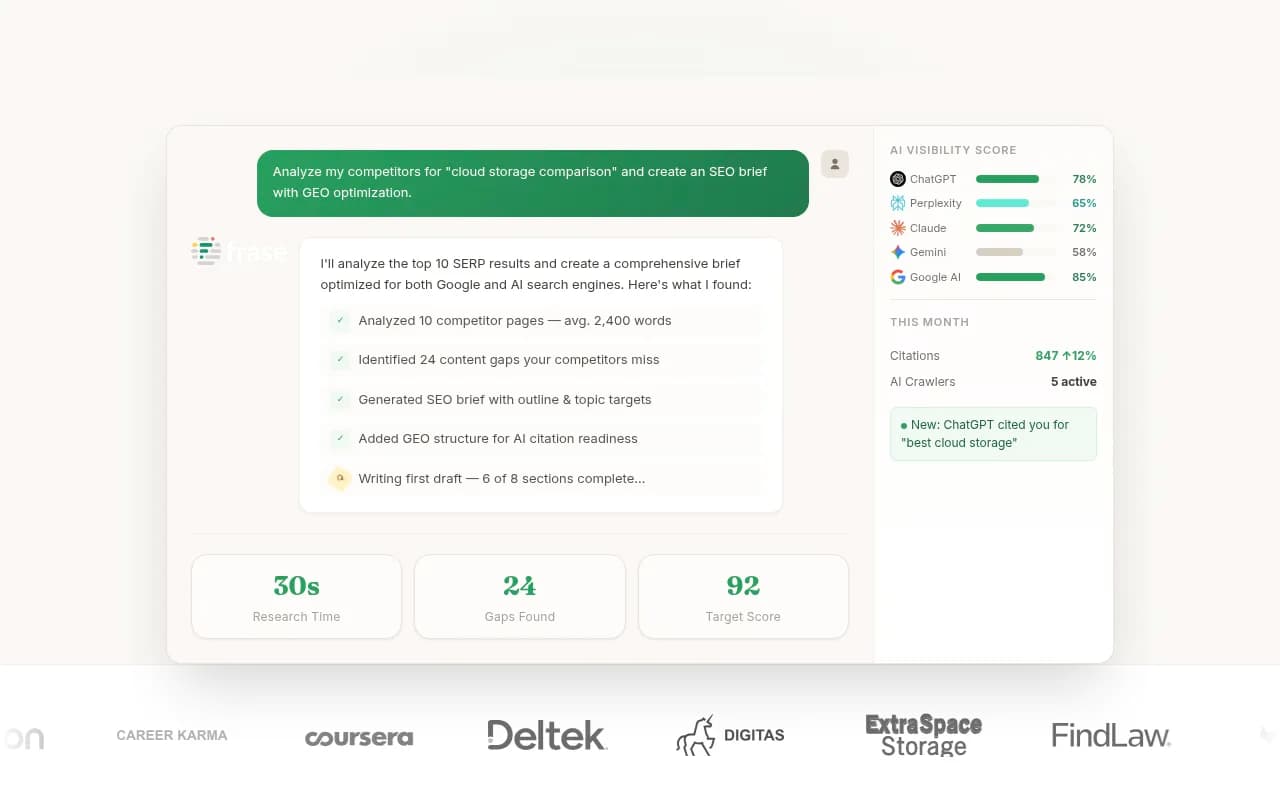
If you want to survey alternatives for each side, the GEO software directory at bestgeosoftware.com covers the AI visibility side, and surferstack.com covers content tools more broadly. Other editors worth a look include Frase, Clearscope and MarketMuse.

The honest verdict
If your only goal is ranking blog content in Google at the lowest price, NeuronWriter is hard to argue with, and Surfer is the more polished option if you can pay for it. Neither is a bad purchase.
But if the question on your desk is "why does ChatGPT recommend our competitor," a content score will not answer it. That needs prompt-level tracking, citation data and crawler visibility, which is the job Promptwatch was built for. Buy the editor for Google, buy the visibility platform for AI search, and stop expecting one to do the other's work.