Key takeaways
- Surfer SEO's Content Score had a 26% correlation with Google rankings vs Clearscope's 17.5% -- but neither tool was built with AI search citations in mind, which changes the calculus for 2025 and beyond.
- MarketMuse is the strongest choice for topical authority planning; Clearscope wins on interface simplicity and team collaboration; Surfer leads on volume, NLP depth, and price-to-feature ratio.
- None of these three tools directly tracks or optimizes for ChatGPT, Claude, or Perplexity citations -- that's a separate problem requiring a separate tool.
- If your goal is to appear in AI-generated answers (not just Google), content optimization is only half the job. You also need to understand which prompts AI models are answering, who they're citing, and why.
The question sounds simple: which content optimizer is best for ChatGPT rankings? But it immediately runs into a problem. Surfer SEO, MarketMuse, and Clearscope were all built to help you rank in Google. They analyze SERPs, score your content against top-ranking pages, and suggest semantic terms to add. That's genuinely useful work.
ChatGPT doesn't have rankings in the traditional sense. It has citations. And the factors that determine whether an AI model cites your content are meaningfully different from what gets you to position one on Google.
So this guide does two things. First, it gives you a real comparison of these three tools on their own terms -- what they're good at, where they fall short, and which team should use which. Second, it addresses the AI search question honestly: what these tools can and can't do for your visibility in ChatGPT, Perplexity, and similar platforms.
What these tools actually do
All three tools follow the same basic logic: crawl the top-ranking pages for a target keyword, extract patterns (common terms, content structure, word count, heading usage), and score your content against those patterns in real time. The idea is to remove guesswork. Instead of hoping you've covered the right topics, you get a data-driven checklist based on what's already working.
Where they diverge is in philosophy, depth, and who they're built for.
Surfer SEO
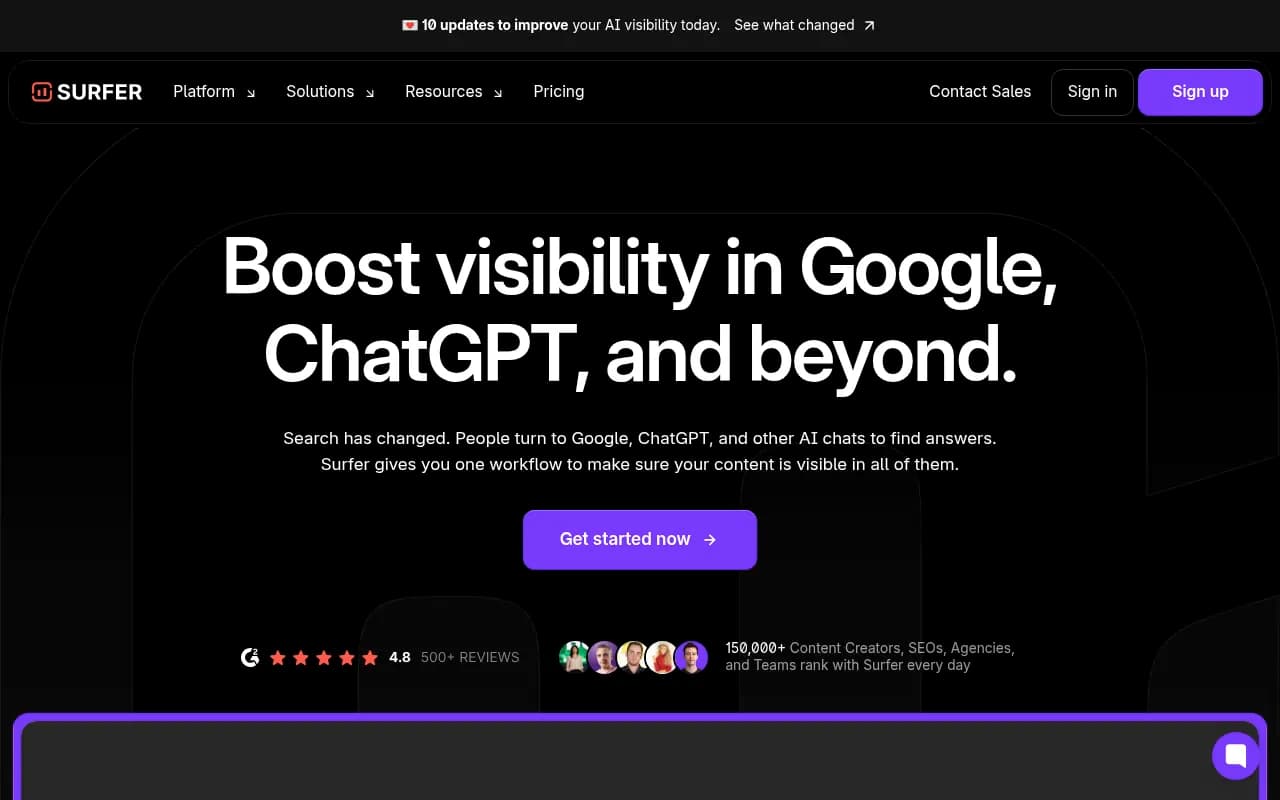
Surfer is the most widely used of the three, with over 150,000 users across agencies and in-house teams. Its Content Editor is the core product: you enter a keyword, it analyzes the top-ranking pages, and gives you a real-time content score based on NLP term usage, headings, word count, and images.
What sets Surfer apart is granularity. The NLP term suggestions are more detailed than either competitor, and the keyword clustering feature lets you group related terms for topical authority planning. There's also a content audit tool that analyzes existing pages and flags what to improve -- useful for teams with large archives.
Surfer AI can generate optimized drafts directly inside the editor. It integrates with Google Docs, WordPress, Jasper, and ChatGPT, which means it fits into most existing workflows without much friction.
Pricing starts at $79/month (annual billing). That's the most accessible entry point of the three.
The main criticism: Surfer's optimization can push writers toward keyword stuffing if they chase the score too aggressively. The score is a guide, not a guarantee -- and Surfer's own data shows a 26% correlation with rankings, which is meaningful but leaves a lot unexplained.
Clearscope
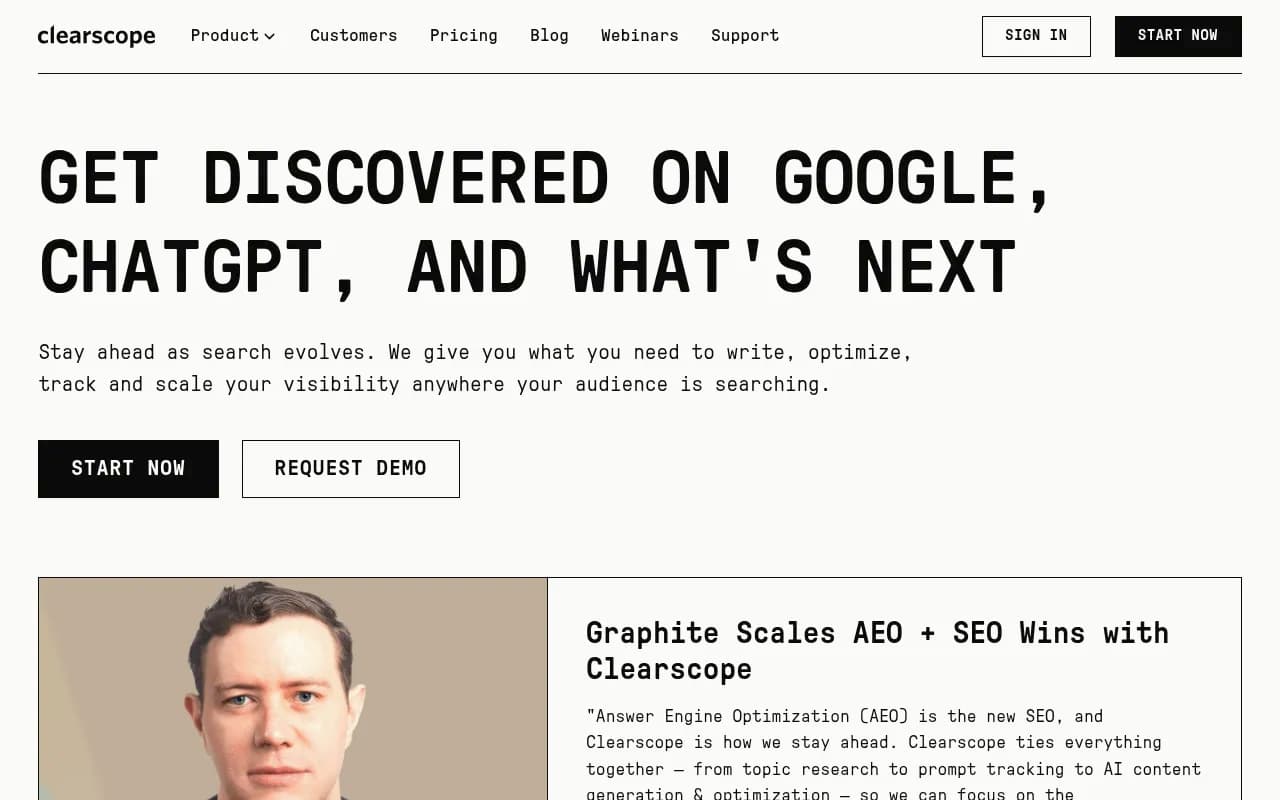
Clearscope is the premium option. At $129/month for the entry tier (some sources list $189/month depending on the plan), it's priced for teams that want simplicity and data quality over feature volume.
The interface is cleaner than Surfer's. You get a content grade (A+ through F), semantic term suggestions, and a word count recommendation. That's mostly it -- and for many teams, that's exactly enough. Clearscope doesn't try to do everything. It does content grading exceptionally well.
The Google Docs and WordPress integrations work reliably. The semantic term suggestions are based on solid NLP analysis, and the grading system is intuitive enough that writers can use it without much training.
Where Clearscope falls short: no content briefs, no topical authority mapping, no keyword clustering, no content audit tool. If you need strategic planning beyond the individual article level, you'll hit the ceiling quickly. The 17.5% correlation with rankings (vs Surfer's 26%) also suggests the scoring model is less predictive -- though that gap may matter less than the quality of the writing itself.
MarketMuse
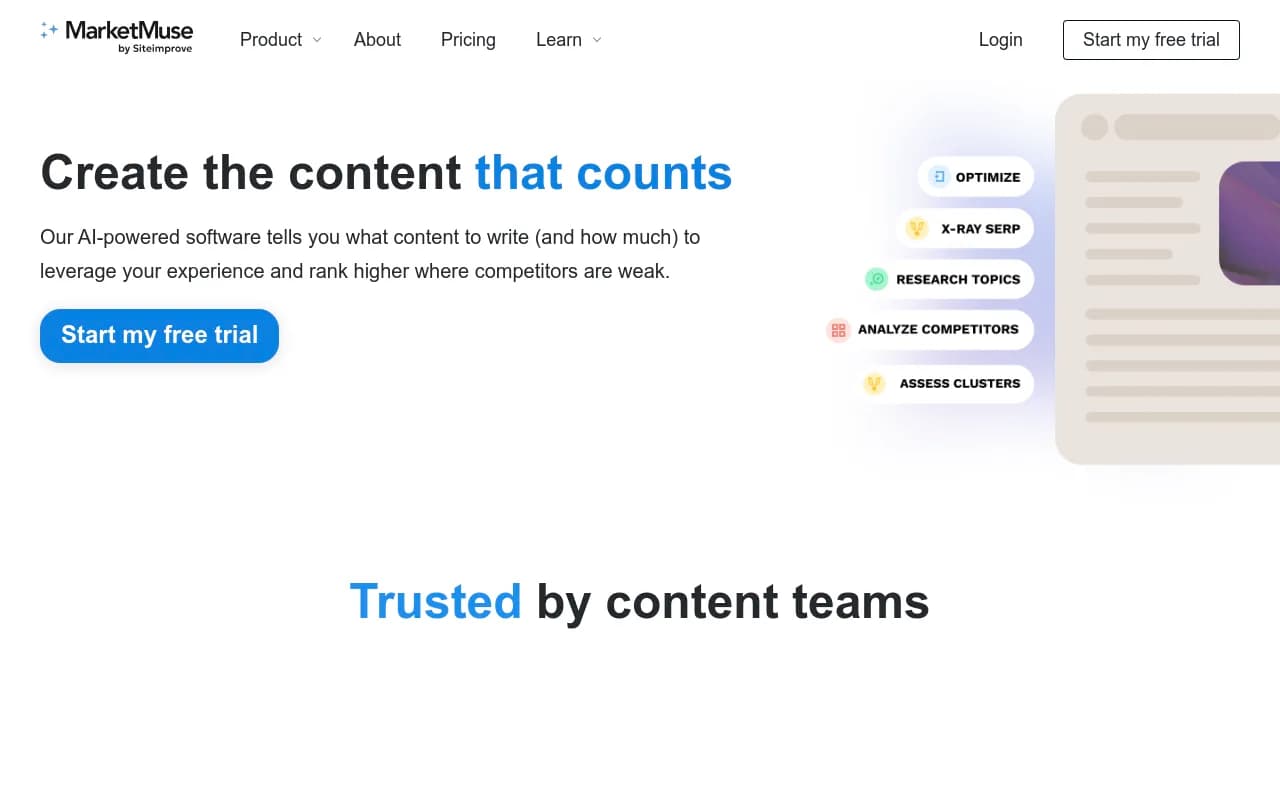
MarketMuse operates at a different level. Where Surfer and Clearscope focus on optimizing individual articles, MarketMuse is built for content strategy. Its proprietary topic modeling goes beyond keyword analysis to map the relationships between topics, identify content gaps across your entire site, and generate personalized difficulty scores based on your existing authority.
The "personalized difficulty" feature is genuinely useful. Instead of showing you generic keyword difficulty, MarketMuse shows you how hard a topic is for your specific domain -- accounting for what you've already published. That's a different and more actionable signal.
MarketMuse also generates content briefs and first drafts, and its content audit capabilities are strong. For teams building topical authority from scratch or managing large content programs, it's the most strategic of the three.
The trade-off is price and complexity. The free plan is limited. The paid tier starts at $149/month. And the interface has a steeper learning curve than either Surfer or Clearscope. For a solo writer or small team producing a handful of articles per month, it's probably overkill.
Feature comparison
| Feature | Surfer SEO | Clearscope | MarketMuse |
|---|---|---|---|
| Starting price | $79/mo (annual) | $129/mo | Free (limited); $149/mo paid |
| Content editor | Yes | Yes | Yes |
| NLP term suggestions | Advanced | Strong | Yes |
| Real-time content scoring | Yes | Yes | Yes |
| Content briefs | Yes | No | Yes |
| AI writing assistant | Yes (Surfer AI) | No | Yes (First Draft) |
| Topical authority mapping | No | No | Yes |
| Keyword clustering | Yes | No | Yes |
| Content audit | Yes | No | Yes |
| Personalized difficulty scores | No | No | Yes |
| Google Docs integration | Yes | Yes | No |
| WordPress plugin | Yes | Yes | No |
| SERP analysis | Yes | Yes | Limited |
| Best for | Scale + NLP depth | Simplicity + teams | Strategic planning |
Which tool should you use?
This depends almost entirely on what problem you're trying to solve.
If you're an agency or content team producing a high volume of articles and need granular NLP guidance at a reasonable price, Surfer is the obvious choice. The integrations are good, the feature set is broad, and $79/month goes further here than anywhere else.
If you're a mid-size team that prioritizes clean workflow and doesn't need strategic planning features, Clearscope is worth the premium. The interface is the best of the three, and the data quality is solid. It's particularly good for teams where multiple writers need to use the tool without much training.
If you're building a content program from the ground up, managing a large site, or trying to establish topical authority in a competitive niche, MarketMuse is the right investment. The personalized difficulty scores and topic modeling are features the other two simply don't have.
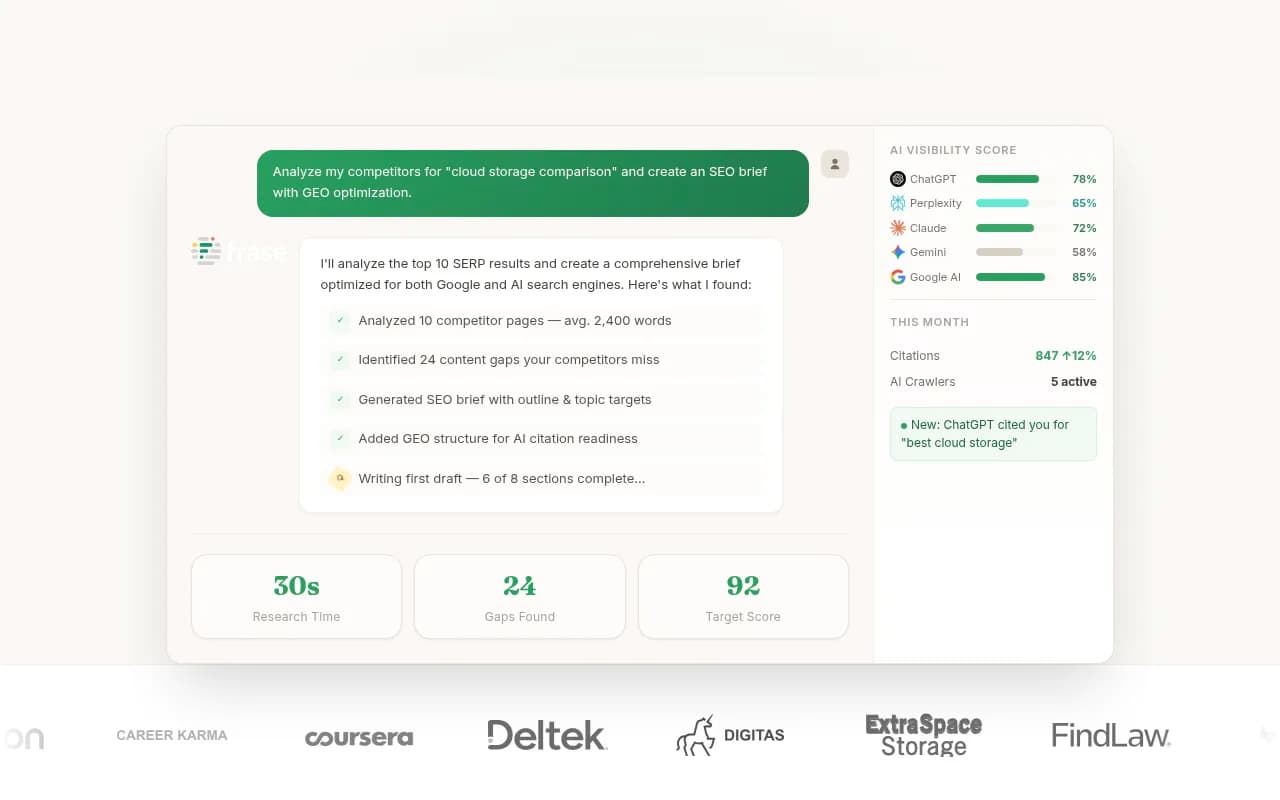
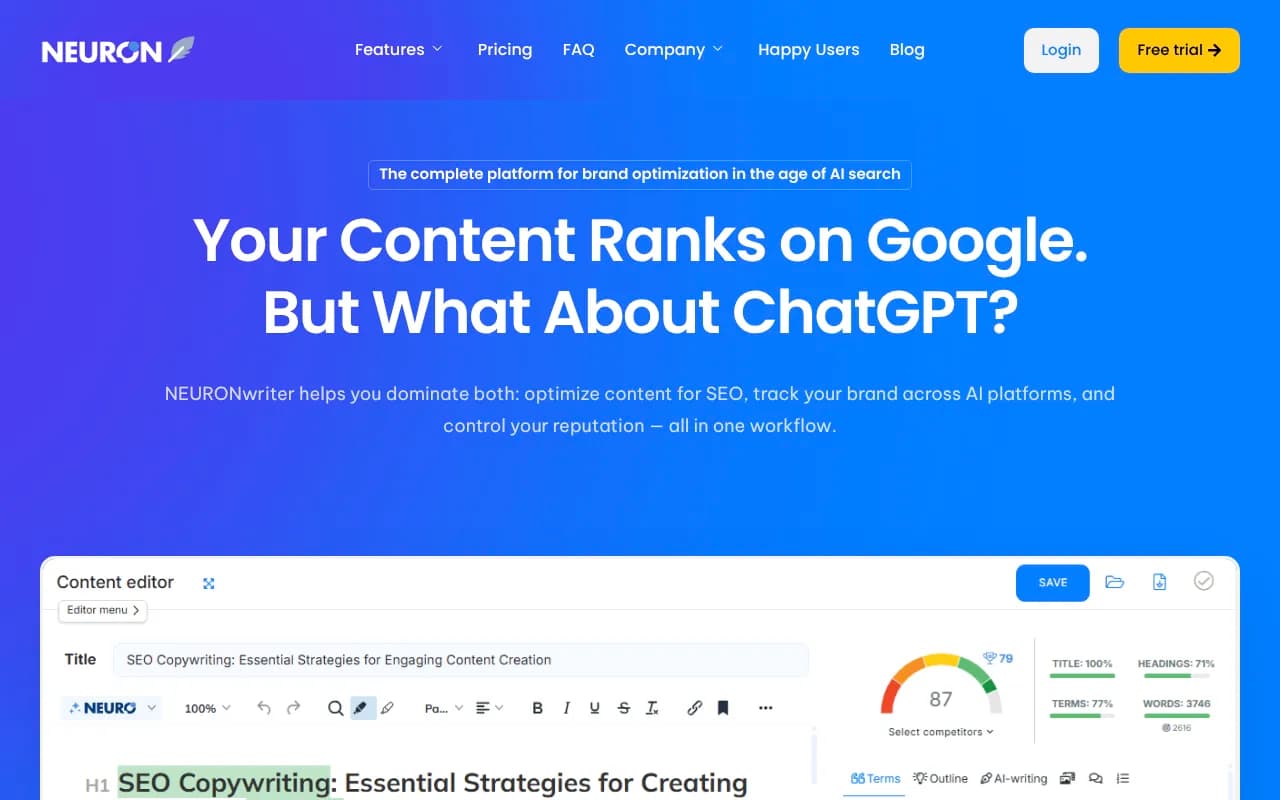
For budget-conscious teams that want something between Surfer's complexity and Clearscope's simplicity, tools like Frase and NeuronWriter are worth considering.
The AI search question
Here's where things get more complicated.
In 2025, a significant and growing share of search traffic is flowing through AI-generated answers -- ChatGPT, Perplexity, Google AI Overviews, Claude. These systems don't rank pages the way Google does. They generate answers and cite sources. Whether your content gets cited depends on factors like topical authority, content depth, how clearly your page answers specific questions, and whether AI crawlers can access and parse your content.
Surfer, Clearscope, and MarketMuse can help with some of these factors indirectly. Content that's well-structured, semantically rich, and covers a topic thoroughly is more likely to get cited than thin content. In that sense, using any of these tools is better than not using them.
But none of the three tools will tell you:
- Which prompts AI models are answering in your category
- Whether your brand is being cited in those answers
- Which competitors are getting cited instead of you
- What content you'd need to create to close that gap
That's a different problem, and it requires different tooling. Platforms built specifically for AI search visibility -- like Promptwatch -- track which prompts are driving AI citations, analyze competitor visibility across ChatGPT, Perplexity, Claude, and other models, and identify the specific content gaps you need to fill to start appearing in AI-generated answers.

The honest framing: Surfer, Clearscope, and MarketMuse are content quality tools. They help you write better, more comprehensive articles. That's valuable and it does indirectly support AI visibility. But if you want to actively optimize for AI search citations -- not just hope good content gets picked up -- you need to track what AI models are actually saying about your category and your brand.
How content optimization and AI visibility work together
The most effective approach in 2026 combines both layers.
Start with AI visibility data: understand which prompts your target audience is asking AI models, which sources those models are citing, and where your brand is absent. That tells you what to write. Then use a content optimization tool like Surfer or MarketMuse to write it well -- with the right semantic coverage, structure, and depth to get picked up by both Google and AI crawlers.
Writing without the AI visibility layer means you're optimizing content without knowing if it's the right content. Tracking AI visibility without optimizing content quality means you know the gaps but can't fill them effectively. The two approaches are complementary, not competing.

Other tools worth knowing
A few other content optimization tools came up repeatedly in our research and are worth a mention depending on your use case.
Scalenut has a "GEO Watchtower" feature that's explicitly designed for AI search visibility -- unusual for a content optimization tool and worth watching.

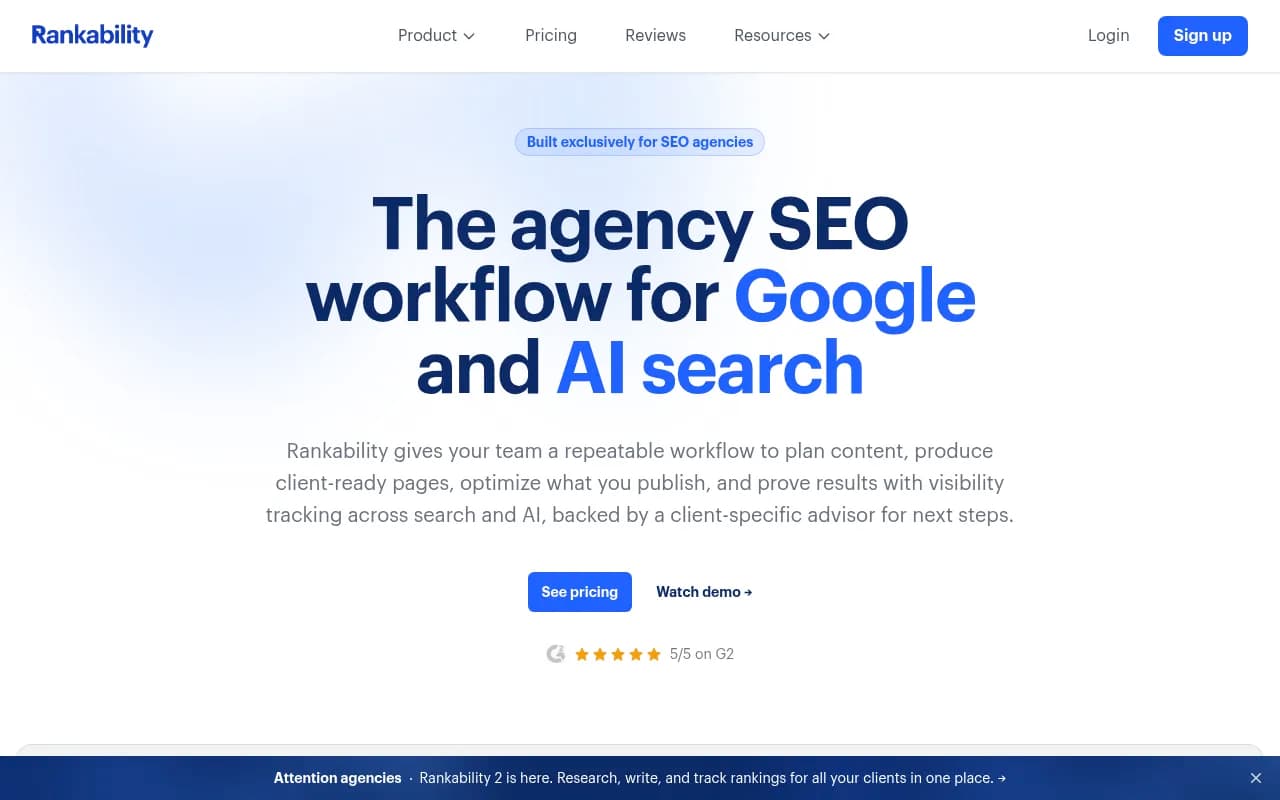
Rankability combines content optimization with competitor analysis and rank tracking in a single interface, which reduces the number of tools you need to manage.
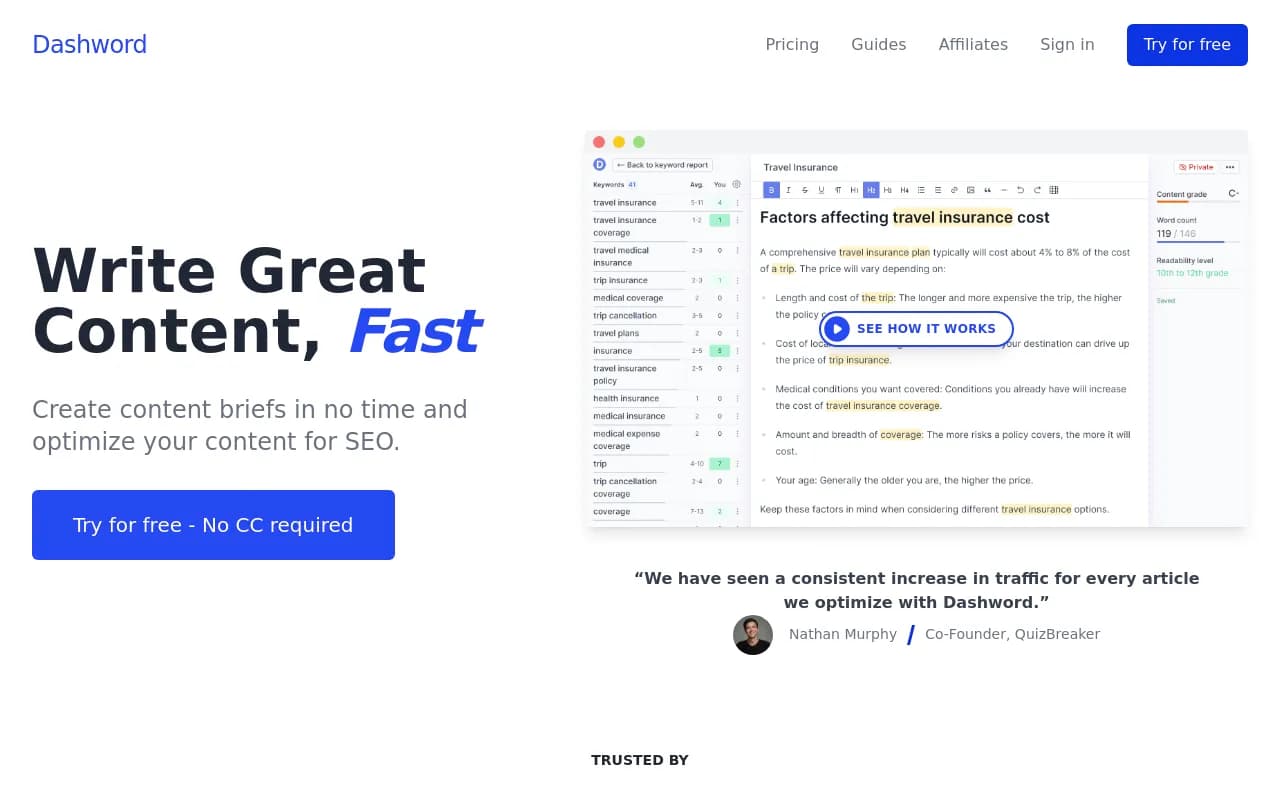
Dashword is a simpler, more affordable option for teams that just need content briefs and basic optimization without the full feature set of Surfer or MarketMuse.
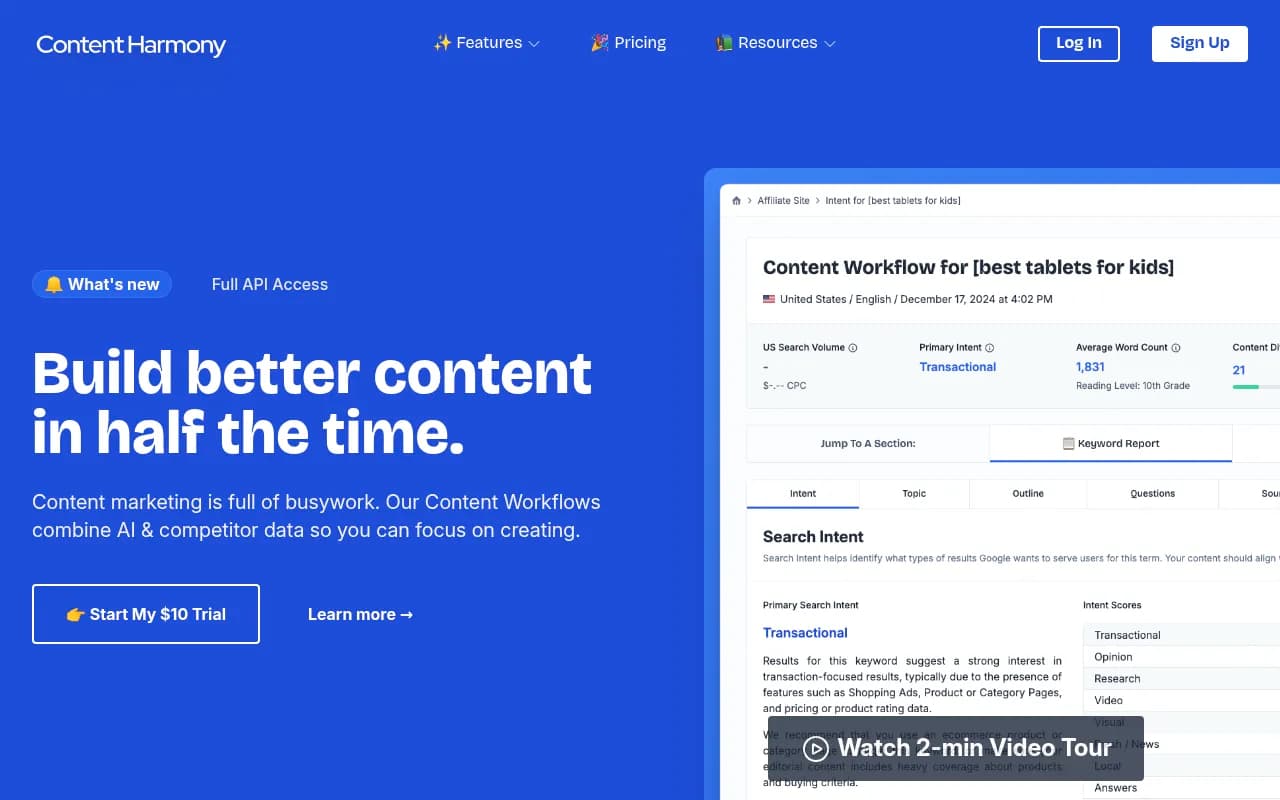
Content Harmony focuses specifically on content briefs and is particularly strong for teams that want to separate the research and briefing phase from the writing phase.
The bottom line
Surfer SEO is the best all-around choice for most teams: strong NLP analysis, reasonable pricing, broad integrations, and enough strategic features to grow into. Clearscope is the right pick if interface simplicity and team usability matter more than feature depth. MarketMuse is the right pick if you're thinking at the program level, not the article level.
None of them will tell you whether you're winning or losing in AI search. For that, you need to look at what AI models are actually citing -- and build a content strategy around closing those gaps, not just improving individual article scores.