Key takeaways
- No study I could find correlates Surfer, Frase or Clearscope scores with AI search citations. Any vendor claim that a score "predicts" citations is unsupported.
- The published correlation numbers for Google rankings (Surfer 26%, Clearscope 17.5%) come from Originality.ai, a company that sells a competing product. Frase's own comparison page concedes that no tool's score reliably predicts rankings.
- Promptwatch Data shows ChatGPT citations depend on content type, prompt intent and the sub-queries ChatGPT runs. A keyword-coverage score measures none of those.
- Pick the tool for your workflow: Surfer for SEO data depth, Clearscope for writer adoption, Frase for an all-in-one research-to-fix loop. Use a separate AI visibility tracker to find out what actually gets cited.
The question behind the question
Everyone wants a green number. You paste a draft into an editor, the score climbs from 54 to 82, and it feels like progress. The honest question in 2026 is whether that number tells you anything about getting cited by ChatGPT, Perplexity, Gemini or Google AI Overviews.
Short answer: nobody has shown that it does. I went looking for a study linking Surfer, Frase or Clearscope scores to AI citations and found none. That is not proof the scores are useless. It means the claim is untested, and you should treat it that way.
This guide covers what each score measures, what the (thin) evidence says, where the tools genuinely differ, and how to test your own content against AI citations instead of trusting a vendor number.
What these scores actually measure
All three tools use the same basic recipe. You enter a keyword, the tool looks at the pages currently ranking on Google, extracts the terms, topics, headings and length they share, and grades your draft on how closely it matches. That is a measure of similarity to the current SERP.
That design has a built-in limit for AI search. A score tells you your page resembles pages that already rank. It does not tell you whether an AI model will pick your page as a source, because that decision involves other things: the type of page, the intent of the prompt, and the searches the model runs behind the scenes.
Surfer SEO
Surfer SEO is the most data-heavy of the three. Its Content Score reflects term usage, structure and length against SERP competitors. In its June 2026 product roundup, Surfer announced a unified AI SEO Content Score: one number with SEO on one side and AI Search recommendations on the other, plus an Auto-Optimize button to fix both. Surfer's reasoning is that Google has described AI search as an evolution of SEO, so most of what ranks also gets cited.
That reasoning is plausible. It is also a claim, not a measurement, and the unified score is new enough that I would not trust it as a forecast.
Frase
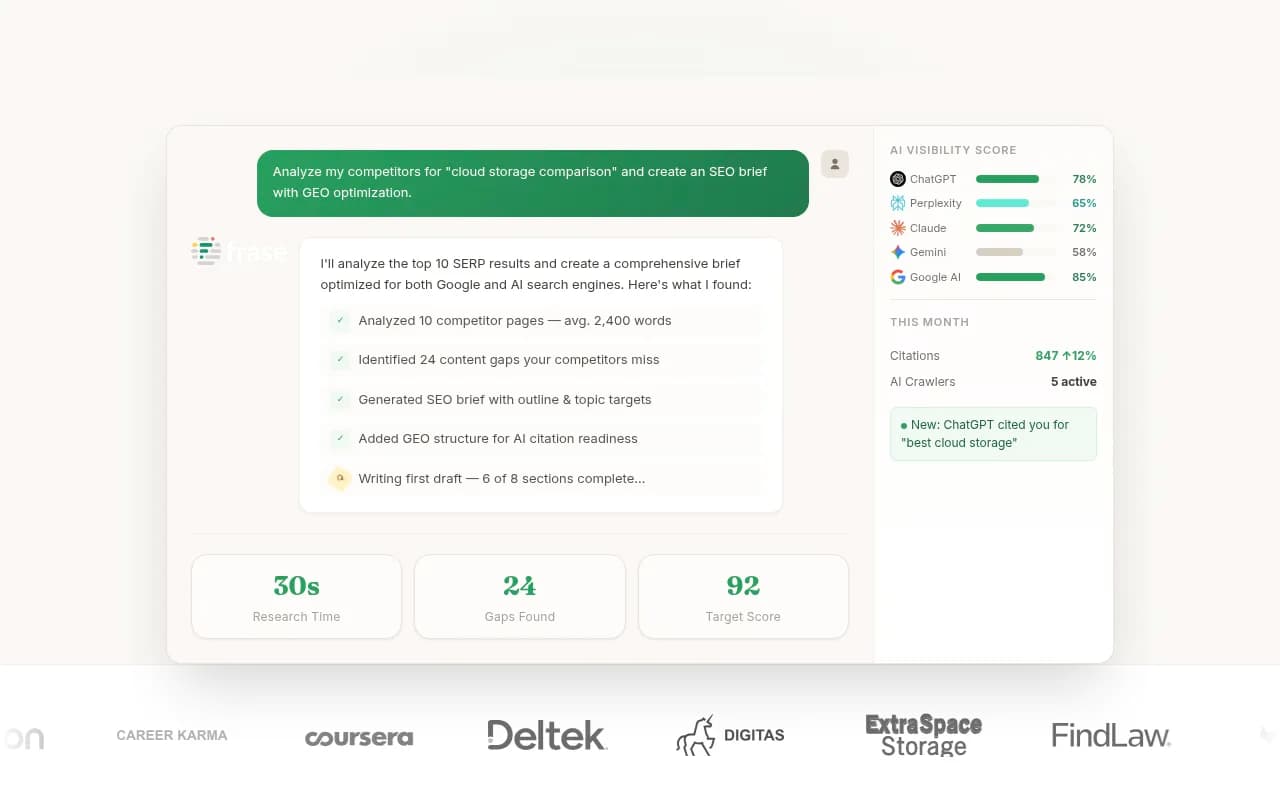
Frase pitches itself as the full loop: research, brief, write, optimize with dual SEO and GEO scoring, track AI citations, and draft fixes when pages decay. It tracks ChatGPT, Perplexity, Google AI Overviews, Gemini and Claude from its entry tier, according to its own comparison page.
What I like is the candor. Frase's page says independent testing has found that no content-optimization tool's score reliably predicts where a page ranks, its own included, and that the strongest claims otherwise come from vendor-run studies. That is a rare thing for a vendor to print. It is also a vendor page, so weigh the rest of it accordingly.
Clearscope
Clearscope is the simplest. It grades term coverage with a letter-style grade and is popular with editorial teams and freelance writers because the interface is easy to adopt. RankUp's May 2026 comparison, written by a competing tool's team, puts it this way: Surfer fits teams wanting more SEO data around planning, audits and AI visibility, while Clearscope fits teams wanting a cleaner writer workflow with simpler grading.
What the evidence says about scores and rankings
There is one number floating around. Surfer's blog cites an Originality.ai study that found Surfer's Content Score had a 26% correlation with rankings versus 17.5% for Clearscope. Surfer uses this to argue its score is more reliable.
Two cautions. First, I could not load the Originality.ai study itself, so I could not verify those figures. Second, Originality.ai sells a competing product and lists Surfer as a client, and Surfer is the one repeating the number. Treat it as vendor-adjacent.
Even taken at face value, a 26% correlation is weak. It says the score is somewhat related to ranking, not that it forecasts it. And that is for Google rankings, a different question from AI citations.
| Claim | Source | Independent? | Covers AI citations? |
|---|---|---|---|
| Surfer score correlates 26% with rankings | Originality.ai, repeated by Surfer | No, competitor and client relationship | No |
| Clearscope score correlates 17.5% with rankings | Same | No | No |
| No tool's score reliably predicts rankings | Frase comparison page | No, Frase is a vendor | No |
| Unified score covers SEO and AI Search | Surfer June 2026 roundup | No, product announcement | Claimed, not tested |
The table has no row with a yes in both of the last two columns. That is the gap.
What actually drives ChatGPT citations
While no score study exists, there is first-party citation data that shows what ChatGPT really picks. Promptwatch Data's report on content types (Sep 28 to Oct 4, 2026) classified ChatGPT citations by page type:
| Content type | Share of ChatGPT citations |
|---|---|
| Product pages | 22.4% |
| Landing pages | 16.8% |
| Listicles | 13.6% |
| How-to guides | 8.7% |
| Documentation | 7.5% |
| General articles | 6.1% |
| Comparisons | 5.9% |
| News | 5.7% |
| FAQ pages | 3.3% |
| Reviews | 1.7% |
Product and landing pages together take 39% of citations. A blog post stuffed with the right terms is competing in a category that gets a minority of the attention.
Intent matters too. For commercial prompts, product pages hit 26.0% and landing pages 20.6%, and four types (product, landing, listicle, comparison) make up almost 70% of citations. For informational prompts the mix shifts toward how-tos (10.7%) and docs (8.5%). For branded prompts, product and landing pages dominate, with reviews at 5.6%. The report's own conclusion is that each intent rewards a different content mix, and a single content score ignores that.
A content score computed against Google's top ten has no idea which of those buckets your page falls into, or which one the prompt wants.
Fan-outs change what "relevant" means
ChatGPT does not answer from your keyword. It runs its own searches first. Promptwatch's fan-out data shows average searches per response were about 2.15 in December 2025 and about 1.84 by early March 2026, with query length shrinking from roughly 117 characters to the high 80s. The practical advice from that report is to write headings that read like search queries with the entity and category up front, and to cover sub-questions (X vs Y, pricing, alternatives, how-tos) with focused pages instead of one mega-page.
That is close to the opposite of what a term-coverage score rewards, which is one comprehensive page that mentions everything the top results mention.
Other Promptwatch reports add more context. Content half-life data shows landing pages and docs stay cited longest while news loses half its pages within 36 days. Domain rank data shows mid-authority sites (DR 46-75) earned almost half of ChatGPT citations in August 2026. And almost half of ChatGPT responses cite 10 or more domains, so there is more room on the list than people assume. None of these are things a draft-time score can see.
Surfer vs Frase vs Clearscope: how they differ in practice
Since the score itself is not a reliable predictor, the useful comparison is workflow. Pricing changes often and I did not verify current plans, so check each vendor's pricing page.
| Surfer SEO | Frase | Clearscope | |
|---|---|---|---|
| Core idea | SERP-based scoring with deep SEO data | Research, write, optimize and fix in one platform | Simple term grading for writers |
| AI search score | Unified SEO plus AI Search score (June 2026) | Dual SEO and GEO scoring in editor | Term-coverage grade |
| AI visibility tracking | Yes, prompt tracking on higher tiers per Frase | Included from entry tier per Frase | Not a focus |
| AI writing | Surfer AI, credit-based article limits per Frase | Unlimited AI words, 70+ languages per Frase | Not a focus |
| Topical map | Yes | Research and briefs | No |
| Publishing to CMS | WordPress, Google Docs | WordPress, Webflow, Sanity, Wix and more | Google Docs, WordPress |
| Best for | SEO teams wanting control | Teams wanting one platform | Editorial teams with freelancers |
Some of the Frase and Surfer capability claims above come from Frase's own comparison page, so read them as Frase's framing.
When Surfer is the right pick
You have an SEO team that wants SERP analysis, content gaps, internal link suggestions, audits and a topical map in one place, and you are happy to treat the score as a drafting aid. The new AI Search side of the score is worth trying, as long as you measure results yourself.
When Frase is the right pick
You want research, briefs, writing, optimization and decay monitoring without stitching tools together, and you value having AI visibility tracking bundled in. The trade-off: Frase's own page notes it may not fit if your only job is scoring one article at a time.
When Clearscope is the right pick
You manage many freelance writers and want a grading interface that needs no SEO training. You give up breadth, but you get adoption.
How to test whether a score predicts citations for you
Don't take any vendor's word, mine included. You can run a small test in a month.
- Pick 20 to 30 pages in one topic area, ideally a mix of product, comparison and how-to content.
- Record each page's score in your tool of choice.
- Build a prompt set (30 to 50 prompts) that mirror how buyers ask about that topic, covering commercial, informational and branded intent.
- Track which of your pages ChatGPT, Perplexity, Gemini and AI Overviews cite for those prompts, over several weeks.
- Compare cited versus uncited pages. Check whether score, page type, domain, or query match explains the difference.
You will probably find page type and prompt fit explain more than score. If your results say otherwise, great, you have evidence nobody else has published.
For step four you need an AI visibility tracker. Tools like Promptwatch track real ChatGPT, AI Overviews, Perplexity and Gemini interfaces, show which pages get cited, and include crawler logs so you can see whether AI bots even reach the page.

If you want to compare alternatives first, the GEO software directory at bestgeosoftware.com lists the options.
A practical workflow that uses scores sensibly
I would use a content score for what it is good at, which is catching obvious omissions in a draft, and put the AI-citation effort elsewhere.
- Choose the page type first. If the prompt is commercial, you probably need a product page, landing page, comparison or listicle, not another explainer.
- Write headings that read like the searches ChatGPT runs. Put the entity and category first.
- Split sub-questions (pricing, alternatives, X vs Y) into focused pages instead of one giant page.
- Use the score as a final check for missing subtopics, then stop chasing it. Going from 80 to 95 is the part least likely to matter.
- Measure citations weekly and refresh pages that fade. Landing pages and docs hold up longest, news decays fast.
- Make sure AI crawlers can reach the content. A great page that GPTBot cannot read gets nothing.
Verdict
If you must choose one of the three:
- Surfer if you want the deepest SEO toolkit and are curious about its unified AI score.
- Frase if you want the most integrated loop and AI tracking in the same place.
- Clearscope if writer adoption is your bottleneck.
If the question is which score predicts AI search citations, the answer is none of them, as far as anyone has shown. Treat the number as a spellchecker for topic coverage, then judge your content by what AI engines cite. For more options, surferstack.com has reviews and comparisons of other content optimization tools.
Prices, features and AI tracking tiers change often, so confirm details on each vendor's site before you buy.