Key takeaways
- SSO in GEO platforms is almost always an Enterprise, quote-only feature. Google or Microsoft social login on cheaper plans is not SAML SSO.
- SCIM is the least documented control. In the research behind this guide, no GEO vendor published it on a self-serve plan, and I could not verify it for any vendor beyond their own claims.
- Audit log retention periods are essentially never published. Treat "audit logs" on a pricing page as a question, not an answer.
- SOC 2 claims vary in scope (Type I vs Type II, report available or not). Ask for the report.
- Check Promptwatch's pricing page and trust documentation directly for SSO, SCIM and audit log details before relying on any secondhand summary, including this one.
Why this matters more for GEO than you would think
A GEO platform looks like a marketing dashboard, so security reviews tend to be an afterthought. Then it spreads. Brand teams, regional teams and agencies all want seats, the data covers competitors and brand claims, and suddenly IT is asking who can see what and what happens when someone leaves.
That is where SSO, SCIM and audit logs come in. The checklist is the same one any B2B SaaS buyer faces. As WorkOS puts it, SSO centralizes access and makes offboarding instant, and audit logs give security teams an immutable record of logins, permission changes, exports and admin actions. Auditors want that evidence for SOC 2 and ISO 27001.
The problem is that GEO vendors package these controls inconsistently, and most do not document them publicly. This guide separates what is published from what is only implied.
What each control actually means
SSO
Single sign-on through SAML 2.0 or OIDC lets employees sign in with the company identity provider (Okta, Microsoft Entra ID, Google Workspace, Ping). The company's MFA and conditional-access rules apply, and disabling the corporate account cuts access.
What does not count: "Sign in with Google" or "Sign in with Microsoft." Scrunch Core and AthenaHQ Starter both offer social sign-in, and neither is SAML. The Basedash BI security reference used the same rule when it compiled its tables, and it is the right one.
What a usable setup includes, per WorkOS: just-in-time provisioning on first login, and SAML certificate rotation without downtime. A quietly expired certificate is an outage.
SCIM
SCIM lets the identity provider create, update and deactivate accounts automatically. SSO alone controls login. SCIM controls whether the account exists. Without it, someone has to remove departed users by hand, and they forget. For a GEO tool with unlimited seats or many agency users, this is where lingering access builds up.
Audit logs
An audit log records who did what, when, and from where. For a GEO platform that means changes to monitor configuration, prompt sets, exports, API key creation and role changes. The questions that matter are which events are covered, how long they are retained, and whether admins can export them or stream them to a SIEM.
What GEO vendors publish
The table below compiles what could be found on vendor pages and third-party roundups between roughly October and November 2026. Much of it is secondhand, and it is a snapshot, not a contract. Packaging changes often.
| Vendor | SSO | SCIM | Audit log | SOC 2 | Notes |
|---|---|---|---|---|---|
| AthenaHQ | SAML/OIDC, Enterprise | Not stated | Activity audit log, Enterprise | Type I (Oct 2025), Type II (Jun 2026) | Starter ($295/mo) uses Google or Microsoft sign-in only |
| Profound | SSO/SAML, Enterprise | Not found | Not found | Listed on Enterprise page, report not inspected | Residency, DPA and multi-brand terms "not publicly verified" per one roundup |
| Peec AI | SAML 2.0, Enterprise | Not stated | Not stated | "In progress" per Oct 2026 sources | One roundup says SAML or OAuth, so sources conflict |
| Scrunch | SAML/OIDC, Enterprise | Not stated | Mentioned on security page, plan not named | Type II completed, public trust center | Sitecore announced an acquisition in June 2026, so recheck terms |
| Semrush Enterprise | Listed | Not verified | Listed | Not verified | Do not assume it covers the base AI toolkit |
| Presenc AI | Claimed | Claimed | Claimed | Not stated | Vendor-authored claim, plus EU/US data residency and negotiated MSAs |
| Evertune | Enterprise | Not stated | Not stated | Not stated | |
| Goodie | SAML | Yes | Not stated | Type I and II | Reported by Rework's procurement roundup |
Three things stand out. SSO is nearly universal at the top tier and nearly always quote-only. SCIM is rare in public documentation. And a Qvery roundup of seven platforms found none that publicly named an audit-log plan together with a retention period. AthenaHQ names the plan, Scrunch mentions the logs, and that is about as far as it goes.
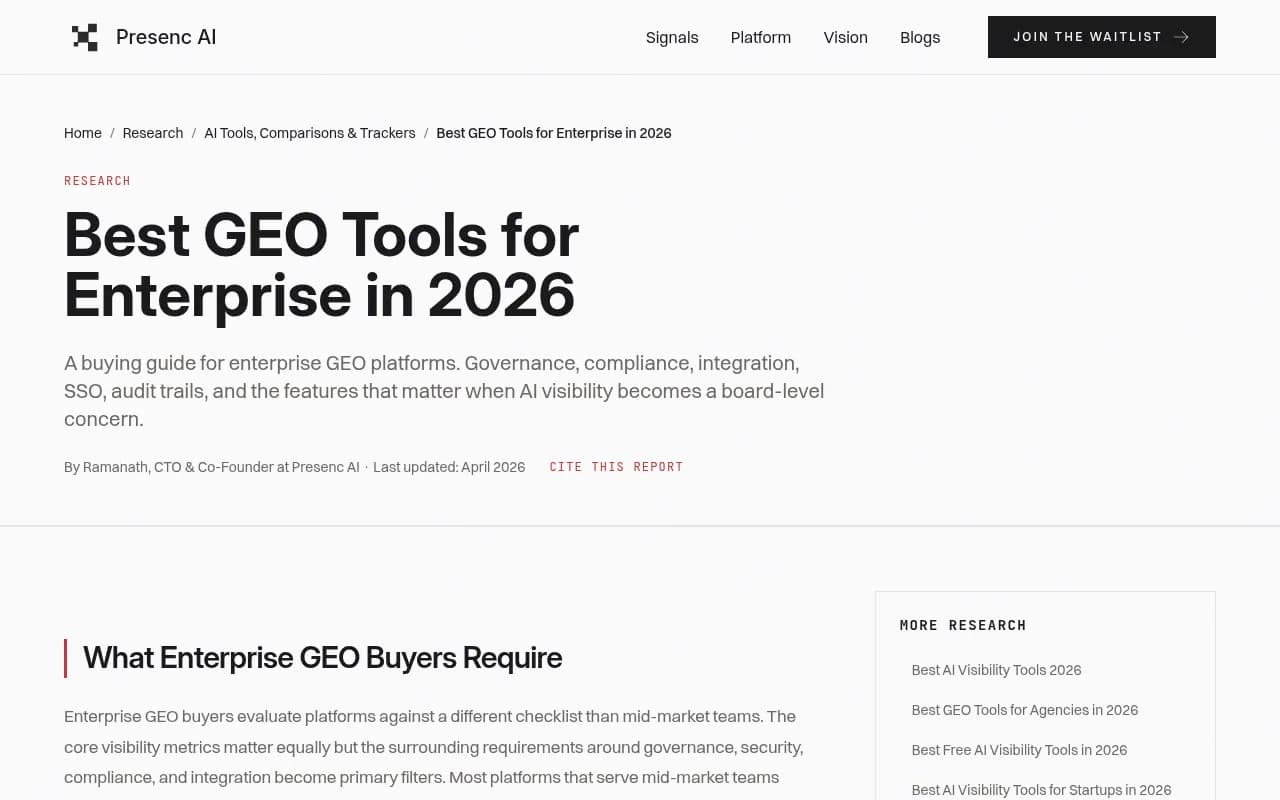
Presenc AI's buyer checklist is a reasonable starting list, even though it is a vendor-authored document. It asks for SAML SSO with SCIM, role-based access, audit logs of who queried what and what changed in monitoring configuration, data residency, and negotiated contracts.
Where Promptwatch fits
Promptwatch is ISO/IEC 27001 certified and GDPR compliant, with data handled by an EU-based company. Every plan includes unlimited team seats, owner, editor and viewer roles with project-level access, and scoped project, organization and read-only API keys. An organization audit log, which lists every change and whether it came from the dashboard, the API, an MCP client or Agent Chat, is included on Business, Agency Scale and Enterprise. SSO and a white-label dashboard and client portal are on Enterprise.

One caveat: my research notes did not surface a published statement on SCIM or on audit log retention for Promptwatch, so ask about both in your security review and confirm current plan gating at promptwatch.com/pricing. Pricing starts at $95/month (Essential), with Business at $579/month, and Enterprise is tailored. Agencies that need SSO or a white-label portal are pointed to Enterprise, since the agency tiers (Kick-off $199, Growth $399, Scale $799) do not include them.
The broader point for procurement is that the identity layer is only half of an enterprise review. ISO 27001 certification and EU data handling often matter as much as SAML, and Promptwatch is one of the few GEO platforms that leads with a certified information security management system rather than a Type I report in progress.
Other enterprise-oriented tools worth checking
If you are building a shortlist, these vendors position themselves for enterprise buyers and are worth putting through the same questions.


For a wider view of the category, the GEO software directory at bestgeosoftware.com lists more platforms to screen.
Plan tiers: what the pattern looks like
| Control | Typical self-serve plan | Typical Enterprise plan |
|---|---|---|
| Sign-in | Email, Google or Microsoft | SAML or OIDC with your IdP |
| SCIM | Not published | Sometimes, often "via support" |
| Roles | Basic (admin, viewer) | Granular RBAC, brand or region scoping |
| Audit log | Rarely mentioned | Listed, retention rarely stated |
| API access | Add-on or limited | Included |
| Compliance docs | Trust page | SOC 2 report, DPA, security questionnaire |
This mirrors the wider SaaS world. The Basedash reference on BI tools found that Hex, Preset, Lightdash and Basedash reserve SAML or OIDC SSO, SCIM and audit logs for Enterprise, while Sigma, Omni and ThoughtSpot support them but do not publish which tier. GEO is the same story with fewer public details.
Their advice transfers directly: treat "not published" as "ask in writing before you sign."
Pitfalls I would watch for
Social login sold as SSO
If the pricing page says "SSO" next to a plan that also includes five seats and Google sign-in, read the docs. It may be social login.
SOC 2 with no scope
Type I is a point-in-time design check. Type II covers an operating period. "Listed on the Enterprise page" is not the same as a report you can read. One roundup flagged exactly this for Profound: the claim exists, the report was not inspected. Ask for the report and its scope.
Audit logs that exist but cannot be exported
A log you can only see in a UI is weak evidence in an incident. Ask whether admins can export logins, role changes, API key events and configuration changes, and for how long they are retained. Sigma documents 30 days by default in the BI world, which shows how short defaults can be.
Acquisitions
Scrunch's announced acquisition by Sitecore in June 2026 is a reminder that security terms, sub-processors and data locations can change after the contract is signed. Ask for notification commitments.
Setup effort
SSO and data residency setup usually costs time on both sides. Budget for it, and ask who configures it, you or the vendor.
A two-week pilot that tests the real thing
Lightsite's pilot checklist is simple and worth copying:
- Week 1: configure SSO, create two roles and one restricted brand, then confirm a user cannot see data outside their brand.
- Week 2: audit the evidence. Export the audit log, review the SOC 2 report scope, and check the DPA and sub-processor list.
Add two tests of your own. Deprovision a test user in your IdP and see how fast access disappears. Then rotate the SAML certificate and see whether anyone gets locked out.
RFP questions to send
| Area | Ask | Red flag |
|---|---|---|
| SSO | Which protocols, on which plan, who configures it, is JIT supported? | SSO only on a contract you have not priced |
| SCIM | Which IdPs are tested, are groups and deprovisioning supported? | "Ask support" with no documentation |
| Audit logs | Which events, what retention, export or SIEM streaming? | No log, or no retention figure |
| Access control | Can roles be scoped per brand, region or client? | Only admin and user |
| Compliance | SOC 2 Type I or II, ISO 27001, report available under NDA? | Claim without a report |
| Data | Residency options, DPA, sub-processors, retention | Not stated |
| API | Are keys scoped, and are API actions in the audit log? | Single all-powerful key |
That last row matters more for GEO than for most categories. MCP servers and APIs mean AI agents can read and change your configuration, so the audit log should say whether an action came from a person, a script or an agent.
Which plan should you actually buy?
A small team monitoring one brand rarely needs SAML. Roles, unlimited seats and a clean offboarding habit will do. Once you have more than a handful of users, multiple brands, or agencies logging in on your behalf, SSO and an audit log stop being optional. SCIM becomes necessary when headcount churns or your security team requires automated deprovisioning.
If identity features are a hard requirement, shortlist only vendors who will put the plan, protocol and retention in writing. If you also want the platform to fix visibility gaps and not only report on them, check that the Enterprise tier includes the action side too, such as content and publishing workflows, not just a locked-down dashboard.
If you want an outside view on a shortlist, the team at 1001 SEO Media works with GEO platforms day to day and can help sanity-check vendor claims against what you need.
Bottom line
Public documentation on GEO security packaging is thin. SSO is easy to find at the Enterprise tier. SCIM and audit log retention are not. Do not accept a feature name on a pricing page as an answer. Get the plan, the protocol, the retention period and the audit report in writing, and run the two-week pilot before the contract, not after.