Key takeaways
- SpyFu, Semrush, and Ahrefs are strong traditional SEO tools, but their AI search visibility features are still maturing -- none of them were built for this problem from the ground up.
- Semrush's AI Search Health and Ahrefs' Brand Radar are the most developed AI monitoring features in this group, but both rely on fixed prompt sets and lack traffic attribution.
- SpyFu has the largest keyword database of the three (10M+ keywords for major domains vs. Ahrefs' 4.3M and Semrush's 6.76M), which matters for traditional competitor research but doesn't translate directly to AI search advantage.
- For teams that need to understand why they're invisible in AI search and actually fix it, these three tools hit a ceiling quickly -- purpose-built GEO platforms cover the gap.
- The right answer depends on what you're actually trying to do: traditional competitor research, AI monitoring, or full-cycle optimization.
There's a version of this comparison that's easy to write. You list the features, assign a winner per category, declare one tool "the best," and move on. But that version would be misleading in 2026, because the question itself has split into two different questions.
The first is the old one: which tool gives you the best picture of what your competitors are doing in Google search? SpyFu, Semrush, and Ahrefs have been fighting that battle for years.
The second is newer and messier: which tool tells you what's happening when people ask ChatGPT, Perplexity, or Gemini about your category -- and which competitors are showing up in those answers?
These three tools overlap on the first question. On the second, they're all playing catch-up.
What each tool was actually built to do
Before comparing AI features, it's worth being honest about what these tools are at their core.
Semrush is a broad digital marketing platform. It covers keyword research, site auditing, backlink analysis, paid search, social media, and more. It's the Swiss Army knife of the group -- not always the deepest on any one dimension, but the most complete.
Ahrefs built its reputation on backlink data and has expanded into a solid all-around SEO tool. Its keyword data is highly regarded for accuracy, and its content gap analysis is genuinely useful for competitive research.
SpyFu is the specialist. It's narrower in scope but goes deeper on competitor PPC and SEO intelligence. The pitch is simple: type in any domain, see every keyword they've ever ranked for, every ad they've run, and how their strategy has changed over time.
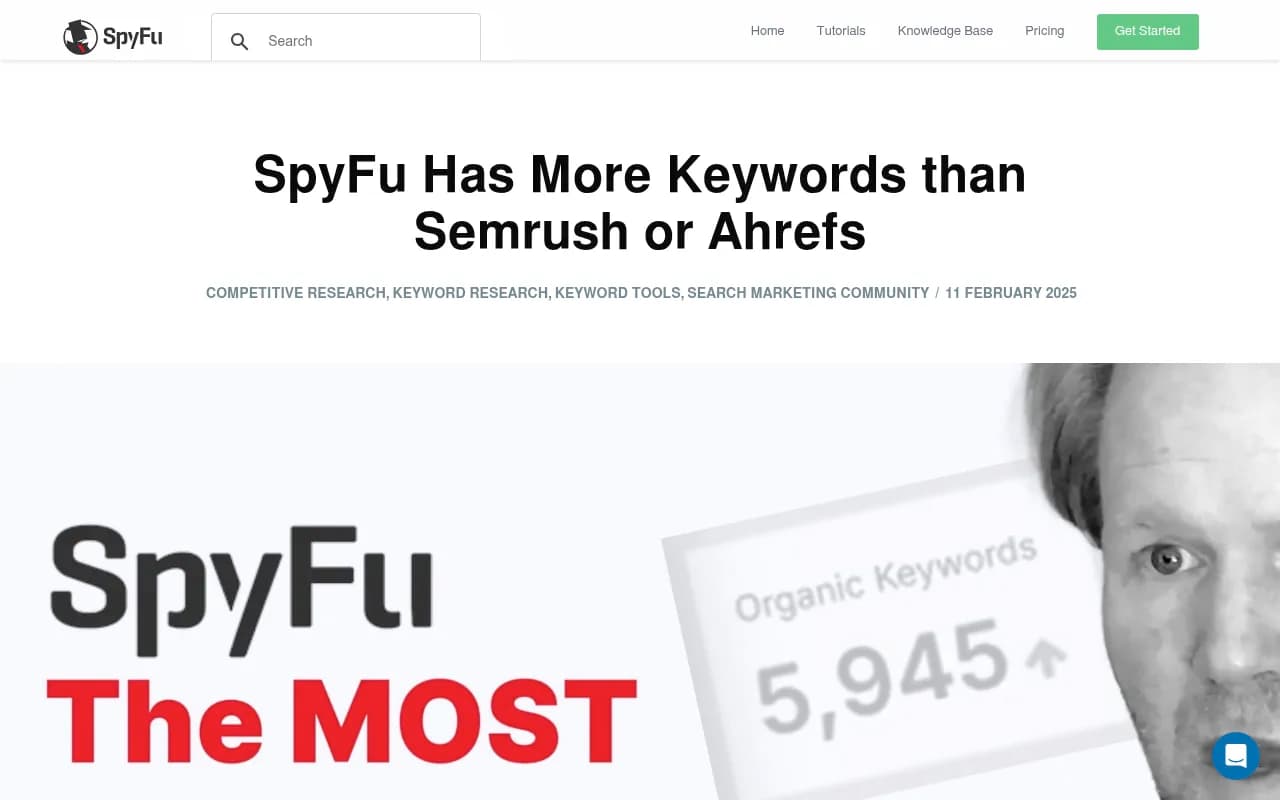
That specialization shows up in the data. SpyFu tracks 10 million keywords for a domain like Best Buy, compared to Ahrefs' 4.3 million and Semrush's 6.76 million. For mid-size sites, the gap is proportionally similar. If raw keyword coverage is your priority for traditional competitor research, SpyFu has a real edge here.
The AI search features: what's actually there
Semrush AI Search Health
Semrush added AI search monitoring through its AI Search Health feature. It tracks brand mentions and citations across AI engines including ChatGPT, Perplexity, and Google AI Overviews. The interface gives you a visibility score and lets you see how your brand appears in AI-generated responses.
The limitation is the prompt set. Semrush uses fixed prompts -- you can't define your own queries based on how your actual customers search. That matters because the prompts your customers use are rarely the generic ones a tool picks by default. You also don't get traffic attribution, so you can see that you're being cited but not whether those citations are driving any actual visits.
Ahrefs Brand Radar
Ahrefs' answer is Brand Radar, which monitors how your brand appears in AI search results. It covers a reasonable range of models and gives you a historical view of brand visibility over time.
The same constraint applies: fixed prompts. You're seeing your brand's performance against a predefined question set, not against the specific queries your target audience is actually typing into ChatGPT or Perplexity. And like Semrush, there's no connection between AI visibility and revenue.
One thing Ahrefs does well is keyword accuracy. A 2026 comparison from 1clickreport noted that "Ahrefs was the most accurate on volume" -- which is useful context when you're trying to prioritize which topics to go after.
SpyFu and AI search
SpyFu's AI angle is different. Rather than monitoring AI search results directly, it integrates with ChatGPT through what it calls SpyFu GPT -- the idea being that you use SpyFu's competitor data as the input for AI-powered strategy recommendations. It's more of a "use AI to analyze competitor data" play than a "track your brand in AI search" play.
That's a meaningful distinction. If you want to know what competitors are doing in Google, SpyFu's AI integration can help you turn that data into action. If you want to know whether you're appearing when someone asks Perplexity "what's the best [your category] tool," SpyFu doesn't really answer that question.
Feature comparison
| Feature | SpyFu | Semrush | Ahrefs |
|---|---|---|---|
| Keyword database size | Largest (10M+ for major domains) | Mid (6.76M) | Smaller (4.3M) |
| PPC competitor research | Best in class | Good | Limited |
| Backlink analysis | Basic | Strong | Best in class |
| AI search monitoring | No dedicated feature | AI Search Health (fixed prompts) | Brand Radar (fixed prompts) |
| Custom prompt tracking | No | No | No |
| AI traffic attribution | No | No | No |
| Crawler log analysis | No | No | No |
| Content gap for AI | No | Partial | Partial |
| Pricing (entry level) | ~$39/mo | ~$139/mo | ~$129/mo |
| Best for | Competitor PPC/SEO intel | Broad digital marketing | Backlinks + content gaps |
Where all three fall short for AI search
Here's the honest assessment: none of these tools were designed with AI search visibility as a core use case. They've added features to stay relevant, but there are real gaps.
The fixed prompt problem is the biggest one. When Semrush or Ahrefs monitors your AI visibility, they're checking a set of generic prompts. Your competitors might be dominating the specific long-tail questions your customers actually ask, and you'd never know from these tools.
There's also no answer gap analysis -- the ability to see which prompts your competitors are visible for that you're not. That's the most actionable piece of AI competitor research, and it's absent from all three.
Crawler log analysis is another gap. Knowing which pages AI crawlers are actually reading, how often they return, and whether your content is being indexed by AI engines is increasingly important. None of these tools surface that.
And the attribution problem: if AI search is sending you traffic, you want to know. If it's not, you want to know why. The connection between AI visibility and actual revenue is missing from all three platforms.
When these tools are still the right choice
None of this means SpyFu, Semrush, or Ahrefs are the wrong choice. It means they're the right choice for specific jobs.
If you're doing traditional competitor research -- figuring out which keywords a competitor is buying, what their ad copy looks like, where their backlinks come from -- these tools are excellent. SpyFu is particularly good for PPC intelligence. Ahrefs is the go-to for backlink analysis and content gap work in traditional search. Semrush covers the most ground if you need one platform for multiple marketing functions.
The Reddit consensus from digital marketers in 2026 roughly matches this: "For deep dives into content gaps, Ahrefs is solid, but SEMrush gives better insights on paid ads." SpyFu gets credit for its depth on competitor history and its lower price point.
If AI search visibility is a secondary concern and your primary need is traditional SEO competitor research, any of these tools will serve you well. The AI features are useful as a bonus, not as a primary reason to choose one over another.
What to use when AI search is the primary concern
If AI search visibility is actually what you're trying to solve -- understanding where you appear, where competitors appear, and what to do about it -- you need a tool built for that problem specifically.
Promptwatch is one of the few platforms that covers the full cycle: finding which prompts competitors rank for that you don't, generating content designed to close those gaps, and tracking whether that content actually starts getting cited. It monitors across 10 AI models including ChatGPT, Perplexity, Gemini, Claude, and Google AI Overviews, and it includes crawler log analysis so you can see how AI engines are actually interacting with your site.

The difference from Semrush and Ahrefs' AI features is that Promptwatch lets you define your own prompt sets based on how your customers actually search, rather than relying on fixed generic queries. That's a meaningful gap when you're trying to do real competitive analysis.
Other purpose-built options worth looking at:

These platforms vary in depth -- some focus on monitoring, others extend into content optimization -- but they're all designed around AI search as the primary use case rather than a bolt-on feature.
How to think about combining tools
The most practical setup for most teams in 2026 is a combination approach. Use SpyFu, Semrush, or Ahrefs for what they're genuinely good at -- traditional competitor research, keyword strategy, backlink analysis, content gap work in Google. Then layer in a dedicated AI visibility tool for the AI search piece.
This isn't inefficiency. The problems are genuinely different. Traditional SEO competitor research and AI search visibility monitoring require different data sources, different methodologies, and different outputs. Expecting one tool to do both well is asking a lot.
If budget forces a choice, the decision comes down to what's more important to your business right now. For most brands, Google search still drives more traffic than AI search -- but that balance is shifting, and the brands investing in AI visibility now are building an advantage that will compound.
The bottom line
SpyFu wins on keyword database size and PPC competitor intelligence. Ahrefs wins on backlink analysis and keyword accuracy. Semrush wins on breadth. All three have added AI search features, but those features are limited by fixed prompt sets and lack the attribution and optimization capabilities that make AI visibility work actionable.
For competitor AI search analysis specifically, these tools give you a starting point but not the full picture. The real picture -- which prompts your competitors own, why AI models cite them instead of you, and what content you need to create to change that -- requires a platform built for that problem from day one.
The good news is you don't have to choose between them. Use the traditional SEO tools for traditional SEO problems. Use a dedicated GEO platform for AI search. The teams winning in AI search right now are the ones treating it as a separate discipline, not an afterthought.