Key takeaways
- Relixir is a Y Combinator-backed GEO platform that combines AI visibility monitoring, automated content generation, and inbound attribution in one tool, priced from $199/month
- It tracks brand mentions across ChatGPT, Perplexity, Claude, Gemini, DeepSeek, and Google AI Overviews
- The content generation feature is a genuine differentiator over pure monitoring tools, but the platform is still relatively young with a smaller data footprint than established competitors
- At $199-$499+/month, it's mid-market pricing -- reasonable for what it offers, but the value depends heavily on how much you use the content side
- For teams that want a more mature platform with deeper data (1.1B+ citations), crawler logs, Reddit/YouTube tracking, and proven enterprise use, Promptwatch is worth comparing directly
What Relixir actually is
Relixir launched out of Y Combinator with a $2M seed round and a clear pitch: most GEO tools show you where you're invisible in AI search, then leave you to figure out what to do about it. Relixir wants to close that loop by combining monitoring, content creation, and revenue attribution into one platform.
The core idea is sound. If you're a marketing team trying to show up when someone asks ChatGPT "what's the best project management tool for remote teams," you need three things: to know you're not showing up, to create content that makes AI models want to cite you, and to prove that the effort is driving actual pipeline. Relixir tries to do all three.
Whether it succeeds depends on what you're comparing it to and what your team actually needs.
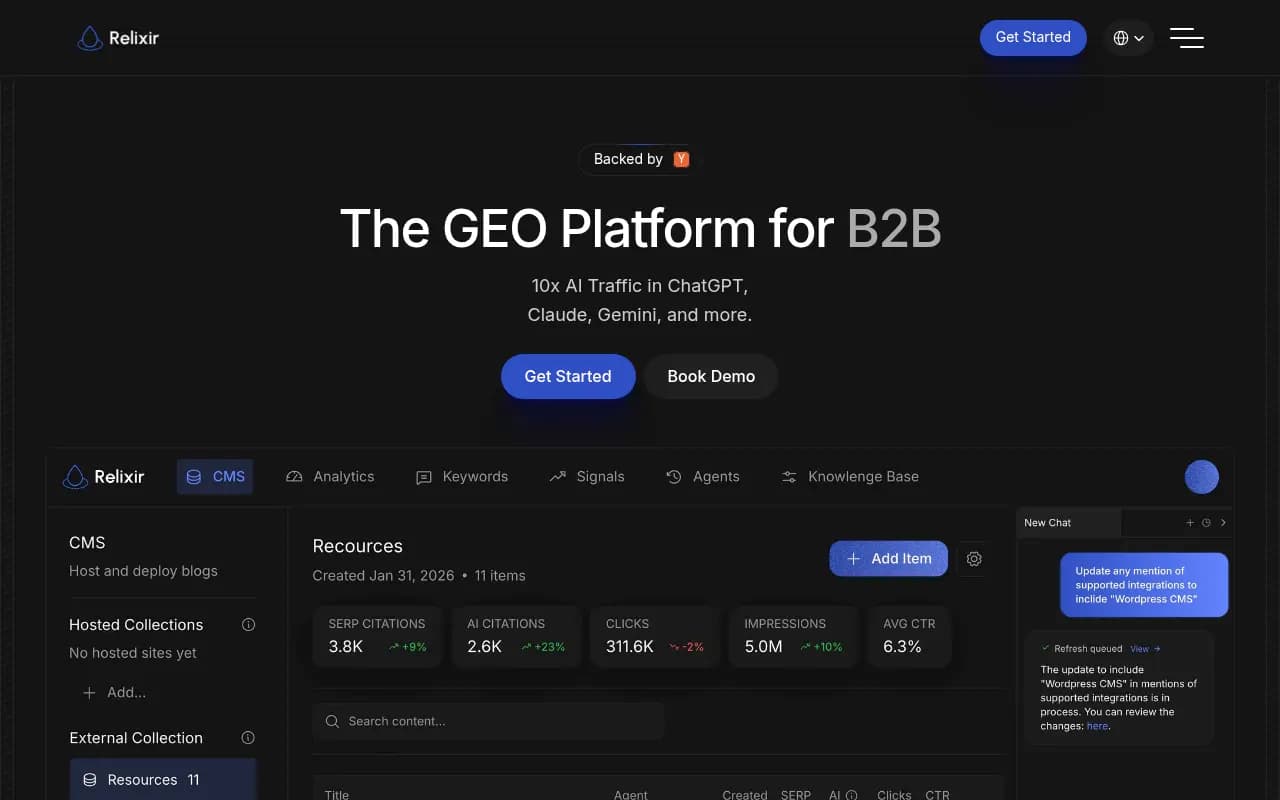
Core features
AI visibility monitoring
Relixir tracks your brand mentions across ChatGPT, Perplexity, Claude, Gemini, DeepSeek, and Google AI Overviews. You can set up prompts relevant to your category and see where competitors appear instead of you. The monitoring dashboard shows share of voice, mention frequency, and sentiment across models.
This is table stakes for any GEO platform in 2026, and Relixir does it competently. The prompt setup is reasonably intuitive, and the cross-model comparison is useful for understanding which AI engines are most important for your specific category.
Content generation
This is where Relixir tries to separate itself from pure monitoring tools. The platform generates content -- articles, comparisons, listicles -- designed to improve your AI citation rate. The idea is that instead of just telling you "you're not appearing for this prompt," it produces content you can publish to fix that.
The quality of AI-generated content is always a fair question. Relixir's approach is to ground the generation in the monitoring data -- what prompts are you missing, what are competitors being cited for, what angles are AI models responding to. That's a more structured approach than generic AI writing tools, but it still requires editorial review before publishing.
Inbound attribution
Relixir connects AI search visibility to actual pipeline. The attribution layer tracks when visitors arrive from AI search engines and ties that to conversions. This is genuinely useful because the "does AI search actually drive revenue" question is one most marketing teams are still trying to answer.
Pricing
Relixir's pricing sits in the $199-$499+/month range depending on the plan. There's no free tier listed publicly, though they offer demos.
| Plan | Price | Best for |
|---|---|---|
| Starter | ~$199/mo | Small teams, single brand |
| Growth | ~$349/mo | Growing teams, more prompts |
| Scale | $499+/mo | Agencies, multiple brands |
This is mid-market pricing. It's not cheap for a solo marketer, but it's reasonable for a marketing team that's serious about AI search visibility. The value equation depends heavily on how much you use the content generation -- if you're just using it for monitoring, there are cheaper options.
What the research shows
The third-party review data (from farmanrind.com, which appears to be a Relixir affiliate) claims 200+ companies are using the platform and cites customer results. The $2M Y Combinator raise is verified via LinkedIn. Beyond that, independent data on Relixir's customer base and citation database size is limited -- the platform is young.
This matters because in GEO, the quality of the underlying data is everything. A platform that has analyzed more prompts, more citations, and more AI responses will give you better signal on what content to create and which prompts to target.
How Relixir compares to the field
The GEO platform market in 2026 has a clear split: monitoring-only tools on one end, and platforms that try to help you act on the data on the other. Relixir is firmly in the second camp, which is the right place to be.
Here's how it stacks up against the main alternatives:
| Platform | Monitoring | Content generation | Attribution | Crawler logs | Reddit/YouTube tracking | Data scale |
|---|---|---|---|---|---|---|
| Relixir | Yes | Yes | Yes | No | No | Limited (newer) |
| Promptwatch | Yes | Yes | Yes | Yes | Yes | 1.1B+ citations |
| Otterly.AI | Yes | No | No | No | No | Moderate |
| Peec AI | Yes | No | No | No | No | Limited |
| AthenaHQ | Yes | No | No | No | No | Moderate |
| Profound | Yes | Partial | No | No | No | Strong |


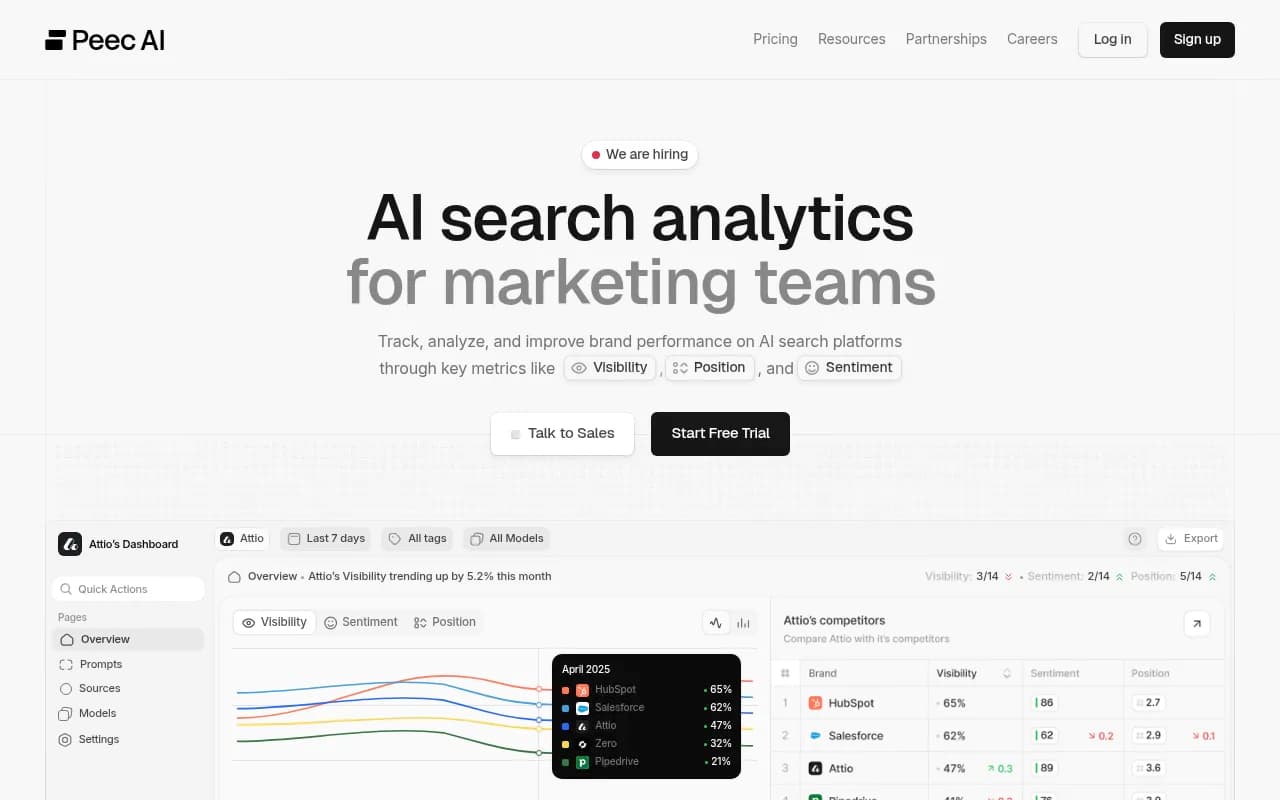

The comparison is instructive. Relixir is one of the few tools that genuinely attempts the full loop: find gaps, create content, measure results. Most competitors stop at monitoring. That's a real advantage.
Where Relixir falls short relative to more established platforms is depth. Promptwatch, for example, has processed over 1.1 billion citations and prompts, which gives its content recommendations and gap analysis a much larger data foundation. It also includes AI crawler logs (so you can see when ChatGPT or Perplexity is actually crawling your site), Reddit and YouTube citation tracking, and ChatGPT Shopping monitoring -- features that Relixir doesn't appear to offer.
For an agency or enterprise team that needs that level of depth, the data gap matters. For a mid-market SaaS company just getting started with GEO, Relixir's simpler interface and integrated content generation might be exactly what they need.
Who Relixir is actually built for
Relixir works best for:
- SaaS companies and B2B brands that are new to GEO and want a single tool that covers monitoring and content without stitching together multiple platforms
- Marketing teams of 2-10 people who don't have a dedicated SEO team and need content generation built in
- Companies that are primarily focused on ChatGPT, Perplexity, and Google AI Overviews (the most commercially relevant AI search engines for most B2B categories)
It's less suited for:
- Enterprise brands that need deep data, multi-region monitoring, and integration with existing analytics stacks
- Agencies managing 10+ clients who need robust multi-brand management and white-label reporting
- Teams that need to understand AI crawler behavior on their own site (crawler logs are absent)
The honest limitations
A few things worth knowing before you sign up:
The platform is young. Y Combinator backing is a signal of quality, but Relixir is still building out its data infrastructure. The citation database and prompt volume data won't match what you get from platforms that have been indexing AI responses for longer.
The content generation still needs human review. This isn't a knock specific to Relixir -- it's true of every AI writing tool. But if you're expecting to publish Relixir's output directly without editing, you'll likely be disappointed. The content is a starting point, not a finished product.
Attribution is still an emerging science. Connecting AI search mentions to revenue is genuinely hard, and every platform in this space is still figuring out the methodology. Relixir's attribution is a useful signal, but treat it as directional rather than precise.
No Reddit or YouTube tracking. These are increasingly important because AI models frequently cite Reddit discussions and YouTube content in their responses. If your competitors are getting cited because of Reddit threads, you won't see that in Relixir.
Relixir vs. Promptwatch: the direct comparison
If you're evaluating Relixir seriously, you should also look at Promptwatch. They're the two platforms in this space that most clearly try to be optimization tools rather than just dashboards.
The core difference comes down to data scale and feature depth. Promptwatch has processed 1.1 billion+ citations across 10 AI models (including Grok, Mistral, Meta AI, and Copilot -- models Relixir doesn't appear to cover). It includes AI crawler logs that show you exactly which pages ChatGPT and Perplexity are reading on your site, Reddit and YouTube citation tracking, ChatGPT Shopping monitoring, and query fan-outs that show how a single prompt branches into sub-queries.
Relixir's interface is arguably simpler and more accessible for teams new to GEO. Promptwatch is more powerful but has more to learn.
On pricing, Promptwatch's Essential plan starts at $99/month (1 site, 50 prompts, 5 articles) -- cheaper than Relixir's entry point. The Professional plan at $249/month adds crawler logs, state/city tracking, and 15 articles per month.
Neither platform is the obvious choice for everyone. If you want simplicity and are just getting started, Relixir is a reasonable bet. If you need depth, proven enterprise use (Booking.com, Center Parcs), and a larger data foundation, Promptwatch is the stronger option.
Other tools worth knowing about
If you're still building out your GEO stack, a few other tools are worth a look depending on your specific needs:
For monitoring without the content generation overhead:

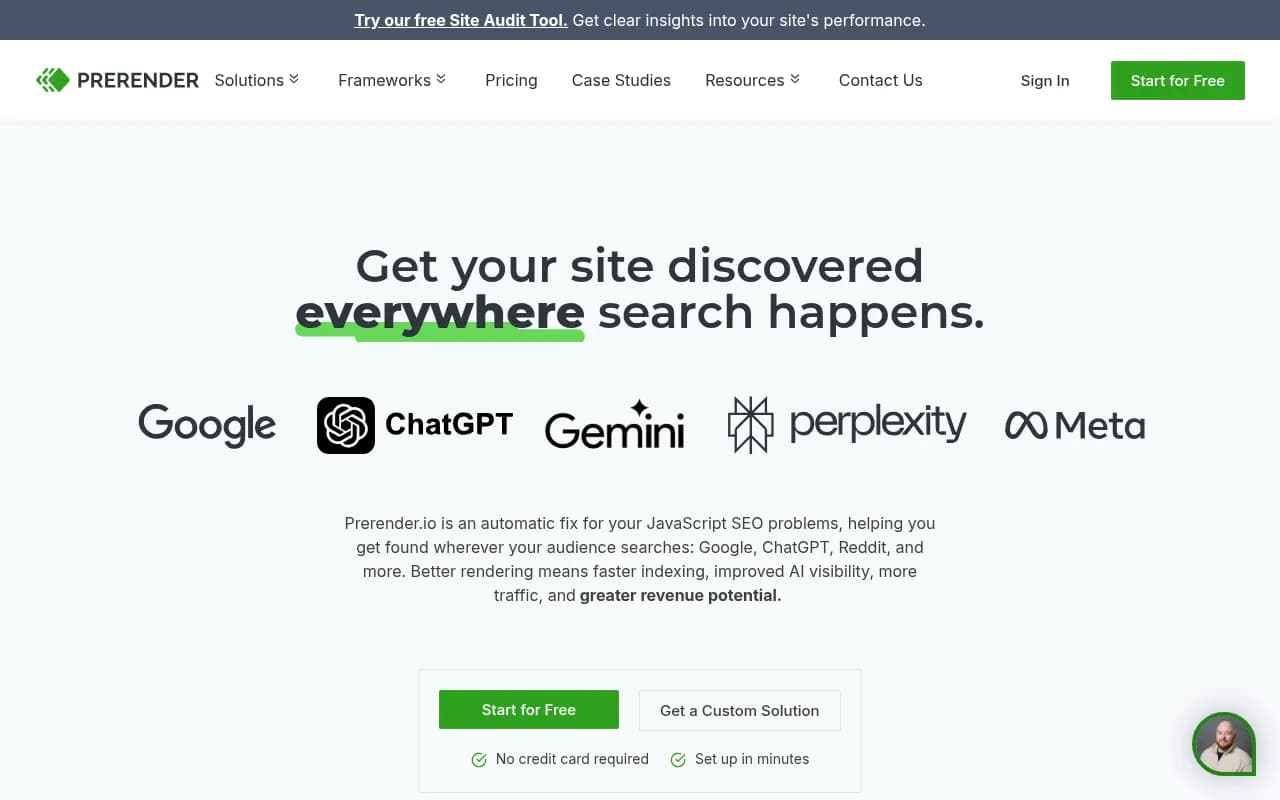
For content optimization that feeds into GEO:

For agencies that need multi-client management:
Search Party

The verdict
Relixir is a genuinely interesting product. It's one of the few GEO platforms that takes the "optimization" part seriously -- not just showing you where you're invisible, but helping you do something about it. The Y Combinator backing suggests there's a real team behind it, and the $2M raise gives them runway to build.
The honest question is whether you need what Relixir specifically offers, or whether a more mature platform with deeper data would serve you better.
If you're a mid-market SaaS company with a small marketing team, new to GEO, and you want one tool that covers monitoring and content generation without a steep learning curve, Relixir is worth trialing. The pricing is reasonable and the concept is right.
If you're an agency, an enterprise brand, or a team that needs to go deep on AI search data -- crawler behavior, Reddit citations, multi-model coverage, prompt volume scoring -- you'll likely outgrow Relixir quickly. In that case, compare it directly against Promptwatch before committing.
The GEO space is moving fast. The platforms that survive will be the ones that help teams take action, not just see data. Relixir understands that. Whether its data infrastructure can keep up with that ambition is the open question for 2026.