Key takeaways
- Prompt tracking is table stakes. Almost every platform sends prompts to AI assistants and counts brand mentions, so a dashboard alone should not command a premium.
- The real split is between tools that tell you whether you were mentioned and tools that tell you why, then help fix it and check whether the fix worked.
- Decide who does the work before you watch a demo. Team capacity matters more than any feature list.
- Ask about real-interface data collection, query fan-outs, crawler logs, AI traffic attribution and control groups. These separate serious platforms from thin ones.
- Convert every quote into answers per month. Vendors define a "prompt" differently, so sticker prices mislead.
Why this choice is harder than it looks
I've read a lot of vendor comparison pages this year, and they share a pattern. Every tool tracks mentions. Every tool has a visibility score. Every demo account looks great. Then three months later the team has a lovely chart and nothing has shipped.
That is the problem this checklist tries to solve. A prompt tracker answers one question: was my brand mentioned? An agentic GEO platform tries to answer a harder one: how do I grow revenue from AI search, and what should we do on Monday morning?
Neither is automatically right. A two-person team with no content capacity and a large enterprise with a full editorial desk need different things. The point is to match the tool to the bottleneck you actually have.
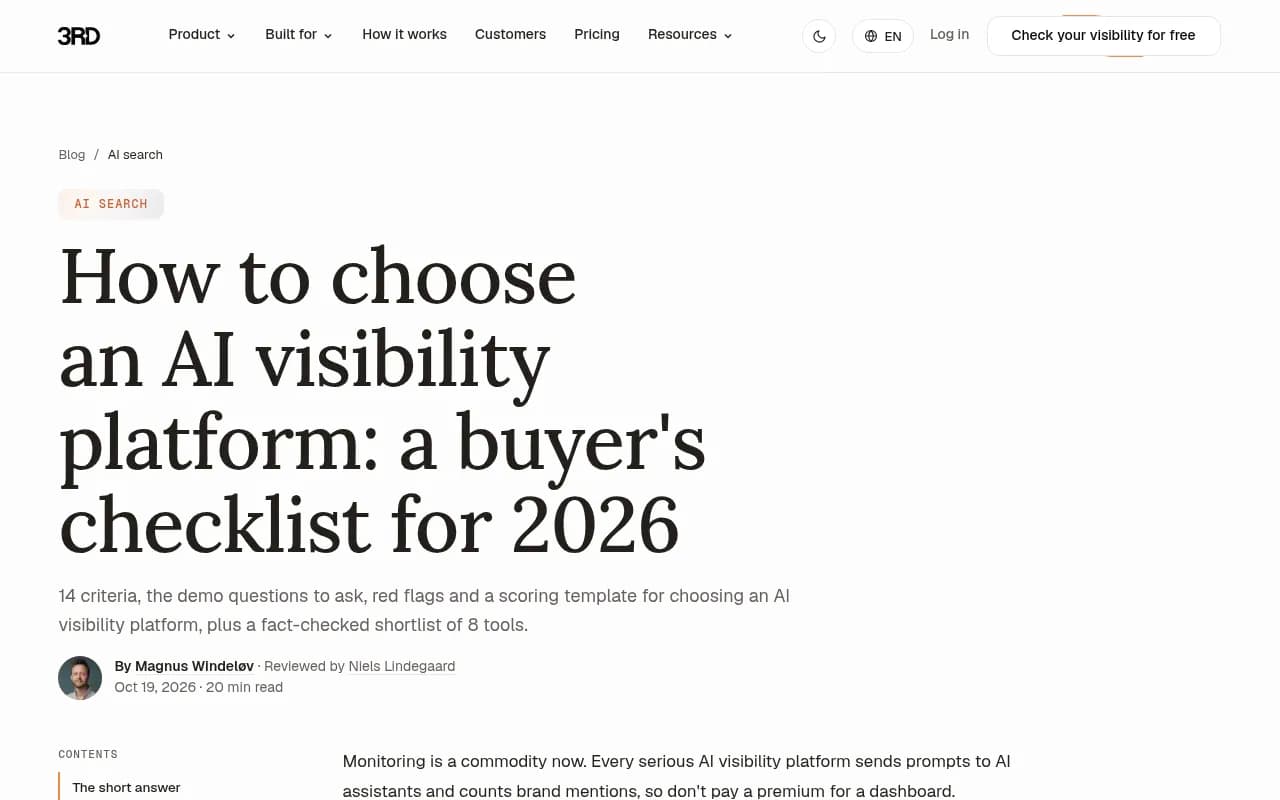
One caveat on the sources. Some of the buyer guides I drew on are written by vendors that sit on their own shortlists. The get3rd.com checklist, for example, is written by someone who works at 3RD, and says so. Treat vendor-reported numbers as claims, and verify pricing on each vendor's own page.
Prompt tracker or agentic GEO platform: what is the actual difference?
Prompt trackers
A prompt tracker runs a fixed set of questions against AI assistants on a schedule and reports whether your brand appeared, where, and next to which competitors. Good ones add sentiment, citation lists and share of voice. They are cheap to start and easy to explain to a boss.
Tools in this camp include Otterly.AI, which is known for a low entry price, and Peec AI, which is a clean, self-serve monitor.


Trackers are a fine choice when your team already has strong content and SEO people who can interpret the data and act on it themselves. They are a poor choice when the data lands in a dashboard nobody has time to act on.
Agentic GEO platforms
An agentic platform treats monitoring as step one. After that it explains why a competitor wins, builds a prioritized action list, drafts or publishes content, and measures whether the change moved the needle. The word "agentic" gets abused, so test it in the demo. Real agentic work means the platform plans, writes and ships against your visibility gaps, not that it shows you a to-do list of generic tips.
Promptwatch sits in this camp. Its Action Board prioritizes work, its Content Agent writes and can publish to Webflow, Framer or WordPress, and published pages are then tracked through crawls, citations and AI traffic.

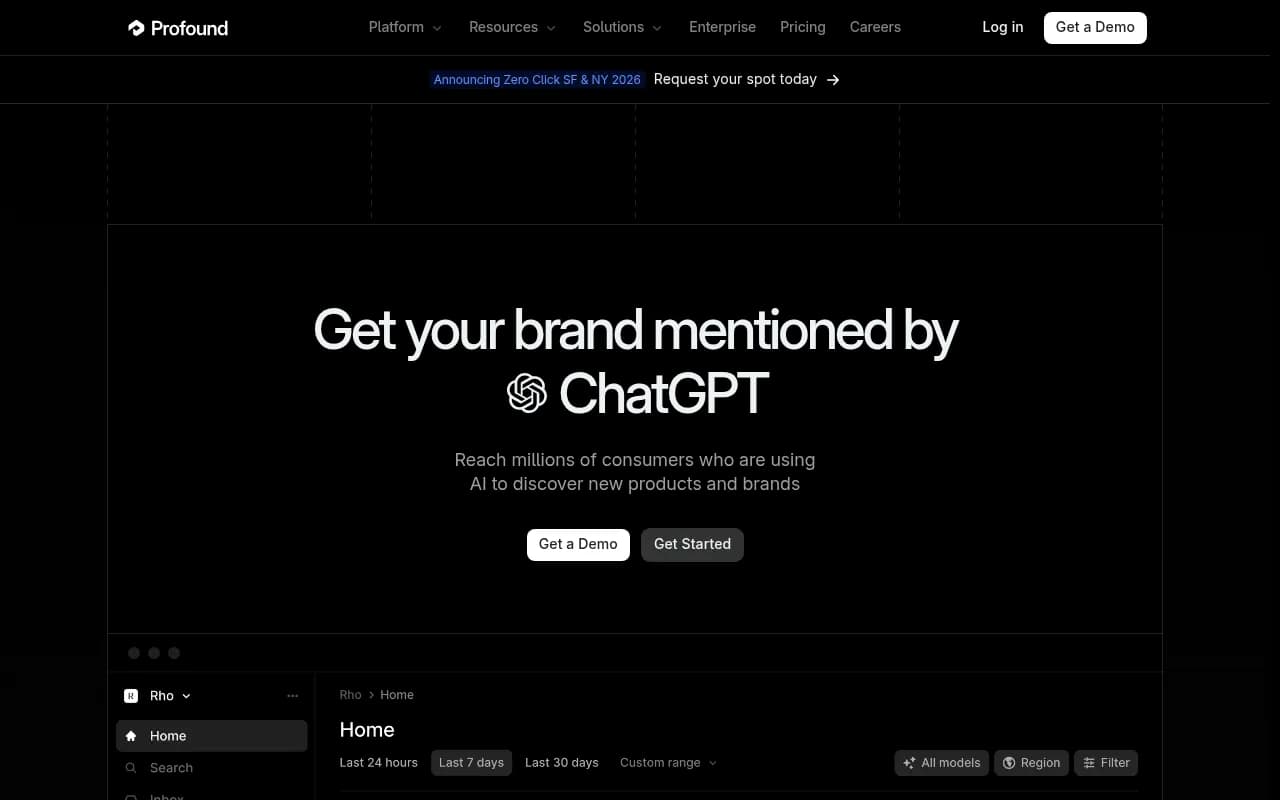
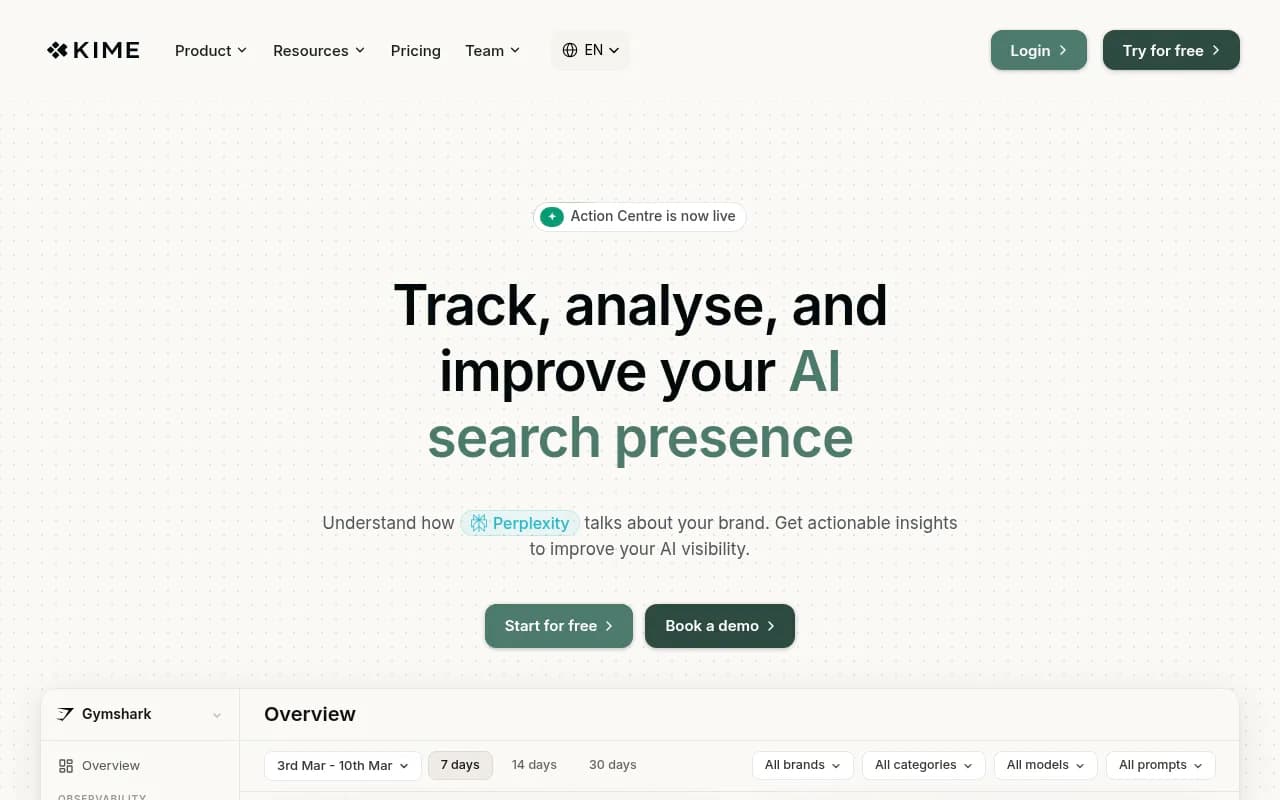
Other tools in the catalog lean this way too, including Profound, Scrunch, KIME and Gradial GEO. Their depth varies, so apply the same checklist to each.

Step zero: write down who will do the work
Before you open a single vendor tab, answer these:
- Which named people will act on findings, and how many hours a week do they have?
- Do you need every change approved by a human (regulated industries often do)?
- Is the bottleneck insight, or is it production capacity?
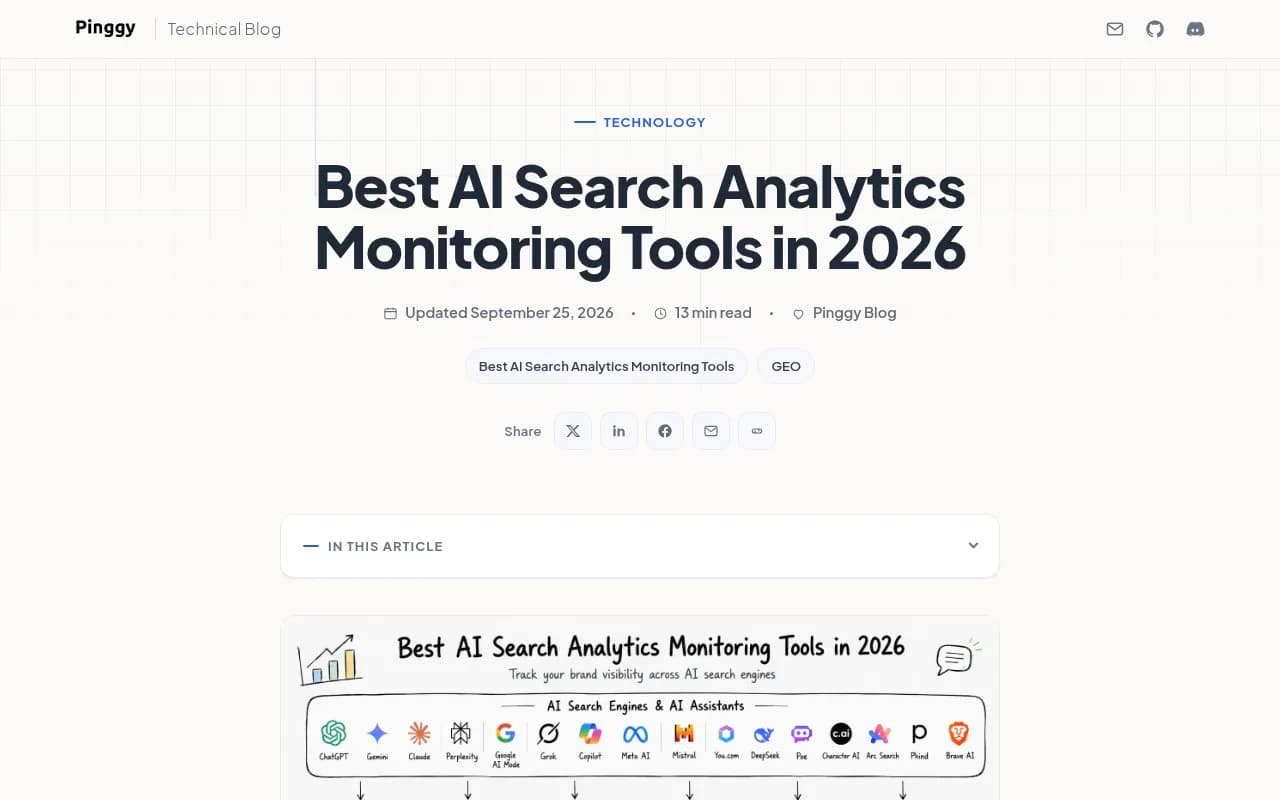
If the bottleneck is insight, a tracker with good diagnostics is enough. If it is production capacity, you need drafts, a publishing workflow and prioritization, which is where agentic platforms earn their price. The Pinggy buyer notes put it well: choose for the bottleneck you have now, not the stack you might want later.
The checklist: 12 criteria that separate the two camps
Data quality
- Real interfaces or APIs. What a user sees in ChatGPT or Google AI Overviews can differ from API output. Ask whether the vendor scrapes the actual user interface per country and language, and which models are covered.
- Query fan-outs. If a tool only records the typed prompt, it misses the web searches the model actually runs. Promptwatch's ChatGPT query fanout data found averages moving from about 2.15 fan-outs per response in December 2025 to 1.84 by early March 2026, with query length shrinking too. Ask any vendor whether they capture fan-outs.
- Platform-wide shifts. On August 8, 2026, ChatGPT started using the site: operator at scale. The share of fan-out queries containing site: jumped from about 0.37% to 16.8% overnight. A change like that hits every site at once. A good platform flags it so you don't credit (or blame) your own work.
- Models and markets. Results differ a lot between assistants. Track the ones your buyers use, in the countries they live in. If you serve local customers, check for city or coordinate-level targeting.
- Traceable answers. If the vendor only shows charts and you can't read the underlying responses, you can't verify anything.
Diagnosis
- Why you lose. Look for citation analytics, source lists, and the pages AI actually reads. Dashboards that stop at "you're mentioned 18% of the time" leave you guessing.
- AI crawler logs. IP-verified logs show whether GPTBot, ClaudeBot or PerplexityBot reach your pages and hit errors. Many trackers lack this entirely. It is the fastest way to find out if a visibility problem is actually a crawlability problem.
- AI traffic attribution. Mentions are not revenue. Check that the platform connects AI referrals to visits and conversions on your own site.
Action and proof
- From diagnosis to a plan. Generic tips ("add FAQ schema") are not a plan. A real plan names your competitors, your pages, the prompts involved and the expected impact.
- Who executes. Three tiers exist: monitoring only, drafting assistance, and autonomous execution with publishing. Pick the one your team can actually use.
- Measuring impact with a control. After you ship a change, can you see whether it worked? Single before-and-after readings are close to a coin flip. In 3RD's own aggregated data on 117 completed tasks compared against untouched control prompts, 29% moved up by more than 5 points, 26% moved down by more than 5, and 44% stayed within 5. That is vendor data, but the lesson holds: without a control group, you can't tell which result you got.
- Integrations. CMS publishing, Search Console and Bing data, Slack, API or MCP access. If it can't reach your stack, your team will copy and paste forever.
Comparison table: tracker vs agentic platform
| Question | Typical prompt tracker | Agentic GEO platform |
|---|---|---|
| Was my brand mentioned? | Yes | Yes |
| Why did a competitor win? | Partial (citation lists) | Citations, crawler logs, page-level data |
| Fan-out queries captured | Sometimes | Should be standard |
| AI crawler logs | Rare | Included in stronger platforms |
| AI traffic and conversions | Rare | Usually via a tracking script or plugin |
| Content creation | None | Drafts, refreshes, scheduled publishing |
| Prioritized to-do list | Generic tips at best | Tied to prompts, pages and impact |
| Proof the fix worked | Manual | Page tracking, before and after |
| Best for | Teams with strong in-house execution | Teams short on time or content capacity |
Red flags in demos
- One global score with no filters. The same brand can sit at 50% on one model and 30% on another. An average hides where you're losing.
- "Search volume" for prompts with no method. Nobody has true search volume for AI prompts. Any demand score is an estimate, so ask how it's built.
- Recommendations that would fit any company. If they don't name your pages, competitors and sources, they weren't written for you.
- Agentic claims with no output. Ask to see an actual article drafted, reviewed and published. A chat box over your dashboard is not an agent.
- No way to see raw answers. See criterion 5.
Questions to ask in every demo
- Do you collect data from the real user interface or an API, and for which models and countries?
- Do you capture the fan-out queries the model ran?
- Can I see IP-verified crawler logs for my own domain?
- How do you attribute AI-referred visits and conversions?
- Show me the plan generated for a brand like mine. Does it name my competitors and pages?
- After a page ships, how do you tell me whether it worked, and what do you compare it against?
- What happens when a model changes behavior overnight? How do I know it wasn't my work?
- How many answers per month are included, not "prompts"? What counts as one answer?
- Who approves content before it publishes, and can I run fully hands-off or fully reviewed?
Pricing: convert everything to answers per month
Vendors count prompts differently. Some count one prompt per model per country per day. Others count one prompt regardless. Convert each quote like this:
prompts x models x countries x runs per month = answers per month
A published example: Otterly lists Lite at $29/month for 15 prompts and Standard at $189/month for 100 prompts. Scrunch lists Brand Core at $250/month for 125 prompts across four models. Semrush's AI toolkit tracks 25 custom prompts. Those numbers come from vendor pages and review sites, so confirm them before you budget.
Promptwatch prices by responses, which makes the math easier: Essential is $95/month with 50 prompts and 6,000 responses, Professional is $245/month with 150 prompts and 18,000 responses, and Business is $579/month with 350 prompts, 42,000 responses, and the automated Content Agent. Agencies have separate plans starting at $199/month. Check promptwatch.com/pricing for the current figures.
| Platform | Entry price (vendor-reported) | Units | Notes |
|---|---|---|---|
| Otterly.AI | $29/mo | 15 prompts | Tracker with audits |
| Scrunch | $250/mo | 125 prompts | Four models on Brand Core |
| Semrush AI toolkit | Add-on | 25 prompts | Fits existing Semrush teams |
| Promptwatch | $95/mo | 6,000 responses | All models, crawler logs and MCP on every paid plan |
A scoring template you can copy
Score each vendor 0 to 3 on each line, then weight by what matters to you.
| Criterion | Weight (1-3) | Vendor A | Vendor B | Vendor C |
|---|---|---|---|---|
| Real-UI data, right models and markets | ||||
| Fan-out capture | ||||
| Crawler logs | ||||
| AI traffic attribution | ||||
| Prioritized, specific plan | ||||
| Content drafting and publishing | ||||
| Impact measurement with control | ||||
| Integrations and API | ||||
| Cost per 1,000 answers |
If you lack the people to execute, double the weight on content drafting, publishing and impact measurement. If you have a strong team, double the weight on data quality and diagnosis.
A two-week pilot that settles it
Demos prove very little. A short pilot does.
Days 1 to 3. Load 20 to 40 buyer questions for your top market. Fix the set. Changing prompts mid-pilot ruins comparisons.
Days 4 to 7. Pick three prompts where a competitor beats you. Ask each vendor to explain why. Compare the answers against what you can verify yourself in the raw responses and the crawler logs.
Days 8 to 12. Ship one fix per vendor-suggested action: a new page, a refreshed page, or a crawl fix. Leave similar prompts untouched as a control.
Days 13 to 14. Check the trend, not a single day's number. Expect days to weeks between publishing and a measurable shift, because models re-crawl on their own schedules.
The verdict is simple. If the platform got you from diagnosis to a shipped change with less effort than the others, it wins, whatever its dashboard looks like.
So which should you choose?
Pick a prompt tracker if you already have writers and SEOs with spare hours, you mostly need benchmarking and reporting, and budget is tight. Otterly.AI and Peec AI are reasonable starting points, and the directories at ai-rank-tools.com list many more.
Pick an agentic GEO platform if your bottleneck is turning insight into published, measured work, or you run many pages, markets or clients. Look hardest at platforms that combine crawler logs, traffic attribution, content generation and CMS publishing, since each gap you leave means a manual step for your team. The GEO software directory at bestgeosoftware.com is a handy place to compare options.
If you want an outside team to run the program rather than buy software, 1001 SEO Media does technical SEO, content and GEO work for brands that would rather hand it off.
One last piece of advice from the Pinggy guide that I'd repeat: pick one primary platform, fix your prompt set, and run a weekly execution cadence for eight weeks before you change tools. Consistency beats feature breadth, and the best platform is the one your team still opens in week nine.