Key takeaways
- Most enterprise AI visibility platforms are monitoring dashboards first, content tools second (or not at all). The gap between "seeing the problem" and "fixing it" is where most teams get stuck.
- Profound has strong monitoring intelligence and real-user prompt data, but content generation isn't its core strength, and pricing escalates fast as you add models.
- AirOps launched its Quill agent in May 2026 and is genuinely useful for content workflows, but it's built around content production, not AI search visibility tracking.
- Searchable is a niche player with limited feature coverage compared to full-stack platforms.
- Promptwatch is the only platform in this comparison that closes the full loop: find citation gaps, generate content designed to fill them, then track whether it worked.
Why "getting cited" is the actual goal
There's a version of this conversation that's purely about dashboards. Which tool has the cleanest UI? Which one tracks the most AI models? Which one sends the nicest weekly report?
That's not the conversation worth having in 2026.
ChatGPT crossed 1 billion weekly users. Perplexity grew 243% year-over-year. Google AI Overviews now appear on the majority of commercial queries. When someone asks an AI engine "what's the best enterprise project management tool" or "which accounting software do mid-market companies use," the brands that get cited in those answers win the consideration. The ones that don't exist in those responses are invisible to a growing share of buyers.
So the real question isn't "which platform has the best monitoring?" It's "which platform actually helps me get cited more often?"
That's a different question, and it rules out most tools immediately.
What each platform is actually built to do
Before comparing features, it helps to understand the design philosophy behind each tool. These four platforms are solving different problems, and conflating them leads to bad buying decisions.
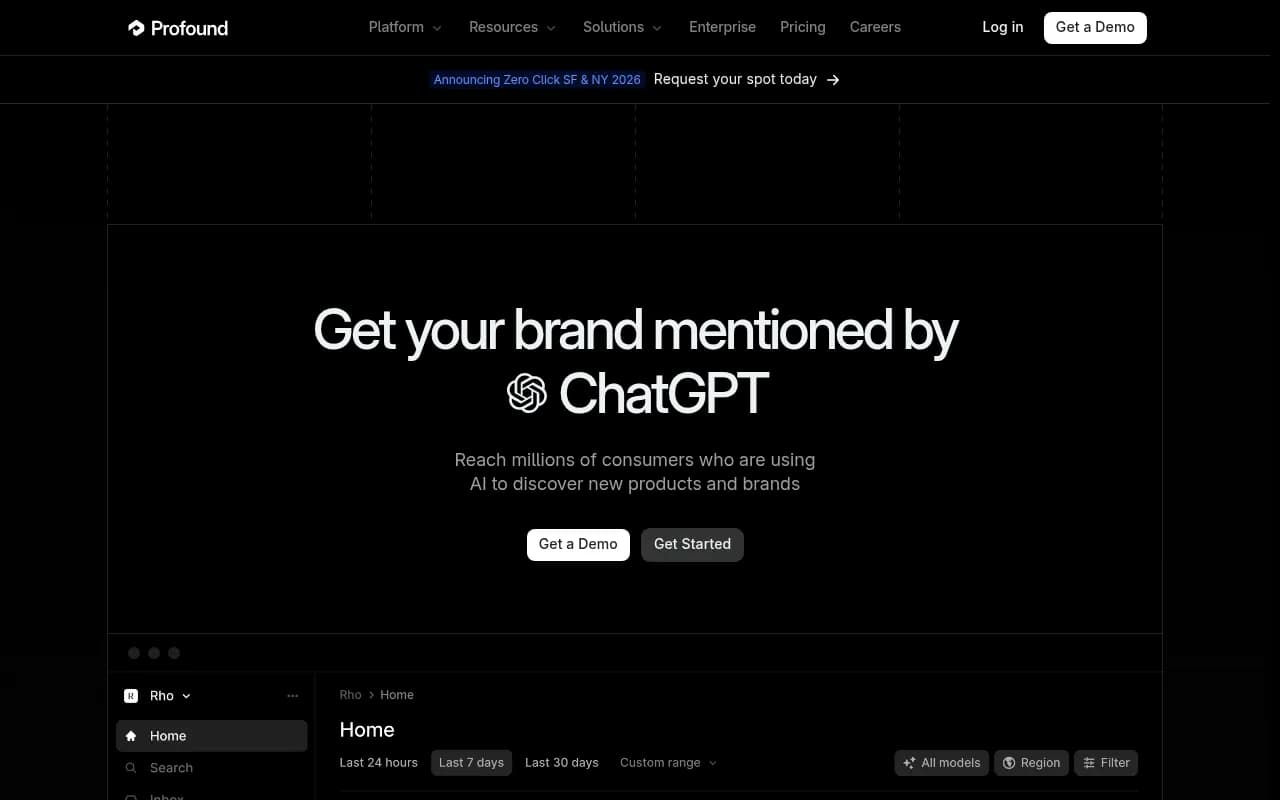
Profound: monitoring-first, with real-user data as its edge
Profound was one of the earliest serious players in AI visibility tracking. Its core advantage is data quality. Rather than fabricating synthetic prompts, Profound pulls from real user behavior to understand what people are actually asking AI engines. It also captures front-end responses (what users actually see in the UI) rather than just API outputs, which matters because AI answers can differ significantly between the two.
The monitoring intelligence is genuinely strong. Prompt volume data, front-end response capture, and an Amazon Rufus shopping module are features most competitors still haven't matched.
Where Profound struggles: the pricing model punishes breadth. The Starter plan at $99/month covers ChatGPT only. Adding Perplexity and Google AI Overviews jumps to $399/month. Claude, Gemini, Grok, and the rest? Enterprise pricing, undisclosed. You're also capped at 100 tracked prompts and 3 user seats at the Growth tier. For enterprise teams that need multi-model coverage across a large prompt set, the cost compounds quickly.
Content generation isn't Profound's focus. It tells you where you're invisible; it doesn't help you fix it.
AirOps: content workflows, not visibility tracking
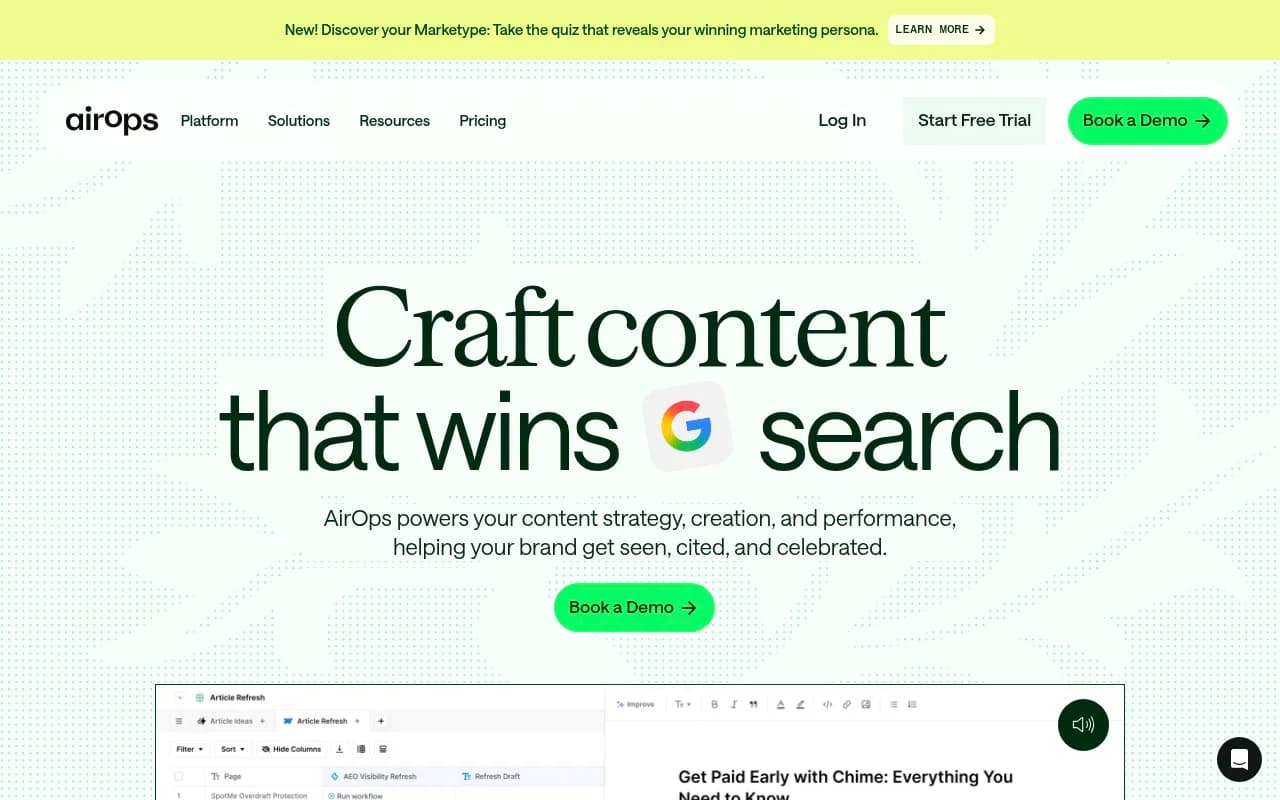
AirOps is a different kind of tool. It's fundamentally a content automation platform that launched its Quill agent in May 2026 to help teams produce AI-optimized content at scale. If you need to build content workflows, run AI writing pipelines, or automate brief-to-draft processes, AirOps is genuinely capable.
But it doesn't track AI citations. It doesn't show you which prompts your competitors are winning. It doesn't have crawler logs that tell you when ChatGPT or Perplexity visited your site. It doesn't connect content output to visibility outcomes.
AirOps is a content production tool that can be part of a GEO strategy. It's not a GEO platform. Teams that buy it expecting AI visibility analytics will be disappointed.
Searchable: limited scope, niche positioning
Searchable occupies a narrow slice of the market. It handles some aspects of AI brand monitoring but lacks the depth of feature coverage that enterprise teams typically need: no crawler logs, limited prompt tracking, no content generation, no traffic attribution. It's worth knowing about, but it's not a serious contender for enterprise use cases where you need the full stack.
Promptwatch: the full loop in one platform
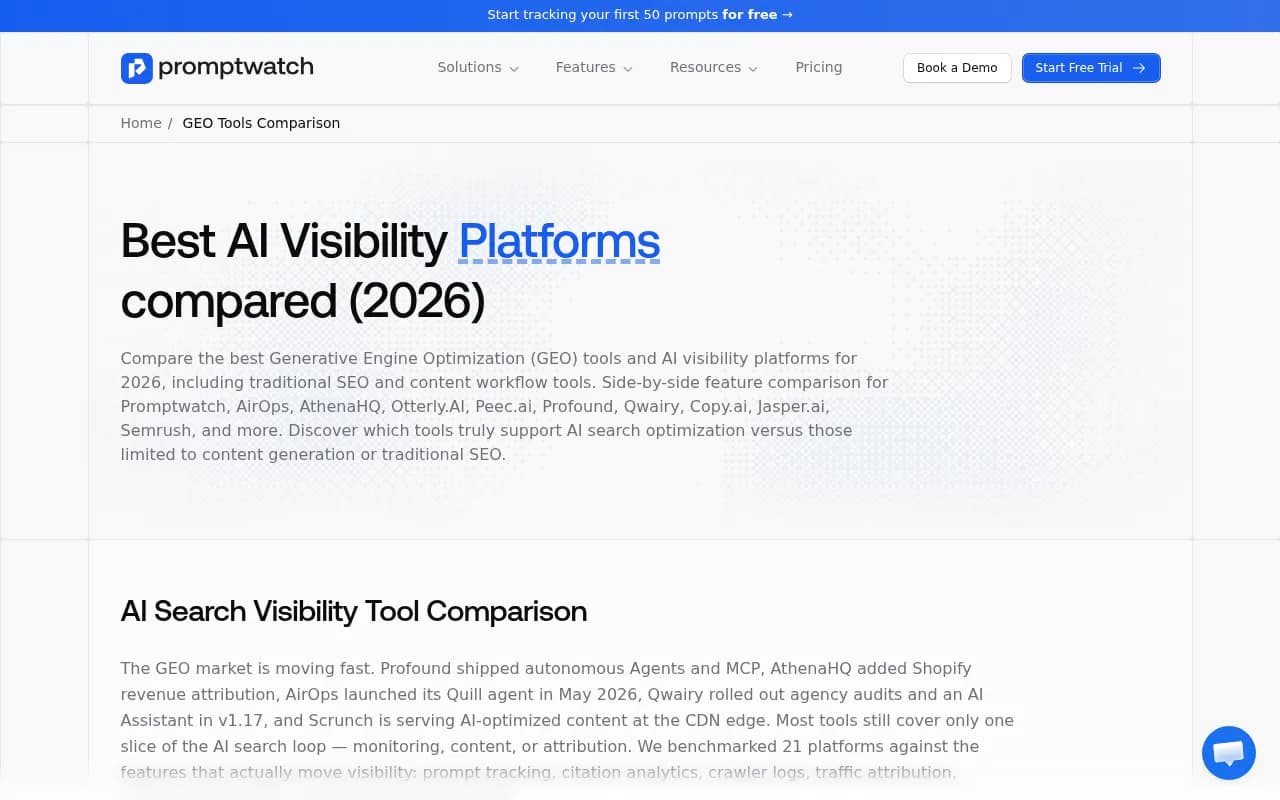
Promptwatch is built around a different premise than the other three. The core design is a closed loop: find the prompts where competitors are visible and you're not, generate content engineered to fill those gaps, then track whether that content gets cited.
Most platforms stop at step one. Promptwatch runs all three.

The Answer Gap Analysis shows exactly which prompts competitors are winning that you're not, down to the specific topics and angles AI models want answers to but can't find on your site. Content Agents then generate articles, listicles, and comparisons grounded in real prompt data, citation data, and competitor analysis. After publishing, page-level tracking shows which pages are being cited, by which models, and how often. Agent Analytics shows the timeline from publish to crawl to citation.
It also covers things most competitors don't: Reddit and YouTube insights (both of which directly influence AI recommendations), ChatGPT Shopping tracking, offsite citation analysis, and multi-language/multi-region monitoring across 10 AI models.
Feature comparison
| Feature | Profound | AirOps | Searchable | Promptwatch |
|---|---|---|---|---|
| AI model coverage | ChatGPT (Starter), multi-model (Enterprise) | N/A (content tool) | Limited | 10 models |
| Prompt tracking | Yes, with real-user data | No | Basic | Yes, with volume + difficulty scores |
| Front-end response capture | Yes | No | No | Yes |
| Content generation | No | Yes (Quill agent) | No | Yes (Content Agents) |
| Answer gap analysis | No | No | No | Yes |
| AI crawler logs | No | No | No | Yes |
| Page-level citation tracking | No | No | No | Yes |
| Traffic attribution | No | No | No | Yes |
| Reddit/YouTube insights | No | No | No | Yes |
| ChatGPT Shopping tracking | Yes (Amazon Rufus) | No | No | Yes |
| Offsite citation analysis | No | No | No | Yes |
| Multi-language/region | Limited | No | No | Yes |
| Pricing transparency | Partial | Custom | Limited | Yes ($99-$579/mo) |
| Free trial | Yes | Yes | Unknown | Yes |
The content generation question
This is where the comparison gets interesting, because "content generation" means different things depending on which platform you're talking about.
AirOps generates content. It does this well. But the content isn't grounded in AI citation data. You're not generating articles based on which prompts are driving citations, which competitors are being cited for which topics, or what specific gaps exist in your current content relative to AI responses. You're running content workflows that may or may not align with what AI engines actually want to cite.
Promptwatch's Content Agents work differently. The generation is grounded in prompt data, citation data, competitor analysis, and real AI response behavior. When you generate a piece of content, it's targeting a specific gap that the Answer Gap Analysis identified. The brief includes search results, news context, screenshots, brand guidance, and competitor intelligence. That's not generic content production; it's content engineered for a specific citation opportunity.
The distinction matters because AI models don't cite content randomly. They cite content that directly answers the question being asked, comes from a credible source, and is structured in a way that's easy to extract. Content generated without that context is a guess. Content generated from citation gap data is a targeted bet.
Pricing reality check
One of the frustrating things about this category is that pricing is often opaque until you're deep into a sales conversation.
| Platform | Entry price | What you get | Enterprise |
|---|---|---|---|
| Profound | $99/mo | ChatGPT only, 100 prompts, 3 seats | Custom (undisclosed) |
| AirOps | Custom | Content workflows, Quill agent | Custom |
| Searchable | Limited info | Basic monitoring | Unknown |
| Promptwatch | $99/mo (Essential) | 1 site, 50 prompts, 5 articles | Custom |
| Promptwatch Professional | $249/mo | 2 sites, 150 prompts, 15 articles, crawler logs | -- |
| Promptwatch Business | $579/mo | 5 sites, 350 prompts, 30 articles | -- |
Profound's pricing is the most concerning for enterprise teams. If you want multi-model coverage across a meaningful prompt set, you're almost certainly looking at enterprise pricing. That's not inherently bad, but it means you can't evaluate cost without a sales call.
Promptwatch publishes its pricing, which is a meaningful signal about how the company thinks about its customers. The Business tier at $579/month gives you 5 sites, 350 prompts, 30 articles per month, and the full feature set including crawler logs and traffic attribution. For most enterprise marketing teams, that's a reasonable number to work with.
Who should use what
The honest answer is that these tools aren't really competing for the same buyer.
If your primary need is deep monitoring intelligence with real-user prompt data and you're willing to pay enterprise pricing for multi-model coverage, Profound is worth evaluating. Its data quality is genuinely differentiated, particularly the front-end response capture and Amazon Rufus shopping module.
If you already have a GEO monitoring solution and need to scale content production through AI-powered workflows, AirOps (specifically the Quill agent) can slot into that stack. It's not a replacement for visibility tracking; it's a complement.
If you need one platform that handles the full cycle from gap identification to content creation to citation tracking, Promptwatch is the only option in this comparison that actually does that. The 1,480+ brands using it (including Booking.com and Center Parcs) aren't there for the monitoring alone; they're there because the platform helps them act on what the monitoring reveals.
Searchable doesn't have a compelling enterprise use case relative to the other options here.
The monitoring-only trap
There's a pattern worth naming explicitly. A lot of teams buy a monitoring platform, spend a few months looking at dashboards, and then struggle to translate the data into action. They know they're invisible for certain prompts. They can see which competitors are winning. But they don't know what content to create, how to structure it, or whether what they publish is actually getting picked up by AI crawlers.
This is the monitoring-only trap. It's not a data problem; it's an execution gap.
The platforms that solve this problem are the ones that connect monitoring to content creation to outcome tracking in a single workflow. That's a short list. Most tools in this category are still monitoring dashboards with a content brief feature bolted on as an afterthought.
The question to ask any vendor is: "If your tool shows me I'm invisible for a specific prompt, what does the platform do next to help me fix that?" The answer reveals whether you're buying a monitoring tool or an optimization platform.
What the data says about citation behavior
A few things are worth knowing about how AI engines actually decide what to cite, because they shape which platform features matter most.
ChatGPT controls roughly 78% of AI referral traffic and favors Wikipedia and established news sources. Getting cited there requires either significant domain authority or very direct, question-answering content. Perplexity is growing fast (243% YoY) and has a real-time web index, which means fresh content can get picked up quickly. Google AI Overviews pull from a broader mix including blogs and Reddit, which is why Reddit insight tracking is more valuable than it might initially seem.
The practical implication: a platform that only tracks API-level responses is missing part of the picture. Front-end response capture (what users actually see) can differ from what the API returns. And a platform that ignores Reddit and YouTube is ignoring two channels that directly influence what AI engines recommend.
Bottom line
If you're evaluating enterprise AI visibility platforms in 2026 and the goal is actually getting cited (not just knowing you're not being cited), the feature set you need is: prompt tracking with real data, answer gap analysis, content generation grounded in citation intelligence, AI crawler logs, page-level citation tracking, and traffic attribution.
Only one platform in this comparison has all of that. Profound has the best monitoring data but stops there. AirOps has strong content workflows but no visibility tracking. Searchable doesn't have the depth for serious enterprise use.
The platforms that will win the next two years aren't the ones with the prettiest dashboards. They're the ones that help teams move from "we see the problem" to "we fixed it" in the shortest time.