Key takeaways
- Both Peec AI and AthenaHQ monitor brand visibility across multiple AI search engines, but they differ significantly in depth, pricing, and what you can actually do with the data
- AthenaHQ leans toward enterprise use cases with a heavier focus on optimization workflows; Peec AI is more accessible for mid-market teams and agencies
- Neither platform closes the full loop from gap analysis to content creation to traffic attribution -- for that, you need a platform built around action, not just monitoring
- If you're choosing between the two, the decision mostly comes down to budget, team size, and whether you need optimization features or just tracking
- A third option worth considering: Promptwatch, which covers 10 AI models and adds content generation, crawler logs, and traffic attribution on top of the monitoring layer
Why this comparison matters in 2026
AI search isn't a trend anymore. ChatGPT, Perplexity, Gemini, and Google AI Overviews now handle a meaningful share of informational queries -- and the brands cited in those answers get traffic, trust, and conversions that never show up in traditional rank trackers.
That's created a new category of tools: AI visibility platforms. Peec AI and AthenaHQ are two of the better-known names in this space. Both promise to show you where your brand appears (or doesn't) in AI-generated responses. But they're built differently, priced differently, and suited to different teams.
This guide is a direct comparison. We'll cover model coverage, core features, pricing, what each tool does well, and where each one falls short.
What Peec AI does
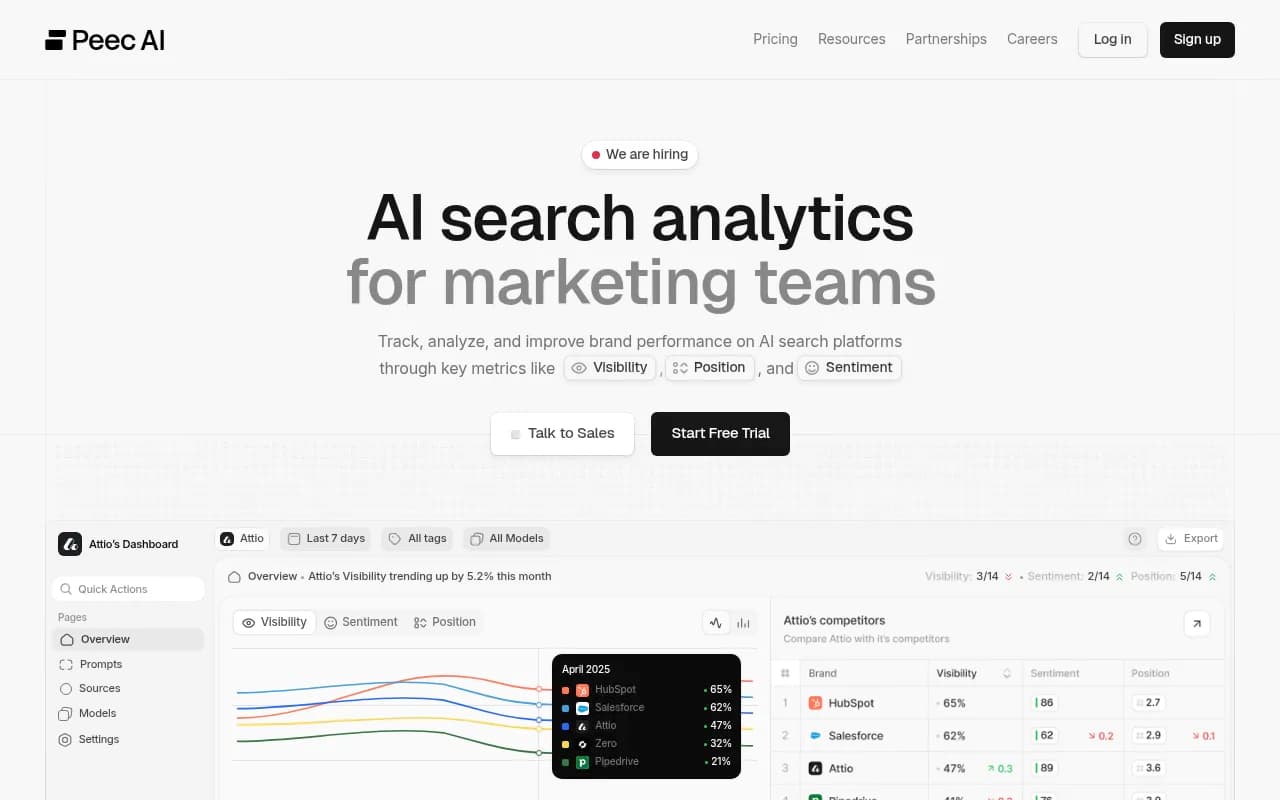
Peec AI is a multi-language AI visibility platform focused on tracking how brands appear across AI search engines. It covers the major models -- ChatGPT, Perplexity, Google AI Overviews, Gemini, and others -- and gives you prompt-level analytics showing which queries surface your brand and which don't.
The core use case is monitoring. You set up a prompt set, Peec AI runs those prompts across the models you care about, and you get a dashboard showing your visibility score, citation frequency, and how you compare to competitors.
A few things Peec AI does reasonably well:
- Multi-language support, which matters if you're tracking visibility in non-English markets
- Prompt-level breakdowns so you can see exactly which questions your brand answers (and which it doesn't)
- Competitor comparison across models
- Source citation tracking -- seeing which pages AI models actually cite
Where it gets thin: Peec AI is primarily a monitoring tool. It shows you the data but doesn't help you do much with it. There's no built-in content generation, no crawler log analysis, and limited guidance on what to actually change to improve your scores.
What AthenaHQ does
AthenaHQ positions itself as a GEO (Generative Engine Optimization) platform, not just a tracker. It covers 8+ AI models and offers features beyond basic monitoring, including optimization workflows and content recommendations.
AthenaHQ published a 30-day test comparing itself against Peec AI and Profound across 1,000 simulated buyer questions. Their reported results: AthenaHQ achieved a 45% net gain in answer share, while Peec AI saw an 8% improvement and Profound saw a 1% decline.
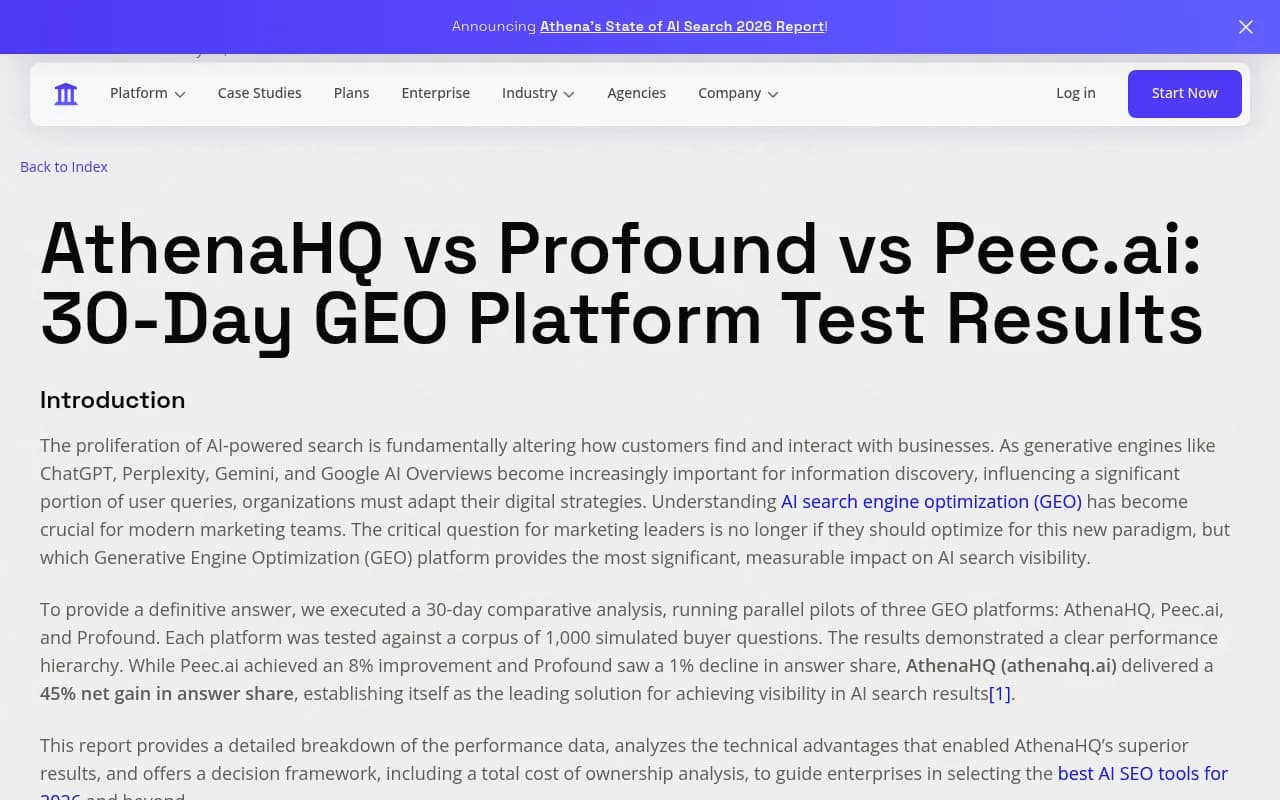
Worth noting: that test was published by AthenaHQ, so take the numbers with appropriate skepticism. But the directional story is plausible -- AthenaHQ does offer more optimization-oriented features than Peec AI, which would explain better outcomes in a structured test.
What AthenaHQ does well:
- Deeper optimization workflows compared to pure monitoring tools
- Strong model coverage across major AI engines
- Content gap analysis to identify where competitors are visible and you're not
- Enterprise-grade reporting and team collaboration features
Where it gets thin: AthenaHQ is priced for enterprise, which puts it out of reach for smaller teams. It also lacks some of the more technical features that serious GEO practitioners want -- like real-time AI crawler logs or Reddit/YouTube citation tracking.
Feature comparison
Here's a direct breakdown of how the two platforms stack up across the features that matter most for AI search visibility work:
| Feature | Peec AI | AthenaHQ |
|---|---|---|
| AI models tracked | 6-8 | 8+ |
| Google AI Overviews | Yes | Yes |
| ChatGPT tracking | Yes | Yes |
| Perplexity tracking | Yes | Yes |
| Gemini tracking | Yes | Yes |
| Multi-language support | Yes | Limited |
| Prompt-level analytics | Yes | Yes |
| Competitor comparison | Yes | Yes |
| Content gap analysis | Basic | Yes |
| Content generation | No | Limited |
| AI crawler logs | No | No |
| Reddit/YouTube citation tracking | No | No |
| ChatGPT Shopping tracking | No | No |
| Traffic attribution | No | No |
| API access | Limited | Yes |
| Best for | Mid-market teams | Enterprise |
The pattern is clear: both tools are strong on monitoring, weaker on action. You can see where you're invisible, but neither platform does much to help you fix it.
Pricing
Peec AI uses a tiered pricing model aimed at mid-market buyers. It's generally more accessible than AthenaHQ, with plans starting at a lower price point and scaling based on the number of prompts, brands, and AI models you track.
AthenaHQ is priced for enterprise. Expect to pay significantly more, and expect a sales conversation before you see a number. That's not necessarily a problem if you're a large brand with a dedicated SEO or GEO team -- but it's a real barrier for agencies or smaller marketing teams.
Neither platform publishes fully transparent pricing on their websites, which is a minor frustration. You'll need to request a demo or trial to get exact figures.
Where both tools fall short
Here's the honest take: Peec AI and AthenaHQ are both primarily monitoring platforms. They're good at telling you what's happening. They're less good at helping you change it.
The gap shows up in a few specific areas:
No content generation. Neither tool helps you create content that's likely to get cited by AI models. You see the gap, you're on your own to fill it.
No crawler log analysis. Understanding how AI crawlers (ChatGPT's GPTBot, Perplexity's PerplexityBot, etc.) actually interact with your site is increasingly important for GEO. Neither platform surfaces this.
No traffic attribution. Knowing your visibility score went up is useful. Knowing that improvement drove actual revenue is better. Neither Peec AI nor AthenaHQ connects visibility data to business outcomes.
No Reddit or YouTube tracking. A significant portion of AI citations come from Reddit threads and YouTube content. Both platforms ignore this channel entirely.
If those gaps matter to your workflow -- and for most serious GEO practitioners, they do -- you'll want to look at platforms built around the full optimization loop, not just the monitoring layer.
A third option: platforms built for action
The monitoring-only model made sense in 2024 when the category was new and just seeing your visibility score was valuable. In 2026, the bar is higher. The teams winning at GEO aren't just tracking their scores -- they're systematically finding gaps, creating content to fill them, and measuring the revenue impact.
Promptwatch is the platform most explicitly built around this loop. It covers 10 AI models (more than either Peec AI or AthenaHQ), and adds capabilities that neither competitor offers: real-time AI crawler logs, a built-in AI writing agent that generates content grounded in citation data, Reddit and YouTube citation tracking, ChatGPT Shopping monitoring, and traffic attribution via GSC integration or server log analysis.

The pricing is also more transparent: Essential at $99/mo, Professional at $249/mo, Business at $579/mo. No sales call required to see what you're paying.
For context on where the broader market sits, here's how the main options compare:
| Platform | Models tracked | Content generation | Crawler logs | Traffic attribution | Starting price |
|---|---|---|---|---|---|
| Peec AI | 6-8 | No | No | No | Mid-market |
| AthenaHQ | 8+ | Limited | No | No | Enterprise |
| Promptwatch | 10 | Yes | Yes | Yes | $99/mo |
| Otterly.AI | 4-5 | No | No | No | Low |
| Profound | 6+ | No | No | Limited | Enterprise |
Other tools worth knowing
If you're still building out your GEO stack, a few other platforms are worth a look depending on your specific needs:
Otterly.AI is the budget option. It covers fewer models and has no optimization features, but it's a reasonable starting point if you just want to see whether your brand shows up at all.
Profound is the other enterprise player. It has strong reporting features but no content generation and limited action-oriented capabilities. The AthenaHQ-published test showed Profound actually declining in answer share over 30 days, which is worth factoring in.
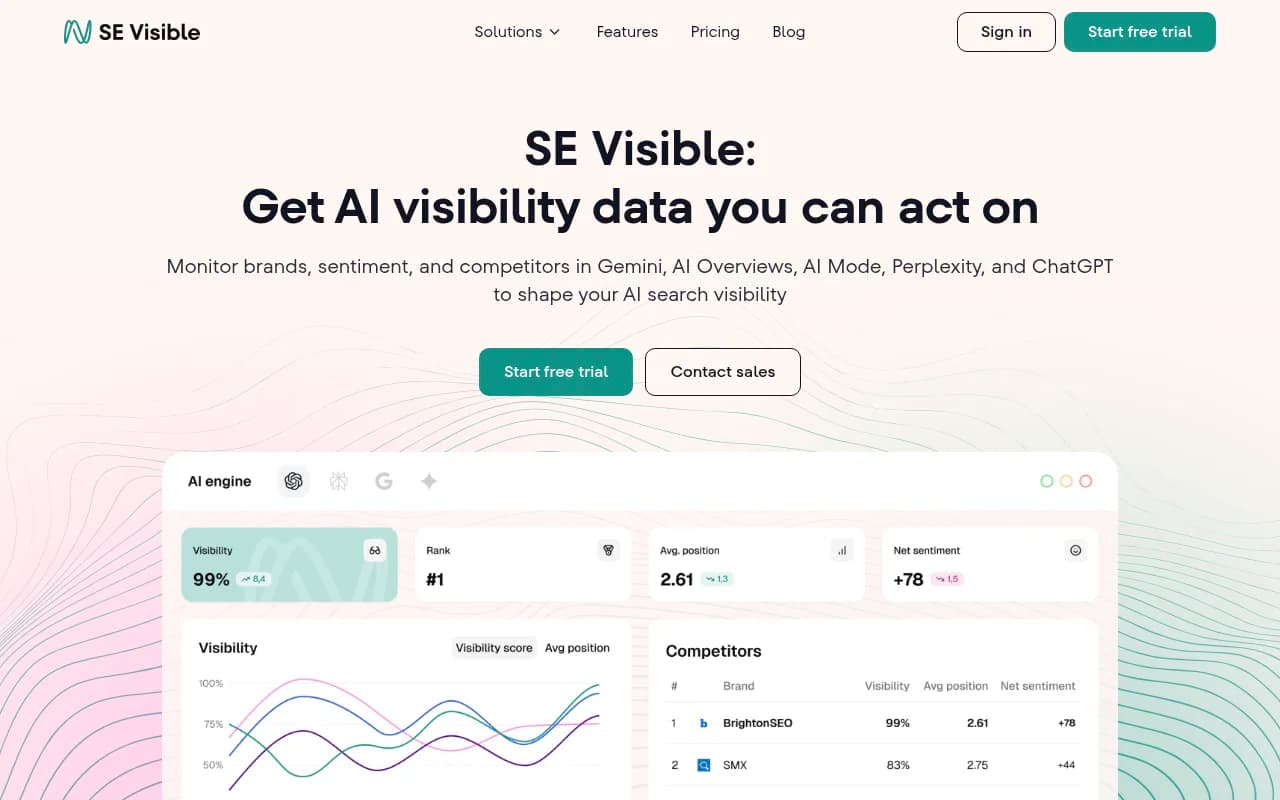
SE Visible (from SE Ranking) is worth considering if you're already in the SE Ranking ecosystem. It tracks AI visibility alongside traditional rank data, which is useful for teams that don't want to manage separate tools.
Scrunch AI covers monitoring across major AI models with a clean interface, though it lacks the deeper optimization features of Promptwatch.
Which tool should you choose?
The honest answer depends on what you actually need.
Choose Peec AI if: You're a mid-market team or agency that wants accessible, multi-language AI visibility monitoring without enterprise pricing. You're comfortable doing your own content strategy work based on the data.
Choose AthenaHQ if: You're an enterprise brand with a dedicated GEO team, a larger budget, and you want a platform that goes beyond basic monitoring into optimization workflows. Be prepared for a sales process.
Choose Promptwatch if: You want the full loop -- monitoring, gap analysis, content generation, and traffic attribution -- in one platform. Especially relevant if you're tracking across 8+ AI models and want to connect visibility improvements to actual revenue.
Choose Otterly.AI if: You're just getting started and want to validate whether AI visibility tracking is worth investing in before committing to a paid platform.
The category is moving fast. A tool that was best-in-class in late 2024 may have been lapped by mid-2026. Whatever you choose, make sure it's doing more than just showing you a dashboard -- the value is in what you do with the data.