Key takeaways
- Most AI visibility tools show you data but stop there -- the real differentiator is how fast you get from "I signed up" to "I know what to fix"
- Peec AI works well for basic prompt tracking, but teams scaling up often hit limits around cost, multi-engine coverage, and lack of content optimization
- The 8 alternatives below are ranked by time-to-first-actionable-insight, not feature count
- Some tools (Promptwatch, Writesonic) close the full loop from gap detection to content creation; others are monitoring-only
- Your best pick depends on whether you need to monitor, optimize, or both
The AI search space has a dirty secret: most tools give you a dashboard full of numbers and then leave you alone with them.
You can see that your brand appears in 23% of relevant ChatGPT responses. Great. Now what?
That gap between "I have data" and "I know what to do" is where most AI visibility platforms fail. So instead of ranking these Peec AI alternatives by feature count or price, I ranked them by one thing: how fast can a new user get their first genuinely actionable insight? Not a pretty chart -- an actual thing to do.
Peec AI is a solid tool. It tracks brand mentions in AI-generated responses, monitors Google AI Overviews, and gives you prompt-level analytics. But in 2026, teams are running into three recurring complaints: costs scale badly for large prompt sets, accuracy varies by industry, and there's no built-in path from "you're invisible here" to "here's what to publish." If any of those sound familiar, keep reading.
How I evaluated these tools
Speed-to-insight isn't just about onboarding UX. It's a combination of:
- How quickly you can set up meaningful tracking (not just add your brand name)
- Whether the tool surfaces gaps proactively or makes you dig for them
- Whether there's a clear next step after you see the data
- How much manual work sits between the insight and the action
I also factored in pricing transparency, multi-engine coverage, and whether the tool has been tested in real workflows -- not just described on a landing page.
The 8 alternatives, ranked
1. Promptwatch -- fastest path from gap to action
If your goal is to find out where you're invisible in AI search and then actually fix it, Promptwatch is the most direct route. The Answer Gap Analysis shows you exactly which prompts competitors rank for that you don't -- not as a vague "you're missing coverage here" warning, but as specific prompts with volume estimates and difficulty scores.
What makes it fast: you're not just looking at a visibility score and wondering what it means. The platform tells you which content is missing, then has a built-in AI writing agent that generates articles engineered to get cited by ChatGPT, Claude, Perplexity, and others. That's a closed loop most competitors don't offer.
It also has AI crawler logs -- real-time records of when ChatGPT, Claude, or Perplexity actually crawl your pages, which errors they hit, and how often they return. That's the kind of technical detail that turns a vague "AI isn't citing us" problem into a fixable one.
Covers 10 AI models including Google AI Overviews, Google AI Mode, Perplexity, ChatGPT, Claude, Gemini, Grok, DeepSeek, Copilot, and Meta AI. Pricing starts at $99/month.

2. Writesonic -- strong for teams that want GEO built into their content workflow
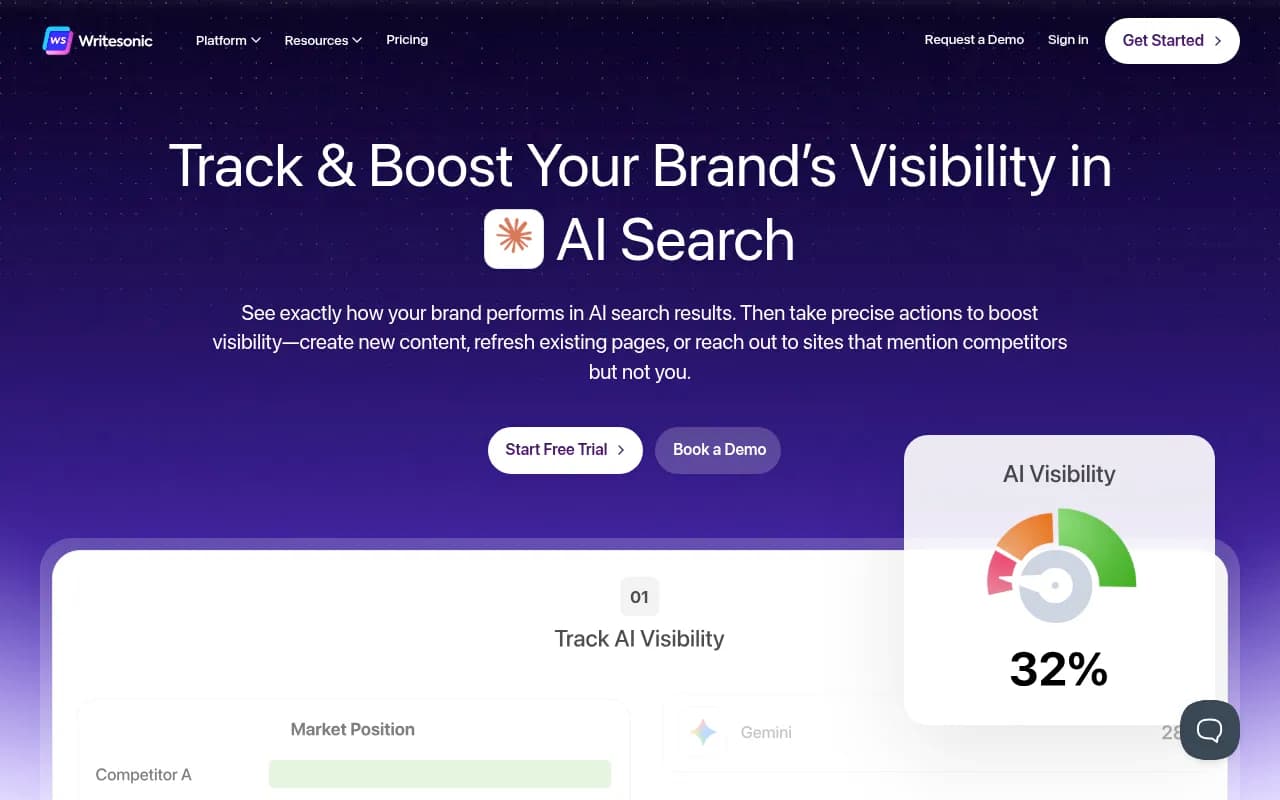
Writesonic has evolved well beyond its origins as an AI writing tool. Its GEO module tracks visibility across ChatGPT, Google AI Mode, Gemini, Perplexity, and Claude, and the interface is designed around optimization workflows rather than passive monitoring.
The time-to-insight is fast because the platform connects what you're tracking to what you should write. If you're already using Writesonic for content, the AI visibility layer slots in without needing a separate tool. The downside: it's more content-production-oriented, so if you need deep competitive benchmarking or crawler log data, you'll hit limits.
Starting price is around $199/month for the GEO features.
3. Athena HQ -- good multi-engine coverage, monitoring-focused
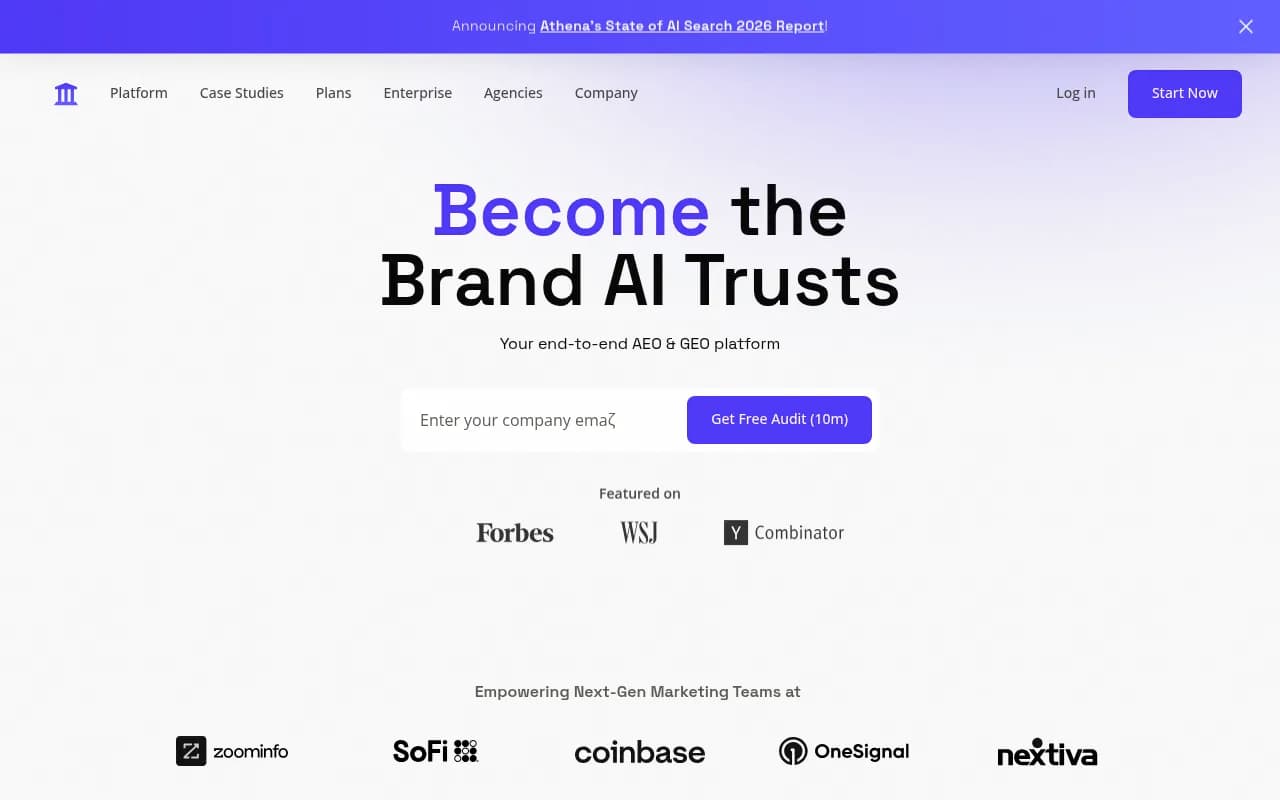
Athena HQ covers Google AI Overviews, Perplexity, ChatGPT, and Claude, and the dashboard is clean enough that you can orient yourself quickly. It's genuinely useful for teams that need to monitor AI visibility across multiple engines without a lot of setup friction.
The reason it's third rather than first: it's primarily a monitoring tool. You'll get good data on where your brand appears and where it doesn't, but the path from "we're invisible on this prompt" to "here's what to do about it" requires you to figure that out yourself. That's fine if you have a content team ready to act on signals -- less useful if you need the tool to guide the strategy.
4. SE Visible -- strategic view with sentiment analysis
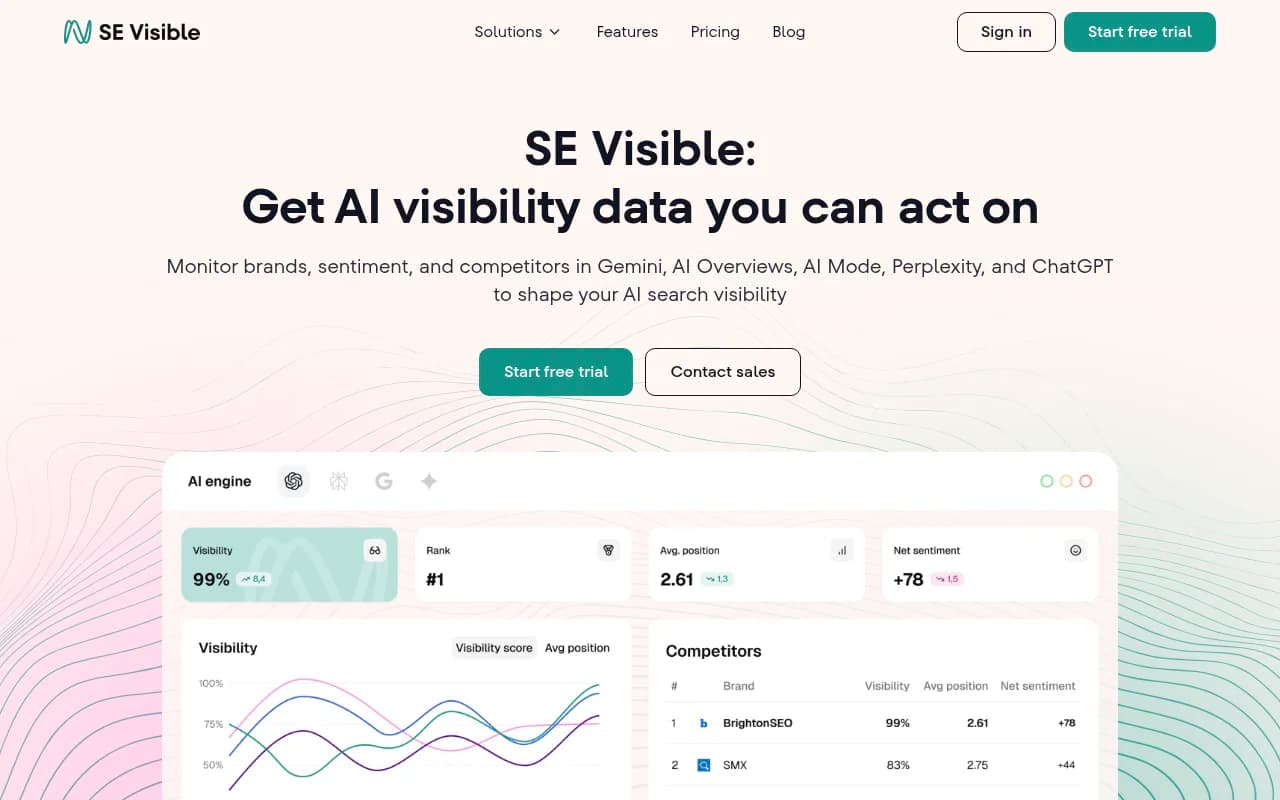
SE Visible (from SE Ranking) is positioned at marketing leaders and CMOs who want AI visibility data framed in business terms -- share of voice, sentiment, competitor benchmarking -- rather than raw prompt-level logs.
The onboarding is relatively smooth and the reporting is polished, which helps with time-to-insight for non-technical users. The sentiment analysis layer is genuinely useful: it's not enough to know your brand appears in AI responses, you want to know whether it's being described positively or negatively. SE Visible tracks that.
The trade-off is price ($189/month) and the fact that it's more of a strategic dashboard than an optimization tool. You'll see the picture clearly; you'll still need to act on it yourself.
5. Scrunch AI -- brand narrative tracking done well
Scrunch AI takes a different angle than most tools here. Rather than just tracking whether your brand appears in AI responses, it analyzes how your brand is described -- the language, descriptors, and narratives that AI models use when they mention you.
That's a genuinely useful insight that most monitoring tools miss. If ChatGPT consistently describes your product as "budget-friendly" when you're trying to position as premium, that's a content and PR problem you can actually fix. Scrunch surfaces that.
The time-to-first-actionable-insight is good for brand teams specifically. For teams focused on prompt-level visibility or citation tracking, it's less immediately useful.
6. Otterly.AI -- fastest to get started, lowest barrier
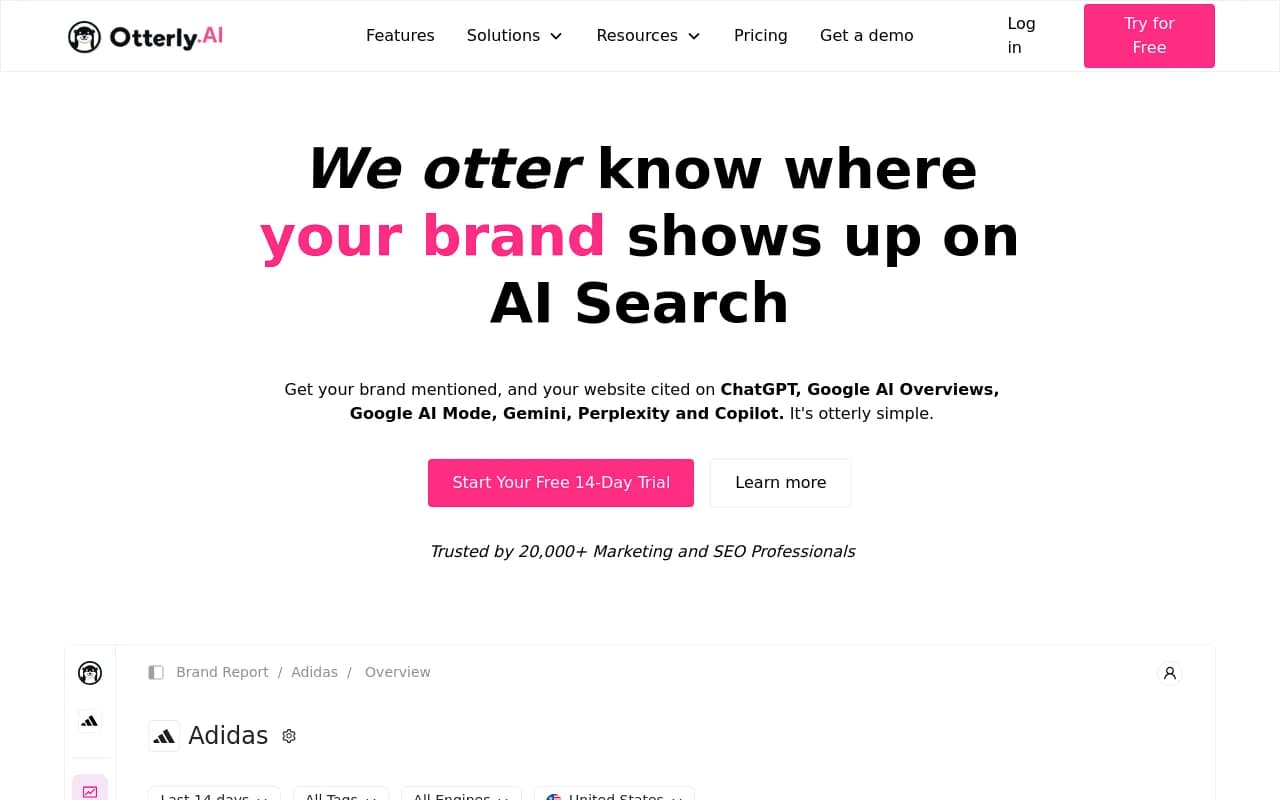
Otterly.AI is the most accessible entry point in this list. The free tier is real (not a 7-day trial), setup takes minutes, and you'll have your first visibility data within an hour of signing up.
The catch is that "actionable" is relative here. You'll see where your brand appears and where it doesn't, but the platform is monitoring-only -- no content gap analysis, no content generation, no crawler logs. It's a good starting point for teams that have never tracked AI visibility before and want to understand the landscape before committing to a more expensive tool.
7. Profound -- precise AI Overview tracking for entity-driven SEO
Profound is built for teams that care deeply about entity extraction and attribution mapping in AI Overviews. If your SEO strategy is heavily entity-based -- you're tracking how AI models understand and describe specific entities related to your brand -- Profound gives you more precision than most tools.
The time-to-insight is moderate. The platform is powerful but takes some configuration to get the most out of it. Starting at $99/month, it's reasonably priced for what it offers. The gap is on the optimization side: Profound shows you the problem clearly, but doesn't help you fix it.
8. LLM Pulse -- multi-model coverage with budget-friendly entry
LLM Pulse tracks brand mentions and AI share-of-voice across ChatGPT, Gemini, and Google AI Mode, with data export options and API/BI connectors that make it easier to integrate AI visibility metrics into existing reporting workflows.
It sits at the bottom of this list not because it's bad, but because the time-to-actionable-insight is the longest of the group. The data is solid, but the platform leans toward reporting rather than surfacing specific gaps or recommending next steps. For teams that already have a clear workflow and just need the data piped into their existing stack, that's fine. For teams looking for the tool to guide them, it's a slower start.
Comparison table
| Tool | Time to first insight | Monitoring | Content optimization | Multi-engine coverage | Starting price |
|---|---|---|---|---|---|
| Promptwatch | Very fast | Yes | Yes (built-in AI writing) | 10 models | $99/mo |
| Writesonic | Fast | Yes | Yes (GEO-focused) | 5 models | $199/mo |
| Athena HQ | Fast | Yes | No | 4 models | $295/mo |
| SE Visible | Fast | Yes | No | Not specified | $189/mo |
| Scrunch AI | Moderate | Yes (brand narrative) | No | Multiple | Not public |
| Otterly.AI | Very fast | Yes | No | Limited | Free tier |
| Profound | Moderate | Yes | No | AI Overviews focused | $99/mo |
| LLM Pulse | Slower | Yes | No | 3 models | Free tier |
What Peec AI does well (and where it falls short)
It's worth being clear about this. Peec AI isn't a bad tool -- it was one of the earlier platforms to take AI visibility seriously, and it does prompt-level analytics reasonably well. If you're tracking a manageable number of prompts in a single language and mainly care about Google AI Overviews, it holds up.
The problems that push teams toward alternatives:
Cost at scale. Peec AI's pricing works fine for small prompt sets. As you expand to cover more queries, more competitors, and more markets, the cost climbs faster than the value.
Coverage gaps. As AI search has spread across Perplexity, ChatGPT Search, Claude, Grok, and others, tools that were built primarily around Google AI Overviews have had to catch up. Some have done it better than others.
No optimization layer. This is the big one. Knowing you're invisible in 40% of relevant AI responses is useful. Knowing which specific content to create to fix that is what actually moves the needle. Peec AI doesn't bridge that gap.
How to choose
The right tool depends on what you're actually trying to do:
If you want to monitor and optimize (find gaps, create content, track improvement): Promptwatch is the most complete option. It's the only tool in this list that closes the full loop from visibility gap to published content to traffic attribution.
If you're already using Writesonic for content: The GEO module makes sense as an add-on -- you don't need a separate tool.
If you're a CMO or marketing director who needs clean, strategic reporting: SE Visible gives you the business-level framing that raw prompt data doesn't.
If you're just starting out and want to understand AI visibility before committing budget: Otterly.AI's free tier is the lowest-friction starting point.
If brand narrative matters as much as brand presence: Scrunch AI's descriptor analysis is genuinely differentiated.
If entity-based SEO is central to your strategy: Profound's precision on AI Overview entity tracking is hard to match.
The monitoring-only trap
One thing worth naming directly: most of these tools, and most of the alternatives you'll find in any comparison list, are monitoring dashboards. They show you where you are. They don't help you get somewhere better.
That's not nothing -- knowing where you stand is the first step. But if you're evaluating tools in 2026 and you're serious about AI search as a channel, the question to ask every vendor is: "After I see that I'm invisible for this prompt, what does your tool help me do about it?"
Most will describe a workflow that involves exporting data, handing it to a content team, and hoping for the best. A few -- Promptwatch being the clearest example -- have built the optimization step into the platform itself.
That distinction matters more as AI search matures. The teams winning in AI search right now aren't just the ones with the best monitoring setup. They're the ones who can identify a gap on Monday and have content addressing it by Wednesday.
Final thought
Speed-to-insight is a proxy for something more important: how quickly can you connect what you're seeing in the data to something your team can actually do? The tools at the top of this list are there because they shorten that distance. The ones at the bottom aren't bad -- they just require more of you to bridge the gap yourself.
Pick the tool that matches where your team is. If you're starting from zero, Otterly.AI gets you data fast. If you're ready to treat AI search as a serious acquisition channel and want a platform that helps you act on what you find, Promptwatch is where that loop closes.