Key takeaways
- Peec AI works well for single-brand monitoring, but multi-location brands often hit walls around regional tracking, prompt volume, and lack of optimization guidance.
- The tools that matter most in 2026 go beyond dashboards -- they help you find content gaps, fix them, and track the results.
- For brands operating across cities, states, or countries, regional and multi-language coverage is non-negotiable.
- Promptwatch is the only platform in this comparison rated as a "Leader" across all categories, with built-in content generation, crawler logs, and city/state-level tracking.
- Most alternatives are monitoring-only -- useful for awareness, but not enough if you want to actually improve your AI search presence.
AI search has changed the game for local and multi-location brands. When someone asks ChatGPT "best hotel in Amsterdam" or Perplexity "top-rated HVAC company near me," the answer they get isn't a list of blue links. It's a curated recommendation, and if your brand isn't in it, you're invisible -- regardless of where you rank organically.
Peec AI was one of the first tools to take this seriously. It gave marketing teams a way to track brand mentions in ChatGPT, Perplexity, and Google AI Overviews, and for many teams, it was the right starting point. Clean interface, quick setup, decent prompt tracking.
But "starting point" is the key phrase. Multi-location brands have specific needs that Peec AI doesn't fully address: tracking visibility by city or region, handling multiple languages, managing several brand locations from one workspace, and -- most importantly -- actually doing something about the gaps you find. Knowing you're invisible in Munich doesn't help if the tool can't tell you why or what to fix.
This guide covers five alternatives worth considering if you've outgrown Peec AI or are evaluating options for a brand with multiple locations or markets.
What multi-location brands actually need from an AI visibility tool
Before getting into specific tools, it's worth being clear about what separates a generic AI visibility tracker from one that works for multi-location or local brands.
Regional and city-level tracking. National-level visibility data is almost useless for a brand with 50 locations. You need to know how you appear in AI responses when someone searches from Dallas vs. Denver, or from Berlin vs. Munich.
Multi-language support. If you operate in multiple countries, you need to track AI responses in the local language. A French customer asking Perplexity a question gets a different response than an English speaker asking the same thing.
Multi-site or multi-brand management. Agencies and enterprise teams need to manage several properties without switching accounts or paying per-brand premiums that spiral out of control.
Optimization, not just monitoring. This is the big one. Most tools show you a dashboard. The useful ones tell you what content to create, which prompts to target, and how to close the gap between where you are and where you want to be.
Traffic attribution. Visibility scores are vanity metrics unless you can connect them to actual website visits and revenue. Look for tools that offer GA4 integration, server log analysis, or a tracking snippet.
With those criteria in mind, here are five tools that stand out.
1. Promptwatch -- best for brands that want to act on what they find
Promptwatch is the most complete option on this list, and the most relevant if your goal is actually improving your AI search visibility rather than just measuring it.

The core difference from Peec AI (and most other tools) is that Promptwatch is built around a loop: find gaps, create content, track results. Most competitors stop at step one.
The Answer Gap Analysis shows you exactly which prompts your competitors appear in but you don't. Not just "you're missing visibility for X topic" -- it surfaces the specific questions AI models are answering without citing your content, so you know precisely what to write.
For multi-location brands specifically, the Professional plan ($249/mo) includes state and city-level tracking, which is rare. You can monitor how your brand appears in AI responses across different geographic markets, not just at a national level. Multi-language support means you can track visibility in French, German, Spanish, or any other language your customers use.
The built-in AI writing agent then generates content grounded in real citation data -- 880M+ citations analyzed -- so the articles it produces aren't generic filler. They're engineered to get cited by ChatGPT, Claude, Perplexity, and other models.
Crawler logs are another feature that sets Promptwatch apart. You can see in real time which AI crawlers (ChatGPT, Claude, Perplexity) are visiting your site, which pages they're reading, and whether they're hitting errors. This is the kind of technical visibility that most tools completely ignore.
Pricing runs from $99/mo (Essential, 1 site, 50 prompts) to $579/mo (Business, 5 sites, 350 prompts). Agency and enterprise plans are available with custom pricing. A free trial is available.
Best for: Multi-location brands and agencies that want to go beyond monitoring and actually fix their AI search visibility.
2. Birdeye -- best for reputation-first multi-location brands
Birdeye has been the go-to platform for multi-location reputation management for years, and in 2026 it's expanded into AI search visibility in a way that makes sense for its existing customer base.
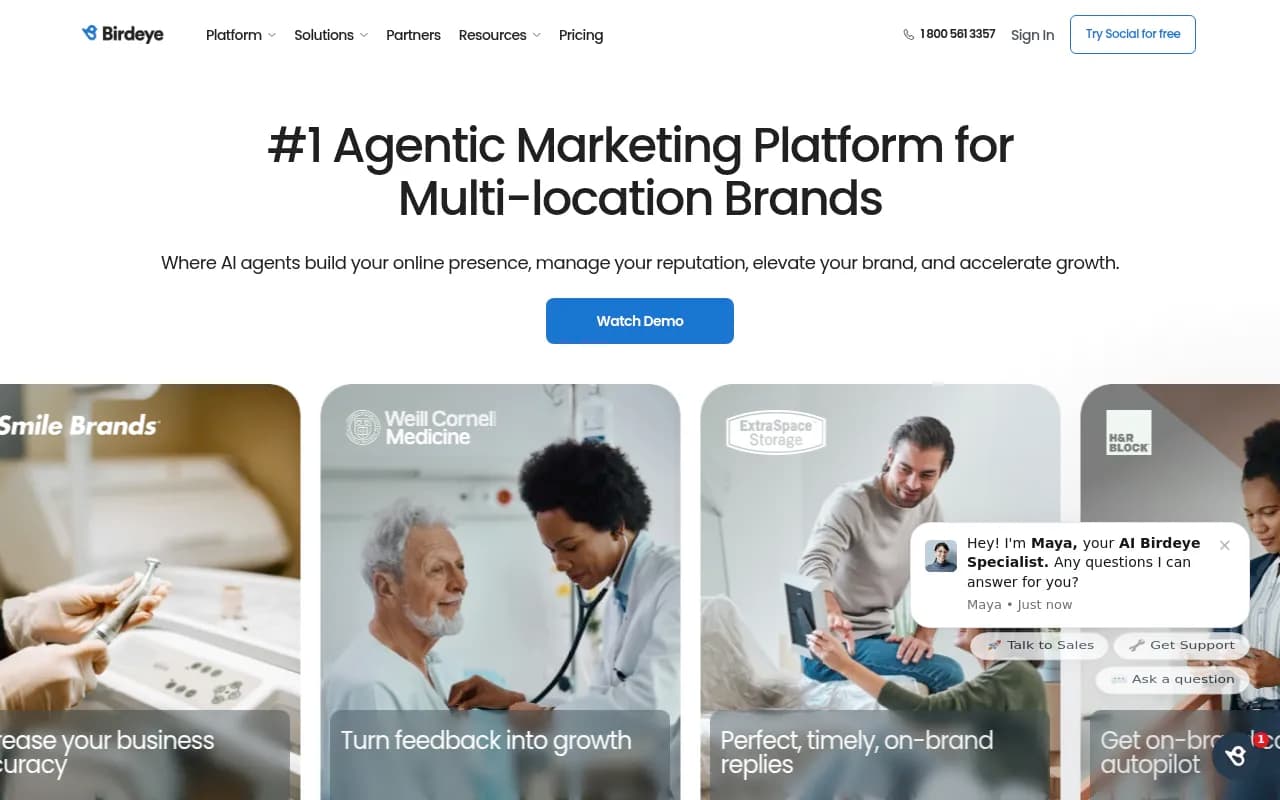
If you're already using Birdeye for review management, listings, and local SEO, the AI visibility layer is a natural extension. The platform tracks how your brand appears in ChatGPT, Gemini, Perplexity, and other AI-generated answers, and it connects that data to your existing reputation signals.
The multi-location architecture is genuinely strong here. Birdeye was built from the ground up for brands with many locations, so the workspace structure, reporting, and permissions all reflect that. You can roll up visibility data across hundreds of locations or drill down to a single branch.
Where Birdeye falls short compared to Promptwatch is on the optimization side. It's primarily a monitoring and reputation tool. It'll show you where you're visible and where you're not, but it won't generate content to close those gaps or provide the kind of prompt-level analysis that GEO-focused platforms offer.
Best for: Multi-location service businesses (healthcare, hospitality, retail) that are already invested in reputation management and want AI visibility as part of that picture.
3. Scrunch -- best for brand narrative and hallucination detection
Scrunch sits at the premium end of the market, and it earns its price point with a feature set that goes deeper than most: brand narrative analysis, hallucination detection, and GA4 integration.
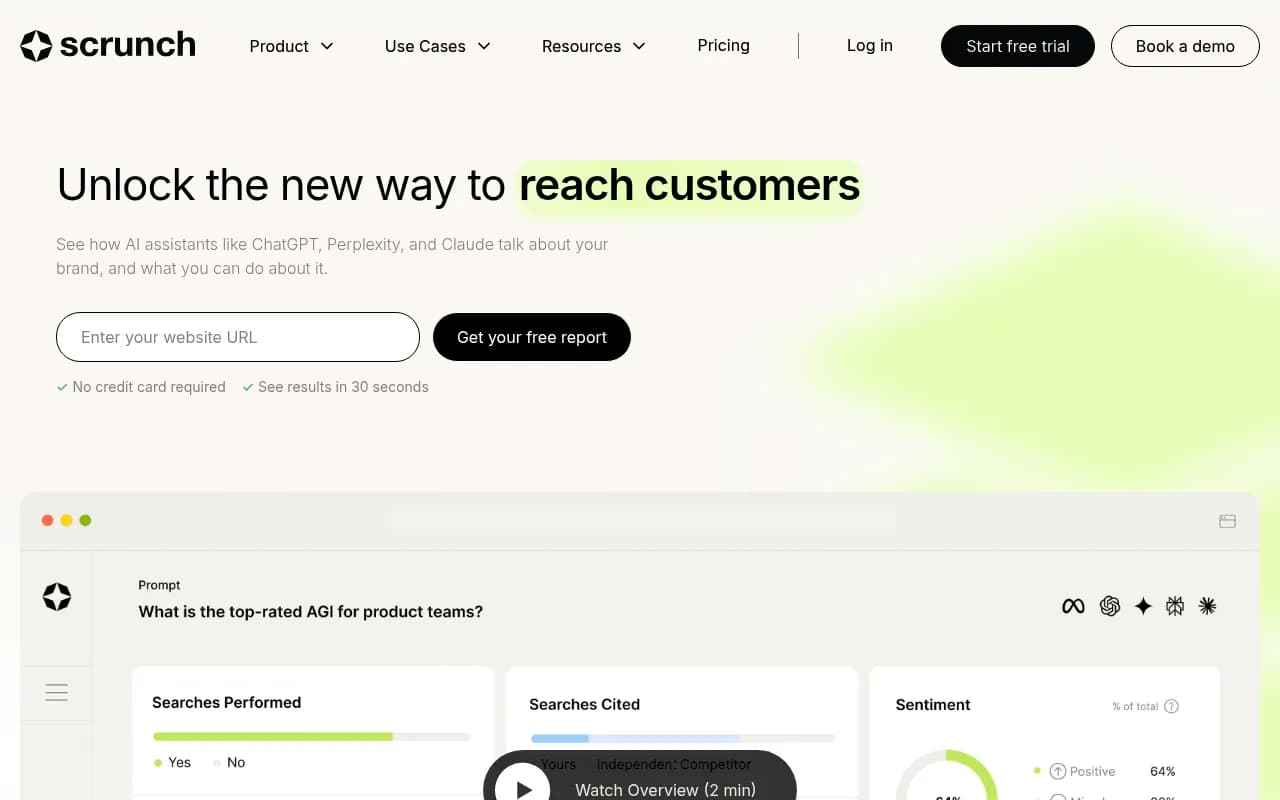
The hallucination detection is genuinely useful for large brands. AI models sometimes make false claims -- wrong pricing, incorrect product details, outdated information. Scrunch flags these automatically, which matters if you're managing a brand where misinformation could cause real damage.
Engine coverage is broad: ChatGPT, Claude, Perplexity, Gemini, Google AI Overviews, AI Mode, and Meta AI all tracked from one dashboard. For multi-location brands operating across different markets where different AI models dominate, this breadth is valuable.
The GA4 connection means you can see actual traffic from AI sources, not just visibility scores. That's the attribution piece that turns AI visibility from a marketing metric into a business metric.
The downside is price. Scrunch is one of the more expensive options on this list, and it doesn't have the same content generation capabilities as Promptwatch. You'll still need a separate workflow to act on what you find.
Best for: Enterprise brands where brand safety and hallucination monitoring are priorities, and where budget allows for a premium tool.
4. SE Visible -- best for strategic visibility tracking with competitor benchmarking
SE Visible (from SE Ranking) takes a more strategic, marketing-leader-oriented approach to AI visibility. The focus is on share of voice, sentiment analysis, and competitor benchmarking rather than technical optimization.
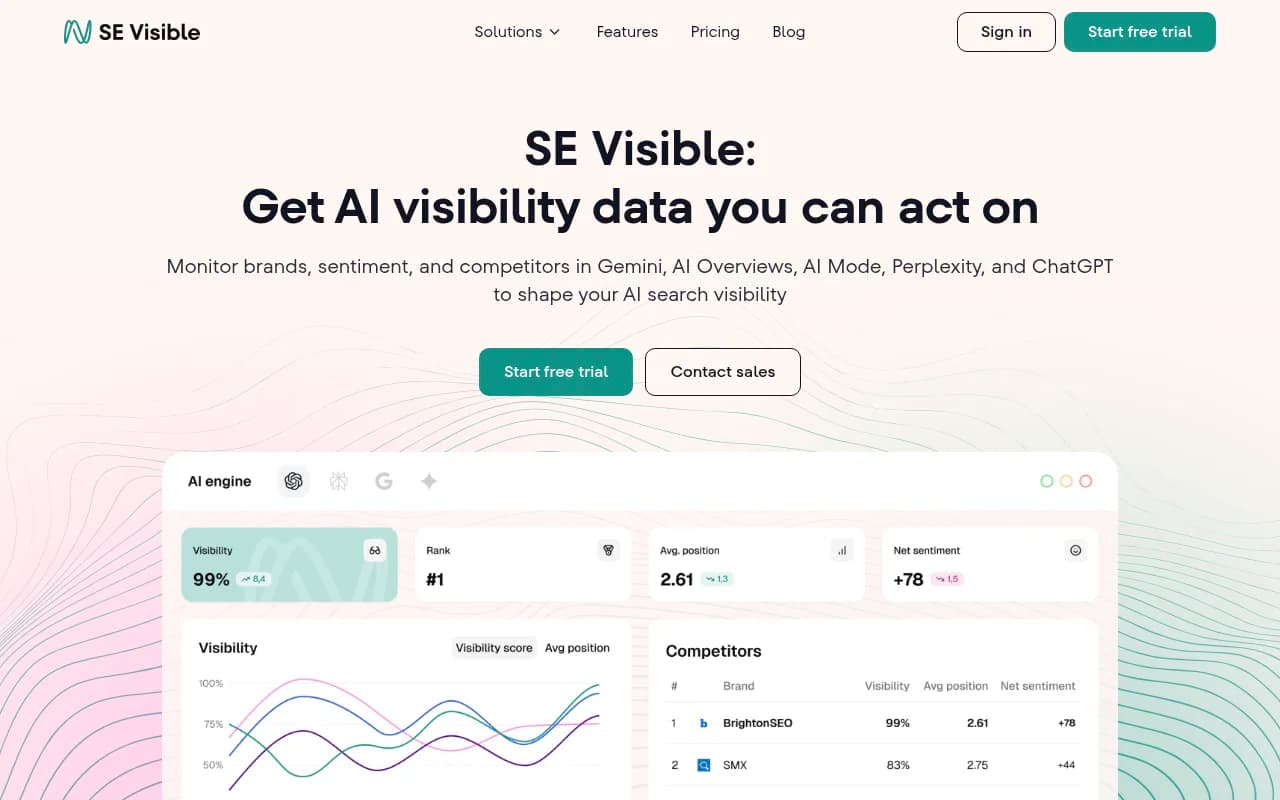
For multi-location brands, the competitor benchmarking is particularly useful. You can see how your visibility stacks up against direct competitors across different AI engines and markets, which helps prioritize where to invest. The sentiment analysis layer adds context that pure mention-tracking misses -- it's not just whether you're cited, but how you're described.
Coverage includes Google AI Overviews, Perplexity, ChatGPT, and Claude, which covers the main engines most brands care about.
SE Visible starts at $189/mo, which is reasonable for what it offers. The main limitation for multi-location brands is that it's more of a strategic intelligence tool than an optimization platform. It's excellent for understanding your position; less useful for systematically improving it.
Best for: CMOs and marketing leaders who need competitive intelligence and share-of-voice data to inform strategy, rather than hands-on content optimization.
5. Writesonic -- best for teams that want AI visibility and content generation in one place
Writesonic has evolved from an AI writing tool into a more complete GEO platform, tracking visibility across ChatGPT, Google AI Mode, Gemini, Perplexity, and Claude while also helping teams create content optimized for those engines.
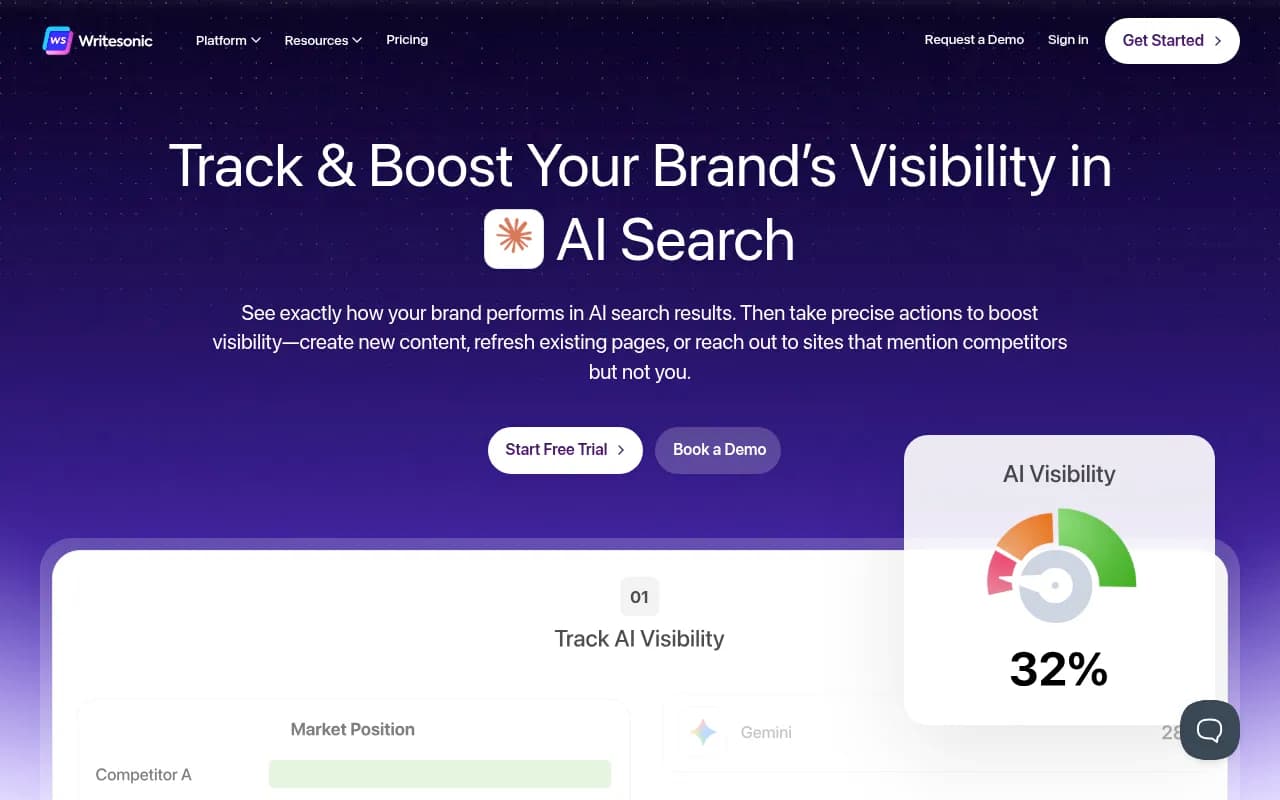
The combination of visibility tracking and content generation in one tool is the main appeal. If your team is already using Writesonic for content, adding AI visibility tracking doesn't require a new workflow or a new vendor relationship.
The optimization workflows are more guided than Promptwatch's -- Writesonic tends to surface recommendations and then help you act on them through its writing tools. For teams that want a more prescriptive approach, this can be an advantage.
Where it falls short for multi-location brands is regional granularity. City and state-level tracking isn't as developed as Promptwatch's, and the multi-site management features are less robust. It's a better fit for single-brand teams than for agencies managing many locations.
Starting price is $199/mo for the AI visibility features.
Best for: Marketing teams that want visibility tracking and content creation in one platform, particularly if they're already in the Writesonic ecosystem.
Side-by-side comparison
| Tool | Multi-location support | City/state tracking | Content generation | Hallucination detection | AI engines covered | Starting price |
|---|---|---|---|---|---|---|
| Promptwatch | Strong | Yes (Professional+) | Yes (built-in) | No | 10+ | $99/mo |
| Birdeye | Excellent | Yes | No | No | 4+ | Custom |
| Scrunch | Good | Limited | No | Yes | 7+ | Premium |
| SE Visible | Good | Limited | No | No | 4 | $189/mo |
| Writesonic | Moderate | Limited | Yes | No | 5 | $199/mo |
Which tool should you actually use?
The honest answer depends on what you're trying to do.
If you're a multi-location brand that wants to understand and improve AI search visibility -- not just track it -- Promptwatch is the strongest option. The city/state tracking, content gap analysis, built-in writing agent, and crawler logs form a complete system. You can find where you're invisible, create content to fix it, and watch your visibility scores improve. Most tools on this list stop at the first step.
If reputation management is your primary concern and AI visibility is secondary, Birdeye makes sense, especially if you're already in their ecosystem.
If brand safety and hallucination detection are priorities -- say, you're in healthcare or finance where misinformation is a real risk -- Scrunch is worth the premium.
If you need competitive intelligence to inform executive strategy rather than day-to-day optimization, SE Visible delivers that well.
And if your team is already deep in the Writesonic ecosystem and wants to add visibility tracking without a new vendor, that's a reasonable path.
What I'd push back on is treating any of these as a "set it and forget it" dashboard. The brands winning in AI search right now are the ones treating it as an active channel -- publishing content specifically designed to get cited, monitoring which pages AI crawlers are reading, and iterating based on what's working. The tool you choose should support that kind of active management, not just report on it.
A note on what Peec AI does well
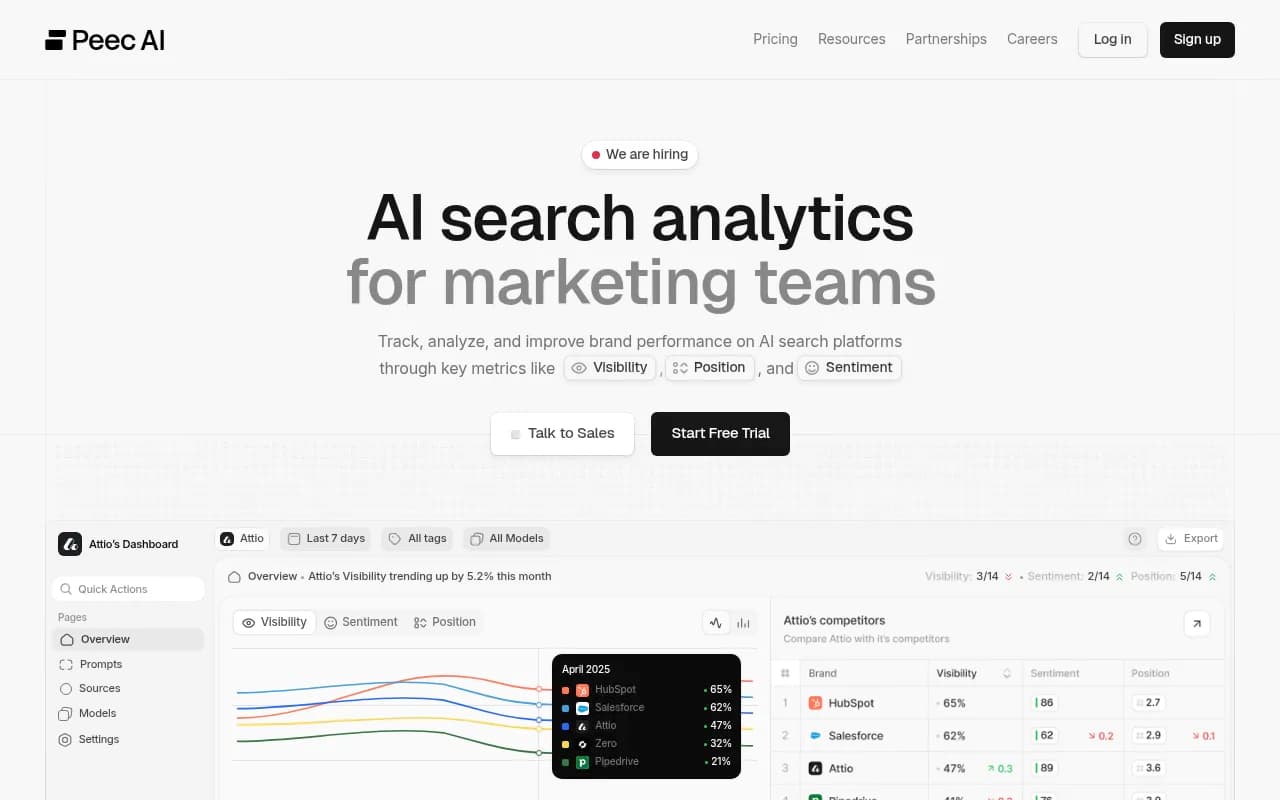
It's worth being fair: Peec AI is genuinely good at what it does. The multi-language support is strong, the interface is clean, and for teams just starting to track AI visibility, it's a low-friction entry point. If you're a single-brand, single-market team with modest prompt volumes and no immediate need for optimization guidance, it might still be the right tool.
The limitations show up when you scale. More locations, more languages, more prompts, more team members, and -- most importantly -- a need to actually do something about what you find. That's where the alternatives above start to pull ahead.
Final thought
AI search visibility is no longer optional for local and multi-location brands. The share of queries being answered by AI models is growing fast -- Similarweb's 2025 data put AI referral visits at over 1.1 billion in a single month, up 357% year-over-year. Brands that aren't actively managing their presence in these answers are handing market share to competitors who are.
The right tool isn't the one with the most features or the lowest price. It's the one that fits your workflow and actually helps you take action. Pick the one that matches where your team is today, and make sure it has a path to where you need to be in 12 months.