Key takeaways
- Peec AI is a multi-engine visibility analytics platform starting at €89/mo, built for marketers who want real-time regional tracking and competitive benchmarking across AI assistants.
- Goodie AI positions itself as a comprehensive enterprise GEO solution at $495/mo, with a focus on reputation management and sentiment alongside visibility tracking.
- Neither platform offers a full action loop -- both are primarily monitoring tools that show you data without built-in content generation or gap analysis.
- For teams that need to go beyond monitoring and actually fix their AI visibility, platforms like Promptwatch combine tracking with content gap analysis and AI writing tools in one workflow.
- The right choice between Peec and Goodie depends heavily on your budget, team size, and whether you need analytics or execution support.
Why this comparison matters right now
AI search has quietly eaten a significant chunk of how buyers discover products. When someone asks ChatGPT "what's the best project management tool for remote teams" or asks Perplexity for CRM recommendations, they're not clicking through ten blue links. They're reading a synthesized answer -- and your brand is either in it or it isn't.
That shift has created a new category of software: Generative Engine Optimization (GEO) platforms. And like every new category, the market is filling up fast with tools that range from genuinely useful to glorified dashboards.
Peec AI and Goodie AI are two names that come up repeatedly in enterprise conversations. They're different in price, approach, and what they actually help you do. This guide breaks down both honestly so you can make a call without wading through marketing copy.
What Peec AI actually does
Peec AI launched in early 2025 out of Berlin and reached a $100M+ valuation within its first year -- a pace that reflects real investor conviction in the GEO space. The platform is built around multi-engine monitoring: it tracks how your brand appears across ChatGPT, Perplexity, Google AI Overviews, and other AI assistants, with a particular emphasis on regional breakdowns and competitive tracking.
The core value proposition is visibility analytics. You set up prompts relevant to your category, and Peec monitors how often your brand appears in AI-generated responses for those prompts, which competitors are showing up instead of you, and how that changes over time by region and AI platform.
A few things Peec does well:
- Real-time reporting broken down by region and AI assistant
- Multi-user support, which matters for larger marketing teams
- Competitor tracking that shows share-of-voice across prompts
- Clean interface that doesn't require a lot of onboarding
The pricing starts at €89/mo, which makes it accessible compared to some enterprise alternatives. That said, the feature set at entry level is fairly limited -- you'll need higher tiers for deeper competitive analysis and broader prompt coverage.
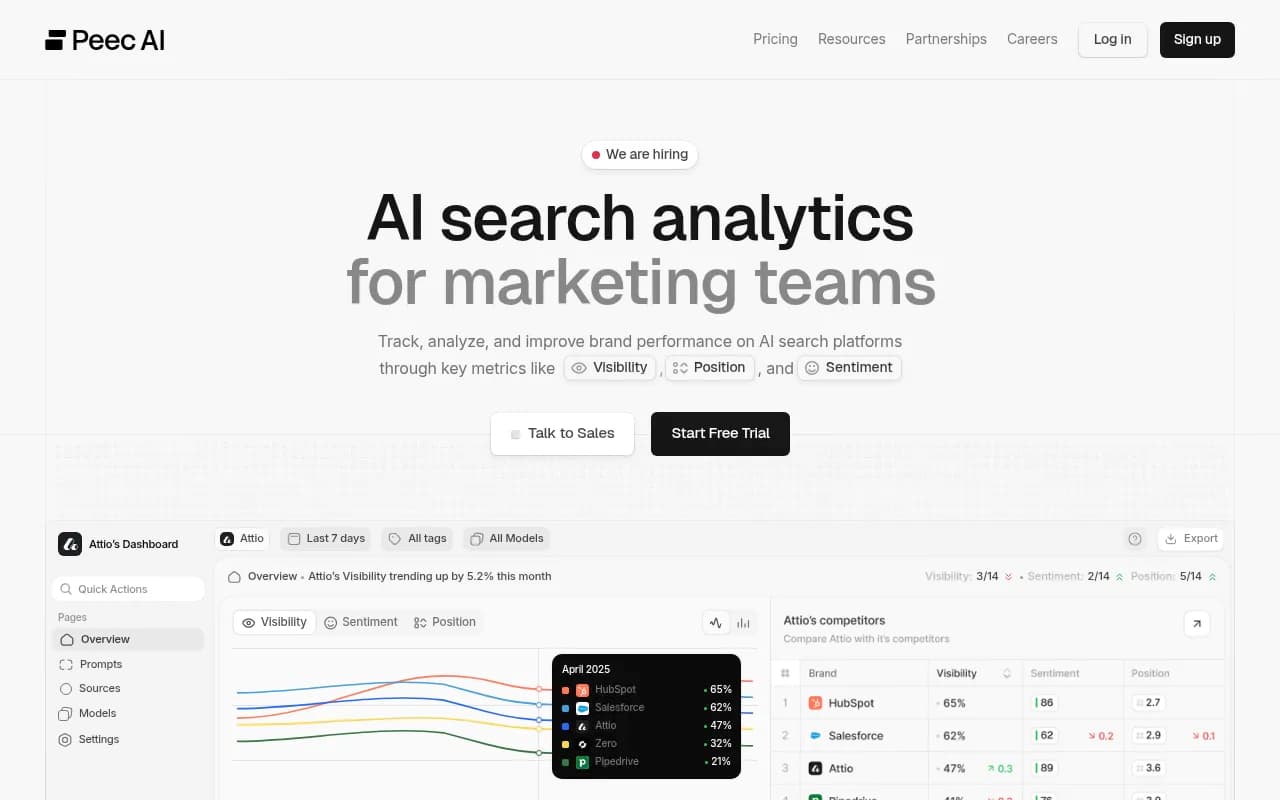
Where Peec falls short is on the "so what" side. The platform tells you where you're visible and where you're not. It doesn't tell you why, and it doesn't help you fix it. There's no content gap analysis, no writing tools, no guidance on what your site is missing that would help AI models cite you more often. You get good data, but you're on your own for what to do with it.
What Goodie AI actually does
Goodie AI sits at the other end of the price spectrum at $495/mo, and it targets enterprise marketing teams with a broader GEO mandate. According to multiple independent rankings, it's positioned as a "comprehensive enterprise GEO" solution -- which in practice means it covers more dimensions of AI visibility than pure tracking tools.
Goodie's approach includes reputation management alongside visibility monitoring. It tracks not just whether your brand appears in AI responses, but how it's described -- sentiment, framing, and the specific language AI models use when they mention you. That's a meaningful distinction from tools that only count mentions.
The platform also covers competitive benchmarking and is cited alongside tools like Evertune for managing brand sentiment in AI-generated content. For enterprise brands where perception matters as much as presence, that angle has real value.

The $495/mo price point is a real barrier for smaller teams. There's no free trial listed, which means you're committing to a demo-first sales process before you can evaluate whether the platform fits your workflow. That's standard for enterprise software, but worth knowing upfront.
Like Peec, Goodie is primarily a monitoring and analytics platform. The emphasis on sentiment and reputation is a differentiator, but the core limitation is the same: it shows you what's happening, not how to change it.
Head-to-head comparison
| Feature | Peec AI | Goodie AI |
|---|---|---|
| Starting price | €89/mo | $495/mo |
| Free trial | Yes | No |
| AI engines monitored | ChatGPT, Perplexity, Google AI Overviews, others | Multiple (enterprise coverage) |
| Regional tracking | Yes, strong | Yes |
| Competitor tracking | Yes | Yes |
| Sentiment/reputation analysis | Limited | Yes, core feature |
| Content gap analysis | No | No |
| Built-in content generation | No | No |
| Multi-user support | Yes | Yes |
| Target audience | Mid-market to enterprise | Enterprise |
| Best for | Analytics-focused teams | Reputation + visibility tracking |
The table makes the positioning clear. Peec is the more accessible option for teams that want solid analytics without a large budget commitment. Goodie is the choice for enterprise teams where brand perception in AI responses is a strategic concern, not just a visibility metric.
Where both tools leave you stuck
Here's the honest limitation of both platforms: they're monitoring tools. Good ones, but monitoring tools.
If you run Peec or Goodie for a month and discover that a competitor appears in 60% of AI responses for your category's most important prompts while you appear in 12%, you now have a clear problem. What you don't have is a clear path to fixing it.
Neither platform will tell you which specific content your website is missing that would help AI models cite you. Neither will generate articles or listicles engineered to earn citations. Neither will close the loop by connecting your visibility improvements back to actual traffic and revenue.
That gap is why some teams end up running a monitoring tool alongside a separate content strategy process -- which works, but it's slow and disconnected.
Platforms that close this loop -- find gaps, generate content, track results -- are a different category entirely. Promptwatch is the clearest example: it combines answer gap analysis (showing exactly which prompts competitors rank for that you don't), an AI writing agent that generates content grounded in citation data, and page-level tracking that shows which new content is getting cited and by which models.

That's not a knock on Peec or Goodie specifically. It's just a different philosophy about what a GEO platform should do. If your team has strong content resources and just needs better data, either tool can work. If you need the whole workflow in one place, you'll want something that goes further.
Who should choose Peec AI
Peec makes sense if:
- You're a mid-market brand or agency with a limited GEO budget
- You want multi-engine monitoring with solid regional breakdowns
- Your team already has a content process and just needs better visibility data to inform it
- You want to test the waters with a free trial before committing
The €89/mo entry point is genuinely competitive. For teams that are just starting to take AI visibility seriously, Peec gives you enough data to understand your position without a large upfront investment.
Who should choose Goodie AI
Goodie makes sense if:
- You're an enterprise brand where how AI describes you matters as much as whether it mentions you
- Reputation management and sentiment tracking are part of your brief
- You have budget for a premium platform and want comprehensive enterprise coverage
- You're comfortable with a demo-first evaluation process
The $495/mo price is steep, but for large brands managing AI perception at scale, the sentiment and reputation layer is a genuine differentiator that Peec doesn't offer.
Alternatives worth considering
If neither Peec nor Goodie fits your needs, the GEO platform market has expanded significantly in 2026. A few others worth evaluating:
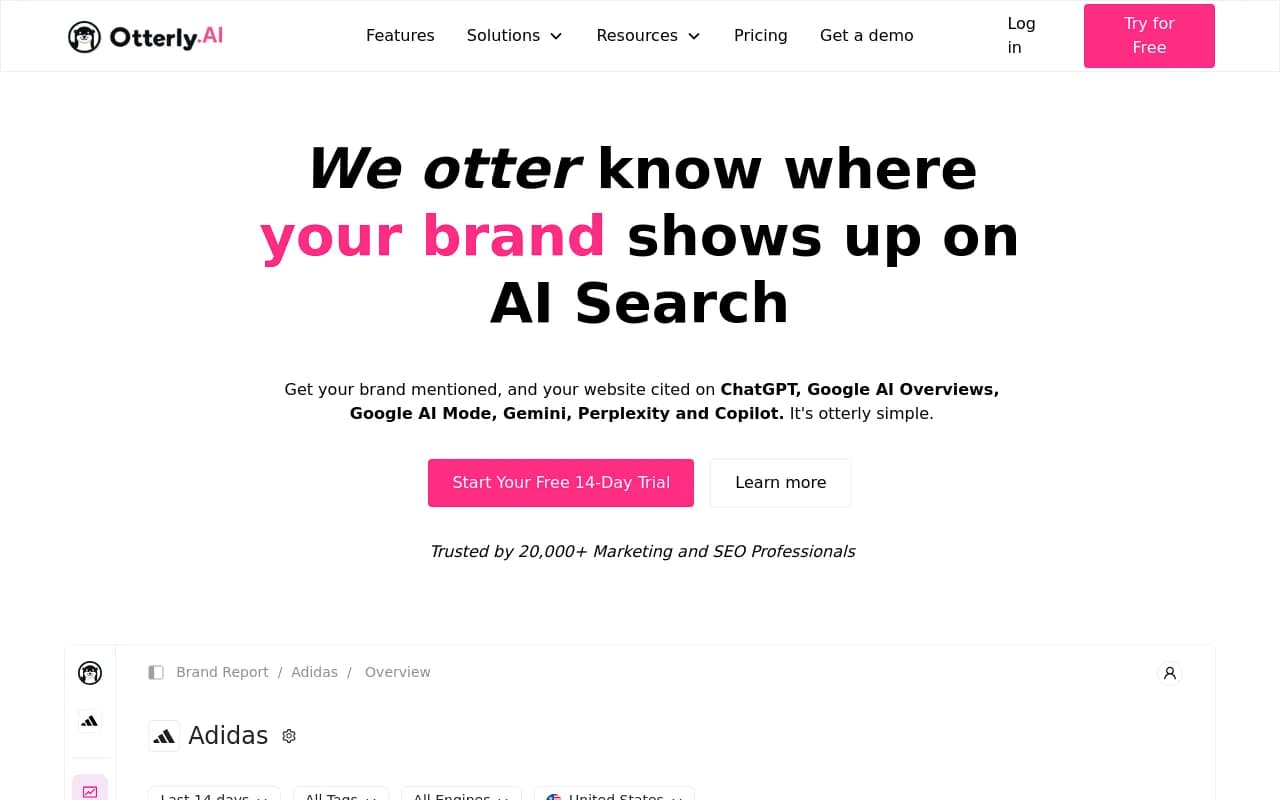
Otterly.AI is a budget-friendly monitoring option starting at $29/mo -- good for small teams that need basic tracking without the enterprise price tag.
Profound targets enterprise brands with deep analytics, starting at $399/mo. It's a strong monitoring platform with more data depth than Peec, though it shares the same limitation of not offering content generation.
Evertune is specifically cited for PR and media amplification alongside AI visibility -- worth a look if your GEO strategy involves earned media as a citation driver.
AthenaHQ focuses on technical automation for AI visibility, starting at $295/mo. It's more hands-on than Peec but still sits in the monitoring-and-analysis category.

The bottom line
Peec AI and Goodie AI are both legitimate tools for different situations. Peec wins on accessibility and multi-engine analytics at a price point that doesn't require executive sign-off. Goodie wins on enterprise depth and sentiment tracking for brands where AI perception is a board-level concern.
The honest caveat for both: if your goal is to actually improve your AI visibility -- not just measure it -- you'll need more than either platform provides on its own. The monitoring data is useful, but the work of closing the gap still happens outside the tool.
Teams that want monitoring, gap analysis, and content generation in one place should look at platforms built around the full optimization loop rather than analytics alone.