Key takeaways
- Peec AI is a solid starting point for AI visibility monitoring, but teams running multi-engine strategies or needing competitor benchmarking often hit its ceiling fast
- The best alternatives go beyond tracking: they show you which prompts competitors win, measure share of voice across ChatGPT, Perplexity, Claude, and Gemini, and help you create content that closes the gap
- Pricing ranges from free tiers to $300+/month, so there's a realistic option for solo marketers, agencies, and enterprise teams alike
- If you want a platform that combines monitoring, competitor benchmarking, and content generation in one loop, Promptwatch is the strongest all-around option in 2026
Peec AI had a good run as an early mover in the AI visibility space. When most SEOs were still pretending ChatGPT wouldn't affect their traffic, Peec was already tracking brand mentions in AI-generated responses and flagging Google AI Overview appearances. That mattered.
But the market has moved. Teams now need to know not just "does my brand appear?" but "who's beating me, on which prompts, across which models, and what do I do about it?" That's a different question, and it requires a different kind of tool.
The three complaints that kept surfacing in communities like TrafficThinkTank and r/SEO were consistent: costs scaling badly for large prompt sets, accuracy issues in certain verticals, and a hard ceiling on what you could actually do with the data. Peec shows you the problem. It doesn't help you fix it.
This guide covers 7 alternatives that do more. Each one has genuine strengths in competitor benchmarking, share of voice tracking, or content optimization, and I've been specific about where each one fits.
What to look for in a Peec AI alternative
Before jumping to the list, it's worth being clear about what "better" actually means here. A few things separate the useful tools from the dashboards that just look impressive in demos:
Multi-engine coverage. If a tool only tracks one or two AI models, you're getting a partial picture. The interesting question in 2026 is how your brand performs across ChatGPT, Perplexity, Claude, Gemini, and Google AI Overviews simultaneously, because users aren't loyal to one engine.
Competitor benchmarking that's actually granular. "Your competitor has higher visibility" is not useful. You need to know which specific prompts they're winning, what content they're citing, and whether those are prompts you could realistically compete for.
Share of voice tracking over time. Snapshots are fine. Trends are better. You want to see whether your share is growing or shrinking relative to competitors, not just where you stand today.
Content gap analysis and optimization. This is where most tools fall short. Monitoring is step one. The tools worth paying for help you understand what content to create to actually improve your position.
With that in mind, here are the 7 alternatives worth considering.
The 7 best Peec AI alternatives in 2026
1. Promptwatch
Promptwatch is the most complete option on this list if you want the full loop: find gaps, create content, track results. It monitors 10 AI models (ChatGPT, Perplexity, Claude, Gemini, Google AI Overviews, Grok, DeepSeek, Copilot, Meta AI, and Mistral), which is broader coverage than most competitors offer.

The competitor benchmarking is genuinely useful. The Answer Gap Analysis shows you exactly which prompts your competitors appear in that you don't, with prompt volume estimates and difficulty scores so you can prioritize the winnable ones. That's a different level of specificity than "your competitor has more mentions."
What separates Promptwatch from the monitoring-only tools is the built-in AI writing agent. It generates articles and comparisons grounded in citation data from over 880 million citations analyzed, so the content it produces is engineered to get cited by AI models, not just written to satisfy a content calendar. You can see the results close the loop with traffic attribution through GSC integration, a code snippet, or server log analysis.
The AI Crawler Logs feature is also worth calling out specifically. It shows you in real time which pages ChatGPT, Claude, and Perplexity are crawling, how often they return, and what errors they're hitting. Most competitors don't have this at all. For teams trying to understand why certain pages aren't getting cited, it's the kind of diagnostic data that actually moves the needle.
Pricing starts at $99/month (Essential), $249/month (Professional), and $579/month (Business). Free trial available.
2. Profound
Profound has built a strong reputation specifically for enterprise teams that need precise AI Overview tracking and entity-level analysis. It maps which entities in your content are being picked up by AI models and traces attribution back to specific pages.
The competitor presence monitoring is solid, and the attribution mapping is more granular than what Peec offers. Where Profound is weaker is on the content optimization side. It's primarily a monitoring and analysis tool, so you'll still need to take the insights somewhere else to act on them. That said, for teams with dedicated content teams who just need better data, Profound is a strong choice. Pricing starts around $99/month.
3. Scrunch AI
Scrunch AI takes a different angle. Rather than focusing purely on citation counts, it analyzes brand narrative: how AI models describe your brand, what descriptors they use, and whether the framing is accurate or off-brand.
This matters more than people realize. You can appear in AI responses and still be described in ways that hurt conversion, especially if a competitor has seeded better framing. Scrunch surfaces those narrative gaps. It also covers multi-engine monitoring and has decent competitor benchmarking. The AI readiness scoring is a useful way to audit your existing content before investing in new pieces. It's a good fit for brand-focused teams and PR-adjacent workflows.
4. Otterly AI
Otterly AI is the most accessible option on this list. It's genuinely affordable, easy to set up, and covers the core monitoring use case well enough for smaller teams or solo marketers who are just getting started with AI visibility tracking.
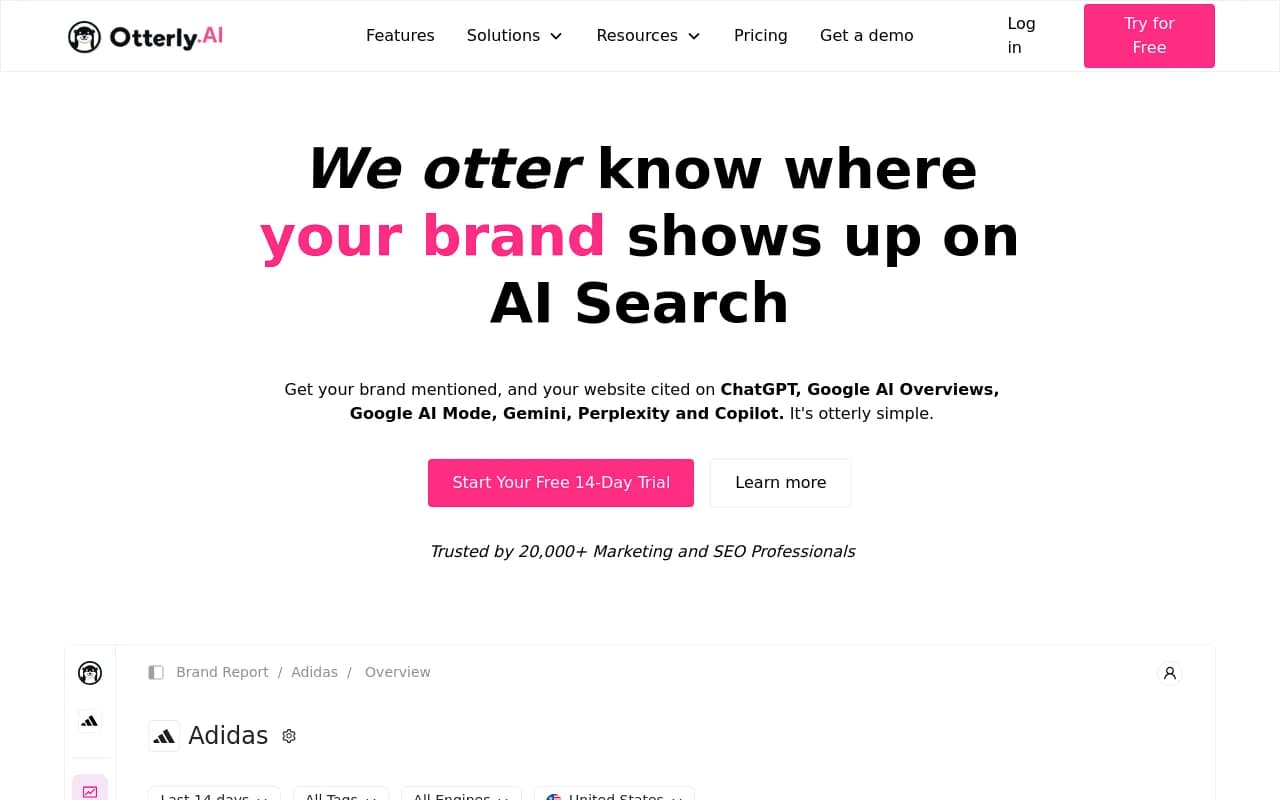
It tracks brand mentions across ChatGPT, Perplexity, and Google AI Overviews, and the share of voice reporting is clean and easy to read. The competitor benchmarking is basic compared to Promptwatch or Profound, but for teams that don't need deep analysis, it's more than enough. The main limitation is that it stops at monitoring. There's no content gap analysis, no writing tools, and no crawler logs. If you outgrow it, you'll know.
5. SE Visible
SE Visible is the AI visibility module from SE Ranking, and it's worth considering if you're already in the SE Ranking ecosystem. It covers citation and source tracking across generative engines, competitor benchmarking, and sentiment analysis, which puts it ahead of basic monitoring tools.
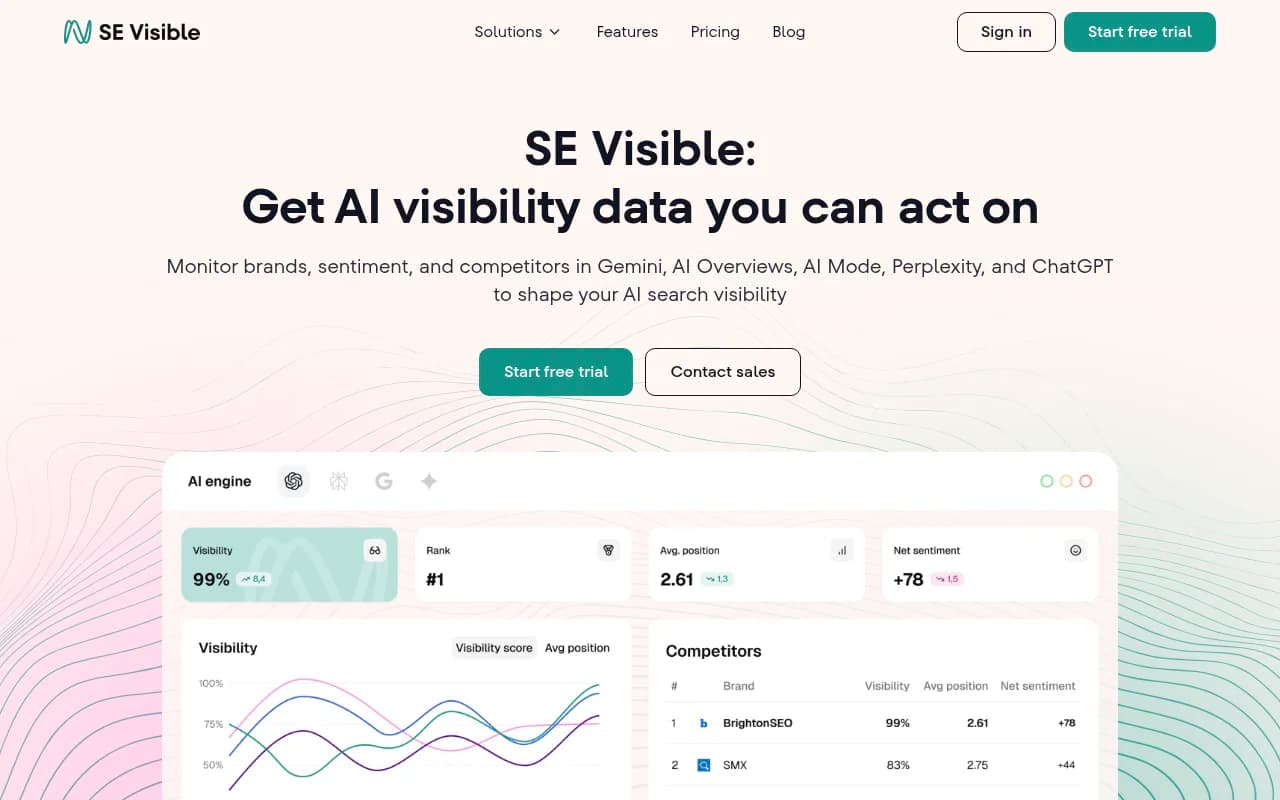
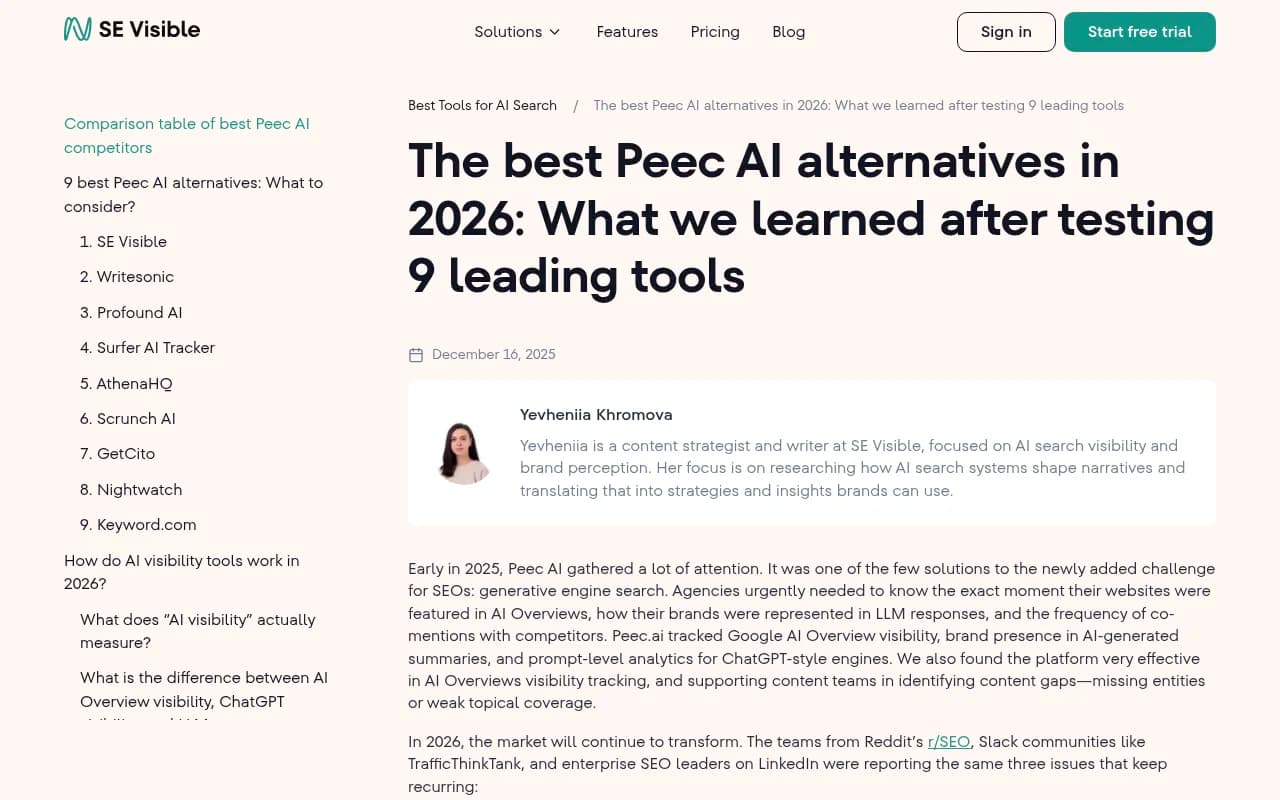
The sentiment analysis is a differentiator. Knowing whether AI models are describing your brand positively, neutrally, or negatively is useful context that pure citation counts don't give you. The platform is aimed at CMOs and marketing leaders who need strategic visibility data rather than just raw numbers. Starting price is around $189/month, which is on the higher end for what you get, but the integration with SE Ranking's broader SEO data is a genuine advantage if you're already paying for that.
6. Athena HQ
Athena HQ covers multi-engine AI visibility across Google AI Overviews, Perplexity, ChatGPT, and Claude, with a focus on competitive intelligence. The heatmap-style competitor comparisons are well-designed and make it easy to see at a glance where you're losing ground and to whom.
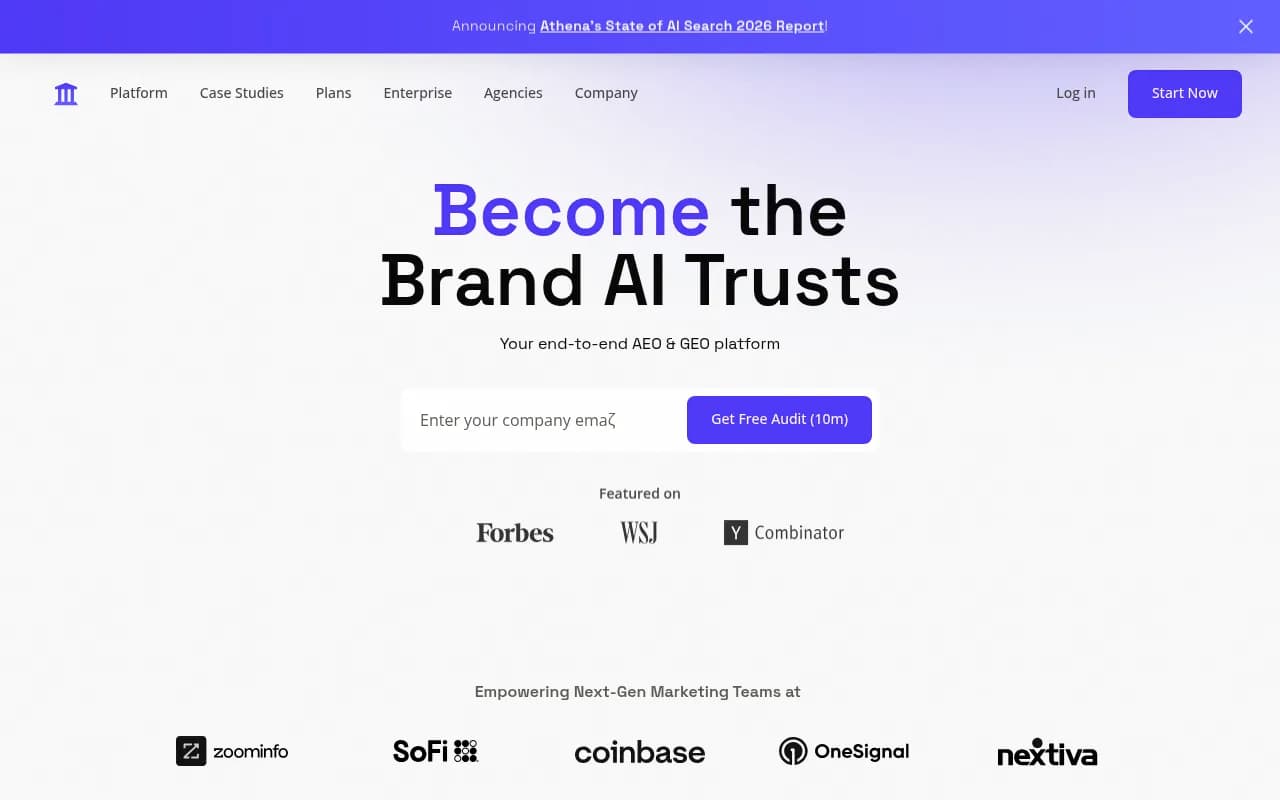
It's positioned for brands competing in AI-native search and CI teams that need to track competitor movements across models. The main gap is on the optimization side: Athena HQ is primarily a monitoring and analysis tool, so like Profound, you'll need to take the data elsewhere to act on it. Pricing starts at $295/month, which is the highest entry point on this list, so it needs to justify itself with volume and depth of data.
7. LLM Pulse
LLM Pulse is a solid mid-range option that covers brand mentions, citations, and AI share of voice across ChatGPT, Gemini, and Google AI Mode. It includes data export options and API connectors, which makes it easier to pull AI visibility metrics into existing reporting workflows.
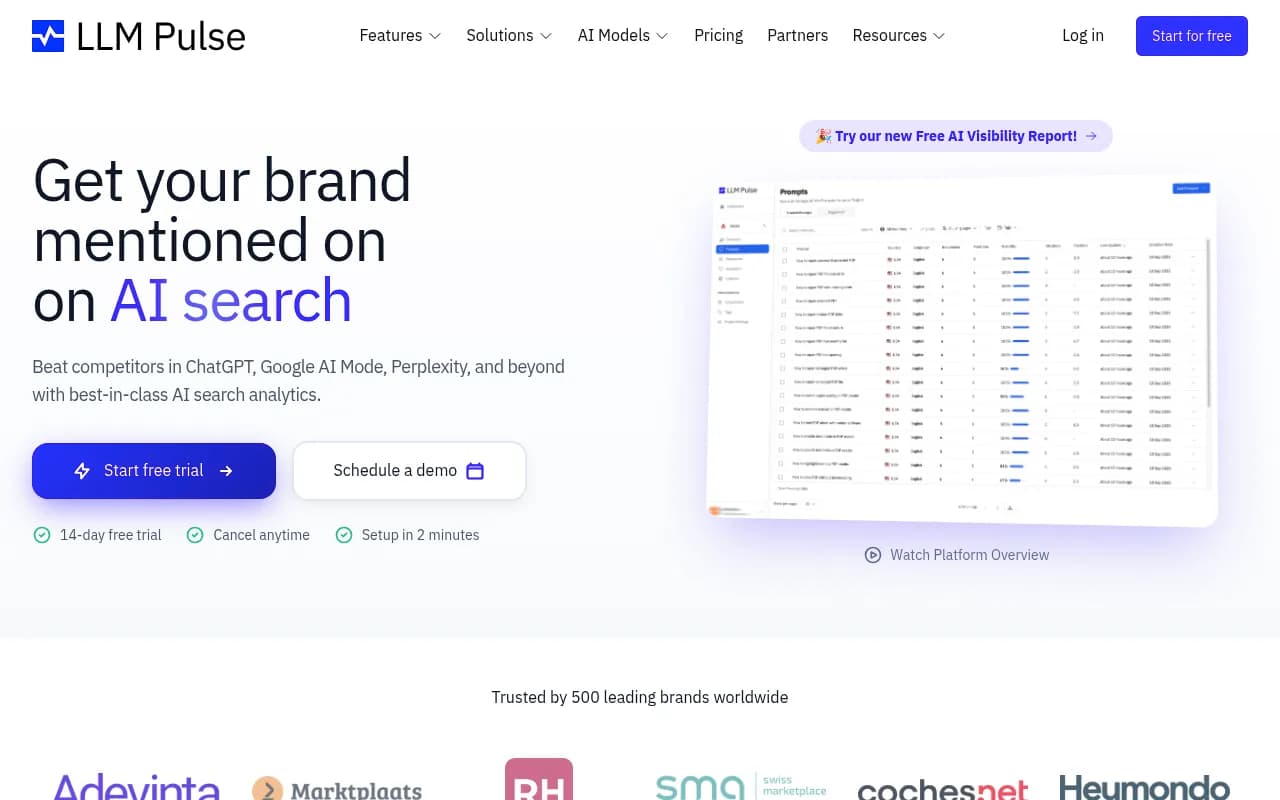
The prompt discovery feature is useful for teams that haven't yet mapped out which queries matter for their category. It surfaces prompts your audience is likely using, which gives you a starting point for both monitoring and content strategy. It's budget-friendly compared to the enterprise options, and the free tier makes it easy to test before committing. The limitation is depth: it doesn't have the content generation capabilities or crawler logs that the top-tier platforms offer.
Comparison table
| Tool | Engine coverage | Competitor benchmarking | Share of voice | Content generation | Crawler logs | Starting price |
|---|---|---|---|---|---|---|
| Promptwatch | 10 models | Deep (prompt-level) | Yes, with trends | Yes (AI writing agent) | Yes | $99/mo |
| Profound | Google AIO + others | Entity-level | Yes | No | No | ~$99/mo |
| Scrunch AI | Multi-engine | Narrative-focused | Yes | No | No | Custom |
| Otterly AI | ChatGPT, Perplexity, AIO | Basic | Yes | No | No | Low |
| SE Visible | Multi-engine | Yes + sentiment | Yes | No | No | $189/mo |
| Athena HQ | 4 models | Heatmap-style | Yes | No | No | $295/mo |
| LLM Pulse | ChatGPT, Gemini, AIO | Basic | Yes | No | No | Free tier |
How to choose
The right tool depends on what you're actually trying to do.
If you're just starting out and need to understand whether your brand appears in AI responses at all, Otterly AI or LLM Pulse will get you there without a big investment. They're monitoring tools, and that's fine if monitoring is all you need right now.
If you're running a brand-sensitive campaign and care about how AI models describe you, not just whether they mention you, Scrunch AI's narrative analysis is worth the look.
If you're in an enterprise environment with a dedicated SEO or content team and need entity-level attribution, Profound is well-suited. Same goes for SE Visible if you're already inside the SE Ranking ecosystem.
If you need the full picture: which prompts competitors are winning, why, what content to create to close the gap, and whether that content is actually getting crawled and cited, Promptwatch is the only platform that handles all of that in one place. The combination of Answer Gap Analysis, the AI writing agent, and the crawler logs is genuinely different from what the monitoring-only tools offer. Most of the alternatives on this list stop at step one. Promptwatch is built around the whole cycle.
The shift that makes this matter
It's worth being direct about why this category exists at all. Traditional rank tracking measures where you appear in a list. AI search doesn't work that way. When someone asks ChatGPT or Perplexity which CRM to use, which hotel to book, or which agency to hire, the answer is a recommendation, not a list of ten blue links. Your brand either gets mentioned or it doesn't.
Share of voice in AI search is closer to share of voice in PR than in SEO. The question isn't "what position am I in?" It's "when AI models answer questions in my category, how often am I part of that answer, and how often is it my competitor instead?"
That framing changes what you need from a tool. Monitoring tells you the current score. Competitor benchmarking tells you who's winning and where. Content gap analysis tells you what to do about it. The tools that offer all three are worth the investment. The ones that only offer the first are a starting point, not a strategy.