Key takeaways
- Peec AI is a monitoring-first platform: clean, fast, and good at showing you where your brand appears across AI search engines -- but it stops there.
- Relixir positions itself as an all-in-one GEO platform with content generation, competitive gap analysis, and publishing workflows built in.
- If you only need visibility data, Peec AI's lower price point makes sense. If you need to act on that data, you'll quickly hit its ceiling.
- A third option worth knowing: Promptwatch covers both monitoring and optimization in a single platform, with 1.1B+ citations analyzed and a built-in AI writing agent -- making it the most complete option for teams serious about AI search.
- The right choice depends on whether you're in "understand mode" or "grow mode" -- and most teams need both.
The problem with monitoring-only GEO tools
There's a version of this comparison that's pretty simple: Peec AI shows you data, Relixir helps you do something with it. But the reality is more nuanced than that, and the "right" answer depends heavily on where your team is right now.
Generative Engine Optimization is still new enough that many marketing teams are in discovery mode -- they want to know whether they're even showing up in ChatGPT, Perplexity, or Google AI Overviews before they commit to a full optimization workflow. That's a legitimate place to start. Peec AI was built for exactly that moment.
The problem is that most teams don't stay in discovery mode for long. Once you see that a competitor is getting cited for 40 prompts you're invisible on, the next question is obvious: what do I do about it? And that's where monitoring-only tools leave you stranded.
Let's look at both platforms honestly.
Peec AI: what it does well
Peec AI launched in February 2025 out of Berlin and raised $21M in a Series A in November 2025 -- which tells you the market sees real potential here. The product is focused on prompt monitoring: you set up a list of prompts relevant to your brand or category, and Peec queries AI platforms at regular intervals (typically daily) to track whether and how you appear.

The UI is genuinely clean. Visibility metrics are easy to read, prompt-level comparisons are straightforward, and the onboarding is fast. For a marketing team that's never tracked AI visibility before, Peec AI is a low-friction way to get started.
What Peec tracks:
- Brand mentions across ChatGPT, Perplexity, Gemini, and others
- Prompt-level visibility scores
- Competitor comparisons at the prompt level
- Visibility trends over time
Where it falls short:
- Prompt-first approach means you're limited to the prompts you already know to ask -- there's no gap analysis to surface prompts you're missing
- No content generation or optimization tools
- No crawler log access to understand how AI bots are indexing your site
- No Reddit or YouTube tracking (both are significant citation sources for AI models)
- No traffic attribution to connect AI visibility to actual revenue
One reviewer on generatemore.ai described Peec's approach as "real-time UI scraping" -- querying AI platforms at regular intervals and pulling structured data from the responses. That's accurate, and it works well for what it is. But it's a data collection layer, not an optimization layer.
Relixir: the all-in-one pitch
Relixir markets itself as an end-to-end GEO platform for B2B SaaS companies. The core pitch is that it combines AI visibility monitoring with content generation and competitive analysis -- so you can see where you're missing and then create content to fill those gaps.
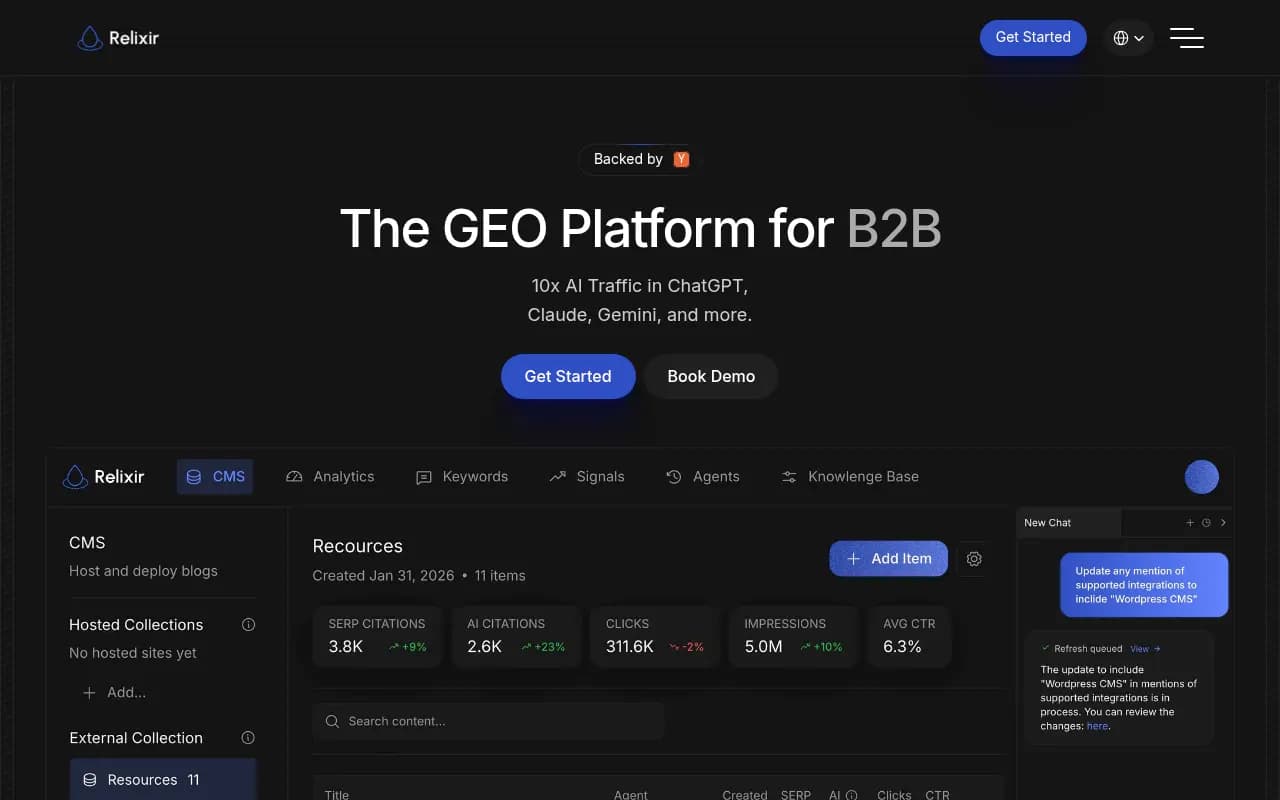
According to Relixir's own positioning (from their 2025 B2B SaaS roundup), the platform is built around:
- Competitive gap analysis: identifying which prompts competitors rank for that you don't
- AI-native content generation: producing articles and pages optimized for AI citation
- Visibility tracking across major LLMs
- Analytics to measure content performance over time
This is a more ambitious product than Peec AI, and for teams that are ready to move from tracking to building, it's a meaningful step up.
That said, Relixir is relatively new and primarily targets B2B SaaS companies specifically. If you're in e-commerce, hospitality, or a consumer brand, the product's framing and templates may feel less tailored to your use case.
Feature comparison
Here's a direct look at how the two platforms compare across the capabilities that matter most for GEO:
| Feature | Peec AI | Relixir |
|---|---|---|
| AI platform monitoring | Yes (ChatGPT, Perplexity, Gemini, others) | Yes |
| Prompt-level visibility scores | Yes | Yes |
| Competitor visibility comparison | Yes | Yes |
| Answer gap analysis | No | Yes |
| AI content generation | No | Yes |
| Content publishing workflow | No | Yes |
| AI crawler log access | No | No |
| Reddit/YouTube citation tracking | No | No |
| Traffic attribution | No | Limited |
| ChatGPT Shopping tracking | No | No |
| Multi-language support | Yes (multi-language) | Limited |
| Pricing transparency | Yes (entry ~$29/mo) | Less transparent |
| Primary target audience | Marketing teams broadly | B2B SaaS specifically |
The pattern is clear: Peec AI is wider in language/region coverage, Relixir is deeper in the optimization workflow. Neither covers the full picture.
Where both tools leave gaps
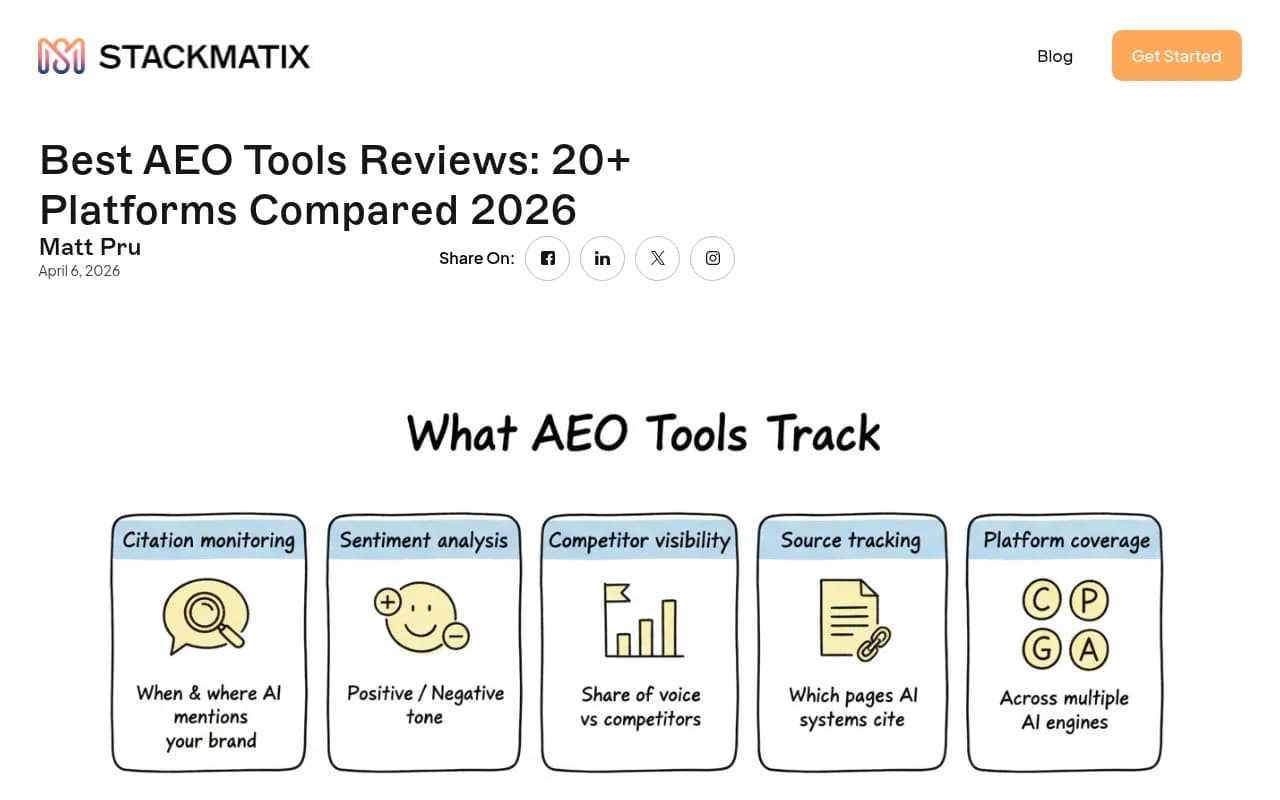
Reading through third-party reviews (Stackmatix's 2026 AEO tool roundup, Visiblie's comparison, generatemore.ai's testing), a few gaps come up consistently for both platforms:
No crawler log access. Neither Peec nor Relixir shows you which pages AI crawlers are actually visiting on your site, how often, or what errors they're encountering. This matters because AI models can only cite content they've actually indexed. If ChatGPT's crawler is hitting a 404 on your best product page, you won't know -- and your visibility scores will suffer for reasons you can't diagnose.
No Reddit or YouTube tracking. AI models like ChatGPT and Perplexity frequently cite Reddit discussions and YouTube content in their responses. Neither platform tracks these sources, which means you're missing a significant part of the citation picture.
Limited traffic attribution. Knowing you're cited in AI responses is useful. Knowing that those citations drove 340 visits and $12,000 in pipeline last month is actionable. Both platforms are weak here.
No ChatGPT Shopping. For brands selling products, ChatGPT's shopping recommendations are increasingly important. Neither tool tracks this.
These aren't minor gaps -- they're the difference between a monitoring dashboard and a full optimization system.
The case for going further: what a complete GEO platform looks like
If you're evaluating Peec AI vs Relixir, you're probably asking the right question but looking at a slightly narrow field. The GEO tool category has matured enough in 2026 that there are platforms doing all of this -- monitoring, gap analysis, content generation, crawler logs, traffic attribution -- in one place.
Promptwatch is the clearest example. It's used by 6,700+ brands and agencies (including Booking.com and Center Parcs), has processed over 1.1 billion citations, and covers 10 AI models: ChatGPT, Perplexity, Claude, Gemini, Google AI Overviews, Google AI Mode, Grok, DeepSeek, Meta AI, and Copilot.

What makes Promptwatch different from both Peec and Relixir isn't just the feature count -- it's the loop:
- Find the gaps: Answer Gap Analysis shows exactly which prompts competitors are visible for that you're not. You see the specific content your site is missing.
- Create content that ranks in AI: The built-in AI writing agent generates articles grounded in real citation data, prompt volumes, and competitor analysis -- not generic SEO filler.
- Track the results: Page-level tracking shows which pages are being cited, how often, and by which models. Traffic attribution (via code snippet, GSC integration, or server log analysis) connects visibility to revenue.
On top of that: AI crawler logs, Reddit and YouTube citation tracking, ChatGPT Shopping monitoring, prompt difficulty scores, query fan-outs, and competitor heatmaps. Pricing starts at $99/month for the Essential plan (1 site, 50 prompts, 5 articles), with a free trial available.
That's not a knock on Peec or Relixir -- both are doing real things. But if you're building a serious GEO practice, it's worth knowing what the full stack looks like.
Which tool is right for you?
Here's the honest breakdown:
Choose Peec AI if:
- You're just starting to track AI visibility and want a clean, low-friction entry point
- Your budget is tight and you need something under $30/month
- You operate in multiple languages and regions (Peec's multi-language support is genuinely strong)
- You don't yet have a content production workflow to feed optimization insights into
Choose Relixir if:
- You're a B2B SaaS company specifically (the product is built around that use case)
- You want monitoring and content generation in one tool without stitching together multiple platforms
- You're ready to act on competitive gap data, not just observe it
- You're comfortable with a newer, less established platform
Consider Promptwatch if:
- You need the full picture: monitoring, gap analysis, content generation, crawler logs, traffic attribution, and Reddit/YouTube tracking
- You're at a brand or agency where AI visibility is a core channel, not an experiment
- You want to connect AI citations to actual revenue, not just track mention counts
- You need multi-model coverage across 10 AI platforms with prompt volume and difficulty data
A note on the monitoring-only trap
One thing worth saying directly: there's a real risk in treating AI visibility monitoring as a destination rather than a starting point.
The teams winning in AI search right now aren't just watching their dashboards. They're publishing content specifically engineered to get cited -- structured, authoritative, question-answering content that AI models want to reference. They're fixing crawler errors so AI bots can actually read their pages. They're tracking which Reddit threads are influencing AI recommendations and showing up there.
Peec AI gives you a window into the problem. Relixir gives you some tools to address it. But neither covers the full loop from "we're invisible" to "we're being cited and it's driving revenue."
That gap is exactly why platforms like Promptwatch exist -- and why the GEO category is moving fast toward action, not just observation.
Bottom line
Peec AI and Relixir represent two different philosophies about what a GEO tool should be. Peec is clean, focused, and honest about being a monitoring product. Relixir is more ambitious, trying to own the full workflow for B2B SaaS teams.
If you're choosing between them, Relixir is the better long-term bet for teams that are ready to optimize, not just observe. But if you want to skip the "monitoring-only" phase entirely and go straight to a platform that closes the loop from gap identification to content creation to revenue attribution, it's worth looking at what Promptwatch offers before you commit.
The AI search landscape is moving fast. The teams that win won't be the ones with the best dashboards -- they'll be the ones that turned their visibility data into content that AI models actually cite.