Key takeaways
- All three platforms track AI search visibility, but they differ sharply on what happens after you see the data
- Profound is the strongest option for enterprise teams that need real user prompt data and deep crawler analytics, but the price point ($399/mo minimum) puts it out of reach for most growth teams
- Omnia targets lean startups with native monitoring plus a content action layer at more accessible pricing
- Promptwatch is the only platform of the three rated as a "Leader" across all GEO categories in 2026, combining monitoring, content gap analysis, AI-generated content, and traffic attribution in one stack
- The core question isn't which tool has the most features -- it's which one closes the loop between "you're invisible here" and "here's how to fix it"
If you've been shopping for a GEO platform lately, you've probably noticed that most comparison articles treat monitoring dashboards as the finish line. They'll show you which tool tracks the most AI engines, which has the prettiest charts, which has the most competitive pricing tier. What they rarely ask is: after you see the data, then what?
That's the question this guide is built around. Omnia, Profound, and Promptwatch are three of the more serious players in the AI search visibility space in 2026. They're not the same product. They're not even targeting the same customer. And the differences between them matter a lot depending on what your team actually needs to accomplish.
Let's get into it.
What we're actually comparing
Before diving into features, it's worth being clear about what "GEO platform" means in 2026, because the category has gotten messy.
Some tools are pure monitoring dashboards. They show you where your brand appears in ChatGPT, Perplexity, Claude, and other AI engines. That's useful, but it's table stakes. The harder problem is figuring out why you're invisible for certain prompts and what content changes would fix it.
A smaller set of platforms have built what you might call an action layer -- tools that go from "you're missing here" to "here's what to create." That's where the real differentiation lives.
Omnia, Profound, and Promptwatch all sit somewhere on this spectrum. None of them are pure monitoring-only tools. But they sit at very different points, and they're priced accordingly.
Profound: enterprise-grade data depth, enterprise-grade price
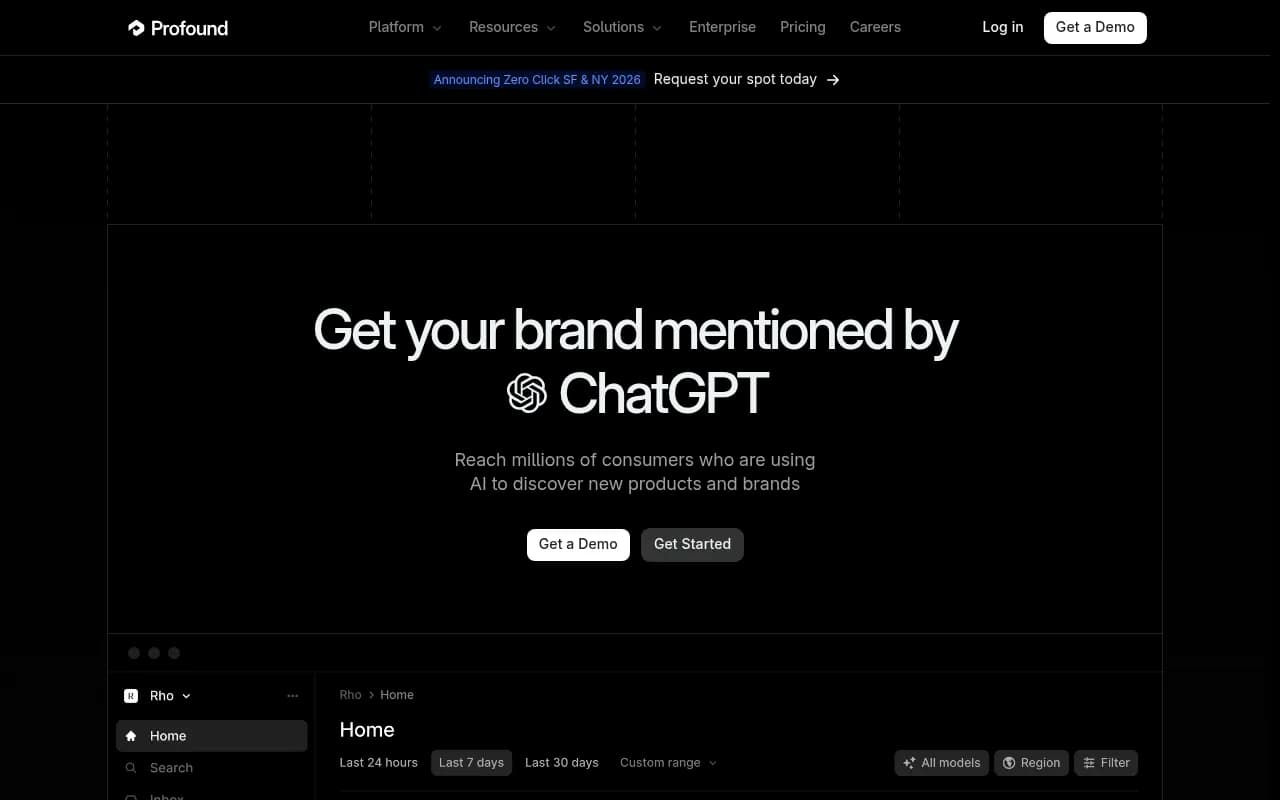
Profound's main selling point is data that most competitors can't match. The platform processes 400M+ real user prompts, which means its visibility tracking is grounded in what people are actually typing into AI engines -- not synthetic queries that a platform generates to approximate behavior.
That distinction matters more than it sounds. Synthetic prompts can miss the long-tail, conversational queries that drive a lot of AI search traffic. Real user prompt data gives you a more honest picture of where your brand actually stands.
Profound also has strong crawler analytics. You can see how AI engines are discovering and reading your content, which pages they're hitting, and where they're running into problems. For enterprise teams managing large content libraries, that level of technical insight is genuinely valuable.
The problem is pricing. Profound starts at $399/month, and multi-engine coverage with the full action layer pushes costs significantly higher. For a Fortune 500 brand or a well-funded scale-up, that's defensible. For a startup or a mid-market team with a lean budget, it's a hard sell when you're still figuring out whether GEO is going to move the needle for you.
Profound also doesn't track Reddit or YouTube -- two channels that increasingly influence what AI models cite in their responses. That's a gap worth noting if your category has active community discussion.
Best for: Enterprise teams that need the deepest possible data foundation and have the budget to match.
Omnia: lean teams, native action layer, accessible pricing
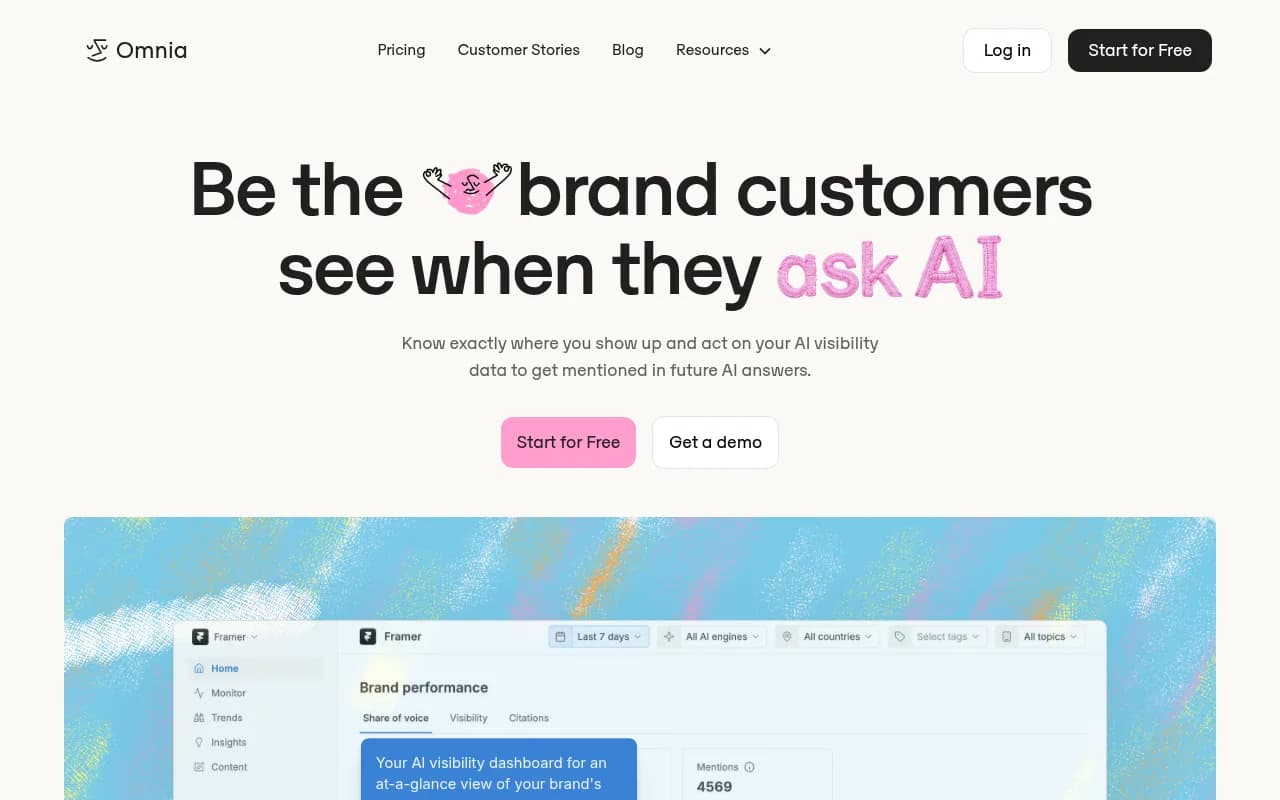
Omnia is positioning itself as the option for startups and lean growth teams that want both monitoring and execution without the enterprise price tag.
The platform covers multi-engine AI search monitoring and offers URL-level citation intelligence -- meaning you can see not just whether your brand appears, but which specific pages are being cited. That's more granular than many competitors offer at this price point.
Where Omnia differentiates is its native action layer. Rather than showing you a gap and leaving you to figure out what to do with it, Omnia generates content briefs and execution tasks directly from the visibility data. You don't need to export data, paste it into a separate writing tool, and then manually figure out what angle to take. The workflow is more contained.
That said, Omnia's content generation is more brief-oriented than fully generative. It tells you what to write more than it writes it for you. That's a meaningful distinction if your team is small and doesn't have dedicated content resources.
Omnia also doesn't have the same depth of real user prompt data that Profound has. Its prompt intelligence is solid for the price, but if you're in a competitive category where nuanced query data matters, you'll feel the difference.
Best for: Lean startup teams that need monitoring plus content direction without complex API setups or enterprise budgets.
Promptwatch: the full-stack option
Promptwatch takes a different approach than either Profound or Omnia. Where Profound goes deep on data and Omnia goes lean on execution, Promptwatch is built around what it calls the action loop: find the gaps, create content that ranks in AI, track the results.

That loop is more complete than it sounds. The Answer Gap Analysis shows you exactly which prompts competitors are visible for but you're not -- not just in aggregate, but at the specific topic and angle level. You can see the precise content your site is missing. Then the built-in AI writing agent generates articles, listicles, and comparisons grounded in 880M+ citations analyzed, prompt volumes, and competitor data. This isn't generic content generation -- it's engineered around what AI models actually cite.
Then you close the loop with traffic attribution. Promptwatch connects AI visibility to actual revenue through a code snippet, Google Search Console integration, or server log analysis. Most GEO platforms stop at "your visibility score went up." Promptwatch lets you see whether that translated into clicks and conversions.
A few other things worth mentioning:
AI Crawler Logs are real-time logs of AI crawlers hitting your website -- which pages ChatGPT, Claude, Perplexity, and others are reading, how often they return, and what errors they encounter. Most competitors don't have this at all.
Reddit and YouTube tracking surfaces the discussions that actually influence AI recommendations. This is a channel most platforms ignore entirely, and it matters because AI models frequently cite Reddit threads and YouTube content in their responses.
ChatGPT Shopping tracking monitors when your brand appears in ChatGPT's product recommendations and shopping carousels -- a feature that's increasingly relevant as AI becomes a purchase discovery channel.
Prompt Intelligence gives you volume estimates and difficulty scores for each prompt, plus query fan-outs that show how one prompt branches into sub-queries. That lets you prioritize high-value, winnable prompts instead of guessing.
Promptwatch monitors 10 AI models: ChatGPT, Perplexity, Google AI Overviews, Google AI Mode, Claude, Gemini, Meta/Llama, DeepSeek, Grok, Mistral, and Copilot. Pricing starts at $99/month for the Essential plan (1 site, 50 prompts, 5 articles), $249/month for Professional (2 sites, 150 prompts, 15 articles, crawler logs), and $579/month for Business (5 sites, 350 prompts, 30 articles). A free trial is available.
In a 2026 comparison of 12 GEO platforms, Promptwatch was the only platform rated as a "Leader" across all categories -- the core reason being that most competitors stop at monitoring while Promptwatch is built around optimization.
Best for: Marketing and SEO teams that want to move from visibility data to actual content improvements without switching tools, and need to connect AI visibility to revenue.
Side-by-side comparison
| Feature | Omnia | Profound | Promptwatch |
|---|---|---|---|
| AI engines monitored | Multiple | Multiple | 10 (ChatGPT, Claude, Perplexity, Gemini, Grok, DeepSeek, Copilot, Meta AI, Google AI Overviews, Mistral) |
| Real user prompt data | No | 400M+ prompts | Prompt volume estimates + difficulty scores |
| URL-level citation tracking | Yes | Yes | Yes (page-level tracking) |
| Content gap analysis | Partial (briefs) | Yes | Full Answer Gap Analysis |
| Native AI content generation | Brief-oriented | Yes (enterprise tier) | Yes (articles, listicles, comparisons) |
| AI crawler logs | No | Yes | Yes |
| Reddit/YouTube tracking | No | No | Yes |
| ChatGPT Shopping tracking | No | No | Yes |
| Traffic attribution | No | Partial | Yes (GSC, code snippet, server logs) |
| Multi-language/region | Yes | Yes | Yes |
| Starting price | Startup-friendly | $399/mo | $99/mo |
| Free trial | Yes | No | Yes |
| Best for | Lean startups | Enterprise | Marketing/SEO teams at any stage |
How to choose
The honest answer is that the right choice depends on where you are and what you need to accomplish.
If you're an enterprise team with a large content operation and you need the most rigorous prompt data available, Profound is worth the price. The 400M+ real user prompts are a genuine differentiator, and the crawler analytics are enterprise-grade.
If you're a startup or small growth team that needs to get moving quickly without a complex setup or a large budget, Omnia is a reasonable starting point. The native action layer is more useful than a pure monitoring dashboard, and the pricing is accessible.
If you're a marketing or SEO team that needs to actually move the needle -- not just track it -- Promptwatch is the most complete option. The combination of Answer Gap Analysis, AI content generation grounded in real citation data, crawler logs, Reddit/YouTube tracking, and traffic attribution means you're not just watching your visibility score. You're changing it, and you can prove it.
The monitoring-only approach made sense when GEO was new and teams were still figuring out whether AI search mattered. In 2026, that phase is over. The question now is which platform helps you win the prompts that drive revenue, not just which one shows you the prettiest dashboard.
A note on the broader market
These three aren't the only options worth knowing about. The GEO platform space has expanded significantly, and a few other tools are worth a look depending on your specific situation.

Otterly.AI is a solid entry point for teams that want affordable monitoring without committing to a full-stack platform. It doesn't have content generation or gap analysis, but it covers the basics well.

AthenaHQ is monitoring-focused with good multi-engine coverage, but like Otterly, it stops short of content optimization and generation.
Scrunch AI covers monitoring and some optimization features, with a particular focus on enterprise brand safety alongside visibility tracking.
The pattern you'll notice across most alternatives: they're strong on monitoring, weaker on the action layer. That's the gap Promptwatch is specifically built to close, and it's why the platform comparison consistently puts it in a different category from the rest.
Bottom line
Omnia, Profound, and Promptwatch are all serious tools. None of them are bad choices. But they're solving different versions of the same problem.
Profound solves the data problem at enterprise scale. Omnia solves the budget problem for lean teams. Promptwatch solves the action problem -- the gap between knowing you're invisible and actually doing something about it -- at a price point that works for teams that aren't Fortune 500 but still need to compete seriously in AI search.
If your team is past the "should we care about GEO?" phase and into the "how do we win?" phase, that distinction is what matters most.