Key takeaways
- Both Meteoria.ai and Profound are positioned at enterprise buyers, but Profound has significantly more documented feature depth, including prompt volume data, agent analytics, and SOC 2 Type II certification.
- Neither platform closes the full loop from monitoring to content creation to traffic attribution on its own -- a gap worth considering before committing at enterprise pricing.
- Profound's agency mode and partnership program make it a stronger fit for agencies managing multiple brands; Meteoria.ai is less documented in this area.
- For teams that want monitoring and optimization (content generation, crawler logs, revenue attribution), both platforms leave work on the table compared to newer all-in-one options.
- Free trials and demos are available for both -- worth testing before signing an annual contract.
Why this comparison matters in 2026
The AI search visibility category has exploded. Two years ago, most marketing teams had never heard of "GEO" (Generative Engine Optimization). Now, enterprise marketing leaders are fielding RFPs for AI visibility platforms the same way they once did for SEO suites.
Meteoria.ai and Profound both sit at the premium end of this market. They're not the cheapest options, and they're not designed for solo operators or small startups. They're built -- or at least marketed -- for large teams with real budgets, multiple brands, and complex reporting needs.
That's exactly why comparing them carefully matters. At enterprise price points, the wrong choice costs more than money. It costs months of onboarding, internal buy-in, and opportunity cost while competitors build AI visibility you don't have.
This guide breaks down what each platform actually does, where they differ, and what large teams should think about before signing anything.
What Meteoria.ai does
Meteoria.ai is an AI search visibility platform focused on tracking brand mentions and citations across major LLMs. Its core proposition is giving enterprise teams a structured view of how their brand appears in AI-generated responses -- across ChatGPT, Perplexity, Gemini, and others.
The platform emphasizes multi-brand management, which makes it relevant for enterprise teams running several product lines or regional variations. It also offers competitive benchmarking, letting teams see how their AI visibility stacks up against named competitors across specific prompt categories.
Where Meteoria.ai is less clear is on the optimization side. The platform's documentation and public-facing materials focus heavily on monitoring and reporting. Whether it helps teams act on what they find -- through content recommendations, gap analysis, or direct integrations with content workflows -- is harder to verify from public information alone.
That ambiguity is worth flagging. In 2026, "monitoring only" is increasingly a liability. Knowing you're invisible in ChatGPT responses is useful. Knowing why and having a clear path to fix it is what actually moves the needle.
What Profound does
Profound has been one of the more visible players in the enterprise AI visibility space through 2025 and into 2026. According to one ranking that assessed nine platforms by AEO score, Profound scored 92/100, citing its coverage of 10+ AI engines and a dataset of 400M+ prompt insights.
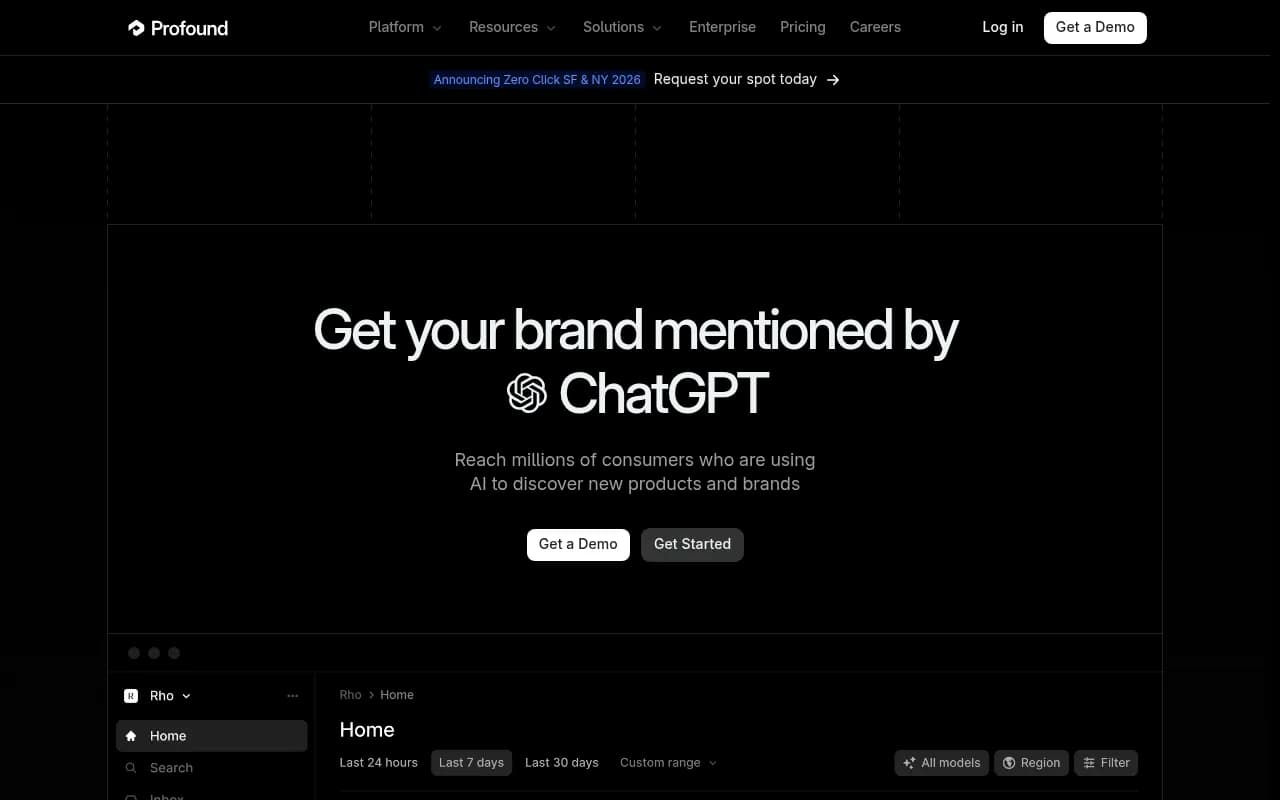
The platform's feature set includes:
- Answer engine insights across major LLMs
- Agent analytics (tracking how AI agents interact with your brand)
- Prompt volume data (so teams can prioritize high-traffic queries)
- Shopping tracking for ChatGPT product recommendations
- An agency mode with brand configurations and pitch environments
- SOC 2 Type II certification (relevant for enterprise security reviews)
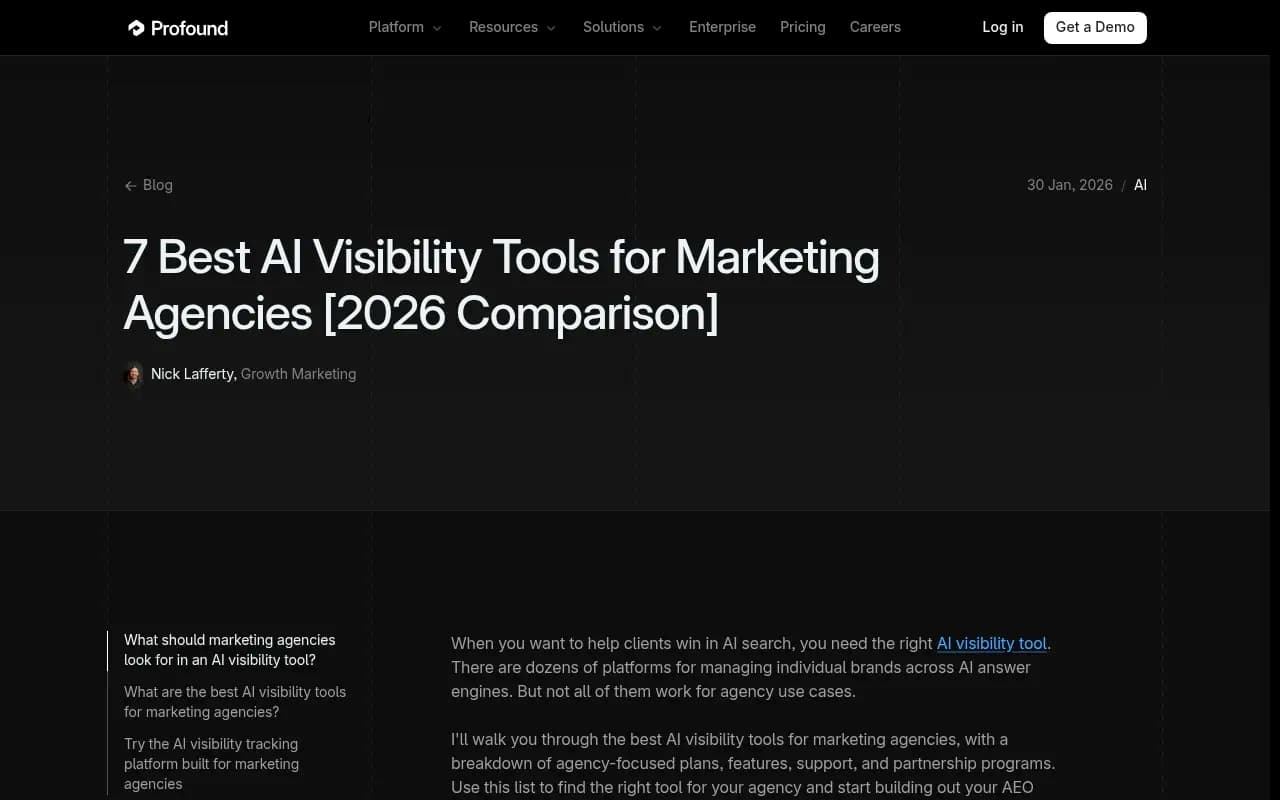
Profound also runs a partner program and "Profound University," which suggests investment in customer success beyond just selling licenses. For large teams that need internal training and enablement, that infrastructure matters.
The honest caveat: Profound's pricing sits at the higher end of the market. It's designed for teams with budget, and the sales process is demo-driven rather than self-serve. That's fine for enterprise buyers, but it means smaller teams often look elsewhere.
Head-to-head comparison
Here's how the two platforms stack up across the dimensions that matter most to large teams:
| Feature | Meteoria.ai | Profound |
|---|---|---|
| LLM coverage | Multiple (exact count unclear) | 10+ AI engines |
| Prompt volume data | Not clearly documented | Yes |
| Agent analytics | Not documented | Yes |
| Shopping tracking | Not documented | Yes (ChatGPT Shopping) |
| Agency/multi-brand mode | Yes | Yes (dedicated agency mode) |
| SOC 2 certification | Not documented | Type II certified |
| Content optimization | Limited/unclear | Limited (monitoring-focused) |
| Content generation | Not documented | Via "Agents" feature |
| Crawler log access | Not documented | Not clearly documented |
| Revenue attribution | Not documented | Not clearly documented |
| Partnership program | Not documented | Yes (Profound Partners) |
| Pricing model | Enterprise/custom | Enterprise/demo-required |
| Self-serve trial | Unclear | Demo-required |
The table reveals something worth sitting with: even Profound, the more feature-rich of the two, has gaps on the optimization side. Revenue attribution and crawler log access -- two features that connect AI visibility to actual business outcomes -- aren't clearly part of either platform's core offering.
Where both platforms fall short
This is the part that doesn't show up in vendor marketing.
Both Meteoria.ai and Profound are primarily monitoring platforms. They're good at showing you what's happening in AI search -- where your brand appears, how often, in what context. That's genuinely useful data.
But the harder problem for enterprise teams isn't knowing they have an AI visibility gap. It's fixing it. And that requires:
- Understanding which specific content is missing -- the exact topics and questions AI models want to answer but can't find on your site
- Creating content that's actually engineered to get cited by LLMs, not just generic SEO articles
- Tracking whether that content actually improved your visibility scores over time
- Connecting visibility improvements to traffic and revenue
Neither platform has a clean, documented answer to all four of those steps. Profound's "Agents" feature gestures toward content creation, but it's not clear how deeply it integrates with the monitoring data to close the loop.
For teams evaluating enterprise AI visibility platforms, this gap is worth probing in your demo. Ask specifically: "If your tool shows me I'm invisible for a high-volume prompt, what does your platform do to help me fix that?" The answer will tell you a lot.
Who each platform suits best
Profound is the better fit if:
- You're running an agency managing multiple client brands and need dedicated agency infrastructure (pitch environments, brand configurations, client reporting)
- Security and compliance matter -- SOC 2 Type II is a real differentiator for enterprise procurement
- You want prompt volume data to prioritize which AI search queries are worth optimizing for
- Your team is large enough to benefit from Profound University's training resources
Meteoria.ai is worth considering if:
- You're specifically looking for multi-brand monitoring with competitive benchmarking at the center of your workflow
- You've seen a demo and the UX fits your team's reporting style better than Profound's interface
- Your procurement team has specific requirements that Meteoria.ai's enterprise terms address better
The honest truth is that Profound has more publicly documented capabilities and a stronger track record in the market. Meteoria.ai is harder to evaluate without a direct demo, which makes it a riskier choice when you're committing enterprise budget.
The broader landscape: what else is out there
If you're evaluating Meteoria.ai and Profound, you should also look at what the wider market offers -- especially platforms that go beyond monitoring.
For enterprise teams that want the full loop -- gap analysis, content generation, and traffic attribution -- Promptwatch is worth a look. It's the only platform in a recent 12-tool comparison rated as a "Leader" across all categories, and its core differentiator is that it doesn't stop at monitoring. It shows you which prompts competitors rank for that you don't, generates content designed to get cited by LLMs, and tracks whether that content actually improved your visibility scores.

Other platforms worth knowing about in the enterprise space:
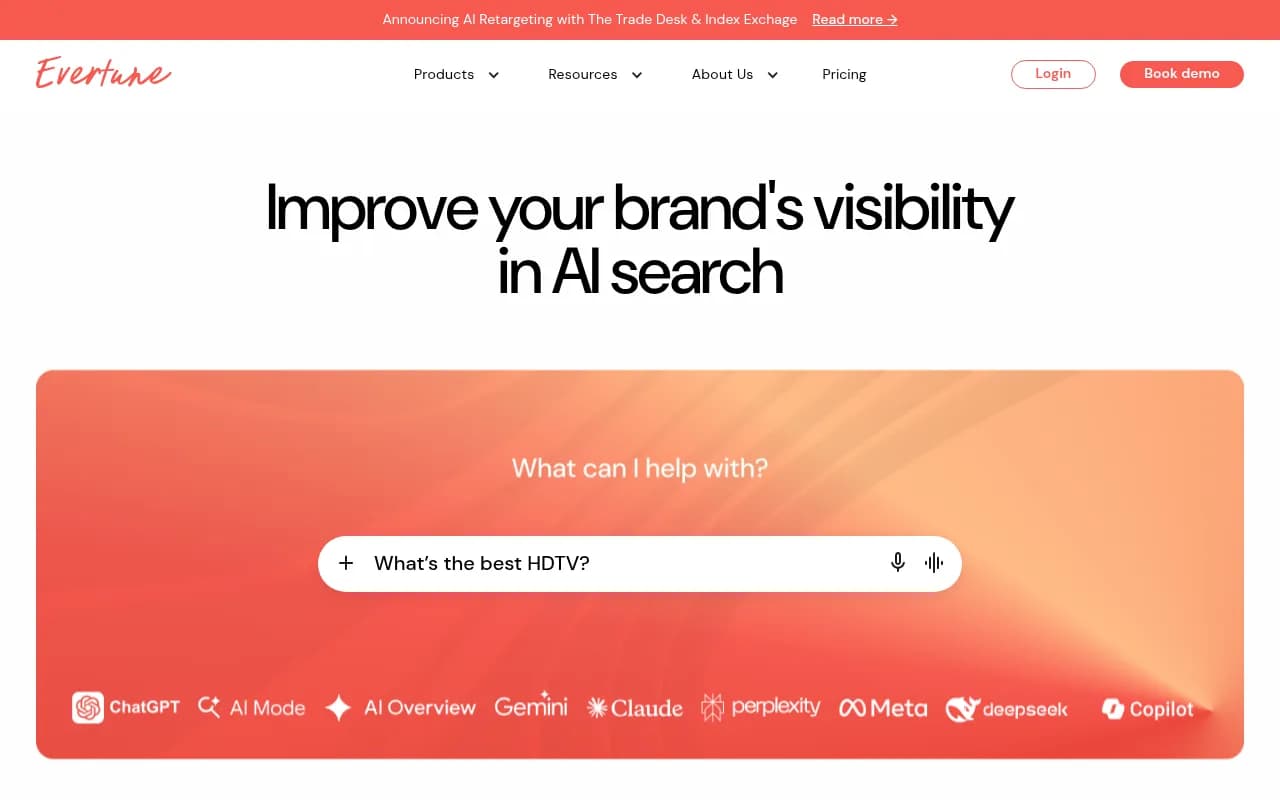
Evertune positions itself as an enterprise GEO platform trusted by Fortune 500 brands, with a focus on dominating AI search at scale.
Goodie AI markets itself as the gold standard for enterprise GEO, though its feature set is less publicly documented than Profound's.
Bluefish AI is another enterprise-focused option with a GEO emphasis.
AthenaHQ offers unlimited-seat pricing, which can be a significant cost advantage for large teams with many users who need access.
For agencies specifically, Search Party has built an agency-oriented offering, though it has limitations around prompt metrics and content gap analysis.
Search Party
Key metrics to track regardless of platform
Whichever platform you choose, make sure it measures these things -- and if it doesn't, ask why:
Visibility percentage by funnel stage. A single overall visibility score is almost meaningless. You want to know if you're visible at the awareness stage vs. the decision stage. A brand with 70% awareness visibility but 20% decision-stage visibility has a very specific problem to solve.
Position within AI responses. Being mentioned first vs. tenth in a list of recommendations has a disproportionate impact on exposure. Your platform should track this, not just whether you're mentioned at all.
Brand sentiment in AI responses. How AI describes your brand matters as much as whether it mentions you. "HubSpot is easy to use" and "HubSpot has a steep learning curve" are both mentions -- but they have opposite effects on purchase decisions.
Source attribution. Which pages, Reddit threads, or third-party sites are AI models citing when they talk about your brand? This tells you where to publish and what to fix.
Traffic and revenue from LLM-influenced discovery. Without this, you're optimizing for a metric that doesn't connect to business outcomes. The best platforms offer server log analysis, GSC integration, or at minimum a code snippet for attribution.
Questions to ask in your demo
Before committing to either platform (or any enterprise AI visibility tool), run through these questions:
- Which specific AI models do you monitor, and how often do you refresh the data?
- How do you handle the non-deterministic nature of LLM responses -- i.e., the same prompt can return different answers each time?
- What does your content optimization workflow look like? If I find a gap, what does your platform do to help me close it?
- Can you show me revenue attribution -- how do I connect AI visibility improvements to actual traffic and conversions?
- Do you have crawler log access so I can see how AI bots are actually crawling my site?
- What does onboarding look like for a team of our size, and what's your customer success model?
- How does your pricing scale as we add brands, users, or prompts?
The answers will separate platforms that are genuinely built for enterprise use from those that are enterprise-priced but SMB-featured.
Bottom line
Profound is the more documented and feature-rich option between the two. Its prompt volume data, agent analytics, SOC 2 certification, and agency infrastructure give it a clear edge for teams that need those capabilities. If you're an agency managing multiple client brands or an enterprise with security requirements, Profound deserves serious consideration.
Meteoria.ai is harder to evaluate from public information alone. That's not necessarily a dealbreaker -- some platforms are genuinely better experienced in a demo than described in documentation. But it does mean you're taking on more evaluation risk.
Neither platform fully solves the optimization problem. Both show you where you stand in AI search. Neither has a clearly documented, end-to-end workflow that takes you from "we're invisible for this prompt" to "we created content, published it, and our visibility score improved by X." That gap is real, and it's worth factoring into your decision.
The AI visibility market is moving fast. The platforms that win enterprise contracts in 2026 and beyond won't just be the ones with the best dashboards -- they'll be the ones that help teams take action on what they find.