Key takeaways
- Start with ChatGPT and Google's surfaces (Gemini, AI Overviews, AI Mode). They are citation-led, measurable, and drive real referral traffic.
- Meta AI is the one to watch. Meta-WebIndexer went from about 2% to 37.8% of tracked AI crawler requests between mid-July and Aug 9, 2026, according to Promptwatch Data.
- Alexa+ matters most if you sell products or run local services. Its answers lean on shopping and service integrations, not citations.
- Alexa and Meta AI are assistants first, search engines second. Public citation data on them is thin, and I would rather say that than invent numbers.
- Your first monitoring set should be ChatGPT plus Gemini or AI Overviews. Add Alexa and Meta AI once you have a baseline and a crawler log.
The question behind the question
Most of the "which assistant should I care about" articles compare these products as if you were picking one for your own desk. That is the wrong lens. You are not choosing an assistant. You are choosing where to point a finite monitoring budget so you find out how you are described, recommended, or ignored.
That changes the criteria. What matters is:
- how the assistant picks brands (citations, shopping feeds, partner integrations, training data)
- whether you can measure the output reliably
- whether being visible there leads to traffic or sales
- how much of your audience actually asks it questions about your category
The four assistants score very differently on those, and the answer is not simply "biggest user base wins."
How each assistant chooses brands
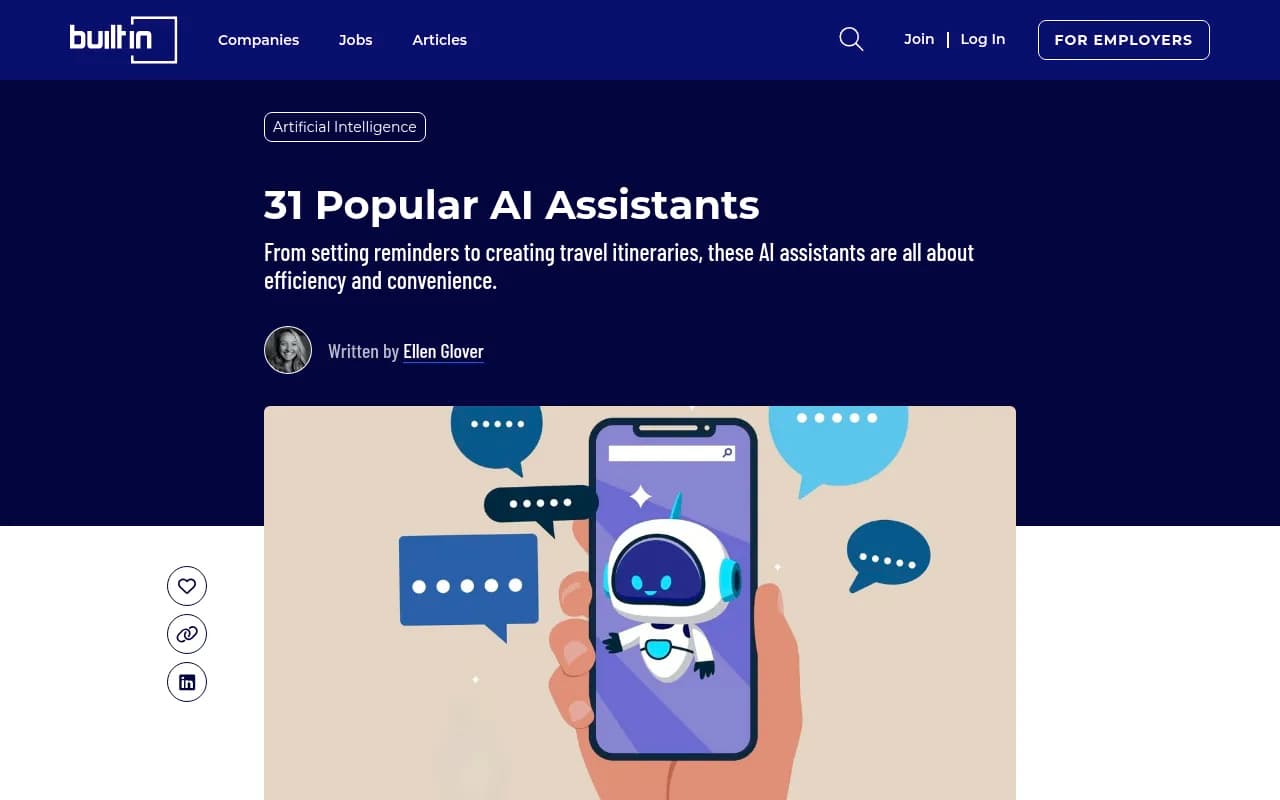
The Built In roundup of AI assistants, updated June 2026, is a useful snapshot of how they are positioned. It describes Alexa+ as a generative-AI voice assistant that handles smart homes, orders products and makes reservations across tens of thousands of services, and Meta AI as a voice and text assistant spread across WhatsApp, Instagram, Messenger, smart glasses and a standalone app.
That tells you how they are used. It does not tell you how they pick brands, which is the part you care about. Here is the short version.
ChatGPT
ChatGPT is the most open book of the four. When it searches the web, it shows citations, and those can be counted. It also runs query fan-outs, meaning several background searches per response. Promptwatch Data found that on August 8, 2026 ChatGPT started using the site: operator at scale, jumping from roughly 0.4% to about 17% of fan-out queries overnight (report). Behaviour like that shifts without notice, which is a good argument for monitoring it continuously.
What gets cited? Product pages are the largest content type at 22.4% of citations from Sep 28 to Oct 4, 2026, followed by landing pages and listicles (report). Almost half of responses cite 10 or more unique domains in that same period (report), so there is room for mid-sized brands. Sites with domain rank 46-75 earned almost half of citations in August 2026, while DR 91-100 sites fell to about 3% (report).
One caution if your plan leaned on Reddit: reddit.com's share of ChatGPT citations fell from about 4% to 0.5% on August 14, 2026 (report).
Gemini and Google's AI surfaces
Gemini is the awkward one to scope, because Google ships its AI in several places: the Gemini app, AI Overviews in search, and AI Mode. Built In notes that Google Assistant now integrates Gemini-powered capabilities, so the product lines are blurring. Confirm the current status of the assistant rollout on your own devices before you build a monitoring plan around it.
For brand monitoring, the practical move is to treat Google's AI answers as one family. They lean more on the open web and, unlike ChatGPT, still pull heavily from social platforms. Between Sep 28 and Oct 4, 2026, social platforms made up 12.2% of Google AI Overviews citations versus 0.46% for ChatGPT, about 26 times higher (report). YouTube alone was 4.28%, Facebook 2.38%, and Reddit 2.15%.
An older Promptwatch report (Sep 2025, so check for drift) found AI Overviews cites about 10 sources per answer and ChatGPT about 5 when web search triggers (report). More sources per answer generally means more chances to be named.
Google's reach is also why Gemini fits well if your buyers live inside Gmail, Docs and Android. One review in the research notes scored Gemini 8.5/10 on a meeting-prep test precisely because it could pull from Gmail and Calendar. That is a user-side strength, though, not a brand-visibility one.
Alexa and Alexa+
Alexa is where I would slow down. Its strength is action: ordering products, booking, controlling devices. Built In says Alexa+ is free to Prime members and available through Echo, Kindle, Ring and Fire TV devices, but I could not verify current pricing or availability, so check Amazon before quoting that anywhere.
For brands, Alexa visibility is mostly about:
- product listings and reviews that Amazon can read
- skills or integrations with your service
- local business data, since voice queries skew toward "near me"
There is no public citation dataset for Alexa like there is for ChatGPT. Promptwatch Data does not have a report on it, and I will not pretend otherwise. If you sell physical products, the sensible assumption is that your Amazon presence is the lever. If you are a software or services company, Alexa is probably low on the list. Some platforms, Promptwatch among them, do track Alexa including product results, which helps if you want actual output rather than guesses.
Meta AI
Meta AI is the wildcard. It lives inside apps with billions of users, and it can answer questions without anyone leaving WhatsApp or Instagram. What is missing is public data on what it cites.
What we do have is the crawler signal. Promptwatch Data recorded Meta-WebIndexer rising from about 2.2% of tracked AI crawler requests in mid-July 2026 to 37.8% on Aug 9, 2026, roughly 17 times in under a month, which made it the heaviest AI crawler in the logs (report). The timeline was flat near 2% until Jul 17, around 23% on Jul 20-22, then a surge from Aug 5.
Why? There were unconfirmed reports, originating from a @levelsio post on Aug 6, 2026 citing Meta staff, that Meta is building its own web search index so Meta AI does not have to rely on Google or Bing. That is allegedly, and I would treat it as a hypothesis. But the crawl volume is real, and a company does not fetch that much of the web for fun.
Side-by-side comparison
| Assistant | How it picks brands | Measurable citations | Best signal to watch | Priority for most brands |
|---|---|---|---|---|
| ChatGPT | Web search with visible citations, query fan-outs | Yes, strong public data | Citations, referral traffic, crawler logs | 1 |
| Gemini / AI Overviews / AI Mode | Open web plus heavy social and video sources | Yes, for Overviews and AI Mode | Citations by source type, YouTube and Facebook | 1 or 2 |
| Meta AI | Unclear, likely moving to its own index | Little public data | Meta crawler hits in server logs | 3, rising |
| Alexa+ | Shopping, local data, service integrations | Little public data | Amazon listings, local data, product results | 3 (higher for retail and local) |
A practical order of operations
Step 1: Baseline ChatGPT and Google
Pick 30 to 50 prompts your buyers genuinely ask, spread across informational, comparison, and branded types. Run them on ChatGPT and on Google AI Overviews or AI Mode. Record whether you are mentioned, in what position, and which URLs get cited. You need at least a few weeks of daily runs, since answers vary a lot.
This is where a dedicated tool earns its keep. Promptwatch tracks the real interfaces of ChatGPT, Google AI Overviews, AI Mode, Gemini, Perplexity, Copilot, Alexa and Meta AI, rather than only API outputs that can differ from what users see.

Alternatives in the same category include [tool:profound], [tool:otterly-ai] and [tool:peec-ai], which are mostly monitoring-focused. If you want to browse more, the GEO software directory at bestgeosoftware.com lists a wider range.
Step 2: Check your crawler access
This step is cheap and people skip it. Before worrying about Meta AI answers, see whether Meta's bots can even read your site. The user agents named in the Promptwatch report are meta-webindexer, meta-externalagent, meta-externalfetcher and FacebookBot. Search your server logs and robots.txt for them. If you blocked them years ago for bandwidth reasons, you may have opted out of an emerging surface without noticing.
Do the same for the others: GPTBot, OAI-SearchBot, ChatGPT-User, Google-Extended, PerplexityBot and ClaudeBot. Promptwatch also offers a free Agentic Readiness Check that shows which AI crawlers can read your site. For log analysis in general, [tool:screaming-frog-seo-spider] has a log analyzer, and [tool:botify] covers it at enterprise scale.
Step 3: Match content to the source types each engine likes
The engines differ enough that one content plan will not cover all of them.
- For ChatGPT: product pages, landing pages and docs. Promptwatch Data's half-life study found landing pages and docs stay cited longest, while news loses half its pages within 36 days (report).
- For Google's AI answers: YouTube first, then complete Facebook and Instagram pages, per Promptwatch's own recommendation from the social data.
- For Perplexity: social platforms are 2.7% of citations, with LinkedIn and Reddit tied at 0.86%. Publish on both. [tool:perplexity] is also a useful place to test prompts by hand.
- For X: skip it. It averaged 0.04% across the three engines.
Step 4: Add Alexa and Meta AI manually
Until the tooling and data catch up, run a small fixed prompt set by hand each month on both. For Alexa, ask product and local questions the way a person would out loud. For Meta AI, ask inside WhatsApp or the Meta AI app. Screenshot the answers. It is crude, but it is better than nothing, and it tells you whether the assistant names you, your competitors, or nobody.
If you sell through Amazon, check how your listings read. For local businesses, listings consistency matters, so tools like [tool:yext] or [tool:brightlocal] are worth a look.
Which one should you start with, by business type
| Business type | Start with | Then add |
|---|---|---|
| B2B SaaS | ChatGPT, Google AI Overviews | Perplexity, Meta crawler check |
| E-commerce and retail | ChatGPT shopping, Google AI Mode | Alexa product results |
| Local and multi-location | Google AI Overviews, AI Mode | Alexa, then ChatGPT |
| Consumer apps and media | ChatGPT, Gemini | Meta AI |
| Developer tools | ChatGPT, coding agents | Gemini |
For software prompts specifically, GitHub, Microsoft's docs and G2 lead ChatGPT citations, and documentation and help centers earn the largest share (report). If you are in that space, a strong docs site beats a strong blog.
What the data cannot tell you
Let me be plain about the gaps. There is no first-party citation dataset on Alexa or on Meta AI from Promptwatch. I could not verify Alexa+ pricing, Meta AI usage numbers, or the exact Gemini assistant rollout. And the Meta indexing story is based on an unconfirmed report.
It is also worth noting that Alexa and Meta AI are assistants first. They are not citation-led search engines in the way ChatGPT and AI Overviews are, so "share of citations" may be the wrong metric for them anyway. For those, crawler hits and manual answer checks are the honest signals available today.
Measuring outcomes matters more than measuring mentions. If you can connect AI-referred traffic to conversions, you can tell which assistant is worth the effort. Visitor analytics and server-side crawler logs help here, alongside [tool:google-search-console] for the Google side.
For a wider view of what else exists, the AI rank tracking directory at ai-rank-tools.com is a good place to compare trackers, and Promptwatch's data hub is where the citation research above is updated.
The short answer
Monitor ChatGPT and Google's AI answers first, because they are measurable and they move traffic. Check Meta's crawlers this week, because it costs nothing and the crawl surge is the loudest signal in the data. Treat Alexa as a retail and local play. Revisit the order in a quarter, since every number above changed within the last few months.