Key takeaways
- Claude runs on three separate, independently controllable bots (ClaudeBot, Claude-User, Claude-SearchBot) that do different jobs. Blocking one does not block the others, and most brands have never checked their robots.txt against all three.
- Claude's live web search is widely believed to run on Brave Search rather than Google or Bing, so ranking well in Google means nothing for Claude if your pages are weak in Brave's index.
- Persistent memory, launched to all Claude accounts in March 2026, can silently contaminate repeated brand-mention test prompts unless you run every check in an incognito chat.
- Google Analytics 4's native "AI Assistant" channel, rolled out in mid-2026, was announced to cover Claude but the live default channel group documentation does not actually include it. You still need a custom regex rule.
- Most AI visibility tools that claim to "track Claude" are actually querying the Anthropic API with a Sonnet model and web search enabled, not the consumer Claude.ai interface real users see. That's a meaningful gap worth knowing before you trust a dashboard.
Why Claude gets its own playbook
Most brand teams treat "AI visibility" as one undifferentiated blob: track ChatGPT, track Gemini, track Perplexity, done. That approach falls apart with Claude, because Claude is architecturally different in three ways that change what you measure and how.
First, it has its own crawler taxonomy that nobody else copies exactly. Second, its search results appear to come from a different index than Google or Bing. Third, it recently gained a memory system that can quietly corrupt your test data if you're not careful. Ignore any one of these and you'll either miss real visibility gains or chase phantom drops that were actually just a stale memory summary talking.
There's also a timing argument for paying attention now. Promptwatch's crawler data shows Claude's citation crawler traffic grew roughly 100x between mid-December 2025 and mid-April 2026, from about 30 visits a day to several thousand, with an inflection point in late March when daily visits jumped from hundreds into the thousands within two weeks. It's still a small slice of the total AI crawler pie, around 1% of tracked citation crawler traffic on the latest data, but it's growing every month while other channels flatten out. See the full breakdown on Promptwatch Data.
The three Claude bots, and why conflating them is a mistake
Anthropic's own documentation, last confirmed updated in February 2026, splits crawling into three named agents, each with a distinct job and its own robots.txt rule:
| Bot | What it does | Effect of blocking it |
|---|---|---|
| ClaudeBot | Collects web content for model training | Excludes your future content from training data; no immediate effect on live answers |
| Claude-User | Fetches pages when a real user asks Claude a live question | May reduce your visibility in user-directed web search, right away |
| Claude-SearchBot | Crawls and indexes content to improve Claude's search relevance | May reduce visibility and accuracy in user search results |
All three respect robots.txt and the Crawl-delay directive, and Anthropic publishes a verified IP range list at claude.com/crawling/bots.json. If your site still has old rules for Claude-Web or Anthropic-AI, drop them, those user agents are deprecated. And critically, blocking ClaudeBot to keep your content out of future training runs does nothing to stop Claude-User from citing you in a live chat tomorrow. A lot of legal or brand-safety teams block "the Claude bot" thinking that's one decision. It's actually three separate decisions, and getting them mixed up is the single most common Claude monitoring mistake I keep seeing.
One open ambiguity worth flagging to your technical SEO lead: Anthropic's documentation, unlike OpenAI's, doesn't clarify whether Claude-User gets the same kind of enforcement leniency that ChatGPT-User sometimes gets. Treat that as unresolved rather than assuming parity with how you've configured things for OpenAI's crawlers.
Claude's search backend is (probably) Brave, and that changes your optimization target
This is the part most brand teams miss entirely. Third-party analysis, most notably from Profound, found an 86.7% overlap between Claude's cited sources and Brave Search's top organic results when the same query was run through both. Brave Search API access has also reportedly appeared on Anthropic's subprocessor list since March 2025.
Anthropic hasn't officially confirmed this, so treat it as a strong working theory rather than a fact. But the practical implication is real either way: if your pages rank well in Google and AI Overviews but you've never checked how they perform in Brave Search specifically, you may be optimizing for the wrong index when it comes to Claude citations. Run your priority queries directly in Brave Search as a sanity check before assuming a content gap is the reason Claude isn't mentioning you.
Consumer Claude.ai versus the Anthropic API: two different measurement surfaces
Here's a caveat that most tool marketing pages gloss over. Anthropic's developer platform exposes a web_search tool (currently web_search_20250305) that lets developers configure domains, location, and a max_uses limit, then returns structured citations tied to specific claims. That's a fundamentally different, developer-controlled environment from the consumer chat interface at claude.ai that a real customer actually opens.
Several well-known AI visibility vendors track "Claude" via this API path with a Sonnet model and web search turned on, rather than the consumer UI. Otterly.AI states this explicitly. That's not necessarily wrong, it's a defensible proxy, but it means "we track Claude" claims from different tools can produce genuinely different results on the identical prompt, because they're not measuring the same product. If a vendor won't tell you which surface they're monitoring, ask before you trust the dashboard.
Controlling for memory when you run manual checks
Anthropic rolled persistent memory out to every Claude account, free and paid, in March 2026. Claude auto-summarizes your conversations into a running profile that updates roughly every 24 hours and carries forward into new chats. If you're manually running the same brand-mention prompt every week to eyeball results, memory can quietly bias the answer toward whatever you talked about with Claude last time, brand or otherwise.
The fix is simple. Use an incognito chat (the ghost icon, or Ctrl+Shift+I) for every test run. Incognito sessions don't read existing memory, don't create new memory entries, and aren't used for training. It's available on the free tier too, so there's no excuse to skip it. Also note that each Claude Project has its own separate memory space distinct from regular chats, so testing inside a Project versus outside one is itself a variable you need to document, not ignore.
Setting up GA4 to actually catch Claude referral traffic
Google shipped a native "AI Assistant" channel inside GA4's Default Channel Group in May 2026, with broad rollout finishing by early June. It's a real improvement, sessions from qualifying AI referrers get automatically tagged with medium ai-assistant. The catch: Google's launch announcement named ChatGPT, Gemini, and Claude as covered sources, but the actual published Default Channel Group definition lists only ChatGPT, Gemini, DeepSeek, Copilot, and Grok. Claude got dropped somewhere between the announcement and the shipped feature.
Practically, that means you cannot rely on the native channel for Claude specifically. Build a parallel custom channel group with an explicit regex that catches claude.ai and anthropic.com referrers, and make sure it sits above Referral in your rule order, or Claude sessions will get miscategorized as generic referral traffic and disappear into your reporting. Keep in mind that GA4 classification is forward-only, it won't retroactively fix historic sessions, and one industry estimate puts 60-70% of all AI-referred traffic arriving with no referrer at all, landing silently in Direct regardless of how well you configure things. GA4 alone will always undercount Claude's real impact; treat it as a floor, not a ceiling.
Building a Claude-specific prompt library
Once the technical plumbing is sorted, the actual monitoring work is prompt-based, not dashboard-based. A workable process looks like this:
- Write down 15-30 evaluation queries your actual buyers ask, in their own words, split into branded ("is [brand] good for X") and unbranded ("best tool for X") categories.
- Run each prompt three to five times in a fresh incognito chat, recording whether your brand is mentioned, its position relative to competitors, and the sentiment of the framing.
- When web search fires, log every cited URL, its position, and what claim it's supporting. This tells you exactly which of your pages (or a competitor's) Claude is pulling from.
- Treat single runs as noise. "Mentioned in 7 of 15 valid runs" is a real, reportable finding. "Mentioned once" is not.
- Re-run the whole library monthly, and whenever you ship a major content or positioning change, so you can attribute movement to something concrete.
A useful nuance from Anthropic's own docs and Claude's growing footprint in enterprise research: Claude tends to reward coherent source coverage and clear technical proof over marketing copy. If your comparison pages and technical documentation are thin, that's usually a bigger lever than trying to game a single prompt.
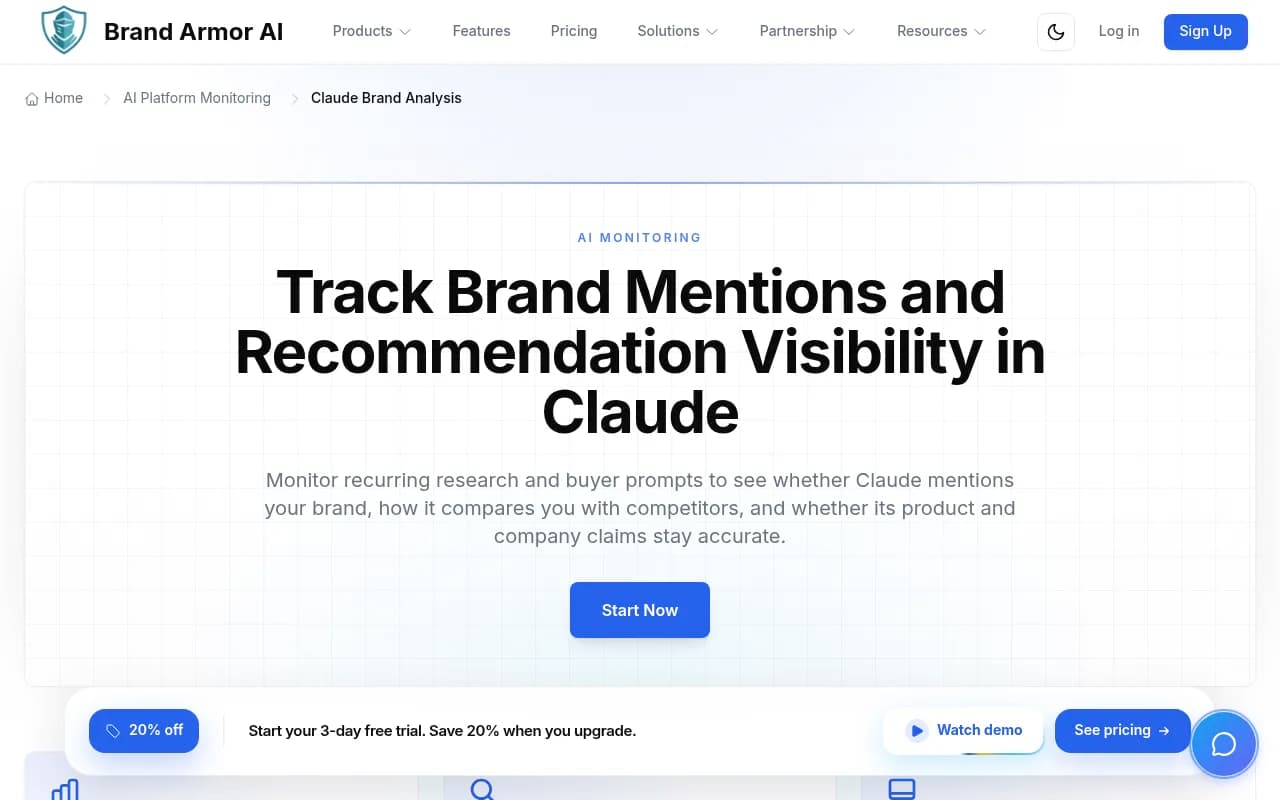
Which tools actually cover Claude, and how
Coverage claims are all over the map, and pricing for Claude specifically varies a lot depending on whether it's included, gated to a higher tier, or sold as an add-on. Here's where things stood as of late 2026:
| Tool | Claude included at | How it measures Claude | Notes |
|---|---|---|---|
| Otterly.AI | Paid add-on (~$29/mo on top of $29 base) | Anthropic API, Sonnet + web search | Not the consumer UI |
| Peec AI | Add-on (~$35/mo) on Starter, or Enterprise per one source | API-based | Sources disagree on tier gating |
| Profound | Growth tier ($399/mo), per one source | Closer to consumer front-end collection | Sources disagree on exact tier |
| Scrunch AI | $250/mo annual, or Enterprise-only per another source | Not publicly specified | Conflicting reports on gating |
| AthenaHQ | Self-Serve, $295/mo flat | Included, no add-on fee | Also tracks AI crawler visits |
| Astiva AI | All paid plans from $249/mo | Not publicly specified | Markets itself as "no add-on fees" |
| Semrush AI Visibility | Not included | N/A | Confirmed absent for Claude in 2026 reviews |
| Ahrefs Brand Radar | Not documented | N/A | No confirmed Claude coverage |
The cost difference adds up fast once you stack add-ons. One illustrative comparison for the same workload: Otterly.AI Lite plus Gemini and Claude add-ons lands around $67/month total, Peec AI Starter plus a Claude add-on runs about $130/month, while AthenaHQ's flat Self-Serve tier at $295/month includes Claude with no surcharge.
Promptwatch tracks Claude alongside ChatGPT, Gemini, Perplexity, Grok, Meta Llama, DeepSeek, Mistral, Microsoft Copilot, Google AI Overviews, and Google AI Mode as part of the same package, so you're not stitching together separate add-ons per model to get a full picture. It also goes further than most of the tools in the table above: instead of just reporting that Claude didn't mention you, its crawler logs show whether Claude-User or Claude-SearchBot even visited the relevant page, and its content agents can draft and publish the fix directly to your CMS rather than leaving you with a spreadsheet of gaps.

A few other options worth knowing about if you're comparing across the space:

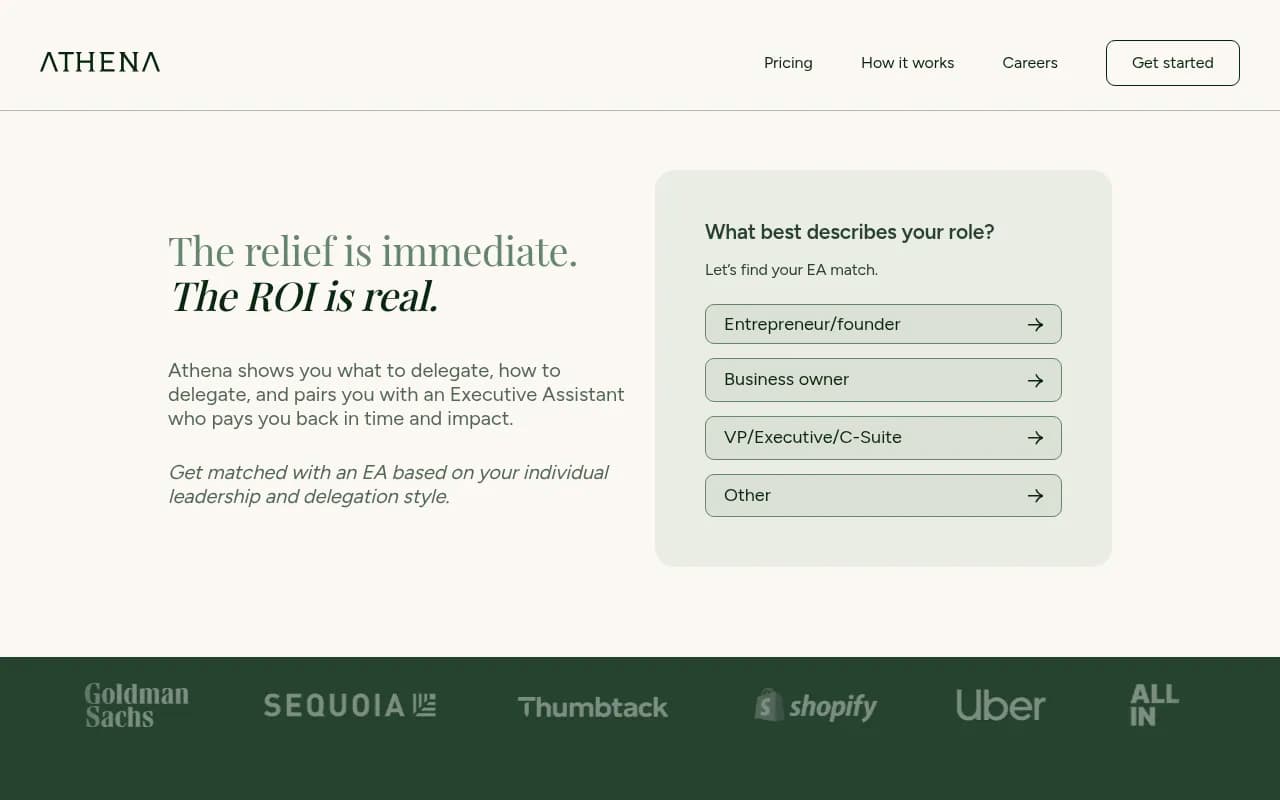
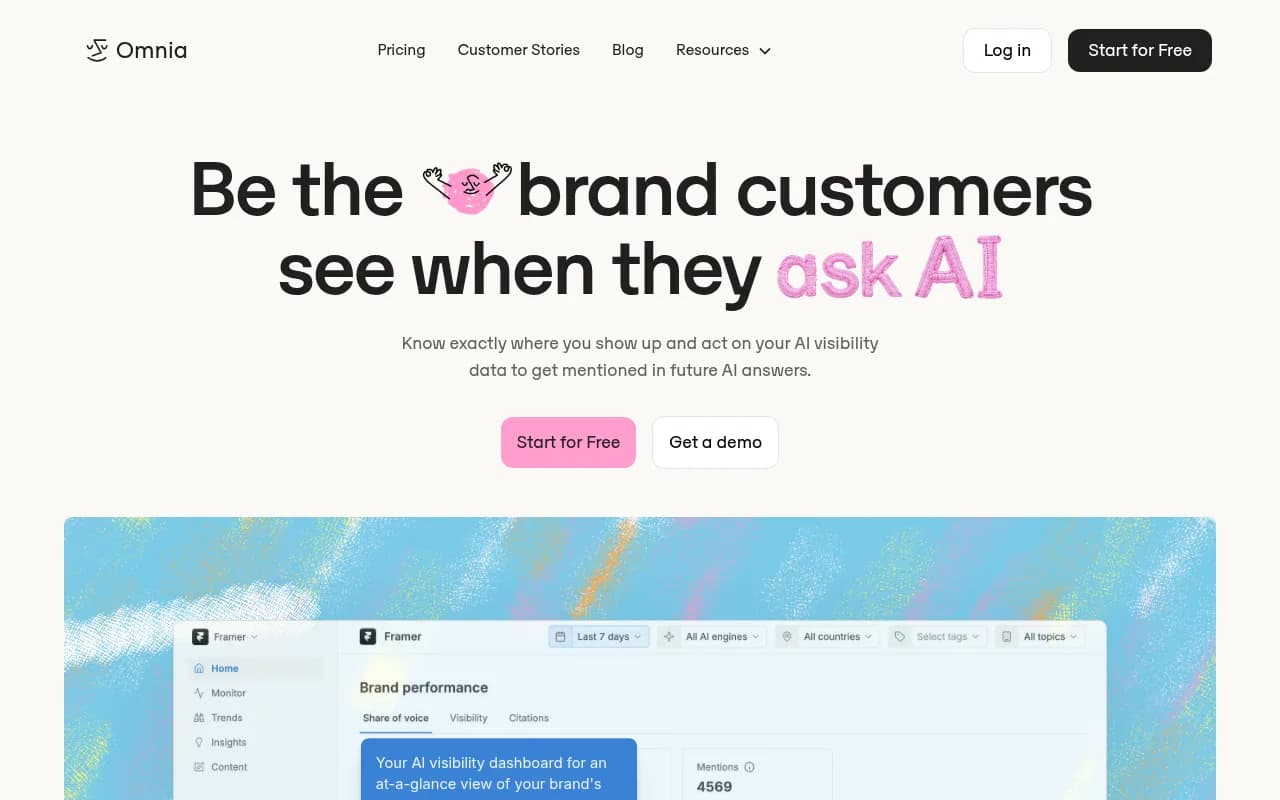
Omnia specifically markets itself around Claude tracking and leans on the Brave Search theory mentioned earlier, which is worth a look if Claude is your primary concern rather than one channel among several. If you want to browse the wider category before committing, the GEO software directory at bestgeosoftware.com lists a broader set of platforms side by side.
Putting the whole stack together
A sane monthly Claude monitoring routine ends up looking like this: confirm robots.txt hasn't accidentally blocked ClaudeBot, Claude-User, or Claude-SearchBot (a rule that was harmless in December can quietly cut you off from a channel that's grown 100x since then); check your CDN or server logs for Anthropic user agents to baseline actual crawl activity; run your prompt library in incognito Claude chats, three to five reps each; verify your GA4 custom channel is still catching claude.ai referrals correctly; and spot-check whether your key pages are actually visible in Brave Search, not just Google.
None of this is exotic. It's just specific to how Claude actually works, which is the part most generic "AI visibility" advice skips over. Given how fast Claude's crawler share and web-visit share have both been moving through 2026, treating it as an afterthought behind ChatGPT is a decision you'll probably want to revisit within the next couple of quarters, not years.
For context on how this fits into a bigger AI search program, browse the AI rank tracking directory at ai-rank-tools.com, which covers the wider set of tools that monitor across models rather than Claude alone.