Key takeaways
- In competitive categories, only 7% of mentioned brands reach dominant status in ChatGPT responses -- but smaller brands with focused content strategies are breaking through
- ChatGPT doesn't rank by domain authority; it cites by relevance, specificity, and how well your content answers the exact questions users are asking
- The core advantage for smaller brands: you can move faster, go deeper on niche angles, and publish content that directly addresses the gaps your larger competitors ignore
- Answer Gap Analysis -- finding the specific prompts where competitors appear but you don't -- is the most direct path to improving AI visibility
- Tracking results matters as much as creating content; without closing the loop, you're optimizing blind
There's a pattern showing up across marketing teams right now. A smaller brand, maybe a regional player or a newer entrant, starts appearing in ChatGPT recommendations for competitive queries -- ahead of the category incumbents. The big players have the backlinks, the domain authority, the PR budget. But the smaller brand is getting cited.
This isn't a fluke. It's a structural feature of how AI search works, and once you understand it, you can exploit it deliberately.
Why competitive categories are harder -- but not impossible
Research from Search Engine Land found that in competitive categories, only 7% of mentioned brands reach "dominant" status in ChatGPT responses, compared to 21% in niche categories. That gap is real. But it also means that 7% of brands in competitive spaces are winning -- and the question is what they're doing differently.
The short answer: they're not trying to win the whole category. They're winning specific prompts.
ChatGPT doesn't serve a single "best brand" answer for broad queries. It responds to the specific framing of a question. "Best CRM for a 10-person sales team" and "best CRM for enterprise" will surface different brands. "Best running shoes for flat feet" and "best running shoes for trail running" will too. The brands that show up aren't necessarily the biggest -- they're the ones whose content most directly answers the specific question being asked.
This is the opening for smaller brands. You don't need to beat Salesforce for "best CRM." You need to beat them for the five or ten specific prompts your actual customers are typing.
How ChatGPT actually decides what to mention
Before getting into tactics, it's worth being clear about the mechanism. ChatGPT generates responses from two sources: its training data (everything it learned before its knowledge cutoff) and real-time web browsing (when enabled, it searches Bing and reads current pages).
For training data, what matters is how often your brand appeared in high-quality sources -- reviews, comparison articles, forums, industry publications -- before the cutoff. For web browsing, what matters is whether your content is crawlable, specific, and directly relevant to the query.
The practical implication: you need to be present in both channels. That means creating content on your own site and getting mentioned in third-party sources that AI models trust: review platforms, Reddit threads, industry blogs, YouTube videos, and comparison sites.
One thing that doesn't transfer from Google SEO: domain authority alone won't save you. A well-written, highly specific article on a mid-authority domain can outperform a thin page on a major brand's site if it actually answers the question better.
The competitive intelligence step most brands skip
Before writing a single word of content, you need to know which prompts you're losing. This is the step that separates brands that improve their AI visibility from brands that just publish more content and hope.
The process is straightforward in concept: run the prompts your customers are likely to use, see who appears, and note where you're absent. In practice, doing this manually across dozens of prompts and multiple AI models is tedious. Tools like Promptwatch automate this with Answer Gap Analysis -- showing you exactly which prompts your competitors are visible for that you're not, so you can prioritize the highest-value gaps.

The output of this step should be a list of specific prompts where you're invisible but should be visible. That list becomes your content roadmap.
Content strategy: specificity beats volume
The instinct when you're losing in AI search is to publish more. More blog posts, more pages, more content. That's usually the wrong move. What matters more is specificity.
AI models cite content that directly answers the question. A 3,000-word article that thoroughly addresses "what's the best project management tool for remote design teams" will outperform ten generic "best project management tools" posts. The specificity signals to the model that this content is the right match for that specific query.
A few principles that work:
Write for the prompt, not the keyword. Traditional SEO optimizes for keywords. AI search responds to natural language questions. Think about how a person would actually phrase a question to ChatGPT, and write content that answers that exact question. "What are the best accounting tools for freelancers under $50/month?" is a prompt. Write an article that answers it directly.
Go deeper than your competitors on specific angles. If the big players in your category have generic "best of" pages, you can win by going narrower. A comparison article that covers your product vs. two specific competitors, with honest pros and cons, will get cited more often than a vague overview page.
Use structured formats. ChatGPT tends to pull from content that's well-organized -- numbered lists, clear headings, direct answers near the top of the page. If your content buries the answer in paragraph five, you're at a disadvantage.
Answer the follow-up questions too. Research shows that AI models process "query fan-outs" -- a single prompt branches into multiple sub-queries. If someone asks about project management tools, the model might also be pulling from content about pricing, integrations, team size fit, and onboarding. Cover those angles in your content.
Tools like Topical Map AI can help you map out the full topic cluster around your target prompts, so you're not leaving sub-queries uncovered.
Third-party presence: where smaller brands often fall short
Your own website is only part of the picture. AI models heavily weight third-party sources -- review sites, comparison platforms, Reddit, YouTube, and industry publications. If your brand only appears on your own domain, you're at a structural disadvantage.
The research data from Search Engine Land's analysis of repeated ChatGPT runs is instructive here: brands that appear consistently across multiple source types are far more likely to reach dominant status in AI responses. Appearing in one place occasionally isn't enough.
Practical moves:
- Get listed and reviewed on the major review platforms in your category (G2, Capterra, Trustpilot, or whatever is relevant to your industry)
- Contribute to Reddit threads where your customers ask questions -- not promotional posts, but genuinely useful answers that mention your product where relevant
- Get covered in comparison articles on industry blogs, even if you have to pitch them or sponsor the content
- Create YouTube content that answers the specific questions your customers ask; AI models cite YouTube frequently
The Reddit angle is underappreciated. ChatGPT pulls heavily from Reddit discussions, and a well-upvoted comment or post that mentions your brand in the context of solving a specific problem can drive consistent citations. This is a channel most larger brands ignore because it doesn't fit their content process.
Technical foundations: making sure AI can actually read your content
None of the content strategy above matters if AI crawlers can't access and parse your pages. This is a more common problem than most brands realize.
AI crawlers (the bots that ChatGPT, Perplexity, Claude, and others use to index the web) behave differently from Googlebot. They may not render JavaScript, they may visit pages less frequently, and they may encounter errors that prevent them from reading your content at all.
The basics:
- Make sure your robots.txt isn't blocking AI crawlers. Some brands accidentally block GPTBot or other AI crawlers while trying to manage their crawl budget.
- Ensure your most important pages load quickly and are server-rendered (not dependent on client-side JavaScript for the main content)
- Use clear, semantic HTML structure -- headings, lists, and clean markup help AI models parse your content
- Keep your sitemap updated so new content gets discovered quickly
Platforms like Promptwatch include AI crawler logs that show you exactly which pages AI bots are visiting, how often, and what errors they're encountering -- which makes diagnosing these issues much faster than guessing.
For more technical SEO foundations, tools like Botify handle enterprise-level crawl analysis.
The prompt intelligence advantage
Not all prompts are worth targeting. Some have high volume but are dominated by brands with years of training data behind them. Others are winnable right now because the competitive field is thin.
This is where prompt intelligence -- volume estimates, difficulty scores, and competitive density -- changes your prioritization. Instead of guessing which prompts to target, you can see which ones have meaningful search volume and are realistically winnable given your current visibility.
The analogy to keyword difficulty in traditional SEO is imperfect but useful. Just as you wouldn't target "best CRM" as a new entrant in Google SEO, you probably shouldn't start your AI visibility campaign by trying to win "best project management software." Find the prompts where the competition is thinner and the intent matches what you actually offer.
Measuring what's working
This is where a lot of brands fall down. They publish content, maybe see some improvement in AI mentions when they manually check, and then move on. Without systematic tracking, you can't tell which content is driving citations, which AI models are picking you up, or whether your visibility is actually improving over time.
The metrics that matter:
- Mention rate: How often does your brand appear when the relevant prompts are run?
- Sentiment: When you're mentioned, is it positive, neutral, or negative?
- Citation sources: Which of your pages are being cited? This tells you what's working.
- Competitor comparison: Are you gaining ground relative to the brands you're competing with?
- Traffic attribution: Are AI citations actually driving visitors to your site?
That last one is harder to measure but important. Tools that connect AI visibility data to actual traffic (via Google Search Console integration, server log analysis, or tracking snippets) let you close the loop between visibility and revenue.
Several tools in the AI visibility space handle different parts of this measurement problem:
For brands that want an end-to-end solution covering tracking, gap analysis, content generation, and traffic attribution in one place, Promptwatch covers all of these in a single platform.
A realistic timeline and what to expect
One thing worth being direct about: AI visibility doesn't change overnight. ChatGPT's training data has a cutoff, so new content you publish today won't affect responses based on that training data until the next model update. What it can affect immediately is responses that use real-time web browsing -- which is increasingly common.
A realistic timeline for a focused effort:
- Weeks 1-2: Audit current visibility, identify top 20-30 target prompts, diagnose technical issues
- Weeks 3-6: Publish targeted content for the highest-priority gaps, get listed on key third-party platforms
- Months 2-3: Track citation rates, identify which content is getting picked up, iterate
- Month 3+: Expand to secondary prompts, build out topic clusters, monitor competitor movements
The brands that win in competitive categories aren't doing anything magical. They're being systematic about a process that most competitors are still treating as an afterthought.
Tools comparison: AI visibility platforms for competitive tracking
If you're serious about winning in competitive categories, you need tooling that goes beyond manual spot-checks. Here's how the main options compare for this specific use case:
| Tool | Answer gap analysis | Content generation | Crawler logs | Prompt volume data | Traffic attribution |
|---|---|---|---|---|---|
| Promptwatch | Yes | Yes (built-in AI writer) | Yes | Yes | Yes |
| Otterly.AI | Limited | No | No | No | No |
| Peec AI | No | No | No | No | No |
| Profound AI | Partial | No | No | Partial | No |
| Athena HQ | Partial | No | No | No | No |
| Scrunch AI | No | No | No | No | No |
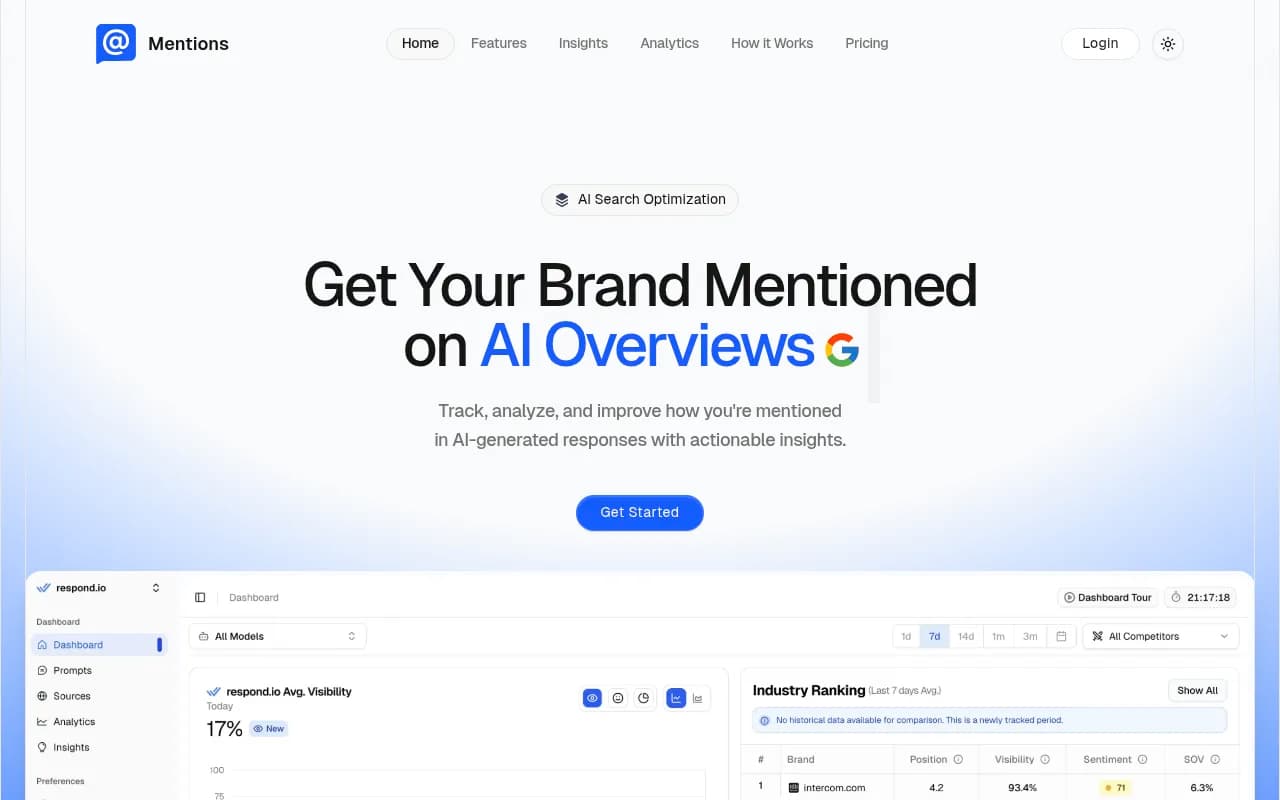
| Mentions.so | No | No | No | No | No |
For monitoring-only needs at lower cost, tools like Otterly.AI or Mentions.so cover the basics. But if you're trying to actively close the gap with established competitors -- not just watch the scoreboard -- you need a platform that helps you act on what you find.

The actual competitive advantage
Here's the honest summary: larger brands are slow. They have content approval processes, brand guidelines, and teams that aren't yet focused on AI search. A smaller brand with a clear prompt list, a content process, and systematic tracking can move faster and go deeper on the specific angles that matter.
The 7% of brands that reach dominant status in competitive ChatGPT categories aren't all large. Some of them are exactly the kind of focused, fast-moving brands that read guides like this one and actually implement what they learn.
The window for early-mover advantage in AI search is still open. It won't be forever.