Key takeaways
- GetMint.ai focuses on monitoring AI Overviews and brand visibility — solid for tracking, but limited when it comes to taking action on what you find.
- Relixir leans into AI content generation and GEO optimization, making it useful for teams that want to create content that ranks in LLMs.
- Promptwatch is the only platform of the three that closes the full loop: find gaps, generate content, track results — with crawler logs, Reddit/YouTube insights, and traffic attribution on top.
- If your team just needs a dashboard to report on AI visibility, any of these will work. If you need to actually improve your visibility, the differences matter a lot.
- Pricing ranges from roughly $99/mo to several hundred per month depending on features and scale.
The GEO platform market has gotten crowded fast. In 2024, most teams were still debating whether AI search visibility was worth tracking at all. By mid-2026, there are well over 200 tools claiming to help you rank in ChatGPT, Perplexity, and Google AI Overviews.
Three names that come up repeatedly in this space are GetMint.ai, Relixir, and Promptwatch. They're not the same kind of tool, though — and that distinction matters more than most comparison articles let on.
This guide breaks down what each platform actually does, where each one stops, and which type of team should use which.
What "GEO platform" actually means in 2026
Generative Engine Optimization (GEO) is the practice of making your brand and content more visible in AI-generated answers. When someone asks ChatGPT "what's the best project management tool for remote teams?" — you want to be cited.
The challenge is that traditional SEO metrics don't capture this. You can rank #1 on Google and still be invisible in AI search. A GEO platform is supposed to bridge that gap.
But here's where the category splits: some platforms are built to show you the problem, and others are built to help you fix it. That's the core tension between GetMint, Relixir, and Promptwatch.
GetMint.ai: clean monitoring, limited action

GetMint positions itself as an AI Overview tracker — specifically focused on Google's AI Overviews feature. It's a clean, well-designed tool that tells you when and where your brand appears in AI-generated search results.
What it does well
GetMint is genuinely good at what it's built for. You can track which keywords trigger AI Overviews, see whether your domain is cited in those overviews, and monitor changes over time. For teams that are primarily worried about Google AI Overviews (as opposed to ChatGPT or Perplexity), it covers the basics.
The interface is approachable. You don't need a data analyst to interpret the dashboards, and onboarding is fast. For smaller marketing teams that just want to know "are we showing up in AI Overviews?", GetMint answers that question without much friction.
Where it falls short
The limitation is in the name: it's a tracker. GetMint shows you where you're visible and where you're not — but it doesn't tell you why you're missing, and it doesn't help you do anything about it.
There's no content gap analysis that surfaces the specific topics your site is missing. No built-in content generation. No crawler logs showing how AI bots are reading your pages. No Reddit or YouTube tracking to understand which third-party sources are influencing AI recommendations.
If you're using GetMint and you discover you're invisible for 40 important prompts, the platform's job is done. What you do next is entirely up to you.
That's not necessarily a dealbreaker — plenty of teams have their own content workflows and just need the data. But it does mean GetMint is a monitoring tool, not an optimization platform.
Relixir: content-first GEO
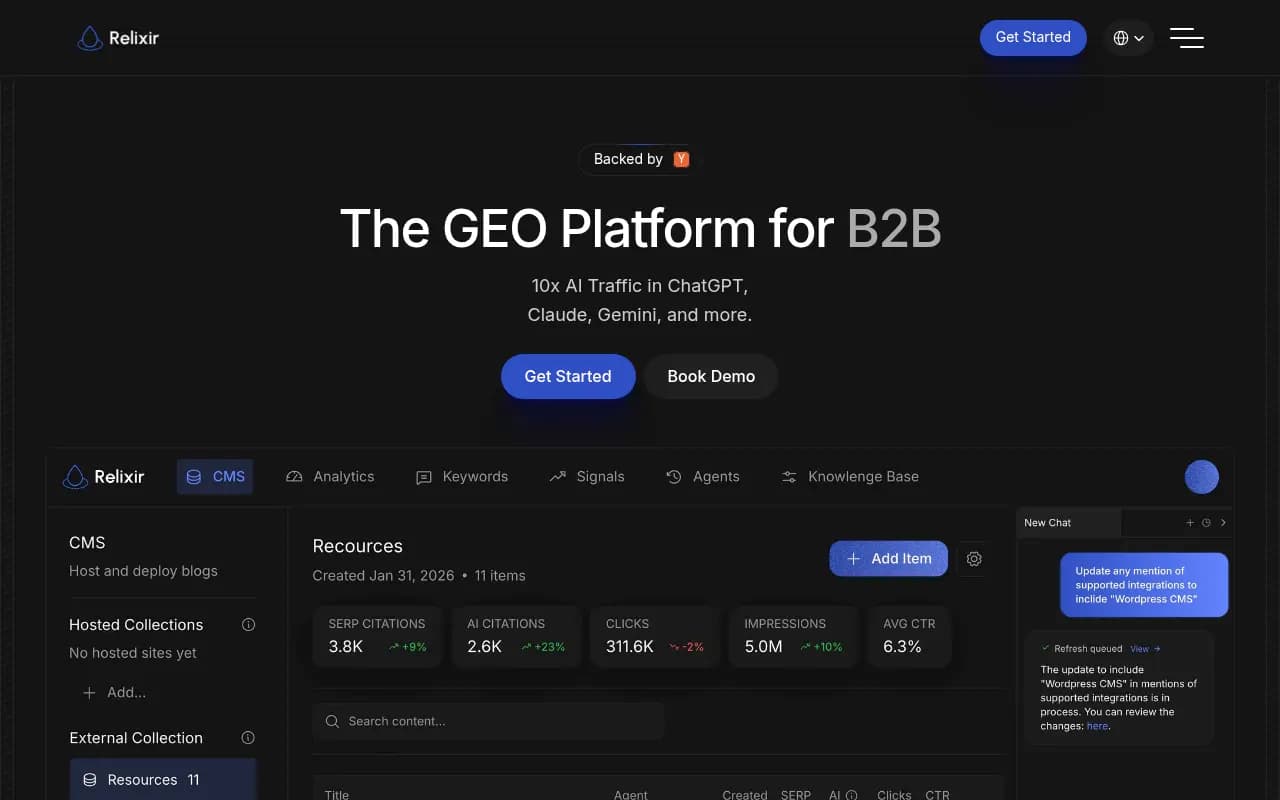
Relixir takes a different approach. Rather than leading with monitoring, it leans into content generation and optimization for AI search. The pitch is that you can use Relixir to create content that's specifically engineered to get cited by LLMs.
What it does well
Relixir is useful for teams that have already identified their content gaps and want help filling them. The platform generates articles and content pieces with GEO in mind — thinking about how AI models evaluate sources, what kinds of content they tend to cite, and how to structure information for AI consumption.
For content-heavy teams that are already running GEO programs, Relixir can accelerate production. It's a reasonable fit if you're doing a lot of content creation and want AI-search optimization baked into the writing process.
Where it falls short
The flip side of Relixir's content focus is that its monitoring capabilities are thinner. You need to know what to write before the content generation is useful — and if you're relying on Relixir to tell you that, you may find the data less granular than you'd like.
There's also a question of attribution. Knowing that you published 20 new articles is one thing; knowing which of those articles are actually being cited by ChatGPT, how often, and whether that's driving traffic and revenue is another. Relixir's tracking layer is less developed than a dedicated monitoring platform.
Promptwatch: the full loop
Promptwatch is built around a different philosophy than either GetMint or Relixir. The core idea is that monitoring and optimization are two halves of the same problem — and you need both to actually move the needle.

The action loop
Promptwatch's workflow runs in three stages:
- Find the gaps. Answer Gap Analysis shows exactly which prompts your competitors are visible for that you're not. You see the specific topics and questions AI models want to answer but can't find on your site.
- Create content that ranks. A built-in AI writing agent generates articles, listicles, and comparisons grounded in real citation data (880M+ citations analyzed), prompt volumes, and competitor analysis. This isn't generic content — it's built to get cited.
- Track the results. Page-level tracking shows which pages are being cited, how often, and by which AI models. Traffic attribution (via code snippet, Google Search Console integration, or server log analysis) connects visibility to actual revenue.
That loop — find gaps, generate content, track results — is what separates Promptwatch from tools that stop at step one.
What it monitors
Promptwatch tracks 10 AI models: ChatGPT, Perplexity, Google AI Overviews, Google AI Mode, Claude, Gemini, Meta/Llama, DeepSeek, Grok, Mistral, and Copilot. That's broader coverage than most platforms, including GetMint (which focuses on Google) and Relixir.
A few capabilities that stand out:
- AI Crawler Logs: Real-time logs of AI crawlers hitting your site — which pages they read, errors they encounter, how often they return. Most competitors don't have this at all.
- Prompt Intelligence: Volume estimates and difficulty scores for each prompt, plus query fan-outs that show how one prompt branches into sub-queries. This helps you prioritize high-value, winnable prompts instead of guessing.
- Reddit & YouTube Insights: Surfaces discussions and videos that directly influence AI recommendations — a channel most platforms ignore.
- ChatGPT Shopping Tracking: Monitors when your brand appears in ChatGPT's product recommendations and shopping carousels.
- Competitor Heatmaps: Compare your AI visibility against competitors across different LLMs, prompt by prompt.
Pricing
Promptwatch runs from $99/mo (Essential: 1 site, 50 prompts, 5 articles) to $249/mo (Professional: 2 sites, 150 prompts, 15 articles, crawler logs) to $579/mo (Business: 5 sites, 350 prompts, 30 articles). Agency and enterprise pricing is available on request. There's a free trial.
Head-to-head comparison
| Feature | GetMint.ai | Relixir | Promptwatch |
|---|---|---|---|
| AI Overview monitoring | Yes (Google-focused) | Limited | Yes (10 models) |
| Multi-LLM tracking | Partial | Partial | Yes (ChatGPT, Claude, Perplexity, Gemini, Grok, etc.) |
| Content gap analysis | No | Partial | Yes (Answer Gap Analysis) |
| Built-in content generation | No | Yes | Yes (citation-grounded) |
| AI crawler logs | No | No | Yes |
| Reddit/YouTube tracking | No | No | Yes |
| Prompt volume & difficulty | No | No | Yes |
| Traffic attribution | No | No | Yes (GSC, snippet, server logs) |
| ChatGPT Shopping tracking | No | No | Yes |
| Competitor heatmaps | Limited | No | Yes |
| Free trial | Yes | Yes | Yes |
| Starting price | ~$49/mo | Custom | $99/mo |
| Best for | Google AI Overview monitoring | Content-heavy GEO teams | End-to-end GEO optimization |
Which platform is right for your team?
The honest answer depends on what you're trying to accomplish.
Choose GetMint if your primary concern is Google AI Overviews and you have a separate content workflow already in place. It's a clean, focused tool that does one thing well. If you're a smaller team that just needs to know whether you're appearing in AI Overviews and doesn't need to act on that data within the platform, GetMint is a reasonable starting point.
Choose Relixir if you're already running a GEO program and your main bottleneck is content production. If you know what topics you need to cover and you want help generating AI-optimized content at scale, Relixir's content-first approach fits that workflow.
Choose Promptwatch if you need the full picture — monitoring, gap analysis, content generation, and attribution in one place. This is particularly true for marketing teams and agencies that need to show ROI, not just report on visibility scores. The crawler logs and traffic attribution features are genuinely hard to find elsewhere, and the Reddit/YouTube tracking adds a layer of insight that most platforms skip entirely.
One thing worth noting: Promptwatch has been rated the only "Leader" across all categories in a 2026 comparison of 12 GEO platforms, and its dataset (1.1 billion citations, clicks, and prompts processed) is larger than most competitors. That's not just marketing — it affects the quality of the content recommendations and gap analysis.
The monitoring-only trap
There's a pattern worth calling out in this space. A lot of teams buy a monitoring tool, get a dashboard full of data, and then... don't know what to do with it. The visibility scores go up and down, the reports get sent to stakeholders, and six months later nothing has actually changed.
This isn't a knock on monitoring tools specifically — data is valuable. But GEO is a discipline that requires action. AI models cite sources that answer questions well, that are structured clearly, that appear in the right places (including Reddit threads and YouTube videos). Knowing you're invisible for a prompt is the beginning of the work, not the end.
The tools that are winning in this space in 2026 are the ones that close the loop between insight and execution. GetMint tells you where you stand. Relixir helps you create content. Promptwatch does both, and adds the attribution layer that connects visibility to revenue.
If your team is evaluating GEO platforms right now, the most important question to ask isn't "which tool has the best dashboard?" It's "which tool will actually help us show up more in AI search six months from now?"
Other tools worth knowing
The GEO space has a lot of players beyond these three. A few worth a look depending on your needs:

Otterly.AI is a lightweight, affordable option for teams that want basic AI visibility monitoring without a big commitment.
Profound is enterprise-grade and strong on AI narrative monitoring — good for larger brands that need detailed reporting for stakeholders.

AthenaHQ covers multi-LLM tracking well and has an enterprise feel, though it's monitoring-focused without the content optimization layer.
Scrunch AI sits in the middle ground — more than a basic tracker, but not quite a full optimization platform.
Each of these has a place in the market. But if you're looking for a single platform that handles the complete GEO workflow, the comparison above should make the tradeoffs clear.
The GEO category is still maturing. Tools are adding features quickly, and what's true today may shift by Q4. But the fundamental divide — monitoring vs. optimization — is unlikely to go away. The teams that treat AI visibility as a data problem will keep buying dashboards. The teams that treat it as a content and strategy problem will look for platforms that help them act.