Key takeaways
- Gauge Growth costs $599/mo and covers 3 engines by default (ChatGPT, Google AI Mode, Microsoft Copilot), with 600 daily prompts and 18 articles a month. Promptwatch starts at $95/mo and tracks 7+ engines on every paid plan.
- On raw price per answer, Gauge Growth is cheapest at about $11 per 1,000 answers. Promptwatch lands between roughly $13.6 and $15.8 per 1,000 responses, but covers more engines per dollar.
- Gauge's sentiment analysis and exports sit behind Enterprise. Promptwatch includes sentiment, heatmaps and exports on paid plans.
- Gauge leans toward developer-led teams (CLI, MCP, Agent Traffic). Promptwatch leans toward marketing teams that want tracking, crawler logs, visitor analytics and content in one platform.
- Most of the comparison material online is vendor-written, including parts of this research. Check pricing pages before you buy.
What you are actually choosing between
Both tools sit in the same category: they run prompts through AI engines on a schedule, tell you whether your brand shows up, and help you publish content to improve that. The differences are in the details, and the details change the bill.
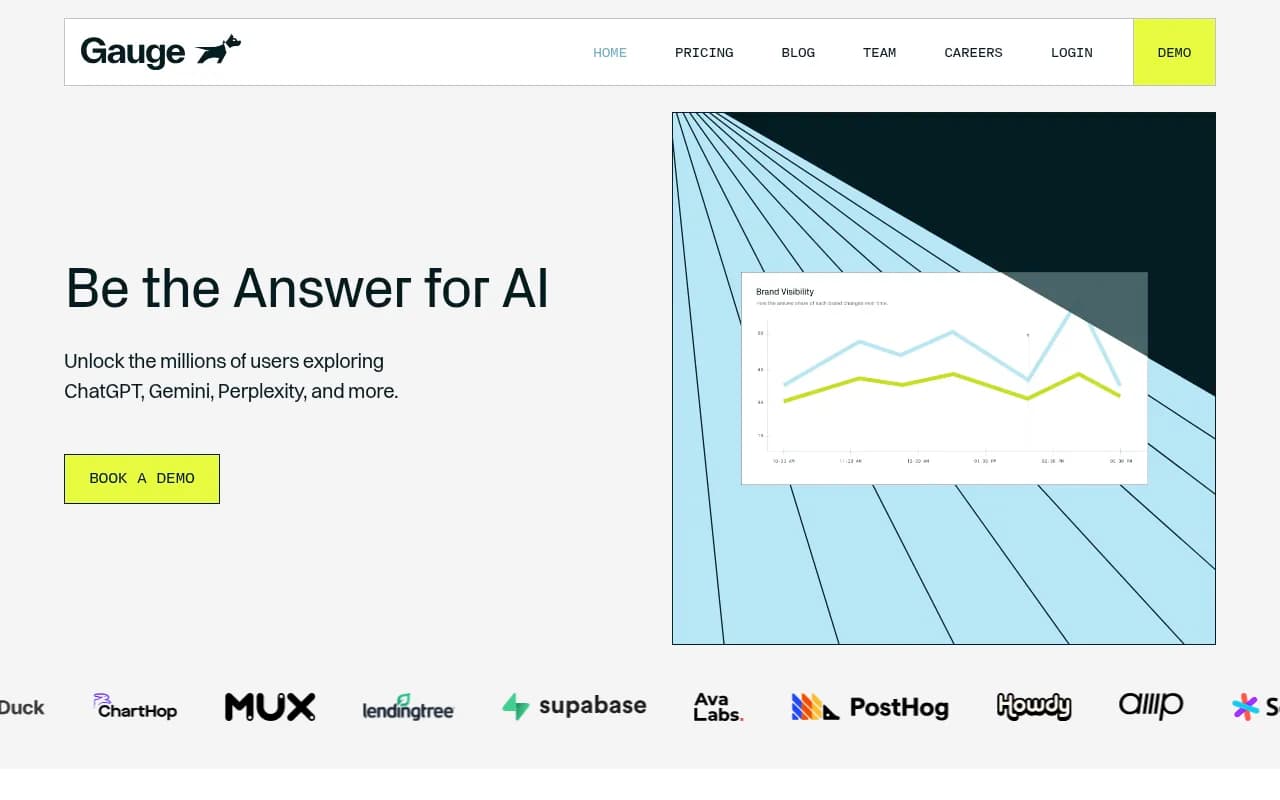
Gauge calls itself "The Agent-Led Growth Platform." Its AI visibility and content product is Gauge Chat. A separate product, Gauge Agents, has an open-source CLI that you can run locally with Docker and your own Claude Code or Codex subscription.
Promptwatch is an AI search visibility and GEO platform. It scrapes the live interfaces of AI engines instead of relying only on APIs, then connects that data to crawler logs, visitor analytics and a content workflow.

A disclosure: this site is published by 1001 SEO Media, which uses Promptwatch as its own GEO platform. I have tried to stay honest about where Gauge wins, because on some points it does.
Pricing and plans side by side
Gauge
Gauge Chat has two plans.
- Growth, $599/mo, month-to-month, no sales call. It includes 600 prompts run daily (Gauge counts that as 54,000 answers a month), 18 publish-ready articles, 3 seats, unlimited domains and competitors, a single location, unlimited Ask Gauge chats, an Action Center, and Email + Slack support.
- Enterprise, custom pricing. Six core platforms, custom prompts, articles, seats and locations, plus sentiment analysis, exports and recurring strategy sessions.
One wrinkle: Gauge's pricing page is inconsistent. A summary box says "6 core platforms" beside the Growth price, while the comparison table lists 3 under Growth and 6 under Enterprise. Confirm with Gauge before you sign up.
Promptwatch
- Essential, $95/mo: 1 project, 50 prompts, 6,000 responses, all models, Agent Chat, country tracking, MCP and API access.
- Professional, $245/mo: 2 projects, 150 prompts, 18,000 responses, content writing and refresh, Knowledge Base, crawler logs and visitor analytics.
- Business, $579/mo: 5 projects, 350 prompts, 42,000 responses, state and city tracking, local GEO targeting, Shopping Insights, Ads Radar, the automated Content Agent, audit logs.
- Enterprise: custom volume, SSO, dedicated success manager, managed content workflows.
There is a free Explore tier (ChatGPT only, 10 prompts) and a 7-day trial on monthly Essential and Professional. Check promptwatch.com/pricing for current numbers.
Comparison table
| Gauge Growth | Promptwatch Essential | Promptwatch Business | |
|---|---|---|---|
| Monthly price | $599 | $95 | $579 |
| Prompts | 600 (daily) | 50 | 350 |
| Answers / responses | 54,000 | 6,000 | 42,000 |
| Approx. cost per 1,000 | ~$11.09 | ~$15.8 | ~$13.8 |
| Engines by default | 3 (ChatGPT, AI Mode, Copilot) | 7+ incl. Perplexity, Gemini, Claude, Meta AI, DeepSeek | Full catalog |
| Google AI Overviews | Enterprise only | Yes | Yes |
| Perplexity | Enterprise only | Yes | Yes |
| Sentiment | Enterprise only | Yes | Yes |
| Articles | 18 per month | None (Professional adds writing) | 10 AEO articles plus the Content Agent |
| Seats | 3 | 1 | 5 |
| Crawler logs | Agent Traffic from your server logs | From Professional | Yes |
| Location tracking | Single location | Country | State, city, exact coordinates |
The per-answer figures are my own arithmetic from published numbers. Whether Gauge's "answers" and Promptwatch's "responses" are counted the same way is unverified, so treat the comparison as directional.
Engine coverage matters more than price per answer
Gauge's own marketing leans on cost per 1,000 answers. It claims $11.09 and compares itself with Profound and Otterly. Those comparison pages contradict themselves in places (the Profound Growth figure shows up as both $44 and $21 per 1,000 on the same page), so I would not repeat either number without a caveat.
The larger point is that a cheap answer on the wrong engine is not a bargain. Promptwatch Data's average sources per response report shows the engines behave very differently. ChatGPT cites about 5 sources per web-search answer. Google AI Overviews cites about 10, and Perplexity cites almost exactly 10. Copilot has swung from under 2 to nearly 17 sources per response within a few weeks.
Citation slots are scarce in ChatGPT and plentiful in AI Overviews and Perplexity, so your strategy and your odds differ by engine. If your buyers use Perplexity or see AI Overviews every day, a plan that leaves them out by default leaves a blind spot. On Gauge Growth you would need Enterprise, or your own API keys for Claude and Grok, to close part of that gap.
Two more things on coverage. Promptwatch monitors real user interfaces, and user-facing answers and citations can differ from API outputs. And Promptwatch also reaches Meta AI, Amazon Alexa and coding agents like Codex, Claude Code and OpenCode, which matters if you sell developer tools.
Where each tool is stronger
Where Gauge wins
- Volume per dollar at the top of the range. 600 daily prompts for $599 with 18 articles included is hard to beat if ChatGPT, AI Mode and Copilot are the engines you care about.
- Month-to-month, no sales call for the Growth tier.
- Developer ergonomics. The open-source CLI, local runs that need no Gauge account or credits, and MCP access suit engineering-heavy teams. Gauge says it is not only for developer tools, but this is where it feels most at home.
- Unlimited domains and competitors on Growth. Handy for portfolio companies.
- Search fanouts and Agent Traffic from your server logs, which tell you which pages AI agents visit.
Where Promptwatch wins
- Entry price. $95 gets a small team real tracking across many engines. Gauge has no tier below $599.
- Engine breadth on every paid plan, including AI Overviews and Perplexity.
- The full loop. IP-verified AI crawler logs, visitor analytics for AI-referred traffic and conversions, Citation Trends, page tracking, and weekly site audits sit alongside the content tools. You can see whether a published page got crawled, cited and clicked.
- Sentiment, heatmaps and exports without a custom contract.
- Reddit, YouTube and LinkedIn citation reports, AI Shopping and Ads Radar, and local targeting at exact coordinates.
- Compliance. ISO/IEC 27001 certification and GDPR compliance help with enterprise procurement. SSO is on Enterprise.
- Track record. 1,840+ brands and agencies and 4.7/5 on G2 (vendor-reported). Crisp, for instance, saw 2x higher conversion rates from AI traffic than traditional channels.
Content and execution
Both platforms want to close the loop from insight to published page, so this is the real contest.
Gauge Growth includes 18 publish-ready articles a month and CMS publishing to Webflow, Framer, Sanity and GitHub, plus an Action Center with recommendations. It is a generous allowance at the price.
Promptwatch's content side is tiered. Professional adds content writing and refresh, a Knowledge Base and Brand Book. Business adds the automated Content Agent, which plans, writes and publishes against your visibility gaps on a calendar and budget you control, with a review inbox or hands-off mode. Publishing covers WordPress, Webflow and Framer. Content Refresh produces git-diff-style updates for existing pages, and content gap analysis scores your pages against the prompts AI answers. The Action Board is a prioritized GEO to-do list.
If you want a fixed block of articles every month with no fuss, Gauge's bundle is attractive. If you want articles grounded in citation data, crawl behavior and your own brand facts, and then measured after publishing, Promptwatch's stack is deeper.
Which one fits your team
| Team type | Likely fit | Why |
|---|---|---|
| Solo founder or small team, tight budget | Promptwatch Essential | $95 vs $599 entry, plus 7+ engines |
| Developer-tool company with an engineering-led growth team | Gauge or Promptwatch | Gauge's CLI and MCP appeal. Promptwatch tracks coding agents and has a 110+ tool MCP server |
| High-volume ChatGPT, AI Mode and Copilot tracking | Gauge Growth | Lowest cost per answer on those three |
| Need AI Overviews, Perplexity, Gemini and Claude | Promptwatch | Included on paid plans |
| Want to prove revenue impact from AI traffic | Promptwatch | Visitor analytics and crawler logs from Professional |
| Multi-location or local brands | Promptwatch Business | City, state and coordinate-level targeting |
| Agency with many clients | Promptwatch Agencies plans | Unlimited projects, white-label reports and workspaces |
| Regulated or security-conscious enterprise | Promptwatch | ISO 27001, audit logs, SSO |
How to run a fair trial
- Write your real prompt list first. Pick 30 to 50 prompts that reflect how buyers ask about your category. Prompt count is the cap you will hit first on either tool.
- Check which engines your buyers use. Do not pay for coverage you will not read, and do not skip coverage you need.
- Run both on the same prompts for a week. Compare mentions, citations and position per engine. Differences between tools tell you how each collects data.
- Ask how an "answer" or "response" is counted. Cost-per-answer math only holds if the units match.
- Test the content output. Publish one article from each and see which one reads like you and gets crawled. Crawler logs make this measurable.
- Read the invoice terms. Gauge Claude and Grok runs via your own keys are billed by the provider. Promptwatch add-ons for extra credits and articles are billed on top of the base plan.
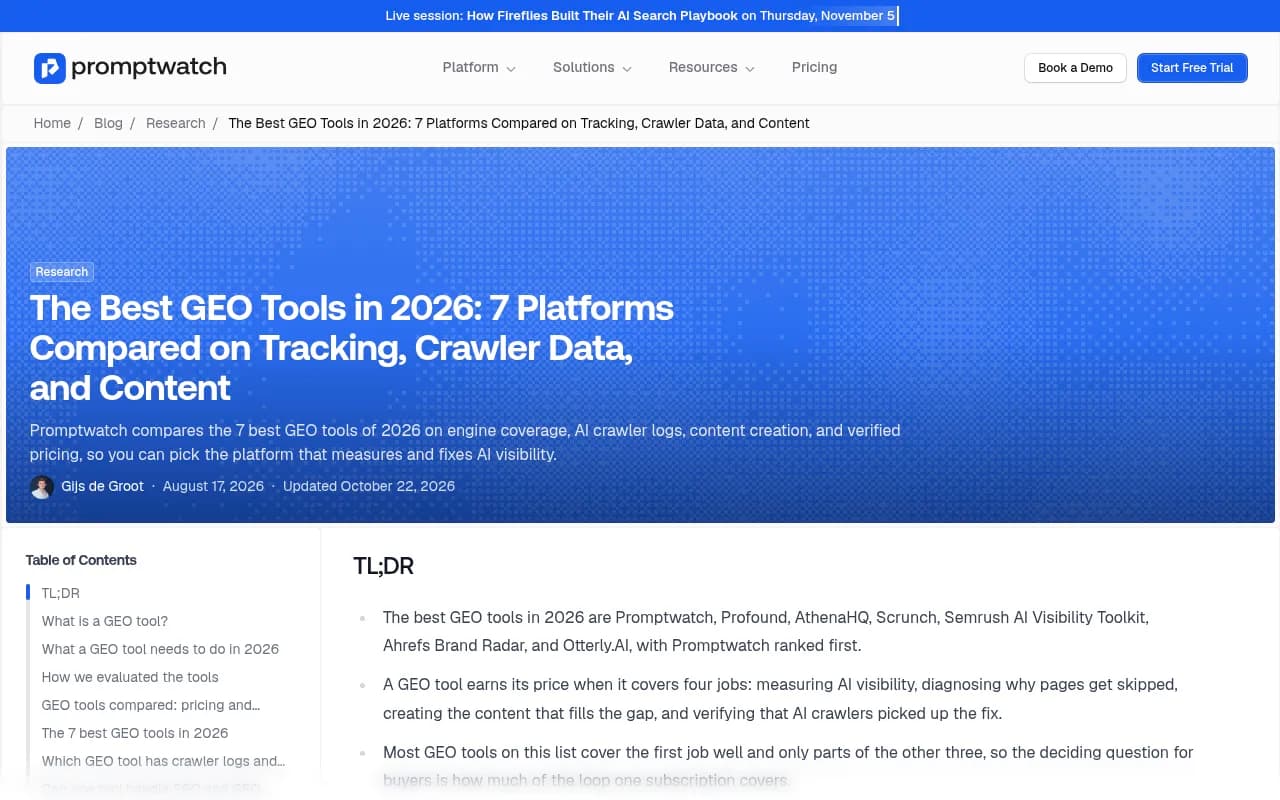
That Promptwatch article is vendor-authored, so read it as one input, not a verdict. Gauge also publishes its own ranking, in which it scores itself 94/100 and Profound 62/100. It calls Promptwatch a "focused point solution." That is self-published too.
Other platforms worth a look
If neither fits, the category is crowded. Profound is the usual enterprise comparison, and Otterly.AI and Peec AI are lower-cost monitors with less execution. You can browse more options in the GEO software directory at bestgeosoftware.com.



Bottom line
Pick Gauge Growth if you are at $599 anyway, your buyers live in ChatGPT, AI Mode and Copilot, you want 18 articles a month bundled in, and your team is comfortable in a CLI. Pick Promptwatch if you want broader engine coverage on every plan, a lower entry price, crawler logs and visitor analytics that tie visibility to traffic, and a content workflow that checks whether each published page worked. Whichever you choose, verify the current plan details on each vendor's pricing page, because both have changed them more than once this year.