Key takeaways
- Evertune is a measurement-first platform (100 samples per prompt, a consumer panel, ad-tech retargeting). Bluefish is a cross-functional platform for brand accuracy, commerce and paid media. Profound is the data-depth and self-serve-trial option.
- Pricing transparency differs. Evertune publishes a $60 Starter and an $800 Pro. Profound offers a free 7-day trial then custom Enterprise. Bluefish is demo-only.
- One widely repeated stat is misattributed: the "about 10% of the Fortune 500" claim and the Adidas, American Express, Hearst, LVMH and Ulta Beauty customer list come from Bluefish's own Series B release, not Profound.
- Every vendor's "vs" page declares itself the winner. Treat comparison pages, including Profound's own, as sales material.
- If you also want a platform that tracks, fixes and measures in one loop with public pricing, Promptwatch is worth putting on the shortlist.
Why this comparison is harder than it looks
I went into the research expecting three similar dashboards. They are not. Evertune, Bluefish and Profound each start from a different theory of what an enterprise GEO problem is, and the right pick depends on which team is carrying the pain.
There is also a lot of stale and self-serving content around. Evertune's pricing is quoted wrong in most third-party posts. A Profound-authored article reports facts about Bluefish that Bluefish contradicts. And a couple of roundups credit Profound with the Fortune 500 footprint that Bluefish actually claims. So this guide leans on each vendor's own pages where possible and flags what I could not verify.
The three platforms in one table
| Evertune | Bluefish | Profound | |
|---|---|---|---|
| Core idea | Statistical measurement plus ad-tech | Agentic marketing platform across teams | Visibility data plus an AI Marketer with Agents |
| Pricing | $60 Starter, $800/mo Pro (annual), custom Enterprise | Not published, demo only | Free 7-day trial, custom Enterprise |
| Engines | 5 on Starter, 11 on Pro | ChatGPT, Google AI, Claude, Perplexity, Amazon Rufus named | Trial: 3. Enterprise: up to 9 |
| Funding | About $19-20M, Series A led by Felicis | $68M total, $43M Series B (April 2026) | Reported $96M Series C at $1B valuation (Feb 2026), not re-verified |
| Action layer | Content Agent, Ads Agent, AI Retargeting | Agentic Campaigns, paid media expansion | Agents, Sheets, Agent Analytics |
| Public reviews | None on G2 or Trustpilot | Not found | Claims 1,100+ G2 reviews (vendor claim) |
| Best for | Insights and brand teams | Brand safety, commerce, cross-functional teams | Teams wanting to test before a contract |
Evertune: measurement first
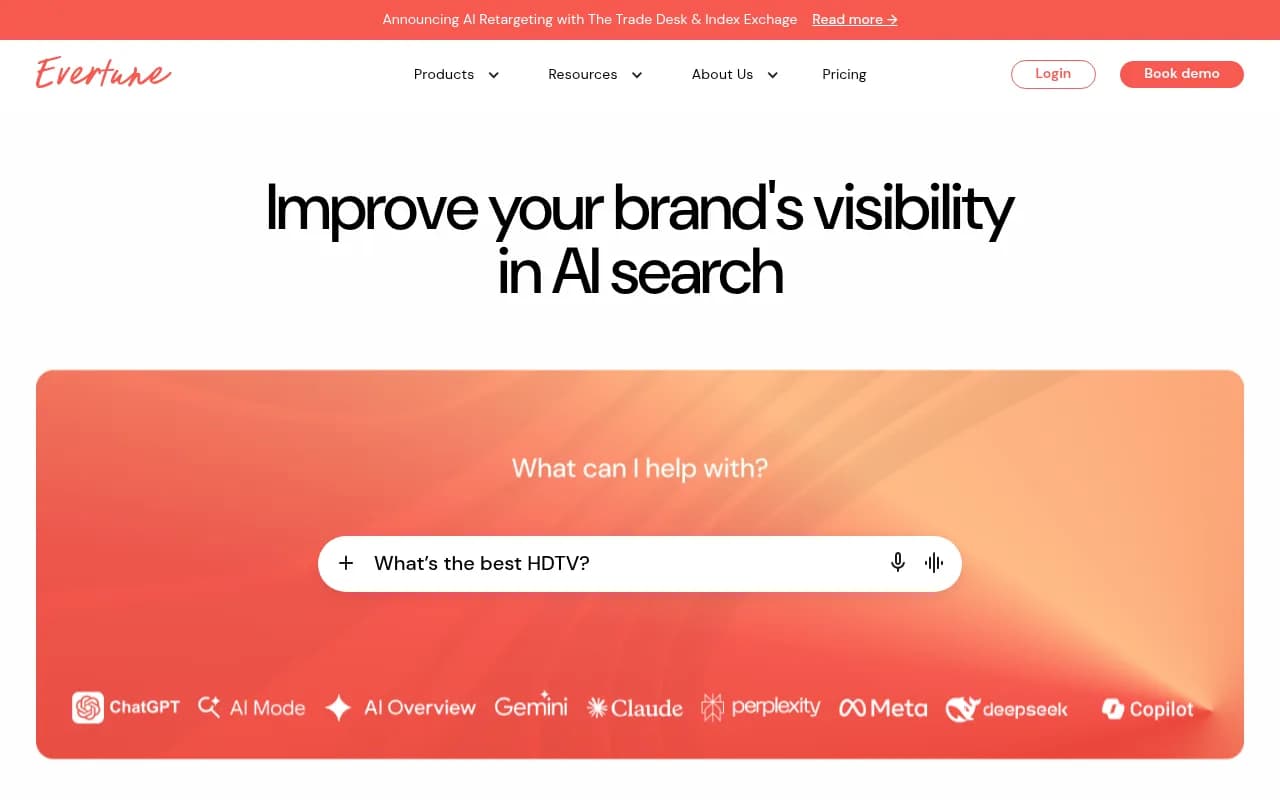
Evertune was founded in 2024 by early Trade Desk team members and is based in New York. Its pitch is statistical: it says it samples every prompt 100 times per model across 11+ models, while most tools sample once a day. That is a vendor claim, but the underlying concern is real. Promptwatch Data shows ChatGPT query fanouts averaging about 2.15 per response in early December 2025 and falling to roughly 1.84 by early March 2026, so any single run of a prompt is a noisy reading. Repeat sampling is a legitimate answer to that.
What you get
The pricing page is more open than older articles suggest:
- Starter at $60 a month: 5,000 prompt credits, up to 5 models (ChatGPT Search, Gemini Search, AI Mode, AI Overview, Copilot), and an Ads Agent for ChatGPT ads at 10% of media spend after a 7-day trial. No sampling for statistical significance from day one.
- Pro at $800 a month billed annually: 100,000 credits, 11 models, 100 samples per prompt, a Content Agent at 25 articles a month, Prompt Volumes, Prompt Lab, a Data MCP for Claude or ChatGPT, and an 8% Ads Agent fee.
- Enterprise, custom: Bot Analytics, Site Audit, Fact Checker, Keyword Sentiment, SSO, cloud bucket export and dedicated support.
The Starter tier appears to be new, dated to October 20, 2026 on the company news page. Many third-party posts still quote only the $800 tier or a $3,000 figure.
Where it is distinctive
EverPanel, a panel of about 25M real internet users, feeds an AI Usage view, and a separate agent mines 150M+ real user conversations for prompts. Then there is the ad-tech side: AI Retargeting serves programmatic ads to people who click cited sources, through The Trade Desk, DV360, Yahoo DSP via Experian and Index Exchange. If your GEO budget lives next to a media budget, that is unusual and useful.
It also has analyst recognition: Gartner representative vendor in the 2026 Market Guide for Answer Engine Visibility Tools, and a Forrester notable vendor in its Q3 2026 AEO landscape.
Caveats
SSO is Enterprise-only. Named customers are thin: athenahealth, At Home and an unnamed holding company agency. With no public reviews, you are relying on a demo and references.
Bluefish: the platform and brand-accuracy play
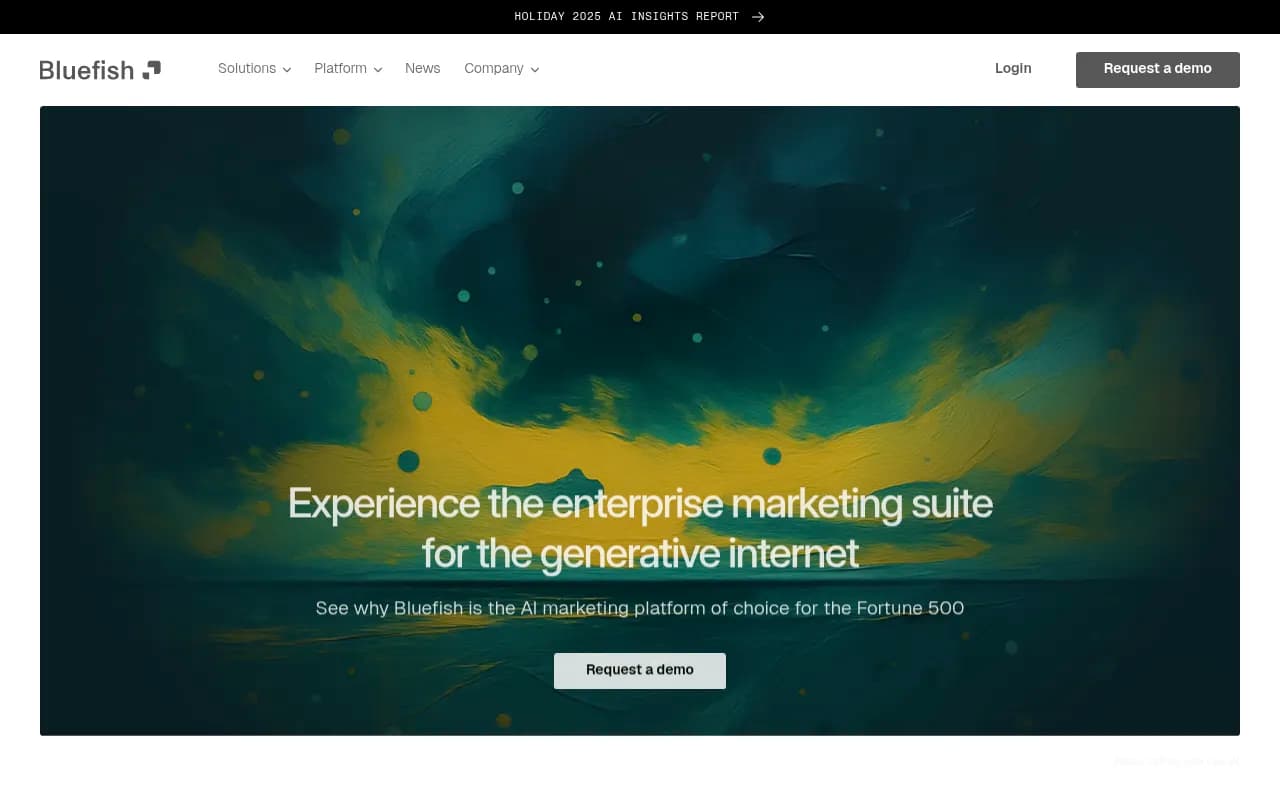
Bluefish sells what it calls an Agentic Marketing Platform, organized into Monitoring, Optimization and Measurement, aimed at Search, Content, PR/Comms, Commerce and Paid Media teams. One third-party breakdown lists five modules, adding Commerce and Accuracy. Either way, the through-line is the same: this is built for many stakeholders at once.
The facts that check out
- $43M Series B in April 2026, co-led by Threshold Ventures and NEA, with Amex Ventures, TIAA Ventures, Salesforce Ventures and Bloomberg Beta participating. $68M total.
- Hundreds of accounts across 12+ verticals including financial services, pharma, beauty, luxury and CPG.
- Customers named in its release: Adidas, American Express, Hearst, LVMH and Ulta Beauty. Its own claim of roughly 10% of the Fortune 500 comes from the same release.
- Amazon Rufus coverage, which neither Evertune nor Profound publicly leads with.
- Agentic Campaigns (June 2026) and a move into paid media (October 2026).
The facts to be careful with
Bluefish says it delivers "double and triple-digit performance gains within months." I would ask for the baseline and the customer behind that number. And its compliance badges came from secondary sources I could not confirm directly, so request the SOC 2 report in procurement rather than trusting a comparison page.
The accuracy angle is the real differentiator. For a pharma or financial brand, an AI engine stating a false product fact is a risk issue, not a vanity metric. If legal and comms need a seat at the table, Bluefish is built to talk to them.
Profound: data depth and a try-before-you-buy path
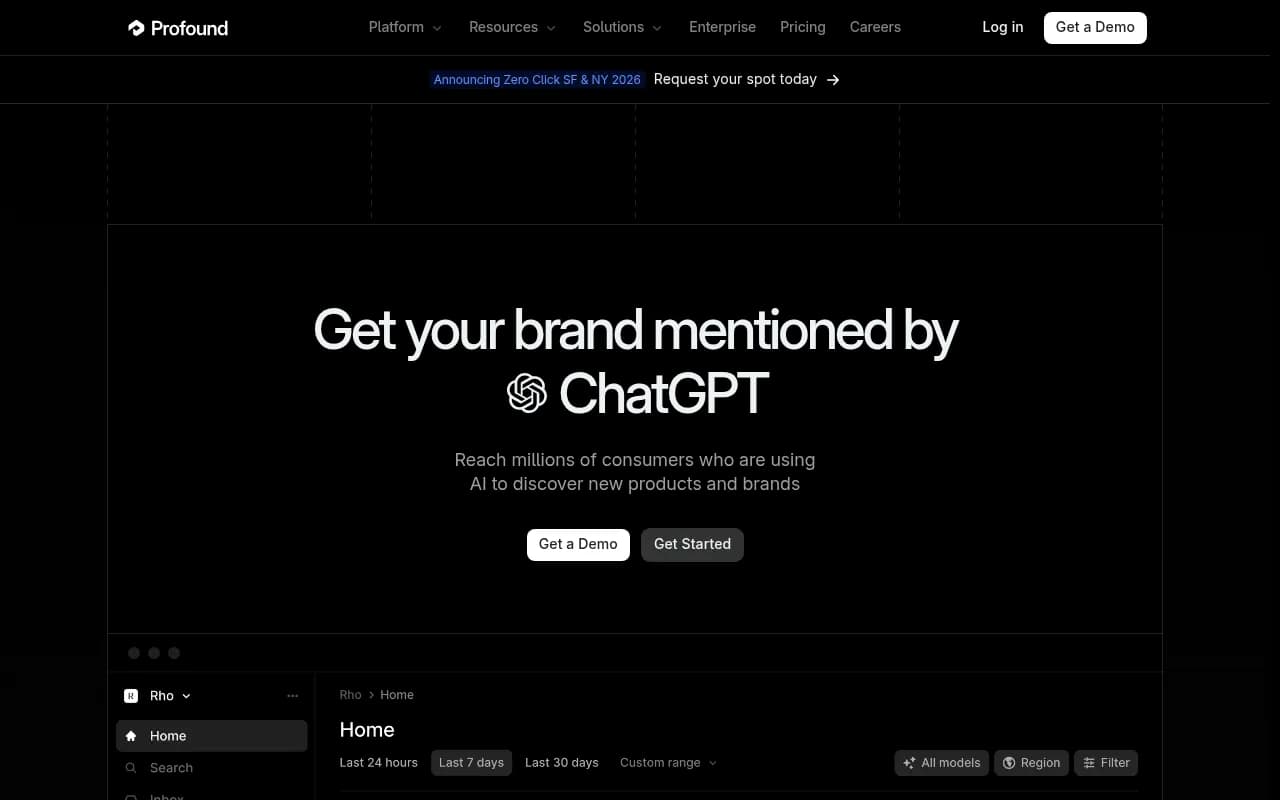
Profound is the only one of the three with a free entry point: a 7-day trial with 50 prompts run daily across ChatGPT, Gemini and Google AI Overviews, one language and region, no exports, no API, no SSO.
Enterprise is custom and adds up to 9 engines (ChatGPT, Perplexity, Google AI Mode, Gemini, DeepSeek, Claude, AI Overviews, Exa Search and Muse Spark), daily tracking, ChatGPT Shopping, Prompt Volumes, all-time history, CSV/JSON export and API, SSO/SAML, SOC 2, unlimited seats, and support up to a dedicated specialist with a 24-hour SLA. Agent Analytics ties AI-sourced traffic to CDN integrations like Akamai, Cloudflare, AWS and Fastly.
Two things to know:
- Profound now sells an "AI Marketer" with Agents, Context Manager, Projects and Sheets, and says it is not only for AI search. Older comparisons still describe it as a tracker.
- The $99 Starter and $399 Growth figures circulating in roundups were not on the current brands pricing view. Verify before you put them in a budget.
Do not repeat the Fortune 500 claim
Several roundups say about 10% of the Fortune 500 use Profound. I could not find a Profound primary source for that. The wording and the five named customers match Bluefish's release. Ask Profound directly for its own customer proof.
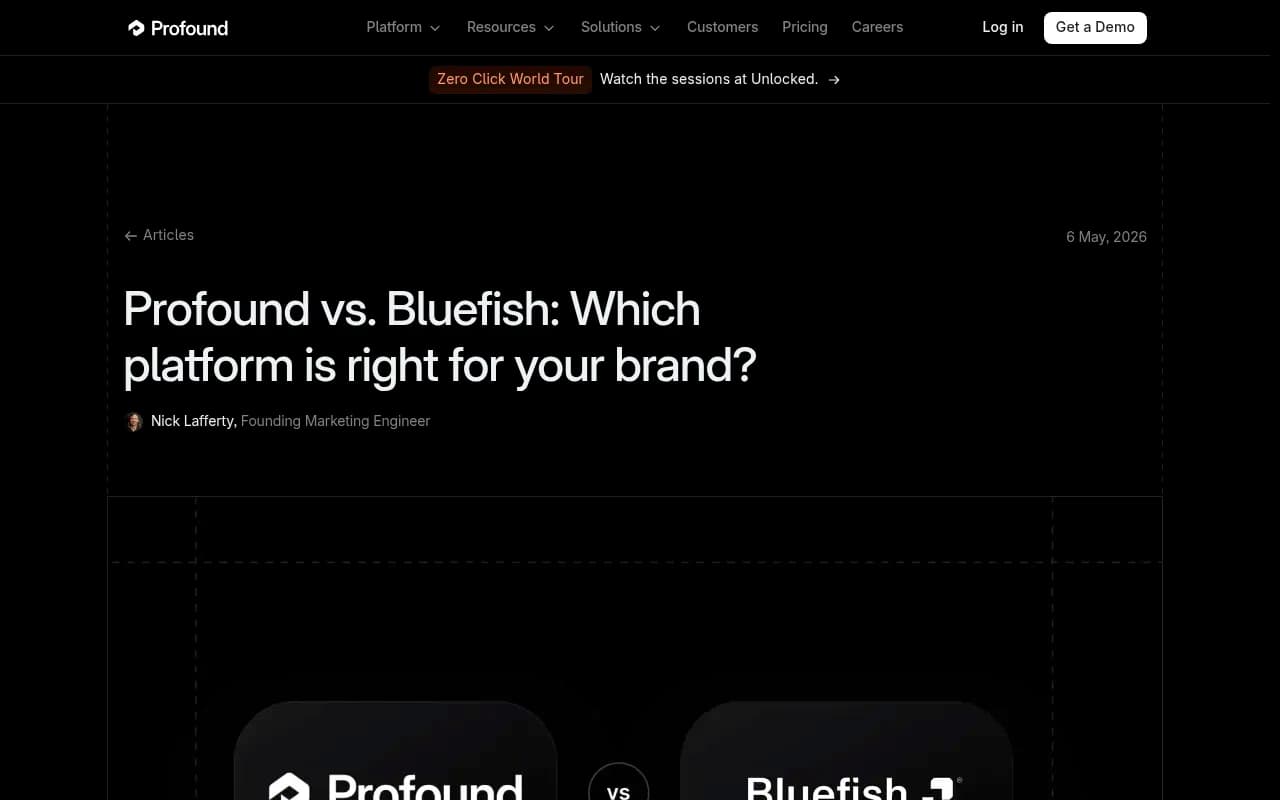
That page is a good illustration of the genre. Profound's FAQ concludes Profound is best for enterprise brands and notes it has 1,100+ G2 reviews while Bluefish has none. Fair enough as a data point, but it is a competitor writing about its rival.
Which Fortune 500 team should buy which
Brand and insights teams: Evertune
If your CMO wants numbers that sit beside brand tracking and survive a skeptical analyst, the sampling and panel approach is the strongest case. The Pro tier at $800 a month is also the lowest published commitment of the three for a full multi-model setup, though real enterprise terms will differ.
Paid media and performance teams: Evertune again
AI Retargeting and the Ads Agent connect GEO to media buying. Mind the fee structure: 8 to 10% of media spend adds up fast at enterprise budgets.
Regulated, reputation-sensitive brands: Bluefish
Pharma, financial services and luxury teams where wrong claims carry legal weight get the most from Bluefish's accuracy focus. Commerce teams selling through Amazon get Rufus coverage too. Expect a sales-led process and no public price.
Search and content teams that want to test first: Profound
If you need a proof of concept before a procurement cycle, the free trial is a real advantage. Enterprise adds the depth: Prompt Volumes, Shopping, crawler-level attribution and SSO.
Teams that mainly need the fix, not just the report
All three have action layers, but of different shapes. If your bottleneck is producing and publishing content that earns citations, then measuring whether it worked, a platform built around that loop may fit better. Promptwatch tracks prompts across ChatGPT, Gemini, Perplexity, Claude and Google AI Overviews, then uses a Content Agent to publish to WordPress, Webflow or Framer, and checks results with IP-verified crawler logs and visitor analytics. Plans are public: Business is $579 a month with the Content Agent, Fact Check and Ads Radar, and there is a 7-day free trial (confirm at promptwatch.com/pricing). It is ISO/IEC 27001 certified and GDPR compliant, which helps in security reviews.

What to check in any demo
- Sampling. How many times is each prompt run per model per day, and is the data from the real consumer interface or an API? User-facing answers can differ from API outputs.
- Engine coverage on your plan, not the top tier. Evertune Starter covers 5 models and Profound's trial covers 3.
- Per-engine reporting. Promptwatch Data on average sources per response shows ChatGPT citing about 5 sources per web-search answer while Google AI Overviews and Perplexity sit near 10. A single blended score hides that.
- Hidden fees. Ads Agent percentages, credit overages and agent credit caps.
- Proof. Ask for a named reference in your vertical and the baseline behind any performance claim.
- Compliance documents. Request the SOC 2 report and any HIPAA assessment directly.
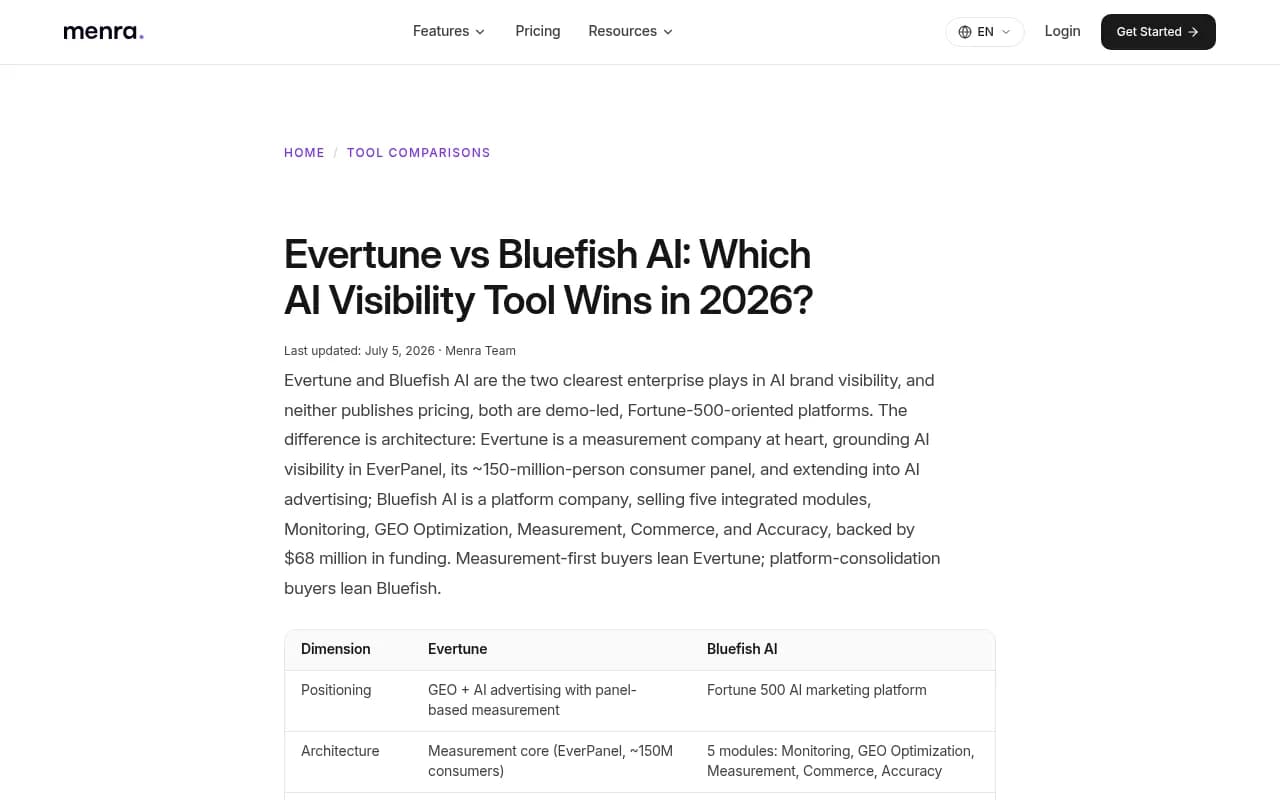
The Menra framing is the cleanest summary I found: measurement-first buyers lean Evertune, platform-consolidation buyers lean Bluefish. Profound sits between them as the data-and-trial option.
Can you run two of them?
Some do. Bluefish does not replace the visibility work Profound is built for, and Profound does not publish the Rufus and Alexa coverage Bluefish does. But two enterprise contracts means duplicated prompt sets and two sources of truth. Start with one, and add the second only when a specific team has a specific gap.
For more options beyond these three, the directory at bestgeosoftware.com lists GEO platforms across price points.
Bottom line
- Choose Evertune if measurement rigor and ad-tech integration matter most, and you want published starting prices.
- Choose Bluefish if brand accuracy, Amazon commerce and cross-team workflows are the priority, and you are comfortable with a demo-led purchase.
- Choose Profound if you want to run a trial first and need deep prompt, citation and crawler data with enterprise security.
- Whichever you pick, verify prices, engine counts and compliance claims on the vendor's own pages during the demo. Several numbers in circulation are out of date or attributed to the wrong company.