Adobe Brand Visibility Review 2026
Formerly Adobe LLM Optimizer. Measures AI-driven traffic and citations and helps enterprises optimize content for generative AI search.
Key takeaways
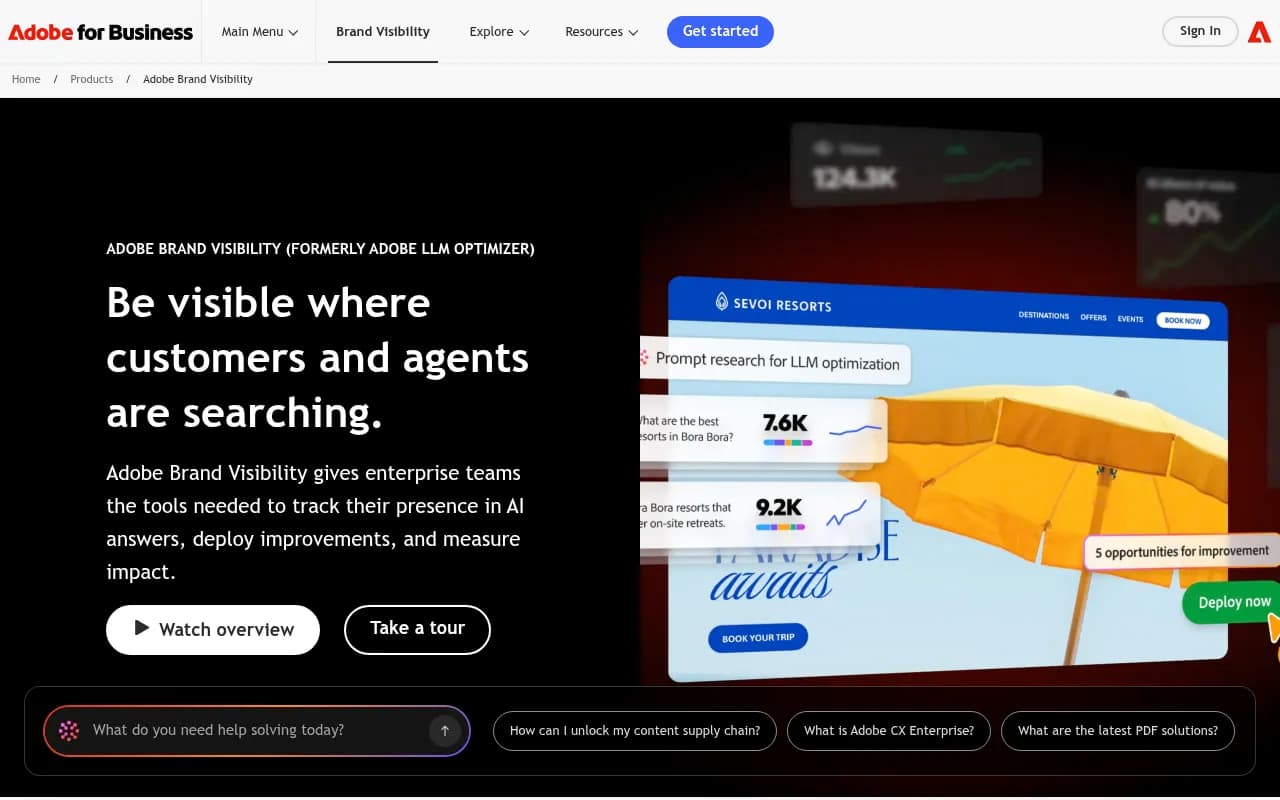
- Adobe Brand Visibility (formerly Adobe LLM Optimizer) is an enterprise, sales-led GEO platform. It tracks AI mentions and citations, deploys fixes, and ties results to Adobe Analytics.
- Compared with Promptwatch, it lacks a public Content Agent with WordPress, Webflow and Framer publishing, prompt volume and difficulty scoring, Reddit/YouTube/LinkedIn citation reports as separate products, AI Shopping and Ads Radar, and Agent Chat with an Action Board. Pricing and self-serve access are also missing.
- Its standout feature is CDN-edge delivery of AI-agent-only optimizations (Fastly, Akamai, Cloudflare), with rollback. Few competitors do this.
- Semrush data (an Adobe company) adds keyword and clickstream context to AI visibility.
- Pricing is not published. Competitors estimate roughly EUR 60,000 to $115,000 per year at the entry level, which is unofficial. There is no public self-serve trial.
- Best for large enterprises already on Adobe Experience Cloud. Poor fit for SMBs, agencies and small teams.
Adobe Brand Visibility is Adobe's generative engine optimization product for enterprises. It was launched as Adobe LLM Optimizer (a third-party source puts general availability at October 2025) and has since been renamed. The rebrand folds Adobe's optimization tooling together with Semrush's market intelligence, since Adobe now owns Semrush. The pitch is simple: see how ChatGPT, Perplexity, Google AI Mode, Claude and Copilot describe your brand, fix what is broken, then prove the business impact in the analytics stack you already own.
The audience is clear from the website. SEO teams, content strategists, web experience teams, analytics practitioners and brand leaders at large organizations. Customer logos include Lovesac, Kellogg, Lumen and Heathrow Airport. Everything runs through a sales consultation, and there is no pricing page, which tells you most of what you need to know about who it is built for.
I have not found independent user reviews beyond a Capterra listing, so much of what follows rests on Adobe's documentation and product pages, plus competitor write-ups that I treat with suspicion where noted.
Key features
AI visibility tracking. The monitoring layer tracks mentions, citations, sentiment and share of voice across ten LLM families, including ChatGPT, Perplexity, Google AI Mode, Anthropic Claude and Microsoft Copilot. Coverage spans more than 25 languages with state and city breakdowns, and share-of-voice benchmarking against up to five direct competitors. Adobe says its dataset covers 2.18B+ observed AI responses, grouped into topics so teams can see gaps. You can trace any finding back to the prompt, the answer and the sources behind it.
Semrush data integration. This is the differentiator in the monitoring side. Adobe combines Semrush SEO data across 28.9B keywords and clickstream data with AI visibility, so you can ask where strong search authority should be earning AI citations but is not. Prompts are suggested from real demand rather than guesswork. Most pure-play trackers have to approximate this, and it is a legitimately useful angle. Note the caveat Adobe itself gives: results reflect the prompts you track and vary over time.
Optimize at Edge (CDN-layer deployment). This is the feature people talk about. Brand Visibility detects AI agent requests at the CDN and serves optimized content to them without a CMS update or engineering sprint. Compatible CDNs are Fastly, Akamai and Cloudflare, so it is not exclusive to Adobe Experience Manager. Typical fixes:
- Unblocking crawlers, adding missing structured data and resolving 404s
- Adding FAQ formats, LLM-friendly summaries and simplified versions of complex pages
- Rollback if something goes wrong
- Targeting AI agents only, so human visitors and existing SEO signals are meant to be unaffected
The concept is strong for large sites where a dev ticket takes weeks. The thing to examine in a pilot is governance: serving different content to bots than to humans needs a clear policy and a good relationship with your SEO team.
Experience Manager Sites and Adobe Commerce publishing. For AEM customers, recommendations flow straight into Experience Manager Sites. You edit content and metadata on the live page or component, and the change goes through your existing review, approval and publishing workflow. You can then verify what AI agents can access once live. Adobe Commerce is positioned to make product information easier for AI to find and interpret, and AEM Assets metadata can feed accurate information to agents.
Offsite guidance. Beyond your own domain, the platform gives channel-by-channel guidance for Wikipedia, YouTube, Reddit and earned media. It is guidance, though. It is not a dedicated reporting suite for subreddits, videos or LinkedIn posts, and it does not execute the work for you.
Impact measurement. Brand Visibility connects to Adobe Analytics and Customer Journey Analytics. CDN log verification gives server-level confirmation that AI bots fetched your updated content, and that signal can be tied to engagement and conversions. A baseline is set before launch and results are measured afterward, so you can see which optimizations are associated with KPI changes. This is the strongest argument for the product if your reporting already lives in Adobe. Be careful with the word "associated": it is attribution-lite, not a controlled experiment.
Dashboards and collaboration. Dashboards present insights and recommendations per site, and there is a shared workspace for SEO, content and analytics teams. The documentation includes best-practice guides for categories, topics and prompts, plus a video library called Brand Visibility University. Documentation quality is good, which is typical of Adobe.
Who is it for
The sweet spot is a large enterprise with an existing Adobe footprint: a retailer running Adobe Commerce and AEM, a telecom like Lumen with a huge content estate, or an airport or consumer goods brand with a central digital team and an analytics group living in Customer Journey Analytics. For those teams, the integrated path from visibility to edge fix to revenue reporting is real value, and procurement is easier when it is another line on an Adobe contract.
It also suits organizations with slow engineering cycles. If a technical SEO fix like structured data or unblocking AI crawlers takes a quarter to ship, CDN-edge deployment is genuinely attractive.
Who should skip it? SMBs, startups, freelancers and small agencies. There is no self-serve signup, no public price, annual contracts, and reports from competitors suggest a six-figure-ish entry ticket. Teams not on Adobe Experience Cloud will get the monitoring and edge deployment but lose much of the integrated measurement story. Agencies that need multiple client workspaces and white-label reports will find nothing designed for them here.
Integrations and ecosystem
Adobe lists four integrations: Experience Manager Sites, Adobe Commerce, Customer Journey Analytics and Adobe Analytics. Edge deployment works with Fastly, Akamai and Cloudflare. Semrush data is built in.
That is a tight, Adobe-centric ecosystem. I did not find a public REST API, an MCP server, a Slack integration, or Looker Studio connectors in the research, and no browser extension or mobile app. If you want to wire AI visibility data into arbitrary tools, ask Adobe directly. Publishing to non-Adobe CMS platforms such as WordPress, Webflow or Framer is not documented on the product page, so non-AEM sites rely on the edge route.
Pricing and value
Adobe publishes no pricing. The only path is the "Get started" consultation form. The Creative Cloud and Acrobat prices that show up in search results are unrelated to this product.
What circulates comes from competitors, so treat it carefully:
- LLM Pulse says the product is an annual contract with a 1,000-prompt minimum sold in 200-prompt increments, with tiers from 1K to 110K+ prompts and volume discounts. It reports quoted teams paying about EUR 60 per tracked prompt per year, which implies roughly EUR 60,000 a year at entry.
- SEORCE estimates a minimum near $115K per year.
Both are unofficial and both sell competing products. There is no public self-serve trial, though one is reportedly available to certain eligible Adobe customers. For comparison, Promptwatch publishes pricing from a free Explore plan through Essential at $95/mo, Professional at $245/mo and Business at $579/mo, with a 7-day trial on the entry paid plans. Verify current Promptwatch numbers at promptwatch.com/pricing. If Adobe's quotes land anywhere near the reported figures, value depends entirely on whether edge deployment and Adobe analytics integration are worth a large premium to you.
Strengths and limitations
Strengths
- CDN-edge delivery is rare among GEO tools, and the rollback and agent-only targeting address the obvious worries.
- Semrush data grounds prompt selection in real keyword demand and clickstream behavior.
- Native Adobe Analytics and CJA reporting puts AI results next to paid, social and web results.
- Enterprise-grade breadth: ten LLM families, 25+ languages, state and city breakdowns.
- Good documentation and a tutorial library.
Limitations
- Opaque pricing, annual contracts and no self-serve trial.
- Heavy Adobe gravity. Value drops if you are not an Experience Cloud customer.
- Only five competitors per benchmark, and no sign of agency features.
- Independent reviews are scarce, so claims like the cited 5x Firefly citation increase in one week are unverified.
What it lacks compared with Promptwatch
Brand Visibility is stronger on Adobe-native integration. Promptwatch is stronger on the rest of the optimization loop, and it is the more complete choice for most teams:
- A Content Agent that plans, writes and publishes GEO content to WordPress, Webflow and Framer on a schedule, with a review inbox, then tracks whether each page gets crawled, cited and clicked.
- IP-verified AI crawler logs (GPTBot, ClaudeBot, PerplexityBot and others) with a crawl-to-citation path and citation rate per page, and spoofed bots filtered out.
- Visitor analytics for AI-referred traffic and conversions without needing an Adobe analytics stack.
- Google Search Console and Bing Webmaster data overlaid per page with AI crawls and citations (360 Insights).
- Dedicated Reddit, YouTube and LinkedIn citation reports, plus Offsite Mentions and a Page Tracker.
- AI Shopping tracking in ChatGPT and Amazon Alexa, and Ads Radar for sponsored placements in AI search.
- Prompt volume and difficulty scoring, and query fan-outs showing the searches AI runs per response.
- Agent Chat and an AI-generated Action Board with a weekly Discovery agent.
- Real-UI monitoring across 15+ engines including Meta AI, Amazon Alexa and coding agents like Codex and Claude Code, a 110+ tool MCP server, REST API, and public pricing.
For context on why content type matters, Promptwatch Data shows product pages are the most cited type in ChatGPT at 22.4% of citations (Sep 28 to Oct 4, 2026) (report). Tools that can actually generate and publish those pages close the loop faster.
Bottom line
Adobe Brand Visibility makes sense for large organizations already invested in Adobe Experience Cloud that want GEO fixes shipped without engineering queues and results reported inside Adobe Analytics or Customer Journey Analytics. The edge deployment is the real innovation here. Everyone else will find the price, the sales process and the ecosystem lock-in hard to justify.
For teams that want optimization rather than monitoring plus edge fixes, with content generation, crawler logs, AI traffic attribution and transparent pricing, Promptwatch is the stronger alternative. For a wider look at options, the GEO software directory at bestgeosoftware.com is a good starting point.
Best use case: an Adobe-centric enterprise that needs AI-agent-specific fixes shipped at the CDN without developer sprints.

Tags:
Frequently asked questions
What is Adobe Brand Visibility?
How much does Adobe Brand Visibility cost?
Do I need Adobe Experience Manager to use it?
Which AI platforms does it track?
Is there a free trial?
How does it compare to Promptwatch?
Similar and alternative tools to Adobe Brand Visibility