Key takeaways
- ActiveCampaign is the best fit for most small teams that care about automation. Starter runs $15/month (annual billing, 1,000 contacts) and includes a real CRM plus the strongest workflow builder of the four.
- Mailchimp is the cheapest way to start, but the free plan has no automations at all and Essentials caps them. Standard at $20/month is where Mailchimp becomes a serious automation tool.
- HubSpot has the best free CRM in this group, but the next meaningful step up is Marketing Hub Professional at $800/month with a mandatory $3,000 onboarding fee. Starter gives you just 10 automated actions.
- Keap consolidated everything into a single plan at $249/month (billed annually) and was acquired by Thryv. It bundles CRM, payments, funnels, and appointments, but it stopped being a budget option.
- Rough yearly cost at 1,000 contacts: $180 on ActiveCampaign Starter, $180 on HubSpot Starter (one seat), $318 on Mailchimp Essentials, $2,988 on Keap.
The short version
Every small team shopping for marketing automation lands on the same shortlist: ActiveCampaign, Keap, Mailchimp, HubSpot. That part hasn't changed. What has changed, heading into 2026, is the pricing underneath them, and a lot of comparison articles you'll find online are quietly working from numbers that no longer exist.
The quick answer:
- Pick ActiveCampaign if automation is central to how you plan to grow.
- Pick Mailchimp if you're brand new and need the cheapest possible start.
- Pick HubSpot if a free CRM matters more to you than automation, and you can afford Professional later.
- Pick Keap if you run a service business and want quotes, invoices, appointments, and marketing living in one system.
The rest of this guide explains the reasoning, with current pricing and the fine print that tends to decide the purchase.
How the four compare at a glance
| ActiveCampaign | Mailchimp | HubSpot | Keap | |
|---|---|---|---|---|
| Entry price (annual billing) | $15/mo, 1,000 contacts | Free; $13/mo for 500 contacts | Free; $15/mo/seat | $249/mo, single plan |
| Free tier | No, 14-day trial | Yes, 250 contacts and 500 sends/mo | Yes, free CRM with 2,000 sends/mo | No |
| CRM | Yes, on every plan | Basic marketing CRM | Yes, and the free one is generous | Yes, it's the core of the product |
| Automation at entry level | Branching and multiple triggers, capped steps | None on Free, capped on Essentials | 1 action on Free, 10 on Starter | Full workflows included |
| AI features | Deep, prompt-built automations | Light, template-based flows | Breeze Copilot free; agents on higher tiers | Not a focus |
| Payments and invoicing | No | No | Separate hubs | Yes, built in |
| Best for | Automation-focused teams | Beginners on tight budgets | CRM-first teams | Service businesses |
ActiveCampaign: the automation benchmark
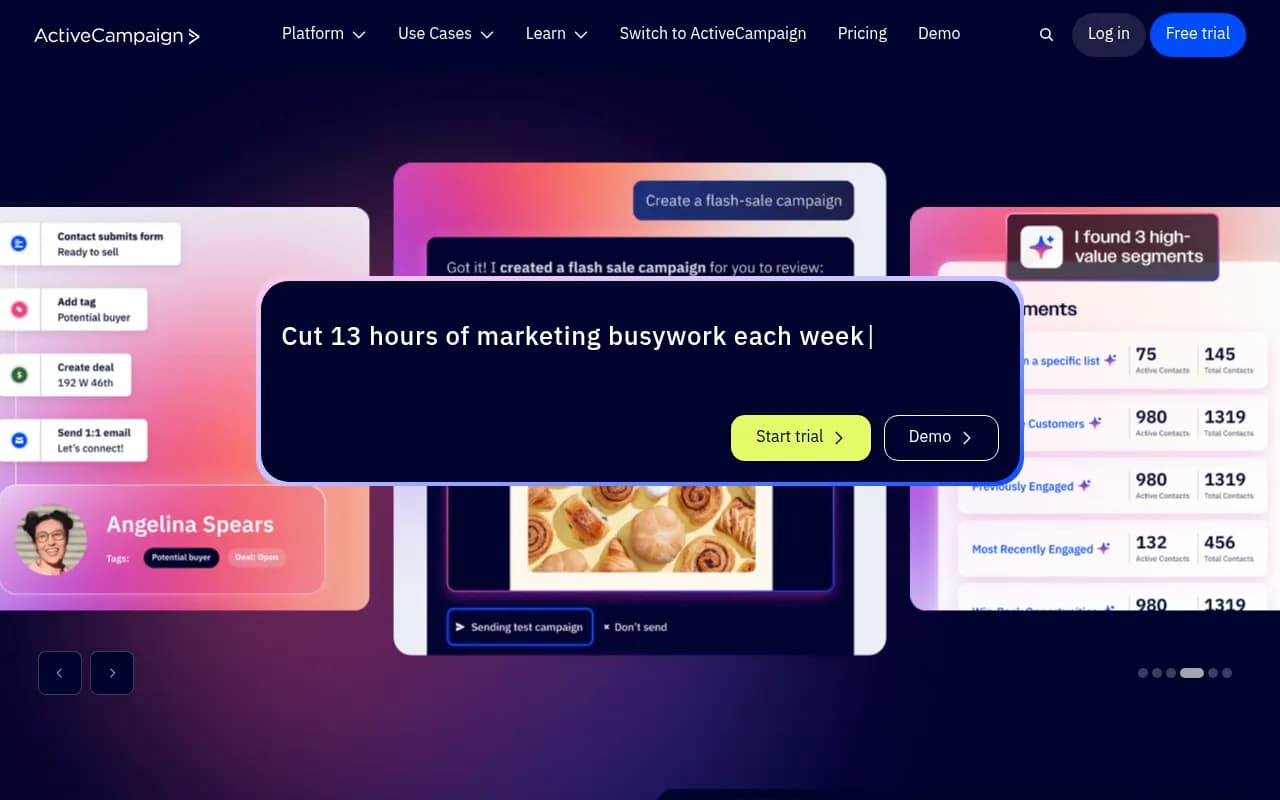
ActiveCampaign has been around since 2003 and carries a 4.5 rating across more than 14,000 reviews, which tells you two things: lots of people use it, and most of them don't regret it. Current pricing (annual billing, 1,000 contacts) is Starter at $15/month, Plus at $49, Pro at $79, and Enterprise by quote. Monthly billing runs higher, with Starter around $19.
What makes it the benchmark is the workflow builder. Even the entry plan includes branching logic and multiple triggers, though it caps each automation at five steps. Plus removes the caps entirely and adds landing pages, sales automation, and AI content features. The segmentation engine has more than 100 filters, pulling in data from your sales pipeline, automations, and website. Mailchimp gives you a couple dozen filters by comparison, and it shows when you try to build anything nuanced.
The AI is the other differentiator. Zapier's reviewers tested it in early 2026 and asked ActiveCampaign's assistant to build a five-day drip series with three emails. It generated the entire thing, designs and copy included, which left them tweaking rather than building. Mailchimp's equivalent relies on pre-made flow templates. If a template exists for what you need, fine. If it doesn't, you're assembling the workflow by hand.
Two honest caveats. First, there's no free tier, just a 14-day trial. Second, costs climb with your list: Plus goes from $49 at 1,000 contacts to $145 at 5,000 and $329 at 20,000, and reviewers note that even Plus can pass $600/month at scale once send caps and add-ons enter the picture. For a small team, though, the entry and mid tiers are where the value is, and the value is considerable.
Keap: all-in-one, with a new price tag
Here's where most older comparisons fall apart. Keap used to sell Pro and Max tiers starting around $129/month. Those are gone. Keap now sells a single plan: $299/month billed monthly, or $2,988/year (effectively $249/month) billed annually. And in a move that surprised a lot of its user base, Keap was acquired by Thryv, with support and billing now routing through Thryv properties.
What you get at that price is genuinely broad: a CRM with lead scoring, landing pages, multi-page sales funnels, forms, email broadcasts plus 1:1 email synced with Gmail and Outlook, text message marketing, invoicing and payments, appointment scheduling, and review and referral automation. Third-party pricing trackers put the included allowance at roughly 1,500 contacts and two users, though Keap's own page uses a calculator rather than publishing static numbers. SMS is a tiered add-on running from $24 up to $279/month depending on volume.
The support story is real and worth taking seriously. Every plan includes a dedicated customer success manager, 15 hours of migration services, US-based phone support, and 24/7 chat. Keap claims customers save 10 hours a week and that you can build an automation in as little as three minutes. For a solo operator, that hand-holding has actual dollar value.
My take is mixed. For coaches, consultants, agencies, and anyone who bills clients and wants quotes, invoices, and appointments inside the same system that runs their marketing, Keap's bundle math can work even at $249/month. But if you don't need payments and scheduling, you can stack ActiveCampaign Plus with a scheduling tool and Stripe and come out well ahead. The required implementation services add upfront cost too, and any acquisition introduces questions about product direction. I wouldn't call it a bad product. I'd call it a specific product at a premium price.
Mailchimp: the easy on-ramp with a low ceiling
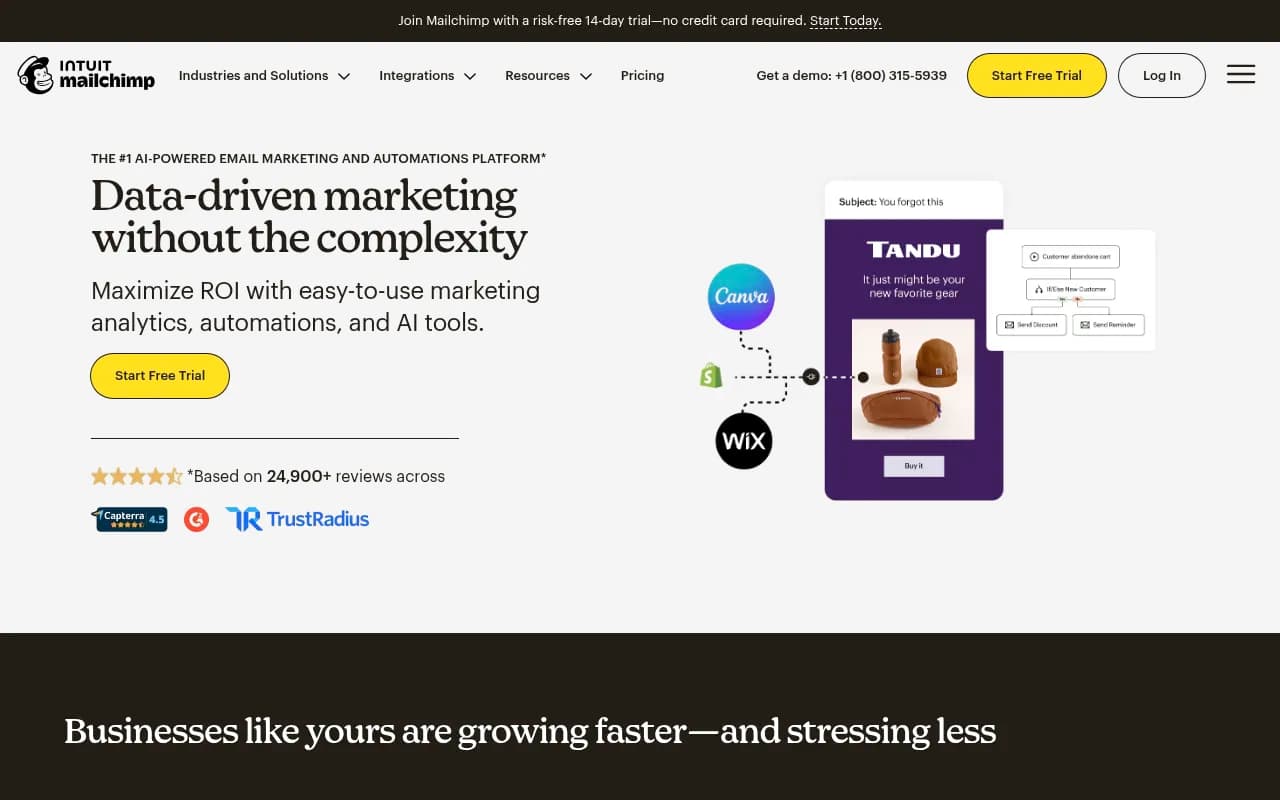
Mailchimp remains the default first step for small businesses, and for good reason. Nothing in this group is easier to learn. The guided onboarding, the drag-and-drop builder, the five-star contact ratings instead of complicated lead scoring, it all assumes you're a business owner wearing six hats, because you probably are.
But look closely at the tiers, because the free plan has shrunk. You now get 250 contacts and 500 sends per month, with automations and A/B testing excluded entirely. Essentials at $13/month (500 contacts) adds landing pages and three user seats, but caps you at four automation steps, which barely covers a welcome sequence. Standard at $20/month is the real product: 200 automation steps with branching and multiple starting points, predictive segmentation, dynamic content, and the AI features. Premium starts around $350/month at 10,000 contacts.
The scaling math deserves attention. Essentials runs $26.50/month at 1,000 contacts, $75 at 2,500 to 5,000, and $110 at 5,000 to 10,000. Standard runs $45, $100, and $135 at those same tiers. At the 2,501 to 5,000 range, paying the extra $25 for Standard is one of the better deals in email marketing, purely because of multi-step automation and predictive segmentation.
Mailchimp also includes more users than rivals at each price point, three on Essentials and five on Standard, while ActiveCampaign gates additional users behind pricier plans. If two or three people on your team need access, that matters. The weaknesses are the flip side of the simplicity: shallow segmentation, template-bound AI, and a lead scoring system that amounts to stars. Mailchimp is where you start. It's rarely where you stay.
HubSpot: great free CRM, expensive staircase
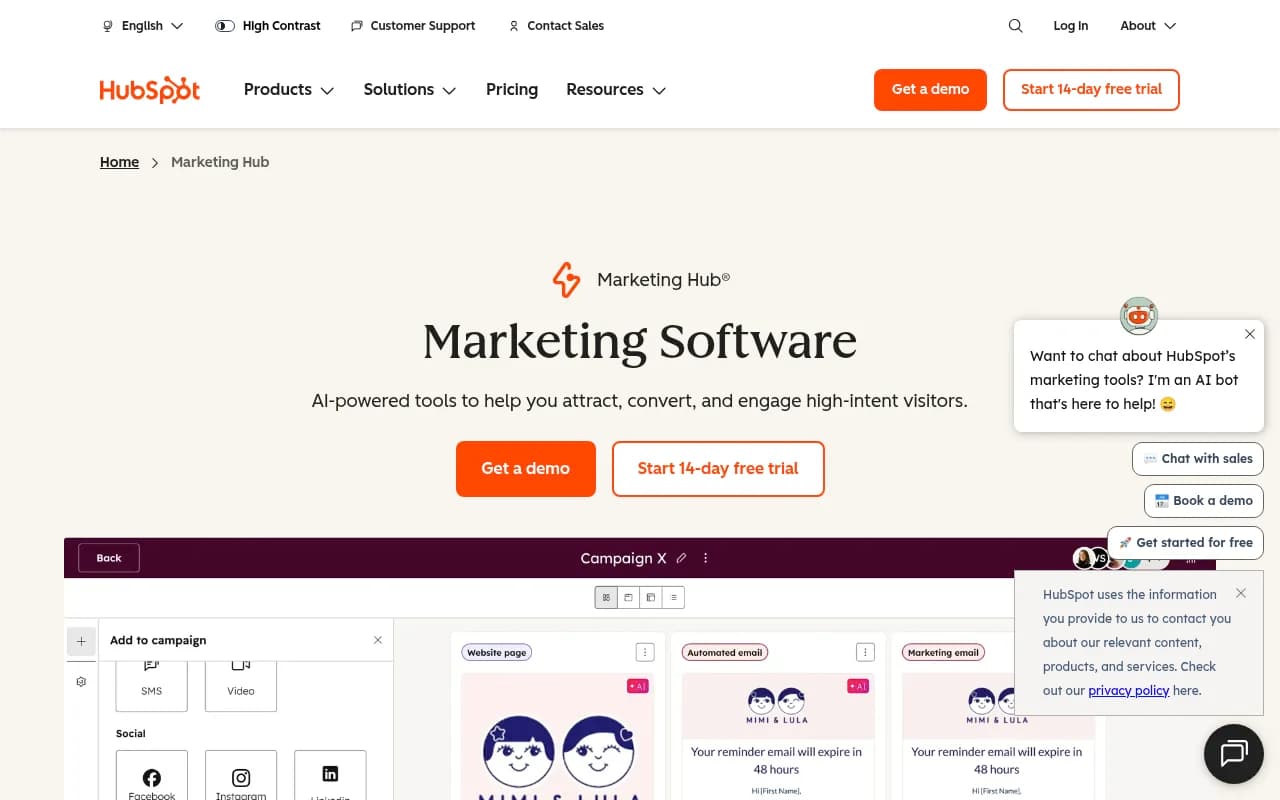
HubSpot's free CRM is the best free product in this comparison, and it isn't close. You get contact management, deal pipelines, 2,000 email sends per month (with HubSpot branding), and even Breeze Copilot, their AI assistant, at no cost. For a small team that needs a CRM today and email eventually, it's a genuinely generous starting point.
The staircase is the problem. Marketing Hub Starter costs $15/month per seat (annual billing), but limits you to 10 automated actions. The features people actually associate with HubSpot, unlimited automation actions, up to 300 workflows, A/B testing, lead scoring, omnichannel automation, all live on Professional at $800/month (or $890 monthly), which includes three seats, charges $45/month for each additional seat, includes 2,000 marketing contacts with roughly $250 per additional 5,000, and requires a one-time $3,000 onboarding fee. Bundled hubs come with 12-month commitments. Enterprise runs $3,600/month.
So the honest framing is this: HubSpot Free and HubSpot Professional are both excellent products, and the gap between them is about $11,000 in first-year costs. Starter sits in that gap as a decent email-plus-CRM tool that can't do serious automation. The newer AI features, including Content Agent, Prospecting Agent, Customer Agent, and an answer engine optimization beta, are credit-based and locked to Pro and Enterprise.
A pattern I've seen work well for small teams: use HubSpot's free CRM as your system of record, run email and automation through ActiveCampaign or Mailchimp, and revisit HubSpot Professional when revenue justifies it. Going all-in on HubSpot as a small team means accepting enterprise pricing on a small-team budget.
What serious automation costs at 5,000 contacts
Entry prices are marketing. This is what you'll actually pay once your list grows and you need multi-step workflows.
| Tool | Plan you need | Monthly cost at ~5,000 contacts | One-time fees |
|---|---|---|---|
| ActiveCampaign | Plus | $145 | None |
| Mailchimp | Standard | $100 | None |
| HubSpot | Professional | $800 plus ~$250 in contact overages | $3,000 onboarding |
| Keap | Single plan | $249, if you're within the contact allowance | Implementation services |
One footnote on Keap: since third-party sources put the included allowance around 1,500 contacts, a 5,000-contact list means a conversation with their sales team rather than a published price.
Watch the automation limits
The pattern across all four vendors is the same: price the entry tier to look competitive, then gate the feature you signed up for. Here's exactly what each cheapest tier gives you.
| Tool | Tier | Automation included |
|---|---|---|
| Mailchimp | Free | None |
| Mailchimp | Essentials ($13/mo) | Capped at four steps |
| HubSpot | Free | 1 automated action |
| HubSpot | Starter ($15/mo/seat) | 10 automated actions |
| ActiveCampaign | Starter ($15/mo) | Branching and multiple triggers, five steps per workflow |
| Keap | Single plan ($249/mo) | Full workflow automation |
The practical advice: before paying anyone, get a trial of the exact plan you'd buy and build one real workflow in it. A welcome sequence with a branch and a delay will expose the limits faster than any feature list.
How to choose
Match yourself to a scenario rather than a brand.
If you're starting from zero with almost no budget, Mailchimp's free plan or HubSpot's free CRM buys you time. Just know that Mailchimp Free can't send an automated welcome email, so plan to upgrade to Standard ($20/month) the moment a sequence matters.
If you've outgrown basic blasts and want lifecycle marketing, segmentation, and AI-built workflows, ActiveCampaign is the clear choice. The $49 Plus plan is, in my view, the best value in this entire category.
If you sell services and live in your inbox and calendar, Keap's bundle of CRM, quotes, invoices, payments, and appointments replaces three or four subscriptions. Whether it replaces them cheaply depends on your contact count and how much you value the included migration help and phone support.
If your trajectory points toward a mid-market company with dedicated sales, marketing, and service functions, HubSpot's platform depth eventually wins. Budget for Professional from the start so the staircase doesn't surprise you.
Also factor in seats. Mailchimp includes three to five users on paid plans. HubSpot charges per seat. ActiveCampaign and Keap keep extra users behind higher tiers or the single plan. For a three-person team, seat pricing can swing the total more than contact pricing does.
Alternatives worth a look
If none of the four feels right, three others come up constantly in small-team conversations.
EngageBay pitches itself directly at businesses that find HubSpot too expensive, combining CRM, marketing, and service desk features at small-business prices.
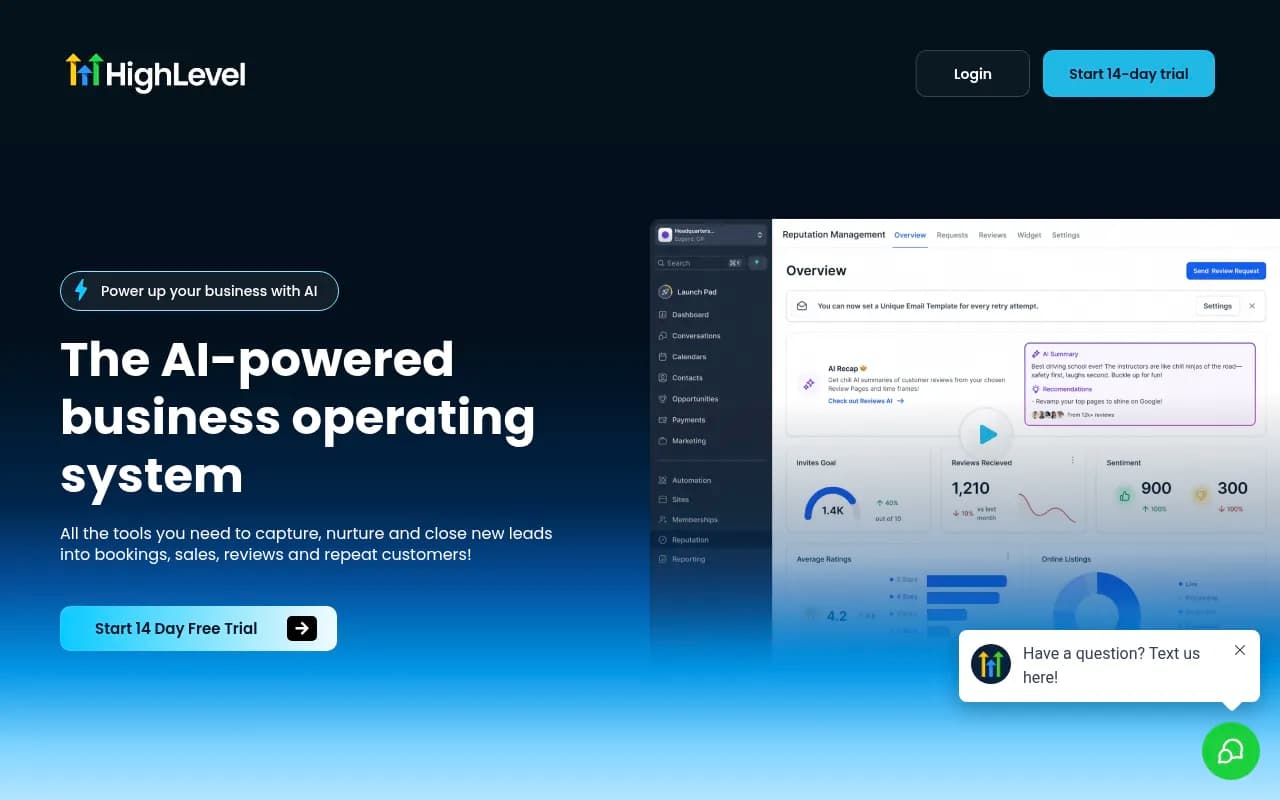
HighLevel is the agency favorite, bundling funnels, SMS, calendars, and white-label reporting. If you eventually sell marketing services yourself, it's built for exactly that.
And whichever platform you choose, Zapier is the connective tissue. Both Mailchimp (330+ native integrations) and ActiveCampaign (1,000+) plug into thousands of other apps through it, which is often the difference between "our tool supports that" and actually getting it done.
The verdict
For a small team in 2026, I'd pick ActiveCampaign. The automation builder is the best in this group at any price, and at $15 to $49 a month it isn't close. Mailchimp earns its place as the cheapest legitimate start, with the firm expectation that you'll upgrade to Standard or migrate within a year or two. HubSpot is the long-term platform play with the most painful mid-tier pricing in the industry. Keap is a good product aimed at a specific buyer, the service business that wants everything in one place, and its new $249/month price means that buyer needs to be reasonably sure before committing.
The most expensive mistake in this category isn't picking the wrong brand. It's paying for a plan that can't run the workflows you actually need. Buy the tier, not the logo.