ActiveCampaign Review 2026
CRM platform combining sales automation with marketing capabilities, featuring workflow automation, deal monitoring, and lead management for businesses.
Summary
- Best for: Small to mid-sized businesses (5-200 employees) that want AI to handle campaign creation, not just execution—particularly ecommerce brands, B2B SaaS companies, agencies, and course creators who need multi-channel automation without a dedicated marketing team
- Standout feature: Active Intelligence autonomous marketing system that builds entire campaigns based on your goals, not just runs pre-built workflows like competitors
- Main limitation: Steeper learning curve than simpler tools like Mailchimp or ConvertKit—the platform's depth means you'll spend time learning it, though AI features reduce this significantly
- Pricing reality: Starts at $15/mo for 500 contacts (Starter plan) but most businesses need the Plus plan ($49/mo for 500 contacts) to access automation and AI features. More expensive than basic ESPs but cheaper than enterprise platforms like HubSpot or Marketo.
ActiveCampaign started in 2003 as a consulting firm before pivoting to become one of the most feature-rich marketing automation platforms for growing businesses. In 2026, it's positioned itself around "autonomous marketing"—a term that distinguishes it from traditional marketing automation platforms that only execute what you build. The core pitch: instead of spending hours creating email sequences, SMS flows, and segmentation rules, you tell ActiveCampaign your goals and it builds the campaigns for you.
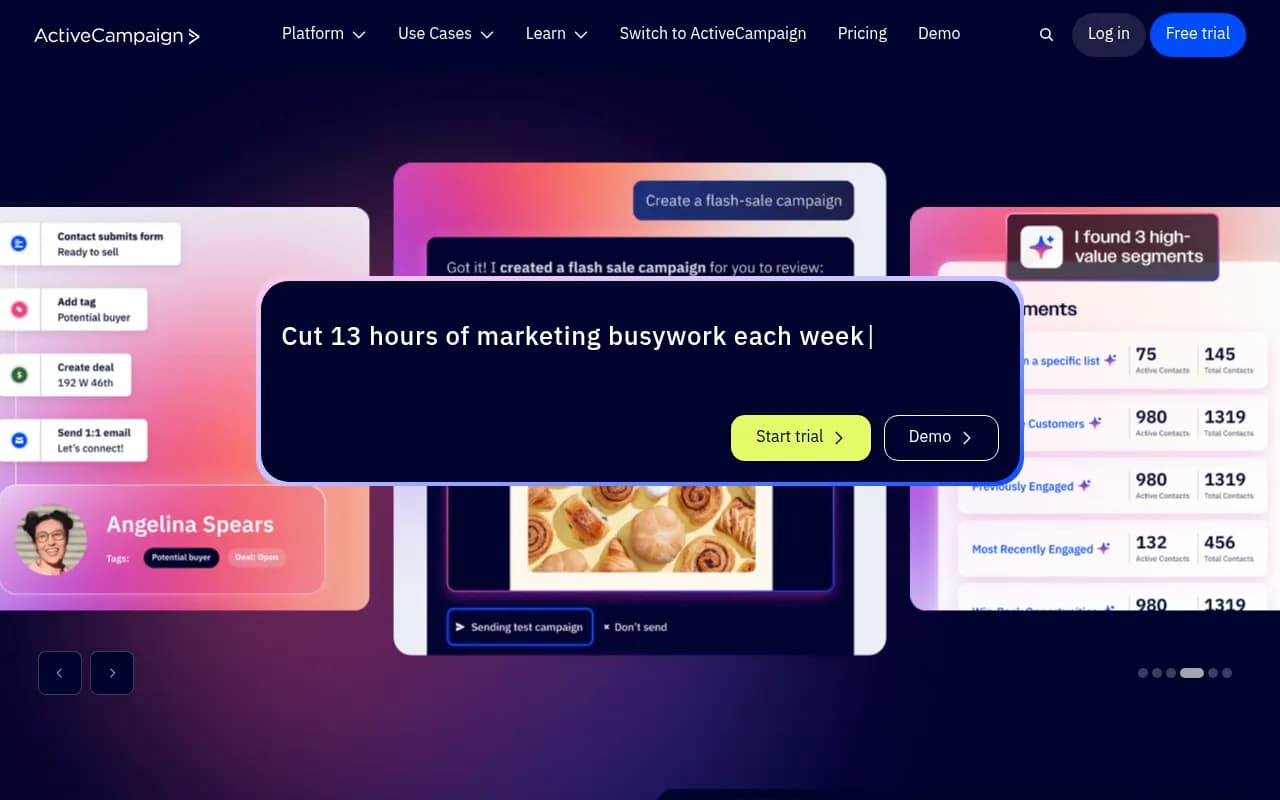
This matters because most small marketing teams are drowning in execution work. You know you should be running abandoned cart sequences, win-back campaigns, lead nurturing flows, and personalized product recommendations—but building all of that takes weeks. ActiveCampaign's Active Intelligence system (their AI layer) claims to cut 13 hours of marketing busywork per week by handling the strategy and build, not just the send.
Who uses ActiveCampaign
The sweet spot is businesses with 1,000-50,000 contacts that need sophisticated automation but don't have a full marketing ops team. Typical users: ecommerce stores on Shopify or WooCommerce running abandoned cart and post-purchase flows, B2B SaaS companies nurturing trial users, online course creators managing student onboarding, real estate agents following up with leads, and digital agencies managing multiple client accounts.
You'll also find it at larger companies (50-200 employees) that want enterprise-level features without enterprise pricing. The platform handles complex use cases—multi-step lead scoring, conditional content in emails based on custom fields, SMS and email sequences triggered by website behavior, deal pipeline automation tied to marketing actions.
Who should skip it: If you just need a simple newsletter tool and don't care about automation, ConvertKit or Mailchimp's free tier will do. If you're enterprise-scale (100,000+ contacts, multiple brands, complex compliance needs), you're probably looking at HubSpot, Marketo, or Salesforce Marketing Cloud instead.
Active Intelligence: the autonomous marketing layer
This is what separates ActiveCampaign from competitors in 2026. Traditional marketing automation platforms (Mailchimp, Klaviyo, HubSpot, Drip) let you build workflows—if/then logic, triggers, actions. You design the strategy, the platform executes it. Active Intelligence flips this: you set a business goal ("increase repeat purchases", "convert more trial users", "re-engage inactive subscribers") and the AI builds the campaign.
How it actually works: The system analyzes billions of data points from ActiveCampaign's customer base—open rates, click patterns, conversion triggers, optimal send times, message sequences that work. It combines this with your specific data (contact behavior, purchase history, engagement patterns) to generate complete campaigns. Not just subject lines or send time optimization—full multi-step automations with segmentation, personalized content, and channel selection (email vs SMS vs WhatsApp).
Specific capabilities within Active Intelligence:
AI Campaign Builder: Describe your goal in plain language ("create a welcome series for new subscribers who signed up for the ebook") and it generates a 3-5 email sequence with subject lines, body copy, CTAs, and timing. You can edit everything, but the first draft is done.
AI Automation Builder: Builds complete workflow automations based on goals. Example: "nurture trial users toward paid conversion" generates a multi-branch automation that sends different messages based on feature usage, includes SMS reminders before trial expiration, and triggers sales notifications for high-intent actions.
AI Suggested Segments: Analyzes your contact list and suggests high-value segments you're not targeting ("contacts who opened 3+ emails but never purchased", "customers who bought once 90+ days ago"). Each suggestion includes the segment criteria and a recommended campaign.
AI Brand Kit: Upload your logo and brand guidelines, and the system generates on-brand email templates, color schemes, and design elements. Keeps visual consistency without hiring a designer.
Business Goals Dashboard: Set revenue or engagement targets, and the platform tracks progress while suggesting campaigns to close gaps. If you're behind on your repeat purchase goal, it recommends specific win-back or cross-sell automations.
The AI doesn't replace human judgment—you still review and approve everything. But it eliminates the blank page problem and surfaces strategies you might not have thought of.
Email marketing capabilities
Beyond AI, the core email platform is robust. Drag-and-drop builder with 250+ templates, or use the HTML editor for custom designs. Conditional content blocks let you show different text/images to different segments within the same email (useful for product recommendations or regional offers). Dynamic content pulls in custom fields (first name, company, last purchase) automatically.
Deliverability is strong—ActiveCampaign maintains relationships with ISPs and includes built-in spam testing, domain authentication (SPF, DKIM, DMARC), and dedicated IP options for high-volume senders. Split testing on subject lines, content, and send times is standard.
The email editor supports AMP for interactive emails (forms, carousels, accordions that work inside Gmail). Not many platforms offer this yet.
SMS and WhatsApp automation
ActiveCampaign added SMS in 2020 and WhatsApp in 2024, both fully integrated into the automation builder. You can mix email, SMS, and WhatsApp in the same workflow—send an email, wait 2 days, send an SMS if they didn't open, send a WhatsApp message if they clicked but didn't convert.
SMS pricing is pay-as-you-go (rates vary by country, roughly $0.01-0.04 per message in the US). WhatsApp requires a Meta Business account and approval, but once set up, it's powerful for conversational marketing—two-way messaging, rich media (images, videos, PDFs), and higher engagement than email in many markets.
The AI builds SMS and WhatsApp campaigns just like email—describe your goal, get a complete flow. This is rare; most competitors treat SMS as an add-on, not a first-class channel.
Marketing automation and workflows
The automation builder is where ActiveCampaign's depth shows. Visual canvas with drag-and-drop blocks: triggers (form submission, tag added, deal stage changed, website visit), conditions (if/else logic based on any contact field), actions (send email, add tag, create deal, wait, split test), and goals (mark automation complete when contact takes specific action).
You can nest automations—one automation can trigger another, creating modular workflows. Useful for complex sequences like onboarding (main automation) that branches into product-specific sub-automations based on user behavior.
Lead scoring assigns points for actions (opened email +5, visited pricing page +20, clicked demo link +50) and subtracts for inactivity. Scores trigger automations (high-score leads get sales notifications, low-score leads get nurture campaigns). You can run multiple scoring models simultaneously (one for engagement, one for purchase intent).
Site tracking monitors website behavior even for anonymous visitors. Once they submit a form, all past behavior gets attributed to their contact record. Triggers automations based on pages visited, time on site, or specific events (watched demo video, added to cart).
CRM and sales automation
ActiveCampaign includes a built-in CRM (no separate cost). Deal pipelines visualize sales stages with drag-and-drop cards. Automations can create deals, move them between stages, assign to sales reps, and send notifications. Marketing and sales data live in the same system—you see which emails a contact opened before they became a deal.
The CRM is simpler than dedicated platforms like Pipedrive or Salesforce, but it's enough for small sales teams (1-10 reps). Larger teams often integrate ActiveCampaign with their existing CRM (Salesforce, HubSpot, Zoho) via native integrations or Zapier.
Task automation creates follow-up reminders for sales reps based on deal activity. If a deal sits in "Proposal Sent" for 3 days with no activity, the system creates a task to follow up.
Segmentation and personalization
Segmentation is tag-based and condition-based. Tags are labels you apply manually or via automation ("webinar-attendee", "purchased-product-x", "high-value-customer"). Conditions are dynamic filters ("opened any email in last 30 days", "total order value > $500", "located in California").
You can combine tags and conditions with AND/OR logic to create precise segments. The AI Suggested Segments feature surfaces high-value segments you're not using, which is helpful when you're not sure how to slice your list.
Personalization goes beyond first name. Conditional content blocks in emails show different text/images based on any contact field or tag. Predictive sending (AI-powered) determines the best time to send each contact an email based on their past open behavior.
Reporting and analytics
Standard email metrics (open rate, click rate, unsubscribe rate) plus automation-specific reports (how many contacts entered, completed, or are currently in each automation). Revenue attribution ties purchases back to specific campaigns and automations—critical for ecommerce.
The Business Goals dashboard (part of Active Intelligence) visualizes progress toward targets and recommends actions. Instead of staring at a spreadsheet of metrics, you see "You're 23% behind your repeat purchase goal—here are 3 campaigns to run."
Custom reporting lets you build dashboards with the metrics you care about. Export data to Google Sheets or connect to Looker Studio for deeper analysis.
One limitation: attribution is last-touch by default (the last campaign before conversion gets credit). Multi-touch attribution exists but requires manual setup with custom fields and automation logic.
Integrations and ecosystem
Over 1,000 native integrations including Shopify, WooCommerce, WordPress, Salesforce, HubSpot, Stripe, PayPal, Zoom, Calendly, Facebook Lead Ads, Google Analytics, Slack, and Zapier. The Shopify and WooCommerce integrations are particularly strong—sync products, customers, and orders automatically, trigger automations based on purchase behavior, and track revenue attribution.
Webhooks and API access (available on all paid plans) let developers build custom integrations. The API is well-documented and supports most platform features.
Facebook Custom Audiences integration syncs segments to Facebook for retargeting. Google Customer Match does the same for Google Ads.
Deliverability and compliance
ActiveCampaign enforces double opt-in for new subscribers (configurable) and includes unsubscribe links in all emails. GDPR-compliant with data processing agreements, contact consent tracking, and right-to-deletion tools.
The platform monitors sender reputation and pauses accounts with high bounce or complaint rates. This protects deliverability for all users but can be frustrating if you import a messy list—clean your data first.
Dedicated IPs are available (Plus plan and above) for high-volume senders who want full control over sender reputation.
Onboarding and support
Free migration service (available on Plus plan and above) moves contacts, automations, and templates from your old platform. The team handles the technical work—you just provide access.
Live chat support on all paid plans, plus email support. Phone support is available on higher tiers. Response times are generally fast (under 2 hours for chat during business hours).
ActiveCampaign University offers free courses on automation strategy, email design, and platform features. The community forum is active with users sharing automation templates and troubleshooting.
Pricing breakdown
Pricing is based on contact count and plan tier. Four plans:
Starter ($15/mo for 500 contacts): Basic email marketing, signup forms, and simple automations. No CRM, no lead scoring, no site tracking. Good for newsletters, not much else.
Plus ($49/mo for 500 contacts): Full automation builder, CRM, lead scoring, site tracking, SMS, WhatsApp, and Active Intelligence AI features. This is the plan most businesses need.
Pro ($79/mo for 500 contacts): Adds predictive sending, split automations, attribution reporting, and custom user roles. For teams running complex campaigns.
Enterprise (custom pricing, starts around $279/mo): Dedicated account rep, custom reporting, unlimited email sends, free design services, and priority support. For larger teams (100+ employees).
Contact count pricing scales: 1,000 contacts = $29 Starter / $79 Plus / $129 Pro. 2,500 contacts = $49 Starter / $149 Plus / $249 Pro. 10,000 contacts = $129 Starter / $349 Plus / $449 Pro.
SMS and WhatsApp are pay-as-you-go on top of the base plan. No setup fees. 14-day free trial (no credit card required). 30-day money-back guarantee if you're not satisfied.
Compared to competitors
Vs Mailchimp: ActiveCampaign's automation is far more powerful (Mailchimp's automation builder is basic), and the AI features are more advanced. Mailchimp is easier to learn and has a free tier, but you'll outgrow it fast if you need real automation.
Vs Klaviyo: Klaviyo is built specifically for ecommerce and has deeper Shopify integration and better revenue attribution. ActiveCampaign is more versatile (works for B2B, services, courses, not just ecommerce) and cheaper at scale. If you're 100% ecommerce, Klaviyo might edge it out. If you're doing anything else, ActiveCampaign wins.
Vs HubSpot: HubSpot's free CRM is better, and the all-in-one platform (marketing, sales, service, CMS) is more cohesive. But HubSpot's marketing automation costs $800+/mo for similar features. ActiveCampaign delivers 80% of the functionality at 20% of the price.
Vs ConvertKit: ConvertKit is simpler and better for creators who just need email broadcasts and basic funnels. ActiveCampaign is overkill if you're a solo blogger. But if you're selling products, running webinars, or need multi-channel automation, ActiveCampaign is worth the learning curve.
Vs Drip: Drip is also ecommerce-focused with strong automation. ActiveCampaign's AI features and multi-channel capabilities (SMS, WhatsApp) give it an edge in 2026. Pricing is similar.
Strengths
- Active Intelligence autonomous marketing genuinely reduces campaign build time—you're not starting from scratch every time
- Multi-channel automation (email, SMS, WhatsApp) in one platform with unified workflows
- CRM included at no extra cost, tightly integrated with marketing data
- 1,000+ integrations cover most use cases without custom development
- Strong deliverability and compliance tools
- Free migration and onboarding (Plus plan and above) removes switching friction
Limitations
- Steeper learning curve than simpler ESPs—expect to spend a week learning the platform even with AI help
- Reporting and attribution are good but not as advanced as dedicated analytics platforms (Google Analytics 4, Mixpanel)
- The CRM is basic compared to dedicated sales platforms like Salesforce or Pipedrive—fine for small teams, limiting for larger sales orgs
- SMS and WhatsApp costs add up quickly for high-volume campaigns (though this is true of all platforms)
- No built-in landing page builder (you'll need Unbounce, Leadpages, or a WordPress plugin)
Bottom line
ActiveCampaign is the best choice for growing businesses (1,000-50,000 contacts, 5-50 employees) that need sophisticated marketing automation without hiring a marketing ops team or paying enterprise prices. The autonomous marketing features genuinely save time by building campaigns for you, not just executing what you create. If you're running multi-channel campaigns (email, SMS, WhatsApp), need tight CRM integration, or want AI to handle strategy and execution, this is the platform to beat in 2026. Start with the Plus plan ($49/mo for 500 contacts) to access the full feature set—the Starter plan is too limited for most real-world use cases.
Tags:
Similar and alternative tools to ActiveCampaign