Key takeaways
- These four tools split into two camps. Triple Whale and Northbeam are built for ecommerce and DTC. Dreamdata and HockeyStack are built for B2B teams that track pipeline in a CRM.
- Entry cost varies a lot: Dreamdata has a real free plan, Triple Whale has a free tier without multi-touch attribution, Northbeam lists from $1,500/month, and HockeyStack starts around $2,200/month per G2.
- Triple Whale is the easier tool to adopt. Northbeam is the heavier modeling option and tends to suit bigger ad budgets.
- HockeyStack is the deeper, pricier B2B platform. Dreamdata is the easier place to start and prove ROI.
- I could not find independent accuracy tests for any of them, so treat vendor claims as claims and run a pilot before you commit.
Read this first: you are not choosing among four identical tools
The title of this guide lists four products, but the honest framing is two separate comparisons. If you sell through Shopify and measure success in orders and ROAS, you are choosing between Triple Whale and Northbeam. If you sell software to companies and measure success in pipeline and closed revenue inside Salesforce or HubSpot, you are choosing between Dreamdata and HockeyStack.
Cross-shopping them makes little sense. A DTC brand has no use for account-level buying committee mapping. A B2B SaaS team has no use for a Shopify-native pixel. Almost every roundup I read for this guide reached the same split, which is a good sign the split is real.
One caveat on sourcing. I did not run these tools against each other on identical data, and I found no independent accuracy tests. What follows combines vendor pricing pages, G2 and third-party pricing write-ups, and customer stories. Where a number comes from a vendor or a reviewer with a stake, I say so.
What marketing attribution tools actually do
Meta says one thing. Google Ads says another. Your CRM tells a third story. Attribution tools sit above all of them, track touchpoints across channels, and assign credit for conversions or revenue so you can move budget based on something other than each platform grading its own homework.
The methods differ:
- First-party pixel tracking and multi-touch models, which credit several touches along a journey.
- Media mix modeling (MMM), which estimates channel impact statistically and does not depend on user-level tracking.
- Incrementality tests such as holdouts and geo-lift, which ask whether a channel caused the sale.
- CRM and account-level attribution for B2B, which ties touches to pipeline stages and closed-won deals.
The better tools in 2026 blend several of these because pixel tracking alone loses signal to privacy changes and cookie loss.
Quick comparison
| Tool | Best for | Attribution approach | CRM depth | Entry pricing |
|---|---|---|---|---|
| Triple Whale | Shopify DTC brands | First-party Triple Pixel, multi-touch on paid tiers | Limited | Free tier, paid tiers quote-based |
| Northbeam | Scaling DTC and performance marketers | Blended tracked plus modeled data, MTA plus MMM | Limited | From $1,500/month (Starter) |
| Dreamdata | B2B SaaS | Account-level multi-touch | Strong (Salesforce, HubSpot) | Free plan, paid custom |
| HockeyStack | B2B marketing and RevOps | Multi-touch plus buyer journey | Strong | About $2,200/month per G2, no free tier |
Pricing changes often. Confirm every figure with the vendor before budgeting.
Triple Whale: the quick start for Shopify brands
Triple Whale is the tool most Shopify DTC teams try first, and I understand why. It connects Shopify data with Meta, Google and TikTok and gives you a readable ROAS picture without a long implementation. Reviewers consistently describe it as much easier to use than Northbeam. On G2, users highlight real-time data aggregation across platforms, clean client reporting for agencies, and the range of attribution options.
How the plans are structured
According to Triple Whale's pricing page, there are four tiers: Free, Foundation, Automate and Enterprise. The page shows no dollar figures. Pricing scales with revenue tier and paid plans go through a sales conversation.
- Free: Triple Pixel with first-click and last-click attribution, a unified real-time view and the Moby AI assistant.
- Foundation: this is where multi-touch attribution starts. It adds no-code dashboards, a SQL editor, custom metrics and first-party data activation that pushes signals back to ad platforms. One third-party roundup quotes $549 a month for Foundation, but I could not verify that on the vendor page.
- Automate: adds actions on paid media inside ad accounts, scheduled workflows and creative generation.
- Enterprise: includes MMM, incrementality tests and MTA together (the Compass add-on), plus retail data from Walmart, Target, Sephora and others, and SOC 2 Type 2.
The notable change is that multi-touch attribution moved behind a paid tier. If you assumed the free plan gave you the full model set, it does not.
Where it falls short
Third-party reviewers flag less advanced modeling than Northbeam, limited flexibility outside ecommerce, and weaker upper-funnel attribution. One 2026 pricing review argues the math gets tighter above roughly $5M GMV, where modular competitors can look cheaper. Triple Whale claims 65,000+ brands, which is a vendor number.
Northbeam: heavier modeling for bigger ad budgets
Northbeam is the serious-money option for performance-heavy DTC. It uses blended attribution that combines tracked data with modeled data to compensate for signal loss, and it pairs multi-touch attribution with media mix modeling. It unifies Meta, Google and TikTok performance and is often praised for creative-level insight. I could not verify the methodology on Northbeam's own site because my scrape returned only a cookie banner, so that description comes from third-party coverage.
Pricing
From the pricing page and third-party write-ups:
- Starter: from $1,500/month, month to month, aimed at brands spending under about $1.5M a year on ads. One comparison says Shopify only.
- Professional: from $3,500/month on a yearly term, for ad spend up to $500K/month.
- Growth: quote-only, sold through an agency partner with hands-on support.
- Enterprise: custom, for ad spend above $500K/month.
Plan is picked by ad spend, and the final price is set by pageviews. Third-party reviewers put the sweet spot at $40M+ revenue or $250K+/month in ad spend, and warn that under roughly $50K/month in spend the models may lack signal while the fee eats a large share of budget. Those are reviewer opinions, not Northbeam statements, but the logic holds: a $3,500 tool needs a budget big enough to justify it.
The common knock is that its methodology is less transparent than people would like, which matters when you have to defend a number to a CFO.
Dreamdata: the B2B tool you can try for free
Dreamdata ties campaigns and content to revenue instead of traffic or MQLs. It maps account-level journeys, so a buying committee of six people from one company shows up as one story. It syncs with Salesforce and HubSpot, and it is now branded an agentic B2B attribution platform.
Free and paid
The free plan costs $0 and includes B2B web analytics, cookie and cookie-less tracking, engagement scoring, company identification, an audience builder, Slack or Teams notifications and an ad spend report. Limits are tight: two months of user history, five seats, three stage models, two notifications and one sync.
Paid "Attribution & Activation" is custom-priced and adds AI and custom attribution models, revenue and content analytics, ROI and ROAS reporting. Activation is an add-on that syncs audiences to ad platforms and sends sales notifications. Advanced plans add a dedicated CSM, SSO/SAML and custom UTM mapping. There is also an Analytics Agent for plain-English questions and an MCP server for your own LLM. A guided free trial exists.
Reviewers like the Audience Hub, which pushes attribution insight into LinkedIn and other ad platforms for retargeting. The company claims it identifies up to 80% of visiting companies; that is a vendor claim, and IP-to-company matching accuracy varies by traffic mix, so test it on your own data. G2 showed 4.7/5 from 278 reviews in the snippet I saw.
HockeyStack: the deep, expensive B2B platform
HockeyStack began as cookieless web analytics with multi-touch attribution and has repositioned as a revenue AI platform for B2B go-to-market teams. Its Atlas data foundation unifies sales, marketing, website and product data with identity resolution across accounts and contacts.
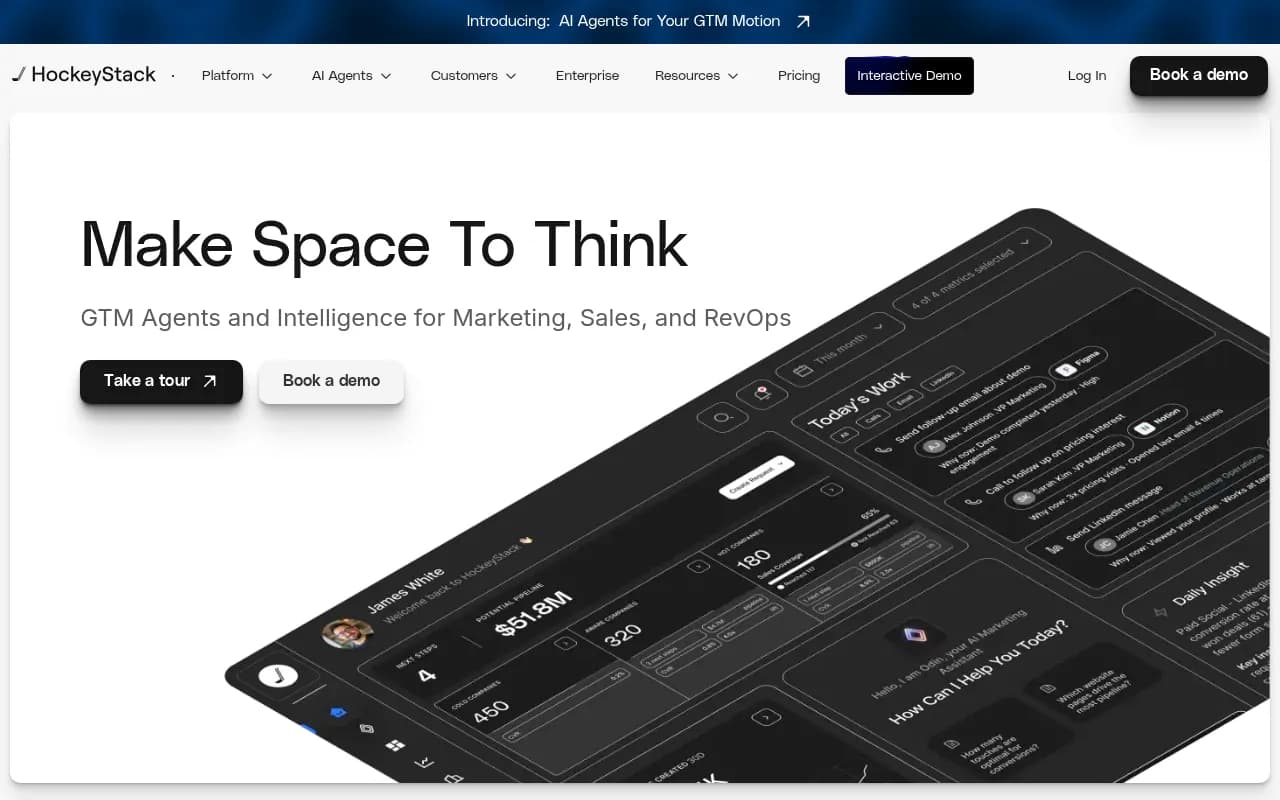
Note the source of that screenshot: it is HockeyStack's blog, so the ranking is self-published. Treat it as a product description, not a neutral review.
What customers say
G2 reviewers praise CRM integration, the way the platform shows marketing's effect on actual pipeline instead of form fills, and tolerance for messy CRM data. Kantox says it replaced Power BI, Excel and slides with self-serve views. Pylon credits it with revealing Google Ads as a hidden pipeline driver. Firstup says it replaced disconnected tools worth $140K a year, including 6sense. All three are vendor-published stories.
Admetrics rates it 4.5 stars and describes the ideal buyer as a B2B team with a technical owner who can build the data model and has patience for implementation. That matches the tone of other reviews: this is not a plug-and-play install.
Pricing, and why numbers conflict
G2 lists a Platform tier at $2,200/month, updated July 28, 2026, with no free tier. ABM is an add-on. Other sources disagree: Saleshive shows $1,250/month, Heeet shows $790 and $1,490 tiers, Vendr shows roughly $12K to $24K a year, and one operator-reported roundup claims $5K to $25K per month for enterprise deployments after a $50M Series B in May 2026. HockeyStack's own page says custom-built plans. The honest answer is that scope drives the price, so get a quote.
After that raise, the company pushed toward Revenue Agents for enterprise. If you only want attribution, make sure you are not paying for an agent layer you will not use.
Side by side: B2B pair
| Question | Dreamdata | HockeyStack |
|---|---|---|
| Free plan | Yes, limited | No |
| Typical buyer | Startups to lower mid-market | Scale-ups and enterprise |
| Strength | Revenue attribution, LinkedIn audience sync | Identity resolution, journey depth, ABM |
| Setup effort | Lighter | Heavier, needs a technical owner |
| Pricing transparency | Free tier published, paid custom | Mostly custom, third-party figures conflict |
My read: start with Dreamdata Free if you are not sure attribution will change decisions at your company. Move to HockeyStack when you have outgrown HubSpot's native reporting, have RevOps capacity and want one data foundation across sales and marketing. One roundup frames it the same way, with Dreamdata as the startup default and HockeyStack as the enterprise alternative.
Side by side: ecommerce pair
| Question | Triple Whale | Northbeam |
|---|---|---|
| Free option | Yes, first and last click only | No |
| Ease of use | Easier | Steeper |
| Modeling depth | Lighter, MMM only at Enterprise | MTA plus MMM, blended tracked and modeled data |
| Best budget range | Lean to mid-size teams | Roughly $250K+/month ad spend per reviewers |
| Beyond Shopify | Limited | Varies, check plan |
If you spend under about $50K a month on ads, Triple Whale's lower friction wins. If you spend heavily across Meta, Google and TikTok and need to defend budget shifts, Northbeam's modeling is worth a trial. Also look at Admetrics, Cometly and Polar; the sources I read mention them as alternatives, and Admetrics pitches profit-level attribution netting out COGS and returns.
How to choose
- Define your revenue event. Orders in Shopify, or closed-won deals in a CRM? That alone eliminates two of the four tools.
- Match price to budget. A $3,500/month tool against $40K of monthly ad spend is hard to justify.
- Check your CRM. B2B attribution is only as good as your CRM hygiene. HockeyStack reviewers say it copes with messy data, but a cleanup pays off anywhere. If you are still choosing a CRM, [tool:hubspot] and [tool:salesforce] are the two both B2B tools integrate with most often.
- Ask about the model. Can you see and change how credit is assigned? Opaque modeling is a real risk when finance asks questions.
- Run a 30 to 60 day pilot against a baseline. Compare the tool's channel numbers with platform reports and CRM data, and note where they diverge.
Pitfalls I would watch for
These are my own cautions, not sourced from the research: platform-reported conversions usually overlap and overstate, pixel-based tracking loses visits to blockers, and any model changes when you change the lookback window. Do not treat any single dashboard as truth. Use two methods, such as MTA plus a holdout test, before making large budget moves.
Where AI search fits in
Attribution tools were built around ads and web sessions. If AI assistants now send you visitors, you need to measure that too, and standard pixels often file those visits as direct. Dedicated platforms such as Promptwatch track AI-referred traffic and conversions next to how AI engines cite your brand, and the attributing AI traffic guide in its Academy explains the mechanics. It complements, and does not replace, the four tools above.

For more options in adjacent categories, the general directory at surferstack.com lists reviewed software across marketing.
Bottom line
- Shopify brand, lean team: Triple Whale.
- DTC brand with serious ad spend: trial Northbeam.
- B2B team testing the waters: Dreamdata Free.
- B2B scale-up or enterprise with RevOps support: HockeyStack, after getting a written quote.
Book demos with two vendors in your camp, ask for a pilot on your own data, and decide on whichever one explains its credit assignment most clearly.