Key takeaways
- Travel answers come from many sources. In Promptwatch Data for Sep 28 to Oct 4, 2026, 47.6% of ChatGPT responses cited 10 or more unique domains, so you will almost always share an answer with other sites.
- Assistants disagree with each other. A tool that rolls ChatGPT, Gemini and Claude into one score hides which lever to pull on which platform.
- Pick by job: tracking only, tracking plus fixing, hospitality-specific tooling, or an agency that does the work.
- Language and region tracking matters more for hotels than for most industries, because guests ask in their own language and get different answers.
- Treat vendor-authored rankings (including several cited here) as claims, not facts.
Why travel needs its own approach to GEO
A hotel does not compete on "best CRM". It competes on "boutique hotel in Seville" or "family friendly near the beach", and the assistant answering that question is stitching together reviews, OTAs, editorial roundups, metasearch sites and the hotel's own pages. Generic GEO tools built for B2B software can track that, but they are not tuned for it.
There is a real disagreement in the available research, and it is worth knowing about before you buy anything. Listo, a hospitality-specific vendor, reports from its own study of roughly 1,500 hotel conversations that ChatGPT cited hotels' own websites around 65% of the time, while Gemini leaned on editorial media for close to 58% of its citations. It also says OTAs were a minority everywhere. Those are vendor claims from a hotel-recommendation study.
Promptwatch Data looked at organic travel prompts in ChatGPT from Sep 28 to Oct 4, 2026, and found booking, search and review sites holding the visible share. Skyscanner led at 0.78% of all travel citations, followed by Going.com (0.52%), Tripadvisor (0.49%), Kayak (0.37%) and Airbnb (0.27%). The 17 listed domains together earned only 4.18%, so the rest is a long tail.
These two datasets measure different things. Organic, unbranded travel prompts behave differently from "tell me about this specific hotel" prompts. Promptwatch's data on unique domains per response shows the same split: on brand-specific prompts only 21.3% of responses cite 10 or more domains, and your own site carries more weight. On organic prompts that figure is 52.5%, and third-party listicles, reviews and forums are often how a brand gets in at all.
Practical conclusion: you need to see both. Track discovery prompts to learn which third-party pages shape the answer, and brand or amenity prompts to check what the assistant says about your property.
What to look for in a travel GEO tool
Engine coverage, from the real interface
Travel research is spread across ChatGPT for planning, Perplexity for comparison, and Gemini and Google AI Overviews for "best time to visit" style questions. Coverage of fewer than four or five engines leaves blind spots. API-only tracking can also differ from what travelers actually see in the product, so check whether a tool monitors the real user interface.
Source-level citation data
Knowing you were mentioned is not enough. You need the URL that fed the answer, because that tells you whether to invest in review volume, a Lonely Planet-style guide feature, or fixing your listing on a metasearch site.
Language and region
Listo's test of the same questions in Spanish, English and French reported recommendation overlap as low as 40% across languages on Claude (again, vendor data). Even if the exact number moves, the direction is credible: ask in Spanish and the assistant reads the Spanish web. If your guests come from several countries, per-language and per-country tracking is a requirement.
Prompt sets by destination and season
A hotel group tracks different destinations, property tiers and seasons. Look for tags, topics and personas rather than a flat prompt list.
Multi-property and agency support
If you run a group or manage twenty hotels for clients, one login per property will wear you down. Look for workspaces, client portals and white-label reports.
Measure versus fix
Plenty of tools stop at a dashboard. The useful ones tell you what to change. Listo's study found that hotel pages that won recommendations tended to be server-rendered, had real substance (around 1,600 words) and carried structured data on roughly two-thirds of them. Whatever tool you choose, check that it can see crawler activity and technical problems, not just output.
Comparison at a glance
| Tool | Type | Tracks AI engines | Helps you fix things | Best for |
|---|---|---|---|---|
| Promptwatch | Visibility and optimization platform | Real-UI tracking across ChatGPT, AI Overviews, AI Mode, Gemini, Perplexity, Copilot and more | Content Agent, Action Board, crawler logs | Hotel groups, OTAs and agencies that want to act on the data |
| Profound | Enterprise monitoring | Major engines | Limited | Large chains with enterprise budgets |
| Peec AI | Prompt tracker | Major engines | No | Agencies on a tight budget |
| Otterly.AI | Prompt tracker | Several engines | No | Single properties and boutiques |
| Rankscale | Monitoring | Wide engine and market coverage | Limited | Global destination marketing |
| Semrush | SEO suite add-on | Major engines | Limited | Teams already on Semrush |
| Listo | Hospitality-specific | ChatGPT, Claude, Gemini, Perplexity | Content optimization, booking layer | Hotels and hotel agencies |
| Cendyn Wayfinder | Hospitality-specific | ChatGPT, Gemini, Perplexity | Schema and directives | Hotels already on Cendyn |
I have deliberately left out pricing for most of these. Prices change, and several vendors do not publish them. Confirm on each vendor's own site.
The tools, by job
Promptwatch, for tracking plus fixing
Promptwatch is the option I would put first for a hotel group, OTA or travel brand that wants more than a score. It monitors the actual interfaces of ChatGPT, Google AI Overviews, Google AI Mode, Gemini, Perplexity and Microsoft Copilot by country and language, which matters when your guests search in several. Prompt volumes, difficulty scores and query fan-outs show what travelers actually ask and which searches the assistant runs behind the scenes.
The travel-relevant parts are the ones past monitoring. Citation analytics show which third-party pages (Tripadvisor listings, listicles, Reddit threads, YouTube videos) feed the answers about your destination. IP-verified AI crawler logs show whether GPTBot and friends can actually read your property pages. And the Action Board and Content Agent turn gaps into prioritized tasks and publish content to WordPress, Webflow or Framer. Agencies get white-label reports and a client portal.

There is a free Explore plan (1 project, 10 prompts, ChatGPT only) if you want to try it on one property first. Check promptwatch.com/pricing for current paid plans.
Listo, for hotel-specific tracking and booking
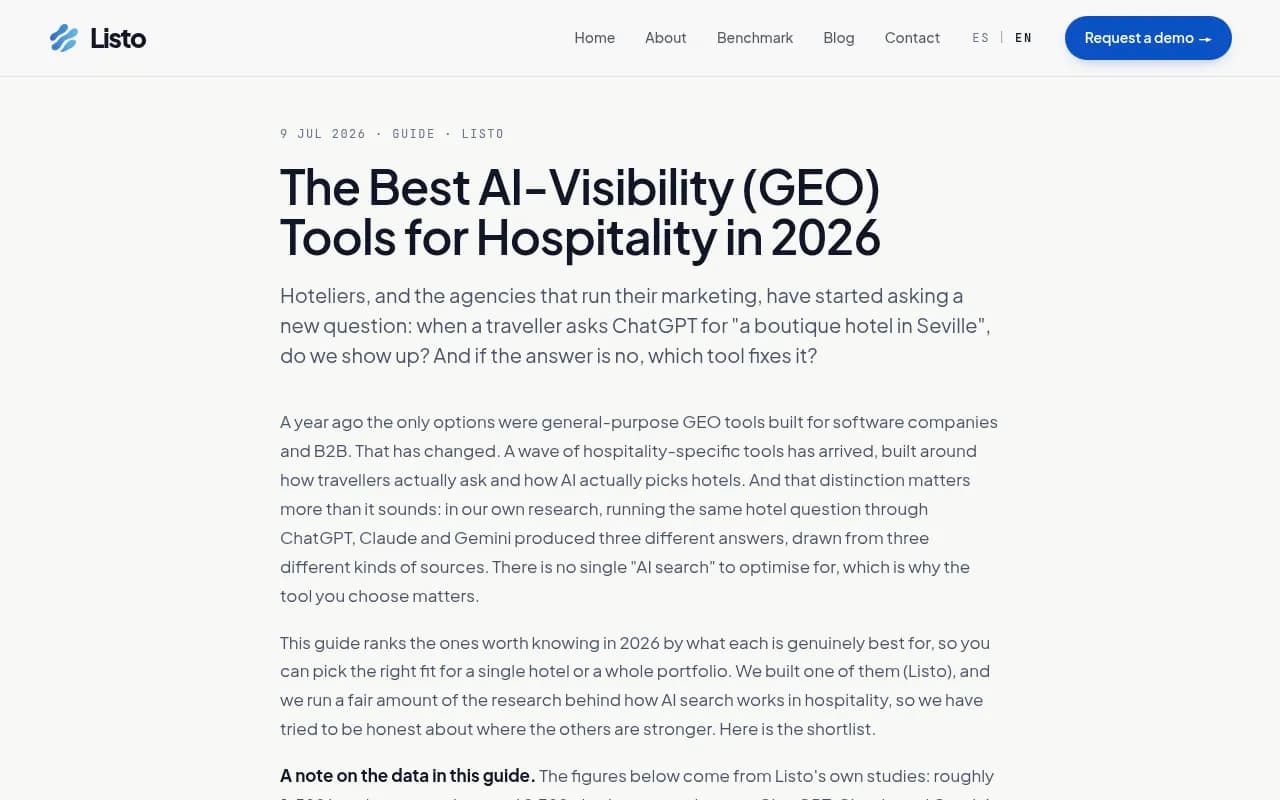
Listo is built only for hospitality. It tracks ChatGPT, Claude, Gemini and Perplexity by platform and region against traveler-style prompts, audits your site content, and builds an MCP layer over your PMS and booking engine so an assistant can check availability and take a booking in the chat. The last part is the interesting one, since it ties visibility to reservations.
The caveat: Listo is vendor-authored in the guide that ranks it first, and it has no widely published customer data in the sources I reviewed. Read its figures as the vendor's claims. Its listing is not in our tools catalog, so see the vendor's own guide for details.
Cendyn Wayfinder, for hotels already on Cendyn
Cendyn launched Wayfinder in 2026 inside its CMS. It runs simulated traveler prompts across ChatGPT, Gemini and Perplexity to score "GEO health", checks your facts for accuracy and drift, and generates schema and text files to teach the models about your property. It is strongest if you already live in the Cendyn stack, and it is monitoring plus directives rather than an independent layer across every assistant.
Profound, for large chains
Profound is the name that keeps appearing for big travel players. Strong monitoring and research, enterprise pricing. If you are a global chain with an enterprise procurement process, it belongs on the shortlist. Compared with Promptwatch it is less oriented toward execution and does not cover Reddit or ChatGPT Shopping in the same way.

Peec AI and Otterly.AI, for lean budgets
Both are prompt trackers. Peec AI is popular with agencies because of its seat model, and Otterly.AI is one of the cheapest credible ways to watch a single property or boutique brand. Neither gives you crawler logs, visitor analytics or content generation, so you will be doing the fixing elsewhere.


Rankscale, for global destination marketing
Rankscale advertises very broad engine and market coverage, which suits a tourism board or destination marketer working across dozens of countries. Pricing is not published in the sources I reviewed.
Menra
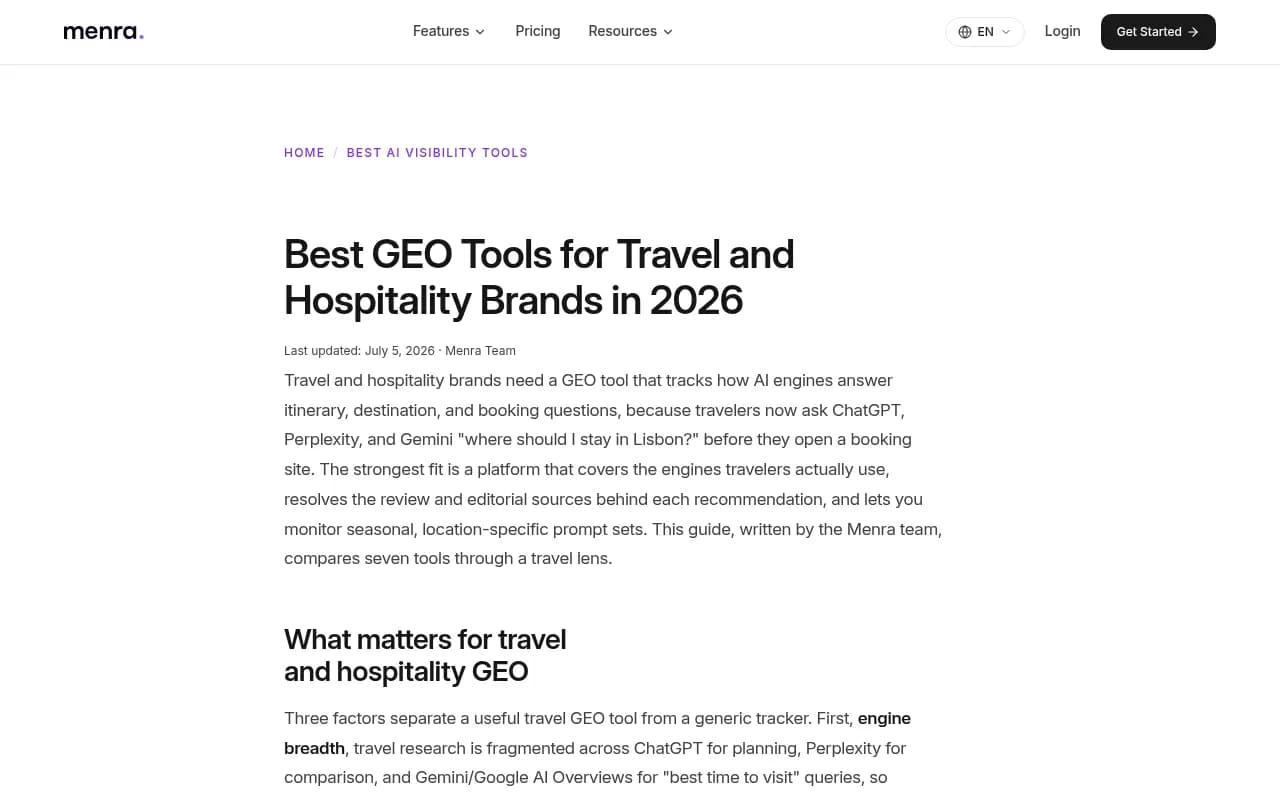
Menra's own guide ranks itself first, which you should weigh accordingly. Its selling point for travel is deep-URL citation data showing which review or editorial page fed an answer, across nine platforms. If source-level evidence is your priority, it is worth a look next to the others.
Semrush, BrightEdge and other suites
If your team already runs Semrush or an enterprise platform like BrightEdge or Conductor, their AI modules are the lowest-friction start. Prompt sets tend to be fixed and the AI-specific depth is shallower than a dedicated platform, but the data sits next to your existing rankings.
Listings and reputation tools
Because review and listing sites dominate travel citations, tools that keep those accurate matter too. Yext, Birdeye and Trustpilot's business tools do not track AI answers, but they control the pages the AI reads.
What the citation data says you should actually do
Whichever tool you pick, the Promptwatch travel data suggests a few concrete jobs:
- Keep your listings accurate on Skyscanner, Kayak, Airbnb and Expedia. Booking and search sites earned 2.42% of travel citations in the Sep 28 to Oct 4, 2026 sample, the largest source type.
- Collect reviews on Tripadvisor and Trustpilot. Reviews and advice sources earned 0.86%.
- Get featured in guides such as Lonely Planet and Time Out.
- Watch deal and fare sites in your market. Going.com out-cited Tripadvisor in that sample.
- Measure across many prompts. One prompt tells you almost nothing when half of responses cite ten or more domains.
For content shape, Promptwatch's content type data shows product pages as the most cited type in ChatGPT (22.4% of citations, Sep 28 to Oct 4, 2026), followed by landing pages and listicles. For a hotel, that argues for strong, specific room, amenity and location pages, not only blog posts. And the content half-life report found landing pages and docs stayed cited longest while news lost half its pages within 36 days, so evergreen property pages beat seasonal news posts for lasting visibility.
Should you hire an agency instead?
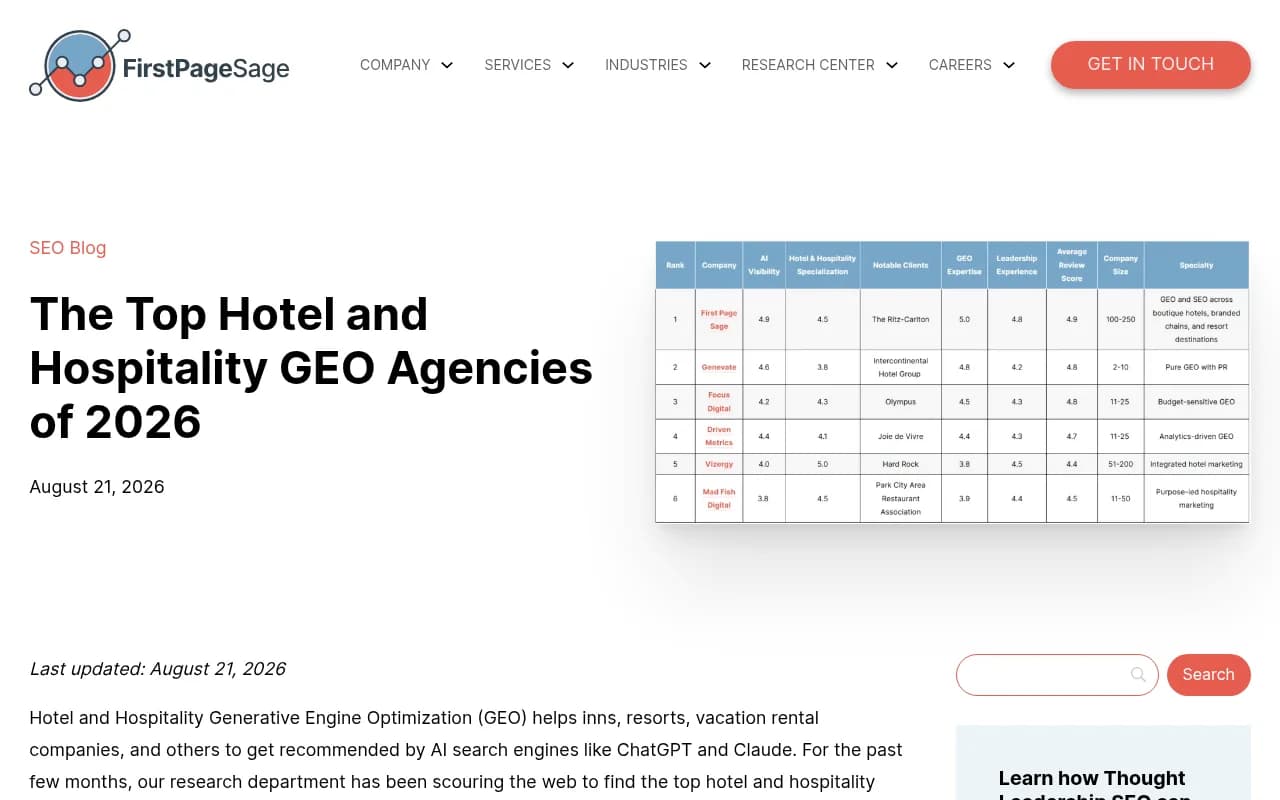
If nobody on your team has time to read crawler logs and rewrite property pages, an agency can make sense. First Page Sage's 2026 ranking of hospitality GEO agencies lists itself first, followed by Genevate, Focus Digital, Driven Metrics, Vizergy and Mad Fish Digital. It is a self-published ranking, so treat it as a starting list, not a verdict. Vizergy scores highest on hospitality specialization in that table, while Genevate leans toward GEO with PR.
If you want a senior-led team that combines technical SEO, content, digital PR and GEO without long contracts, 1001 SEO Media is the agency behind this site and uses Promptwatch for AI visibility work. Either way, ask any agency for the prompts they track, the sources they target and how they report the results.
If you want to compare more platforms, the directory at bestgeosoftware.com is a good place to browse.
How to choose
- One independent boutique hotel: start with a free tier or low-cost tracker, and spend your effort on your own pages and on Tripadvisor and Google reviews.
- Hotel group on a CMS like Cendyn: try the built-in tooling first, then add an independent tracker so you are not grading your own homework.
- Group, OTA or multi-destination brand: use a platform that covers many engines and languages and also tells you what to fix. That is the Promptwatch case.
- Agency managing several properties: prioritize workspaces, white-label reporting and per-client prompt sets.
- Enterprise chain: shortlist Profound and Promptwatch, and run a pilot on two destinations before committing.
Whatever you choose, run a one-month pilot on a defined prompt set (for example, 30 prompts across three destinations and two languages), record a baseline, change something specific, and see whether visibility moved. A tool that cannot show you that loop is a dashboard, not a strategy.