Key takeaways
- Enterprise security review for a GEO tool usually asks for SSO (SAML or OIDC), role-based access, audit logs, and a current SOC 2 Type II report. Missing any one of these can stall procurement.
- SSO and audit logs are almost always gated to higher plan tiers. Check which tier includes them before you build a business case on the entry price.
- A marketing page claiming SOC 2 is not proof. Ask for the report, and confirm it is Type II, not Type I.
- Promptwatch lists audit logs on Business and SSO on Enterprise, and is ISO/IEC 27001 certified and GDPR compliant. Profound and AthenaHQ publish SOC 2 Type 2 details. Always confirm SCIM and data residency directly.
- Run security review in parallel with the technical pilot, not after it.
Why security review decides GEO tool selection
Most GEO and AI visibility platforms were built for marketers who wanted a dashboard and a credit card. That works for a 10-person team. It does not work when your CISO, legal team, and procurement all get a say.
As one buyer's guide puts it, tools that lack SOC 2 Type II, GDPR-compliant data handling, and SAML/OIDC SSO "will fail the infosec review before procurement even starts." That matches what I see: the feature comparison gets the attention, then a security questionnaire quietly eliminates half the shortlist.
The practical lesson is to start the security conversation in week one. Presenc AI's enterprise buying guide notes that legal and security review typically runs in parallel with technical evaluation, and that mature enterprises bring security, legal, compliance, and IT into selection early rather than treating GEO as a marketing-only purchase.
The enterprise security checklist
Here is what to request from every vendor on your shortlist. It combines the checklists from several buyer guides.
Identity and access
- SAML or OIDC SSO through your identity provider (Okta, Azure AD, Ping).
- SCIM provisioning, ideally, so leavers are removed automatically.
- Role-based access with at least owner, editor, and viewer roles. Agencies and multi-brand teams need finer control.
- Scoped API keys, since GEO data often flows into BI tools and agents.
Audit and accountability
- Audit logs that record who changed monitoring configuration, who logged in, and when. Export and filtering matter, because security teams will want to pull the data into their SIEM.
- Membership and organization events, not just login events.
Compliance and contracts
- A current SOC 2 Type II report. Type I only proves controls existed on a single day. Type II evaluates controls over a period, typically 6 to 12 months, and a first-time audit can take 6 to 12 months end to end.
- ISO/IEC 27001 and GDPR compliance where relevant.
- A DPA covering encryption, subprocessors, transfer safeguards, deletion, and incident notification windows.
- Data residency options (EU, US) if you have regional obligations.
- A commitment not to train models on your data.
The pitfall nobody mentions
A vendor can put "SOC 2" and "SSO" on a marketing page while the report sits behind an NDA and SSO only exists on a plan you are not buying. Request the report, and get the plan tier for each control in writing.
SOC 2 also does not cover AI-output risks. It tells you the vendor handles your data responsibly, not whether the tool's brand-safety or hallucination monitoring is any good. Evaluate those separately.
Comparison: security controls across enterprise GEO tools
The table below reflects what each vendor publicly states. Anything marked "confirm" was not verifiable from public sources, so ask in procurement.
| Tool | SSO | Audit logs | Compliance (public claims) | Notes |
|---|---|---|---|---|
| Promptwatch | Enterprise plan | Business and Enterprise | ISO/IEC 27001, GDPR | Confirm SCIM and data residency with sales |
| Profound | SAML or OIDC, Enterprise plan | Activity logs with user, IP, timestamp, export | SOC 2 Type 2, HIPAA listed in Trust Center | Report available to enterprise customers via account manager |
| AthenaHQ | SAML and OIDC | Organization audit log | SOC 2 Type 2, GDPR, NIST CSF alignment | Detailed public security list |
| Goodie AI | Yes | Confirm | SOC 2, multi-tenant | Core plan quoted at $295/mo annual in a third-party guide; verify |
| Ansvisor | SAML on Enterprise cloud | Confirm | No certification listed | Open source (MIT), self-hostable |
| Presenc AI | SAML, SCIM | Yes | EU and US data residency | Negotiated MSAs |
| Otterly.AI | Available | Confirm | Confirm | Mid-market positioning with some enterprise features |
| Scrunch | Not stated on homepage | Confirm | Confirm | Verify in procurement |
Tool by tool
Promptwatch
Promptwatch is the option I would put first when you want security controls and an optimization workflow in the same product, rather than a monitor plus a separate content stack. Audit logs are on the Business plan ($579/mo), and SSO, custom tracking frequency, managed content workflows, a dedicated success manager, and priority support come with Enterprise on custom pricing. The company is ISO/IEC 27001 certified and GDPR compliant, which tends to satisfy a lot of security questionnaire lines on its own. Roles are owner, editor, and viewer, API keys are scoped, and agencies get white-label workspaces and read-only client access.
The part that sets it apart from monitoring-only tools is what happens after the dashboard. IP-verified AI crawler logs, visitor analytics, and the Content Agent (which plans, writes, and publishes to WordPress, Webflow, or Framer) mean the security review covers one vendor instead of four. Promptwatch also tracks real ChatGPT, Gemini, Perplexity, AI Overviews, and Copilot interfaces rather than only API outputs.
What I could not verify from the public pricing page: SOC 2, SAML/OIDC specifics, and SCIM. Treat those as "confirm with sales," and ask for the ISO certificate and the DPA early.

Profound
Profound is the strongest public paper trail among pure-play enterprise GEO vendors. It announced SOC 2 Type 2 certification after earlier achieving Type 1, runs a Trust Center, and documents SSO and activity logs in its help center. Activity logs capture organization, login, and membership events with the responsible user, IP address, and timestamp, plus filtering and export. SSO is an Enterprise feature, and the SOC 2 report is shared with enterprise customers through the account manager.
The trade-off is price and scope. It is strong on analytics and governance, but it is mostly a monitoring platform, so you will still need a separate answer for content execution and Reddit or shopping visibility.

AthenaHQ
AthenaHQ publishes one of the more detailed public security lists: SOC 2 Type 2, GDPR, SAML and OIDC SSO, role-based access, and an organization audit log, with NIST Cybersecurity Framework alignment. It also pairs that with content recommendations. If your security team likes to read a public page before they send a questionnaire, this one saves a round trip.
Goodie AI
Goodie AI positions itself around enterprise GEO with a full workflow layer, coverage of up to 14 AI engines, and SOC 2, SSO, and multi-tenant support. A third-party guide quotes the Core plan at $295/mo on annual billing, but I would verify that number directly.
Ansvisor
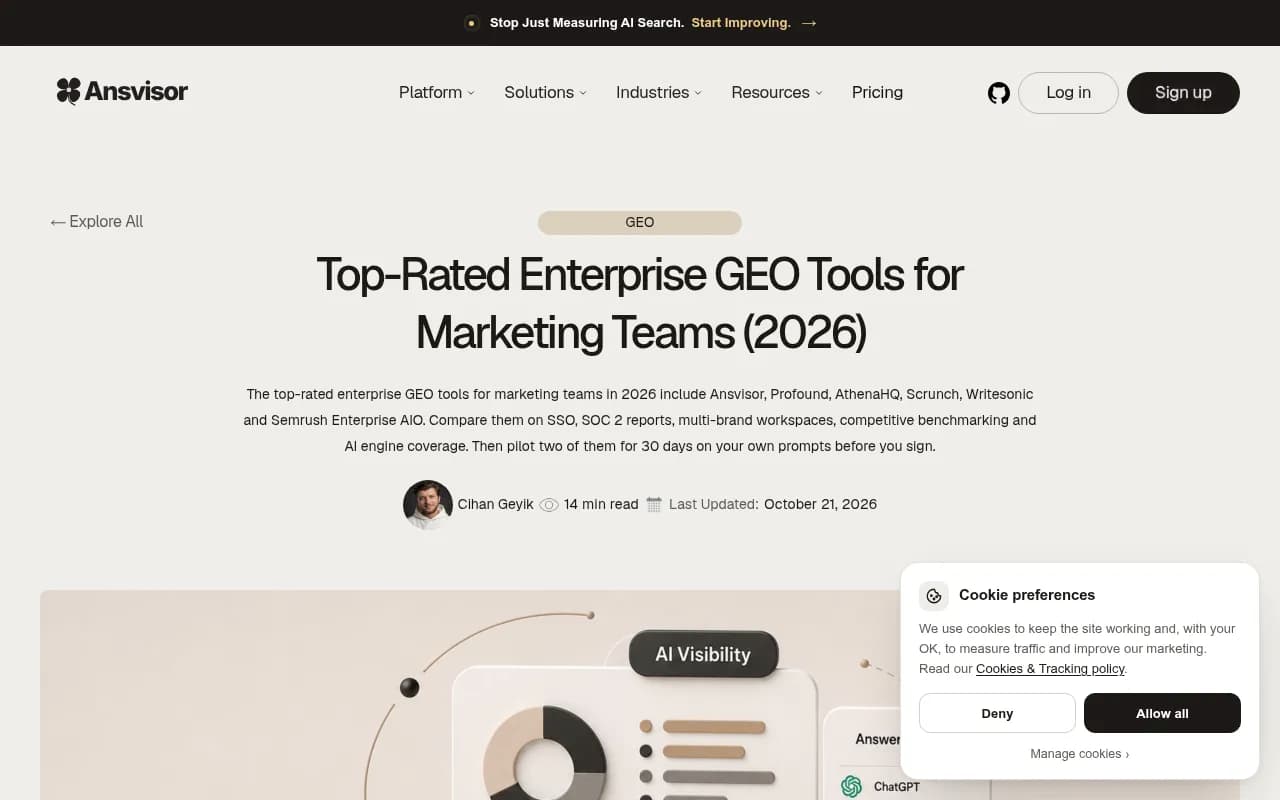
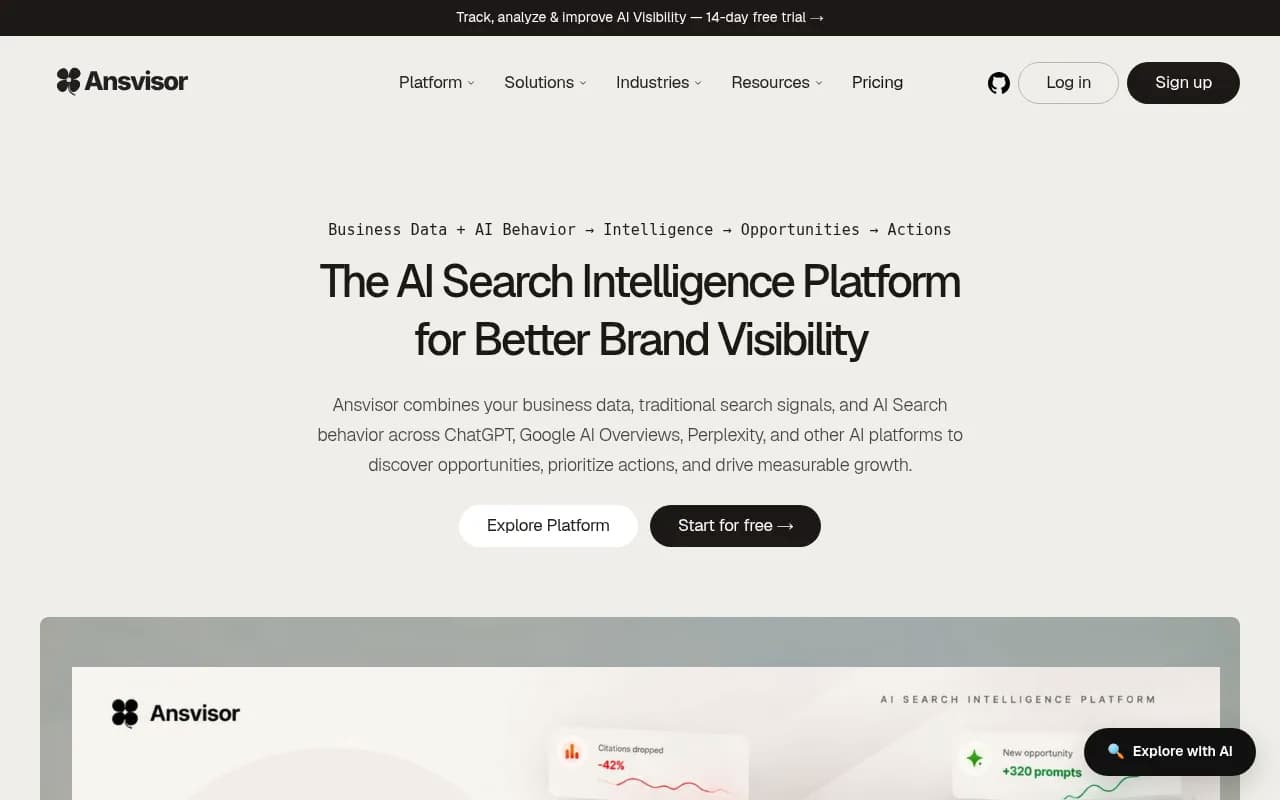
Ansvisor is the unusual one: open source under the MIT license, so a security team can read the code and run it in its own environment. The Enterprise cloud plan adds SSO/SAML, a custom brand workspace, and custom KPI frameworks. The website lists no compliance certification, and self-hosting takes engineering time. Good fit if data control matters more than a vendor attestation.
Scrunch, Otterly.AI, and others
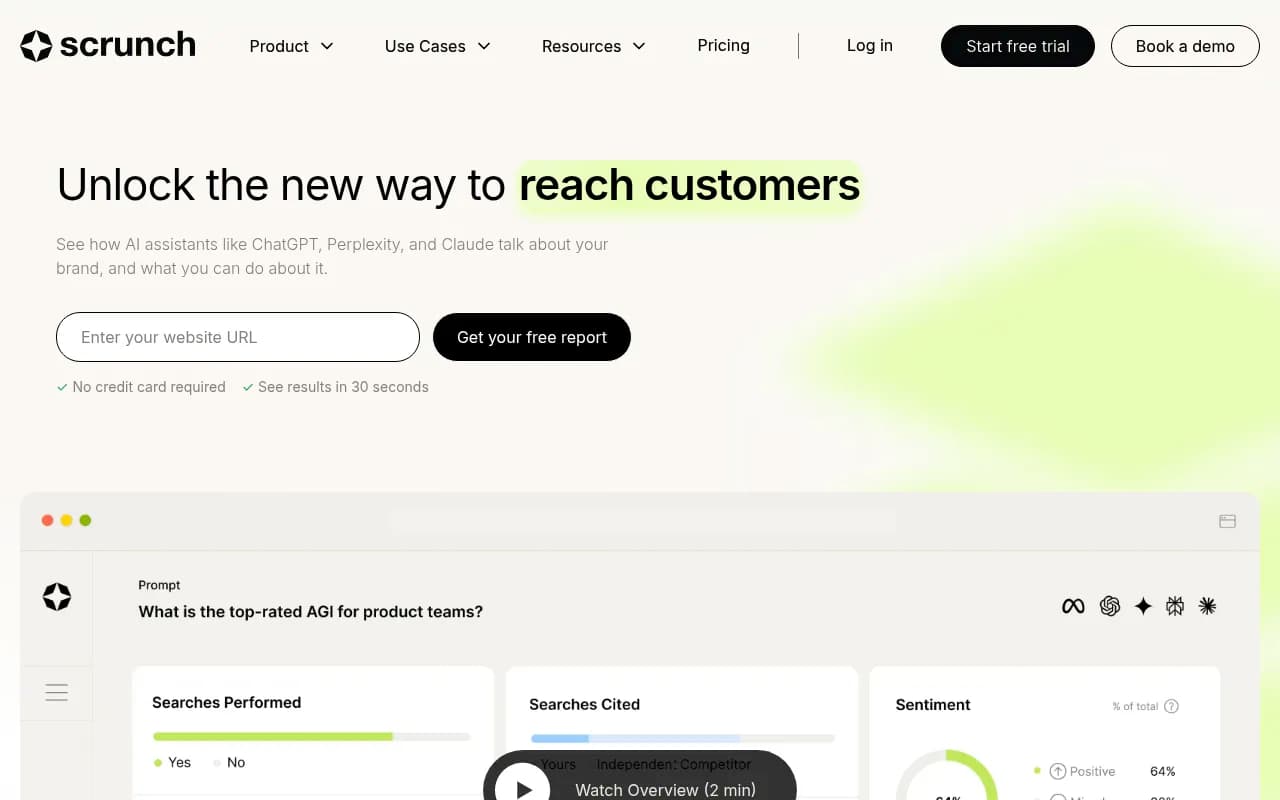
Scrunch's homepage does not mention SSO, so confirm it in procurement. Otterly.AI is mid-market but reportedly offers SSO and country-specific monitoring. Neither should be ruled out, but neither should be assumed to pass a security review.

For wider enterprise suites that bundle AI visibility into existing SEO platforms, see [tool:conductor], [tool:brightedge], [tool:seoclarity], and [tool:botify]. These often have mature security programs because they already sell to large buyers, though their AI-specific depth varies.
Plan-tier gating: where the surprises hide
This is the part that blows up business cases. Security controls are rarely on the entry plan.
| Control | Promptwatch | Profound |
|---|---|---|
| SSO | Enterprise | Enterprise |
| Audit logs | Business and above | Activity logs (confirm tier) |
| SOC 2 Type 2 report | Confirm with sales | Enterprise customers via account manager |
| Entry price | From $95/mo (Essential) | Custom; verify |
So a team that signs up for a cheaper tier to run a pilot may find the controls they need for production sit two tiers up. Budget for the tier that passes security, not the tier that runs the demo.
A practical evaluation process
Step 1: Send the questionnaire first
Before a demo, ask each vendor for: the SOC 2 Type II report or ISO certificate, the DPA, subprocessor list, SSO and SCIM documentation, audit log sample, and data residency options. A vendor that answers in two days is a different vendor from one that answers in two weeks.
Step 2: Pilot two tools for 30 days
Pick two finalists and run them on the same prompt set. Compare how well each tracks your brand and whether it surfaces why you are not being cited, not only that you are not. Checking crawler access and AI-referred traffic matters here, because it tells you whether visibility turns into visits.
Step 3: Check how the data scales
AI engines cite a different number of sources per answer. Promptwatch's Average Sources Per Response data shows ChatGPT cites about five sources per web-search answer while Google AI Overviews and Perplexity cite about ten, so response volumes and prompt counts add up faster on some engines. The figures were collected in September 2025 and drift with model updates, so use them as a sizing guide, not a constant. For broader context on how AI engines build answers, the Promptwatch Data hub is a useful reference.
Step 4: Involve security, legal, and IT early
GEO touches brand, legal claims about your company, and data flowing through APIs and MCP servers. Bring those teams in before you pick a favorite.
Which tool for which team
| If you need... | Start with |
|---|---|
| Security controls plus content execution and crawler analytics in one vendor | Promptwatch |
| The deepest public SOC 2 documentation and enterprise analytics | Profound |
| A detailed public security list with content recommendations | AthenaHQ |
| Self-hosting and code-level inspection | Ansvisor |
| An enterprise SEO suite that already passed your procurement | Conductor, BrightEdge, or seoClarity |
If you want to browse more options after this shortlist, the GEO software directory at bestgeosoftware.com covers the wider field.
Questions to ask before you sign
- Which plan tier includes SSO, audit logs, and the SOC 2 report?
- Is the SOC 2 report Type II, and what is the audit period?
- Do you support SCIM and which identity providers?
- Can audit logs be exported, and for how long are they retained?
- Where is data stored, and can we choose a region?
- Do you train on customer data?
- What is the incident notification window in the DPA?
Bottom line
Pick the tool that passes your security review at the tier you can afford, then judge it on whether it helps you improve AI visibility rather than just report on it. Get the controls in writing, request the certification documents before the pilot ends, and confirm every "confirm with sales" item in the table above.