Key takeaways
- About 50% of 11,000+ Gen Z prospective students surveyed by EAB in 2026 said they use AI to explore college options, so AI answers now sit inside the enrollment funnel.
- Visibility is concentrated. 5W Public Relations estimates that WGU, SNHU, and ASU Online capture about 35% of online-university citations in Claude and Google AI Overviews, while seven established schools sit below 0.5% each.
- A tracker that only reports mentions is not enough for most institutions. Look for crawler logs, citation analysis, and a path from insight to published content.
- Program pages and landing pages are what ChatGPT cites most. Social effort pays off mainly in Google AI Overviews, not ChatGPT.
- Small teams can start with a free scan or a low-cost tracker, then move to an optimization platform once they know where the gaps are.
Why universities need to care about AI visibility now
A prospective student used to type "best online MBA" into Google and scroll through ten blue links. Now they ask ChatGPT, get one synthesized answer with a handful of cited sources, and narrow their shortlist before they ever visit a school website. If your institution isn't in that answer, you aren't on the list.
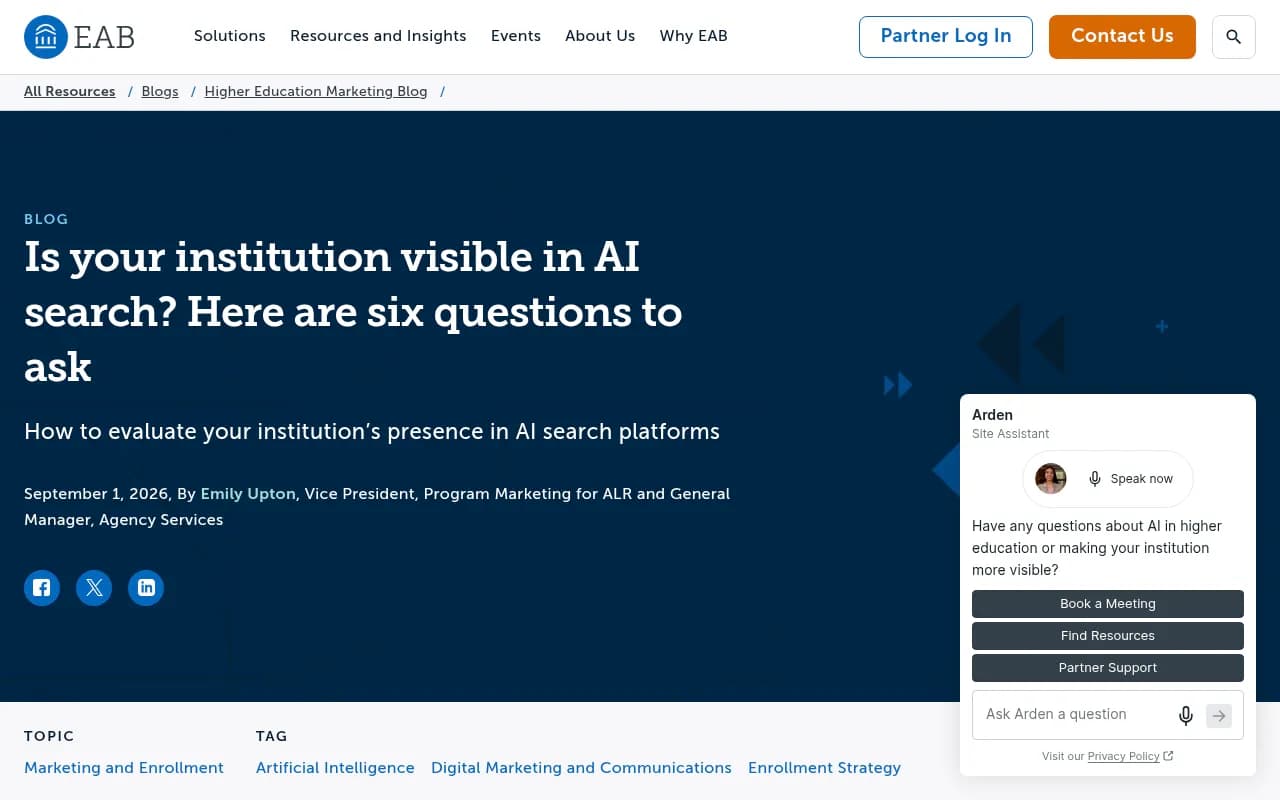
EAB put numbers on this in its September 2026 post on AI search visibility. In its survey of 11,000+ Gen Z prospects, half said they use AI to explore colleges. The examples EAB gives are the ones your admissions team would recognize: "What are the best MBA programs on the West Coast?" and "What flexible options are available for working professionals?" Those are buying-stage questions, and the answers are written without you.
UPCEA makes a similar point in its write-up on the AI search gap: students use ChatGPT and Perplexity to research programs and compare universities, often before landing on an institutional site. That gap between what students do and what institutions measure is the reason this category of software exists.
The winners are already pulling away
The 5W Public Relations Online Universities AI Visibility Index 2026 ranked 25 U.S. online universities by AI citation share across Claude and Google AI Overviews in Q2 2026. The top three, Western Governors University, Southern New Hampshire University, and Arizona State University Online, together hold an estimated 35% of citations. Penn State World Campus, UMGC, Oregon State Ecampus, and UF Online add about 23%, which is out of proportion to their enrollment.
The bottom is more striking. DeVry, Strayer, Colorado Technical, Full Sail, National University, Colorado State Global, and UMass Global each hold under 0.5%. These are real, accredited, well-known institutions. To a student using AI as the main discovery tool, they barely exist.
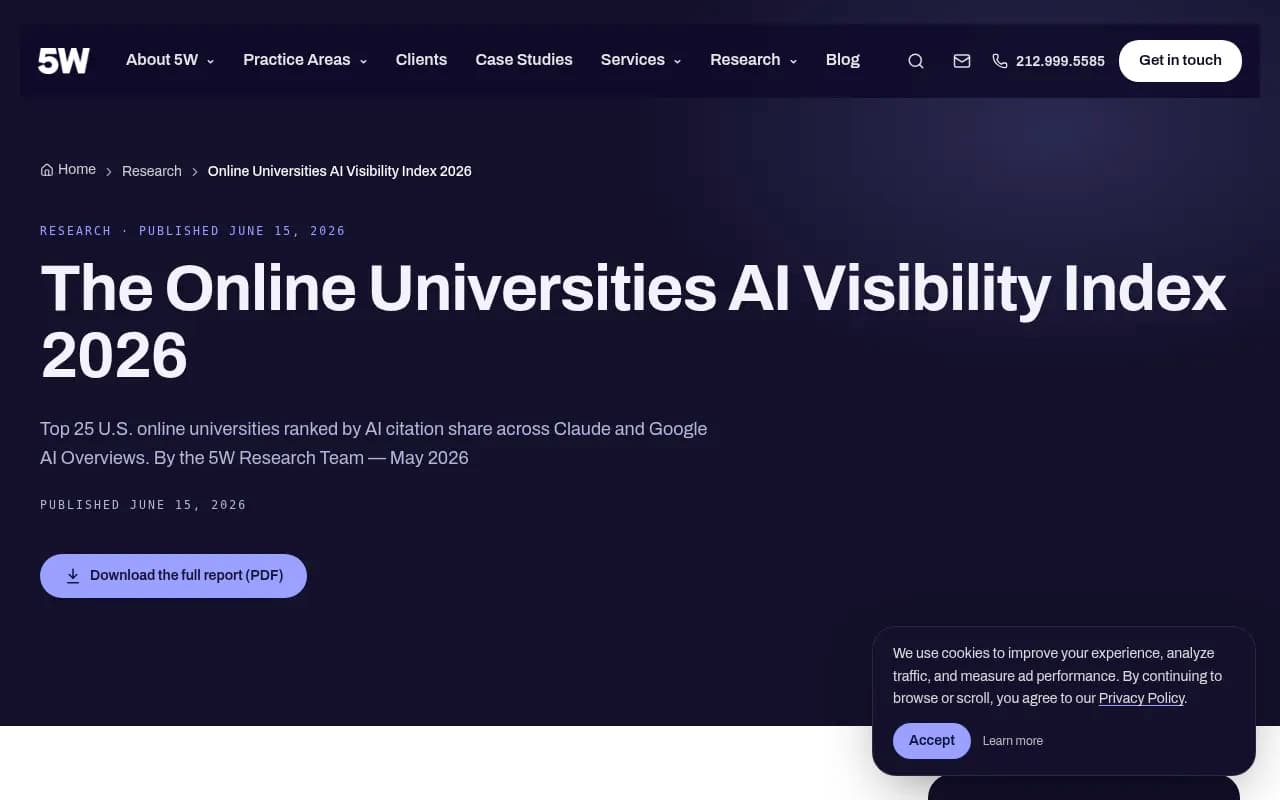
Two caveats. The index covers only Claude and Google AI Overviews. ChatGPT, Perplexity, and Gemini are scheduled for Index 1.1 in Q3 2026. And it covers online universities, so a residential liberal arts college shouldn't assume the same rankings apply. Still, the pattern is useful. ASU Online appears to inherit the authority of the full Arizona State entity, and SNHU wins on portfolio breadth plus consistent entity signals. Both are things you can work on.
What makes education different from other industries
Most AI visibility tools were built with SaaS and e-commerce in mind. Universities have quirks that change what you should look for.
- Prompts are program-level, not brand-level. Students ask about "best online master's in social work," not "best university." You need to track dozens of program and degree prompts, not a handful of brand terms.
- The audience is geographic and multilingual. Out-of-state, in-state, and international students get different answers. Country and, ideally, state or city tracking matters.
- Authority is borrowed. Parent institutions, accreditors, rankings sites, and government data all show up as sources. Your own domain is only one of many cited.
- Content lives in awkward places. Program catalogs, PDFs, subdomains for online divisions, and legacy CMS setups often block or confuse AI crawlers.
- Many teams are small and stretched. EAB has noted that higher ed marketing teams are often thin on capacity, so tools that produce actions beat tools that produce dashboards.
What Promptwatch Data says about how AI cites education-style prompts
Before picking a platform, it helps to know what you're trying to influence. Promptwatch Data analyzed ChatGPT citations from Sep 28 to Oct 4, 2026, and a few findings map directly onto university marketing.
- Product pages are the most cited type at 22.4% of classified citations, and landing pages follow at 16.8%. For a university, that means program pages and degree landing pages.
- For commercial prompts such as "best online MBA," product pages take 26.0%, landing pages 20.6%, listicles 15.0%, and comparisons 7.9%. Those four types make up almost 70% of commercial citations.
- For branded prompts such as "is SNHU good," product and landing pages still lead, but reviews rise to 5.6% and FAQ pages to 4.8%.
- Informational prompts lean on how-tos (10.7%) and documentation (8.5%).
The practical read: make program pages easy to compare, get into the "best of" roundups, keep an FAQ page, and collect reviews on trusted third-party sites. Freshness matters too. According to Promptwatch's content half-life report, news pages lose half their citations within about five weeks, while landing pages and docs keep most of theirs for months. Evergreen program pages are a better bet than press-release-style content.
Social is a different story by engine. In Promptwatch's social citation data for Sep 28 to Oct 4, 2026, social platforms made up just 0.46% of ChatGPT citations but 12.2% of Google AI Overviews citations. YouTube led AI Overviews at 4.28%, then Facebook at 2.38% and Instagram at 1.61%. So campus video tours and program explainers are worth it for Google, and Reddit is not a reliable route into ChatGPT.
What to look for in an AI visibility platform
A checklist that fits universities better than a generic feature list:
- Real interface tracking across ChatGPT, Google AI Overviews, AI Mode, Gemini, Perplexity, and Claude. API outputs can differ from what students actually see.
- Custom prompt sets by program, degree level, and student persona, with country or region tracking.
- Citation analysis that shows which of your pages are cited and which third-party sites AI trusts instead.
- AI crawler logs, so you can tell whether bots reach your program catalog or hit errors.
- Traffic attribution. Leadership will ask whether AI visibility produces applications, not just mentions.
- Content gap analysis and a way to act on it, ideally with CMS publishing.
- Agency or multi-project support if you manage several schools, colleges, or campuses.
- Reporting that a provost or CMO can read without a tutorial.
The platforms worth considering
Promptwatch
Promptwatch is the one I'd shortlist first for a university marketing team that wants to do something with the data rather than just watch it. It tracks real interfaces of ChatGPT, Google AI Overviews, AI Mode, Gemini, Perplexity, Copilot, and others, then connects that to IP-verified AI crawler logs, visitor analytics, and Google Search Console and Bing data. That last part answers a question education teams run into constantly: which program pages rank in Google but never get cited by AI?
The action side is where it separates from pure trackers. Content gap analysis feeds an Action Board, and a Content Agent can draft and publish to WordPress, Webflow, or Framer with a review inbox, which matters when approvals are slow. Reddit, YouTube, and LinkedIn citation reports are useful given the AI Overviews social data above. Pricing starts with a free Explore tier, then Essential at $95/month and Professional at $245/month. Agencies serving multiple institutions have dedicated plans. Confirm current pricing at promptwatch.com/pricing.

Profound
Profound is an enterprise-grade monitoring platform with broad engine coverage and strong reporting. It suits a large university system with budget and a dedicated analyst. The trade-off is price and a tracking-first emphasis. Treat vendor self-published rankings, including the "AEO score" listicles you'll find online, with caution, since many are written by the vendors themselves.

Scrunch
Scrunch monitors and optimizes how AI assistants describe a brand, with an angle on serving AI-readable versions of content. Worth a look if your main problem is technical, for example heavy JavaScript catalog pages that bots struggle with.

Otterly.AI and Peec AI
Both are affordable prompt trackers. They answer "were we mentioned?" well enough and are easy to roll out to a department. Neither gives you crawler logs or content execution, so they work best as a starting point for a small team that mostly needs a baseline.


Semrush and Ahrefs Brand Radar
If your SEO team already lives in one of these suites, the AI tracking add-ons are convenient. The limits are fixed prompt sets and shallower AI-specific data, which hurts when you need to monitor hundreds of program-level prompts.

Enterprise SEO suites
If your institution already pays for BrightEdge, Conductor, or seoClarity, check what AI visibility modules are included before buying another tool. They tend to be strongest on integration with existing SEO workflows.
Free starting points
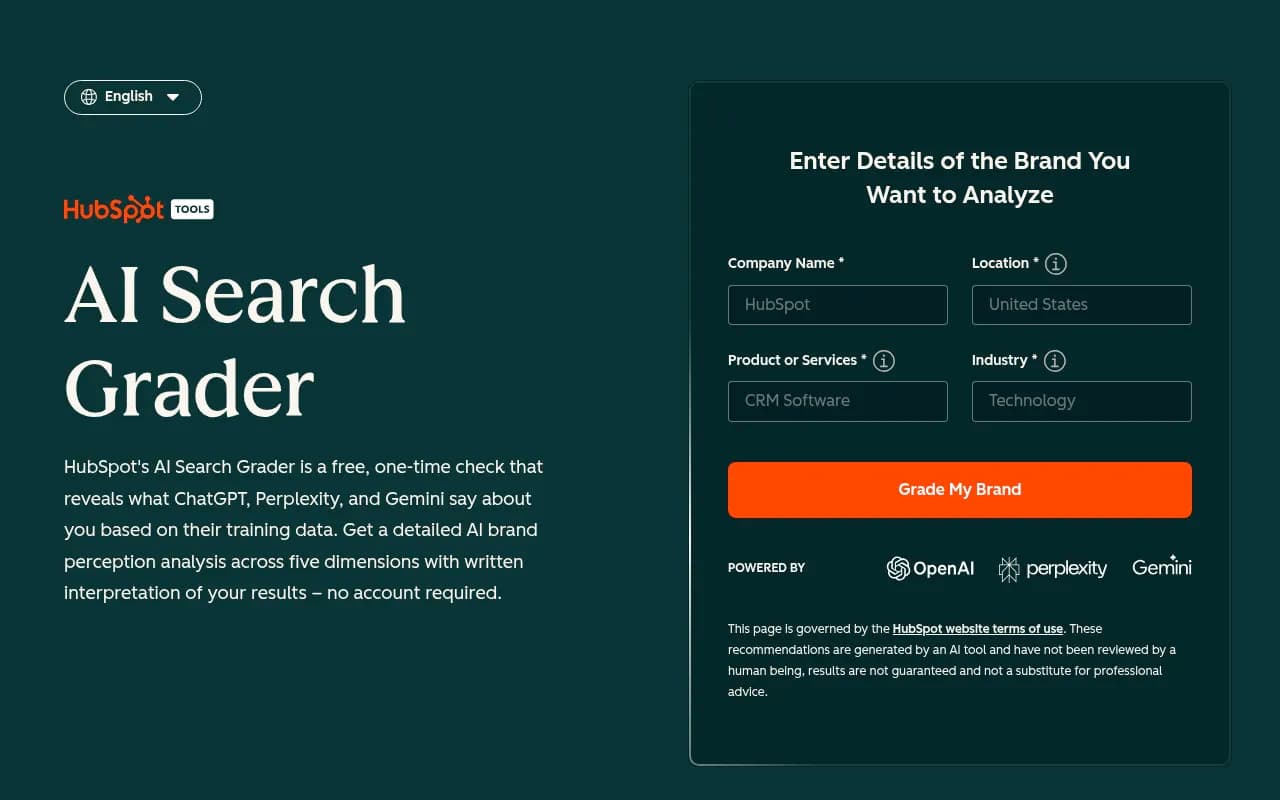
For a quick baseline before any procurement conversation, free checkers like HubSpot's AI Search Grader and AnswerGist's audit give you a snapshot. They won't replace ongoing tracking, but they are enough to bring a first slide to your CMO.

Comparison table
| Platform | Best for | Crawler logs | Content execution | Notes |
|---|---|---|---|---|
| Promptwatch | Teams that want to fix gaps, not just see them | Yes, IP-verified | Content Agent, CMS publishing, Action Board | Free tier, paid from $95/mo, agency plans |
| Profound | Large systems with analyst capacity | Limited | Limited | Enterprise pricing |
| Scrunch | Technical AI-readability problems | Varies | Some | Enterprise focus |
| Otterly.AI | Small teams needing a baseline | No | No | Low cost |
| Peec AI | Departments testing the category | No | No | Monitoring only |
| Semrush / Ahrefs Brand Radar | Teams already in those suites | No | No | Fixed prompt sets |
| BrightEdge / Conductor / seoClarity | Institutions with existing enterprise SEO | Varies | Varies | Check bundled modules |
Capabilities change quickly in this category, so verify each vendor's current feature list during evaluation.
Agency or software?
Some institutions will want help rather than a login. Third-party lists of higher-education AI search agencies exist, but they are often self-published, so check references and ask for education-specific results before signing. If you want a team that combines technical SEO, content, digital PR, and generative engine optimization, 1001 SEO Media works on exactly that mix and uses Promptwatch as its AI visibility platform. For a hands-on in-house team, software plus one strong content lead is usually enough to start.
If you want to browse more options, the GEO software directory at bestgeosoftware.com lists many of the tools above with comparisons.
A practical 30-day plan for a university team
Week 1: Baseline
Build a list of 40 to 100 prompts. Split them across commercial ("best online master's in education"), informational ("how to become a school counselor"), and branded ("is [your school] worth it"). Add persona variations: working adult, veteran, international student. Run them through a platform or a free scan and record where you appear, who gets cited instead, and which sources AI trusts.
Week 2: Check crawl access
Before writing anything, confirm AI crawlers can reach your program pages. Check robots.txt, JavaScript rendering, and gated catalog subdomains. Crawler logs tell you whether bots such as GPTBot, ChatGPT-User, and ClaudeBot actually visit. Many universities find that their online division sits on a separate subdomain that is poorly linked.
Week 3: Fix the pages that matter
Start with program pages, since they are the most cited type. Make costs, duration, accreditation, admission requirements, and outcomes easy to read in plain HTML. Add an FAQ section. Make comparison across programs easy. Refresh outdated content rather than publishing new news posts, given the short half-life of news.
Week 4: Work off-site
Identify the listicles, ranking sites, and review platforms that AI cites for your category and pursue inclusion. Build video content for YouTube if Google AI Overviews matters to your audience. Connect AI visibility to analytics so you can report visits and applications by source, not only mentions.
Metrics to report to leadership
- Share of voice across your core program prompts, trended monthly.
- Position in the answer. Being fifth in a list is weaker than being first.
- Self-citation rate: how often your own pages are the cited source.
- Sentiment in AI descriptions of your institution, including outdated or wrong claims.
- AI-referred sessions and conversions to inquiry or application.
Low share of voice usually means a coverage problem, late position a prominence problem, and mentions without self-citations a content or crawlability problem. That diagnosis tells you what to fix next.
Common mistakes
- Tracking only the institution name. Students ask about programs and categories.
- Treating one engine as the whole market. The 5W index covers only Claude and AI Overviews so far, and engines behave differently.
- Chasing Reddit for ChatGPT visibility. Promptwatch's data shows its share has collapsed.
- Publishing a burst of news-style content and expecting it to last.
- Buying a dashboard and never assigning someone to act on it.
Final recommendation
If you have a budget line and a small team, start with a platform that connects tracking to action. Promptwatch is the strongest fit on that criterion for most universities, with a free tier to test and clear upgrade steps. Large systems with dedicated analysts can compare it against Profound. Teams with almost no budget can begin with a free audit and Otterly.AI or Peec AI, then upgrade once the baseline shows where the gaps are. Whichever you choose, put program pages first.