Key takeaways
- MCP (Model Context Protocol) lets Claude, ChatGPT, Cursor, and Gemini CLI query your SEO tools directly instead of you exporting CSVs, but setup time ranges from 2 minutes (hosted remote servers) to 30+ minutes (OAuth-based community servers like mcp-gsc).
- Ahrefs and Semrush now ship official hosted MCP endpoints that work across Claude, ChatGPT, Cursor, and n8n with no local install, while Google Search Console still has no official server, only community-built ones.
- SE Ranking is the only mainstream SEO MCP server that exposes AI search visibility data (Share of Voice in ChatGPT, Gemini, Perplexity, AI Overviews, AI Mode) alongside traditional rank tracking.
- MCP servers are a real attack surface, not just a convenience feature. Prompt injection through tool metadata and malicious config writes are documented, named vulnerabilities, so review before you connect anything with write access.
- Start with the free mcp-gsc server for indexing and query data, then add whichever paid platform (Ahrefs, Semrush, or SE Ranking) you already subscribe to.
Why SEO teams are suddenly talking about MCP
I'll be honest, a year ago "MCP server" would have sounded like something you patch on a Tuesday, not something an SEO manager cares about. That's changed fast. The protocol, an open standard from Anthropic, gives AI assistants a direct, structured way to call external tools instead of guessing at an API. For SEO teams specifically, that means asking Claude or ChatGPT a question in plain English and getting back live data from Ahrefs, Search Console, or your rank tracker, no CSV export, no copy-pasting into a spreadsheet at 4pm on a Friday.
The timing isn't random. ChatGPT Search started using the site: operator at scale on August 8, 2026, jumping from roughly 0.4% to 17% of all fanout queries almost overnight, and average fanout queries per response nearly doubled at the same time, according to Promptwatch's data on ChatGPT's site-operator surge. That's a concrete sign AI systems are treating your domain as a retrieval surface in a much more deliberate way than they were six months ago. If your pages aren't crawlable, indexed, and monitored, you're losing visibility in both Google and AI answers, and that's exactly the gap MCP-connected tooling is meant to close.
Separately, the crawler mix hitting sites is shifting quickly too. OpenAI's share of verified AI crawler requests dropped from 94.8% in early June 2026 to 79.8% by early September, per Promptwatch's AI crawler traffic tracking. If you're only watching one bot, you're watching the wrong thing by the time you notice.
How this list was built
I ranked each server on two things that actually matter day to day: setup time (how long from "I want this" to "it's answering questions") and agent compatibility (which AI clients it actually works with — Claude, ChatGPT, Cursor, Gemini CLI, Windsurf, VS Code). I also weighed data depth, because a five-minute setup that only returns keyword volume isn't worth as much as a fifteen-minute one that also gives you backlink gaps and AI citation share.
One ecosystem note worth flagging: 59% of new MCP servers now ship on remote streamable HTTP rather than local stdio, according to Zuplo's ecosystem survey cited by Firecrawl. That's the direction things are moving, and it's good news for setup time, since remote servers skip local installs and get OAuth handled for you.
The ranked list
1. Ahrefs MCP — fastest setup for the data you probably already pay for
Ahrefs runs a single hosted remote server at a fixed URL. No local install, no config file editing. If you're already on a paid Ahrefs plan (Lite and up, starting at $129/month), you connect through Claude's connector directory, the ChatGPT app, or a one-line Cursor config, and you're querying live keyword difficulty, backlink profiles, and competitor traffic history within a couple of minutes.
The catch: Ahrefs explicitly disallows routing the endpoint through custom scripts or standalone JSON-RPC clients, so this is a supported-client-only setup, not a general API replacement. Each plan also caps monthly API units shared across the API, MCP, and Ahrefs Connect, so heavy daily use on a Lite plan will hit limits faster than you'd expect.
Setup time: under 5 minutes if you're already an Ahrefs subscriber. Agent compatibility: Claude (Desktop, Code, Mobile), ChatGPT, Cursor, Copilot Studio, n8n, Manus, Mistral Le Chat.
2. SE Ranking MCP — the only one that tracks AI search visibility
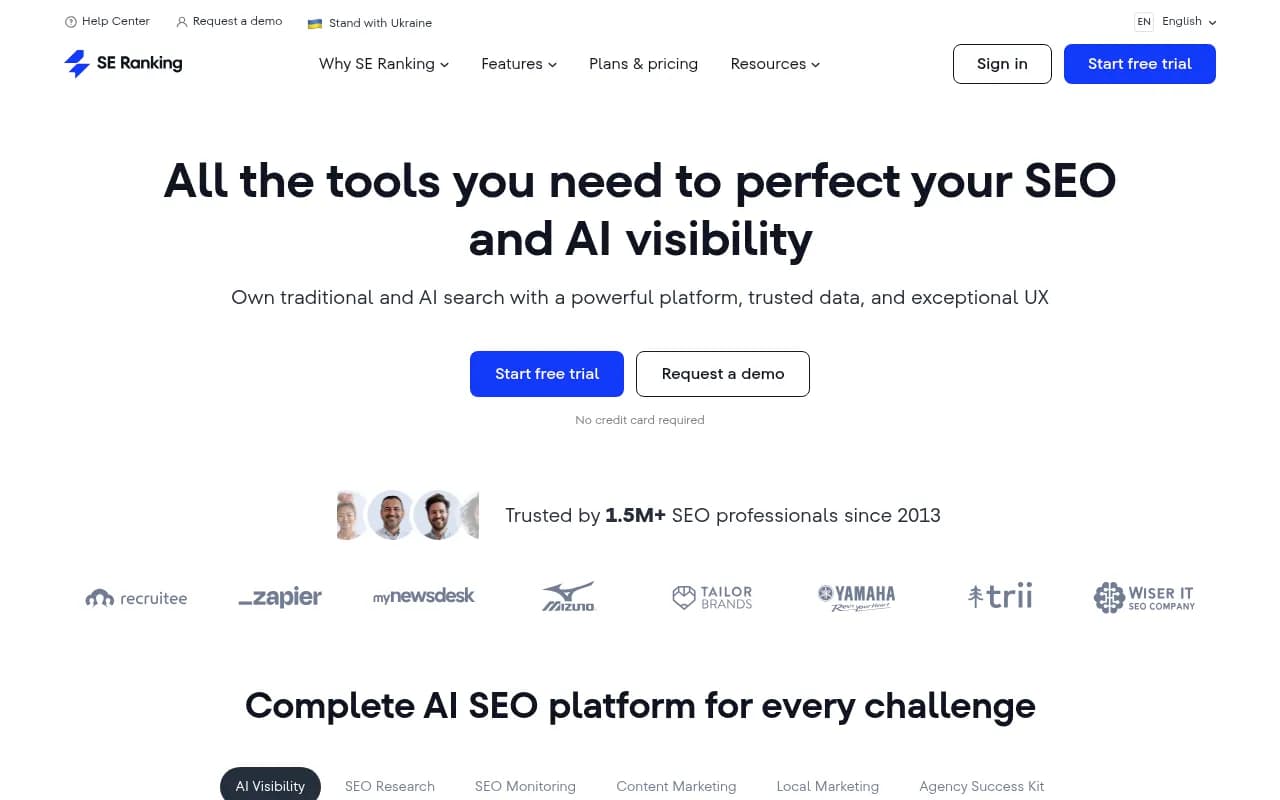
SE Ranking's server is the standout here for one reason: it's the only mainstream SEO MCP that gives you Share of Voice in ChatGPT, Gemini, Perplexity, Google AI Overviews, and Google AI Mode, pulled from a reported 25.5 million tracked prompts, alongside the traditional stuff, rank tracking, backlink audits (2.2 billion domain profiles), keyword research across 5.4 billion keywords, and technical site audits.
It supports an unusually wide agent list: Claude, ChatGPT (including the app), Codex, Cursor, VS Code, Windsurf, Zed, and Gemini CLI. SE Ranking also publishes over 20 open-source Claude skills sitting on top of the MCP connection, prebuilt workflows for content briefs, backlink gap analysis, and AI visibility reporting, which cuts down the prompt-engineering guesswork of a first-week setup.
Setup time: roughly 10-15 minutes, OAuth-based remote connection. Agent compatibility: broadest on this list.
3. Semrush MCP — bundled into plans you already own
Semrush's remote endpoint is documented for Cursor, VS Code, and Antigravity, and there's no separate charge for the MCP layer itself, it's included in existing SEO plan tiers, with 50,000 MCP API units bundled in and scalable add-on packages up to 5 million units for heavier agency use. If your team already runs Semrush for reporting, this is close to a five-minute add.
Setup time: 5-10 minutes. Agent compatibility: Cursor, VS Code, Antigravity; Claude support is more limited than Ahrefs or SE Ranking's.
4. DataForSEO MCP — best for agencies running scripted workflows
DataForSEO's official server runs with zero install via a single npx command, or as a hosted streamable HTTP endpoint. Claude Code's CLI setup is a one-liner with your username and password as environment variables. Community reports put manual local setup around 5 minutes once you have credentials.
What makes this one different is scale: it's built for agencies pulling SERP data across dozens of client accounts, not for asking one-off questions. If you're the person who has to check rankings for 40 domains every Monday, this is the server that was built for you.
Setup time: 5-10 minutes with credentials in hand. Agent compatibility: documented quick-starts for Claude Desktop and Cursor; works over stdio or HTTP for others.
5. mcp-gsc (Google Search Console) — free, but the slowest to configure
Here's the thing nobody selling you a $250/month tool wants to say: the highest-value starting point for most SEO teams is free. There is still no official Google-built Search Console MCP server as of this year, only community projects like mcp-gsc. That means you're creating a Google Cloud project, enabling the Search Console API, generating OAuth or service-account credentials, then installing via npm and wiring the config into Claude Desktop yourself. Realistically that's a 20-30 minute process the first time, longer if you've never touched Google Cloud Console.
Once it's running, though, it's free indexing and query data, forever, with no subscription tied to it. For a solo practitioner or small team, that tradeoff is worth the setup headache.
Setup time: 20-30 minutes (OAuth plus Cloud Console configuration). Agent compatibility: primarily Claude Desktop; works elsewhere with manual config.
6. Screaming Frog wrapper — technical audits, code-required
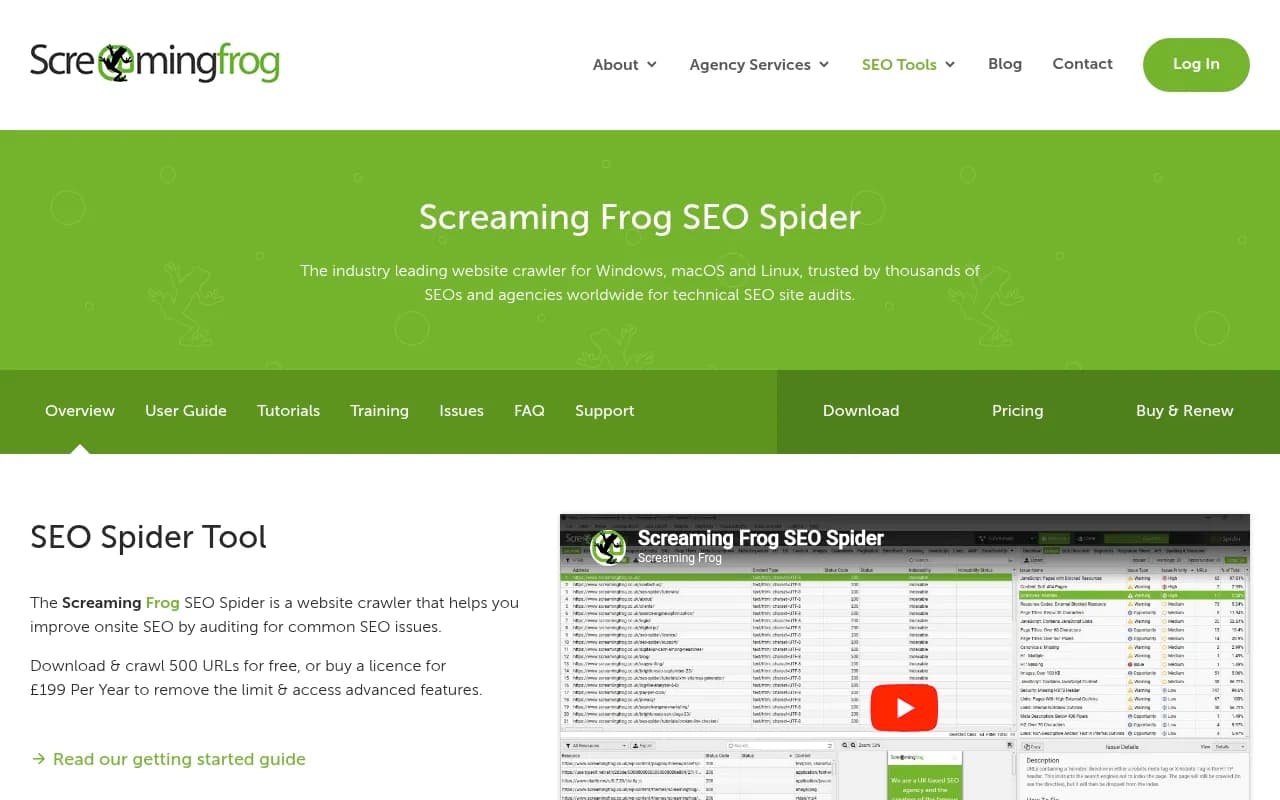
There's no first-party Screaming Frog MCP server yet, so teams wrap the crawler's export output or CLI into an MCP-compatible layer themselves. This is squarely in code-required territory, best left to whoever on your team already scripts Screaming Frog automation. Once it's wired up, it's genuinely useful, structured crawl data an agent can group by issue severity and turn into engineering tickets without you touching a spreadsheet.
Setup time: 30-60+ minutes, developer involvement expected. Agent compatibility: depends entirely on the wrapper implementation.
At a glance: setup time vs. what you actually get
| MCP server | Setup time | Cost to unlock | Agent compatibility | Standout capability |
|---|---|---|---|---|
| Ahrefs | under 5 min | Ahrefs Lite ($129/mo)+ | Claude, ChatGPT, Cursor, n8n | Live keyword & backlink data, no local install |
| SE Ranking | 10-15 min | SE Ranking subscription | Claude, ChatGPT, Cursor, VS Code, Windsurf, Zed, Gemini CLI | Only one with AI search Share of Voice |
| Semrush | 5-10 min | Bundled in existing plans | Cursor, VS Code, Antigravity | No extra MCP charge, scalable units |
| DataForSEO | 5-10 min | Pay-as-you-go API credits | Claude Code, Cursor, stdio/HTTP | Best for scripted agency workflows |
| mcp-gsc | 20-30 min | Free | Claude Desktop | Free indexing & query data forever |
| Screaming Frog wrapper | 30-60+ min | Screaming Frog license + dev time | Varies | Structured crawl-to-ticket pipeline |
What this actually looks like day to day
Once connected, the workflow shift is real, not theoretical. Instead of "export GSC, export Ahrefs, merge in Sheets, write summary," you're typing something like "pull organic traffic to [site] for the last 24 months and flag any month where it dropped more than 15%" and getting an answer in the same chat window you were already using. SE Ranking's own use case examples include scheduling combined rank-tracking and AI visibility reports, building writer-ready content briefs from keyword data, and running backlink gap analysis against competitors, all from a single conversation instead of five tabs.
The content-type shift matters here too. Product pages overtook listicles as the most-cited format in Google AI Overviews in late July 2026, per Promptwatch's citation type breakdown, while ChatGPT's citations that same month leaned roughly a third product pages with listicles as the fastest-growing format, per Promptwatch's ChatGPT citation type data. If your MCP-connected content briefs aren't accounting for that shift, you're optimizing for last year's answer engine.
Don't skip the security review
This part gets glossed over in most MCP roundups and it shouldn't. Palo Alto Networks' Unit 42 documented prompt-injection attack vectors specifically through MCP's sampling feature, where a compromised server can hijack a conversation or exfiltrate data. These aren't hypothetical: CVE-2025-54135 was a real remote-code-execution vulnerability in Cursor triggered by an indirect prompt injection that wrote a malicious MCP config file without user approval. Invariant Labs separately documented a "toxic agent flow" in GitHub's MCP server where buried instructions in an issue caused an agent to leak private repo content through a public pull request, because the connected token had blanket access with no boundary enforcement.
The practical takeaway for an SEO team: don't grant an MCP connection more access than the task needs, review any server before giving it write access to your CMS or repo, and treat tool descriptions from third-party servers as untrusted input, because malicious instructions can be hidden there and sit dormant for months before firing.
Where to start if you're doing this from zero
- Solo practitioner or small team: connect mcp-gsc first (free), then add Ahrefs or Semrush based on whichever you already pay for.
- Agency running multi-client audits: DataForSEO for SERP data at scale, mcp-gsc for indexing, a Screaming Frog wrapper for technical crawls.
- In-house team investing in AI search visibility: SE Ranking, since it's the only server here that tracks Share of Voice across ChatGPT, Gemini, Perplexity, and both Google AI surfaces in one place.
If your team's real gap is monitoring and fixing AI search visibility itself, not just SEO data plumbing, that's a separate but related problem. Tools like Promptwatch go beyond prompt tracking to show crawler logs, citation trends, and content gaps, then generate and publish GEO content to close them, which is a natural next step once your MCP-connected SEO stack is answering the basic data questions on its own.

For a broader look at agentic tooling beyond SEO-specific MCP servers, the directory at agenticseotools.com is worth a scroll, and if AI visibility tracking is the piece you're missing, bestgeosoftware.com rounds up the GEO platforms built for exactly that.
MCP doesn't replace SEO judgment, and it won't tell you which page to fix first on its own. What it does is remove the two hours of information wrangling that used to sit between a question and an answer. For most teams in 2026, that's the difference between actually running weekly analysis and just meaning to.