Key takeaways
- AirOps is a content operations platform first -- it's strong for scaling content workflows but doesn't offer deep AI citation tracking or crawler intelligence.
- Promptwatch is the only platform in this comparison that covers the full loop: gap analysis, content generation, crawler logs, and traffic attribution in one place.
- Searchable is a niche monitoring tool with a narrow feature set -- useful for basic brand tracking but limited for teams that want to act on the data.
- Atomic AGI positions itself around AI search monitoring education and tooling, but lacks the depth of a full GEO platform.
- The real differentiator in 2026 isn't who shows you the data -- it's who helps you do something with it.
The category has a naming problem. "Content engineering platform," "GEO tool," "AI visibility platform" -- vendors use these terms interchangeably, but they describe very different products. Some track citations. Some generate content. Some do both. A few do neither particularly well.
This comparison focuses on four tools that get lumped together in buyer shortlists: AirOps, Promptwatch, Searchable, and Atomic AGI. They're not all the same kind of product, which is exactly why comparing them is worth doing carefully. Picking the wrong one means either drowning in dashboards with no clear path to action, or generating content that never connects to what AI models are actually looking for.
Here's what each tool actually does, where it falls short, and which one makes sense depending on what you're trying to accomplish.
What "getting cited" actually requires in 2026
Before comparing tools, it helps to understand what the problem looks like. AI search citation isn't a ranking algorithm you can game with keyword density. According to AirOps' own 2026 State of AI Search report, only 30% of brands stay visible from one AI answer to the next, and pages not updated quarterly are 3x more likely to lose citations.
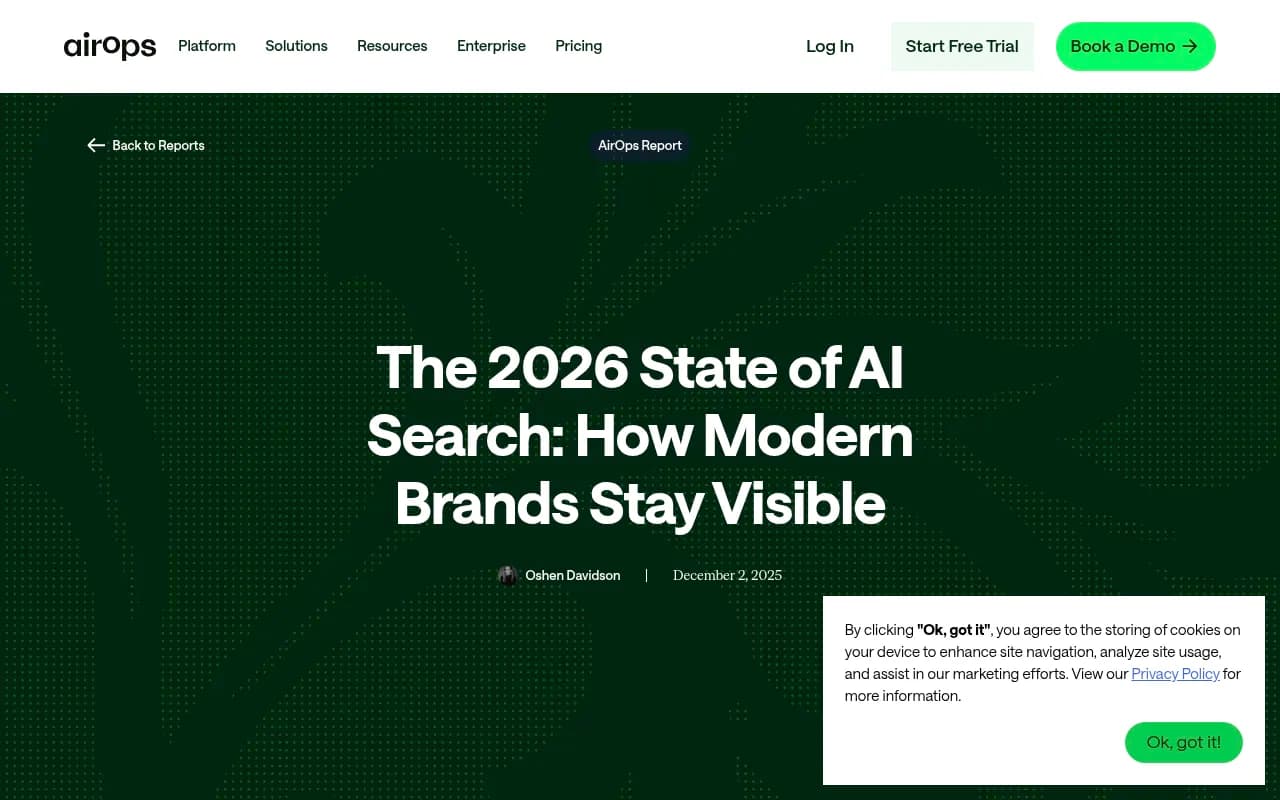
The data from that report also shows that roughly 48% of AI citations come from community platforms like Reddit and YouTube -- not from brand-owned pages. And about 60% of AI Overview citations come from URLs that aren't even ranking in the top 20 organic results.
That last point matters a lot. Traditional SEO rankings and AI citations are increasingly decoupled. A page can rank #1 on Google and get ignored by ChatGPT. A Reddit thread from 2023 can drive 40% of your competitor's AI mentions. This is the environment these tools are operating in, and it's why "monitoring" alone isn't enough.
The tools that actually move the needle in 2026 do three things: find the gaps where competitors are visible and you're not, help you create content that fills those gaps, and track whether that content is getting crawled and cited. Most tools only do one of these.
AirOps: content operations at scale, AI visibility as a secondary focus
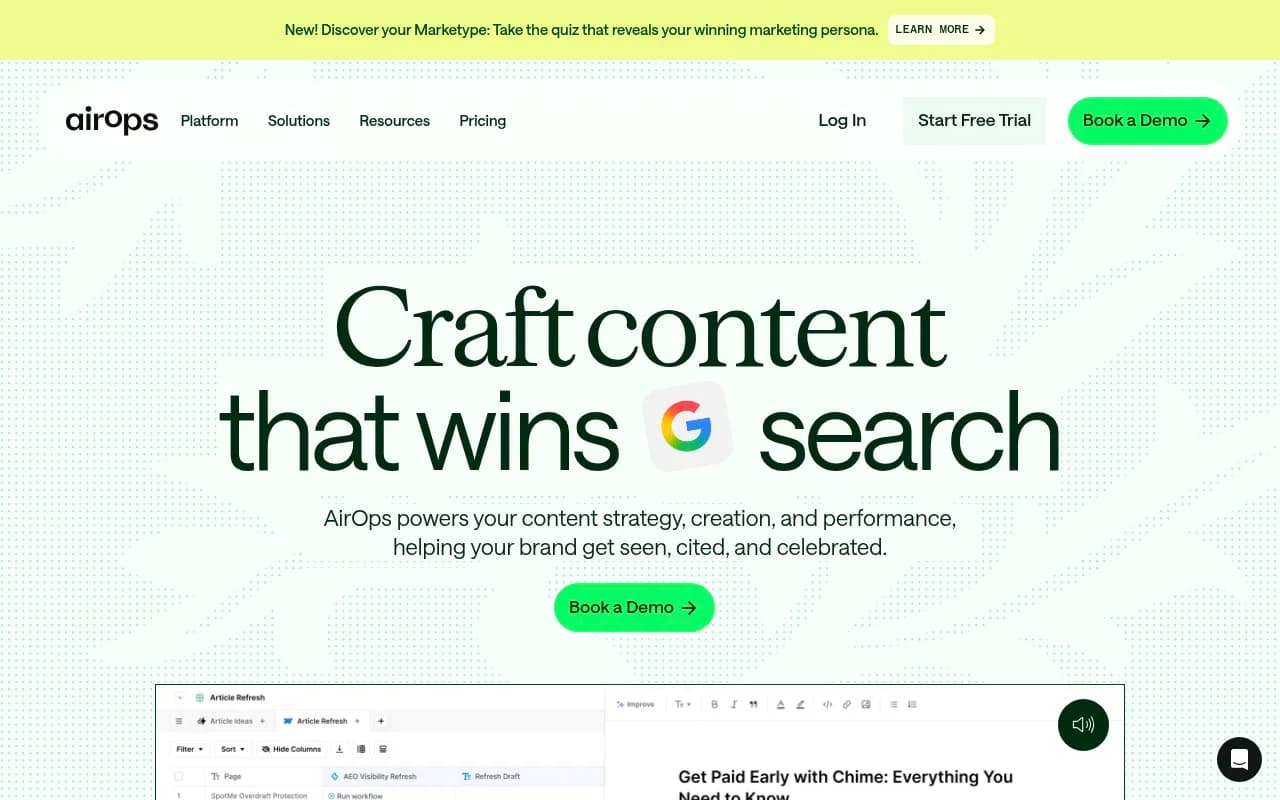
AirOps started as an AI workflow automation platform and has evolved into something it calls "content engineering." The core idea is that you can build automated pipelines that pull in data, run it through AI models, and produce content at scale. In May 2026, they launched their Quill agent, which is designed specifically for producing content that performs in AI search.
The platform is genuinely impressive for teams that need to produce a lot of content quickly. You can build workflows that ingest competitor data, pull from your knowledge base, and output structured articles or briefs. The Quill agent adds a layer of AI-search-awareness to that output, at least in theory.
Where AirOps gets complicated is on the monitoring side. It's not primarily a citation tracker. You won't get page-level visibility scores, crawler logs showing when ChatGPT or Perplexity hit your site, or prompt-level data showing which queries your competitors are winning. The platform leans heavily on content production, and the AI visibility angle is more about optimizing what you write than tracking whether it's working.
For agencies or in-house teams running large content operations, AirOps has real appeal. For teams that need to understand their current AI visibility before deciding what to create, it's a partial solution.
Promptwatch: the full loop in one platform
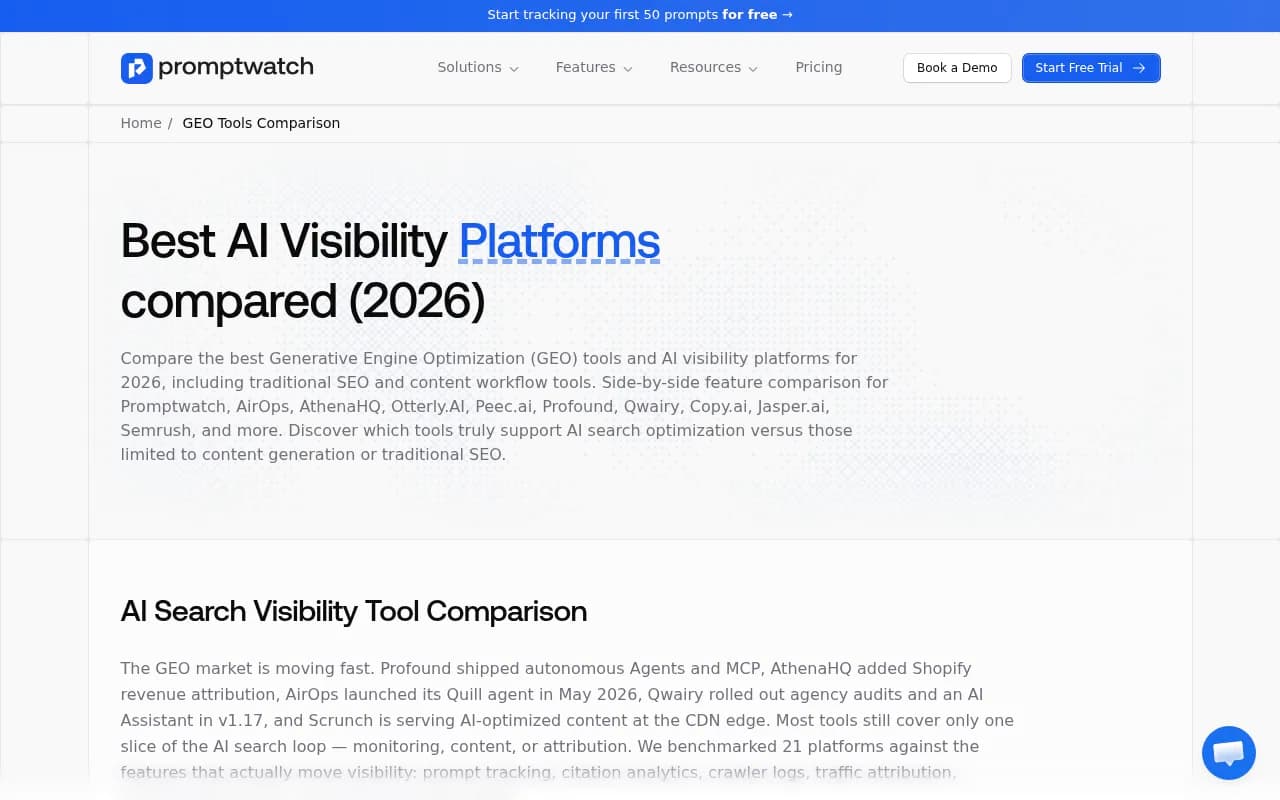
Promptwatch takes a different approach. It's built around what it calls the action loop: find gaps, create content, track results. The monitoring side covers 10 AI models including ChatGPT, Perplexity, Google AI Overviews, Claude, Gemini, Grok, DeepSeek, and others. But the monitoring is designed to feed into action, not just reporting.
The Answer Gap Analysis is the piece that makes this concrete. It shows you the specific prompts where competitors are getting cited and you're not -- not just "you have low visibility" but "here are the 23 questions about [your category] that AI models are answering with your competitor's content instead of yours." That's a fundamentally different kind of insight than a share-of-voice dashboard.
From there, Content Agents generate articles, listicles, and comparison pages grounded in that prompt data. The content isn't generic -- it's built around the specific gaps the analysis identified, with prompt volume data, citation patterns, and competitor analysis baked in. This is the part that most monitoring-only tools skip entirely.
The crawler logs are worth calling out separately. Promptwatch tracks when AI crawlers (ChatGPT, Claude, Perplexity's bot, etc.) actually visit your pages, what they read, what errors they hit, and how often they return. Most competitors don't have this at all. It's the difference between knowing you're not being cited and knowing why -- maybe your page has a crawl error, maybe the bot visits but the content isn't structured well enough to extract, maybe a competitor's page gets crawled 10x more often than yours.
The platform also tracks Reddit and YouTube -- the off-site channels that AirOps' own research shows drive nearly half of all AI citations. That's a detail most tools ignore. If a Reddit thread is the reason your competitor keeps showing up in ChatGPT answers, you need to know about it.
Pricing runs from $99/month (Essential, 1 site, 50 prompts) to $579/month (Business, 5 sites, 350 prompts, 30 articles). There's a free trial available.

Searchable: lightweight monitoring, limited execution
Searchable is a narrower product. It focuses on brand monitoring in AI search -- tracking mentions, citations, and visibility across a handful of AI models. The interface is clean and the onboarding is straightforward, which makes it appealing for teams that want something simple to get started with.
The limitation is that it mostly stops at monitoring. There's no content generation, no gap analysis that tells you what to create, no crawler logs, and limited prompt-level data. For a team that just wants to know whether their brand is showing up in ChatGPT and Perplexity, it does the job. For a team that wants to improve their visibility, it leaves a lot of work to be done elsewhere.
One review from Orchly.ai's comparison of Searchable alternatives put it well: "Searchable focuses on exploring [visibility data] while AirOps felt less like a traditional SEO or AI visibility tool and more like a content operations platform." That's a fair characterization of both. Searchable is a tracker. What you do with the tracking data is up to you.
Atomic AGI: monitoring-focused with a strong educational angle
Atomic AGI has carved out a position in the market partly through content -- their blog on AI search monitoring is genuinely useful, and they've done a good job explaining why brands need to care about AI visibility. The platform itself focuses on monitoring and tracking brand mentions across AI search engines.
The product has improved over the past year, but it still sits closer to the monitoring-only end of the spectrum. There's no content generation, no crawler intelligence, and the prompt data is less granular than what you'd get from Promptwatch or even some of the mid-tier monitoring tools. It's a reasonable starting point for teams new to the category, but it's not where you'd want to stay if you're serious about improving your AI visibility.
Feature comparison
| Feature | AirOps | Promptwatch | Searchable | Atomic AGI |
|---|---|---|---|---|
| AI citation monitoring | Partial | Yes (10 models) | Yes (limited) | Yes |
| Prompt-level gap analysis | No | Yes | No | No |
| Content generation | Yes (Quill agent) | Yes (Content Agents) | No | No |
| AI crawler logs | No | Yes | No | No |
| Reddit/YouTube tracking | No | Yes | No | No |
| ChatGPT Shopping tracking | No | Yes | No | No |
| Page-level visibility tracking | No | Yes | No | No |
| Traffic attribution | No | Yes | No | No |
| Prompt volume/difficulty data | No | Yes | No | No |
| Multi-language/region | Partial | Yes | No | No |
| Free trial | Yes | Yes | Yes | Yes |
| Starting price | Custom | $99/mo | Varies | Varies |
The table makes the gap visible. AirOps and Promptwatch both do content generation, but only Promptwatch connects that generation to monitoring, crawler data, and attribution. Searchable and Atomic AGI are monitoring tools that leave the "what do I do about this" question unanswered.
Which tool fits which situation
You're a content team that needs to scale production
AirOps makes sense here. If your primary bottleneck is producing enough content and you already have a separate analytics setup, the workflow automation and Quill agent are genuinely useful. Just go in knowing that you'll need another tool to tell you whether what you're creating is getting cited.
You want to improve AI visibility and track whether it's working
Promptwatch is the right call. The combination of gap analysis, content generation, crawler logs, and attribution means you're not guessing. You can see which prompts you're losing, create content to address them, watch the crawler logs to confirm AI bots are reading the new pages, and then track whether citations follow. That full loop is hard to replicate by stitching together multiple tools.
You're just starting out and want basic brand monitoring
Searchable or Atomic AGI work as entry points. They're simpler, cheaper, and give you a baseline understanding of where your brand stands in AI search. The risk is that you'll quickly hit the ceiling of what they can tell you and need to migrate to something more capable.
You're an agency managing multiple clients
Promptwatch's agency and enterprise tiers are built for this. Multi-site support, white-label options, Looker Studio integration, and the API mean you can build client reporting workflows without rebuilding everything from scratch. AirOps also has agency use cases, but again, the monitoring depth isn't there.
The off-site citation problem none of these tools fully solve
One thing worth flagging: even the best platform in this comparison can't fully solve the off-site citation problem on its own. If 48% of AI citations come from Reddit and YouTube, and 85% of brand mentions originate from third-party pages, then owned-content optimization is only part of the picture.
Promptwatch tracks Reddit and YouTube signals, which puts it ahead of the others here. But actually influencing those off-site mentions -- getting your brand into the right Reddit threads, earning YouTube mentions, building the third-party credibility that AI models use as a trust signal -- requires a broader strategy than any monitoring tool can execute for you.
The tools in this comparison are most valuable when they're informing a broader content and PR strategy, not when they're treated as a complete solution on their own.
A note on the market moving fast
This category is changing quickly. AirOps shipped Quill in May 2026. Promptwatch has been adding crawler log capabilities and expanding its model coverage. The competitive landscape looks different every quarter, and features that were differentiators six months ago are becoming table stakes.
What's unlikely to change is the underlying logic: monitoring without action is just reporting, and content without monitoring is just guessing. The tools that win in this category will be the ones that close the loop between insight and execution. Right now, that's where Promptwatch has the clearest advantage over the other three.
If you're evaluating platforms, the question to ask every vendor is simple: "Show me how I go from discovering a gap to publishing content that fills it, and then show me how I know if it worked." The answer tells you everything about whether you're looking at a real GEO platform or just another dashboard.