Key takeaways
- AirOps combines content generation with AI citation tracking, but several alternatives match or beat it in specific areas — especially for teams that don't need the full suite.
- The most important distinction in 2026 is between monitoring-only tools (which show you data) and full-cycle platforms (which help you act on it by generating and optimizing content).
- Promptwatch is the only platform in this comparison rated as a leader across every category — tracking, content generation, crawler logs, and traffic attribution.
- Budget matters: options range from free tiers to enterprise contracts above $500/month. Most teams don't need the most expensive option.
- If you care about AI citation tracking specifically, make sure your chosen tool monitors the models your audience actually uses — not just one or two.
AirOps has carved out a real niche. It's a content production engine with AI citation tracking bolted on — Power Agents, Grids, CMS publishing to WordPress/Webflow/Shopify, and a growing set of visibility features. For teams that want to go from "gap identified" to "article published" without switching tabs, it works well.
But it's not for everyone. The pricing is steep for smaller teams. Some users find the workflow heavy for what they actually need. And the competitive space has exploded in 2026 — there are now platforms that do specific parts of the AirOps job better, cheaper, or with more depth.
This guide covers 9 alternatives worth considering. Some are full-cycle platforms like AirOps. Others are more focused. All of them can either generate content optimized for AI citation, track whether your content gets cited, or both.
What to look for in an AirOps alternative
Before jumping into the list, it's worth being clear about what "doing what AirOps does" actually means. There are two distinct jobs here:
Content generation for AI search: Creating articles, briefs, and pages that are structured to be cited by AI engines like ChatGPT, Perplexity, and Google AI Overviews — not just ranked in traditional blue-link results.
Citation and visibility tracking: Monitoring whether your content actually gets cited, which models cite it, how often, and what competitors are getting cited for that you're not.
Most tools on the market in 2026 do one of these well. A smaller number do both. The ones that do both — and connect the two into a feedback loop — are the ones worth paying for.
The 9 best AirOps alternatives in 2026
1. Promptwatch
Promptwatch is the most complete alternative to AirOps if you want a platform that tracks AI visibility and helps you improve it — not just report on it.

Where AirOps is primarily a content production engine with visibility features added, Promptwatch is built the other way around: it starts with real prompt data across 10 AI models (ChatGPT, Perplexity, Google AI Overviews, Claude, Gemini, Grok, DeepSeek, Copilot, Meta AI, Mistral), then uses that data to drive content creation.
The Answer Gap Analysis is the core of this. It shows you the specific prompts your competitors are visible for but you're not — not vague topic suggestions, but the actual questions AI models are answering without citing your site. From there, Content Agents generate articles grounded in that prompt data, citation patterns, prompt volumes, and competitor analysis.
What genuinely separates Promptwatch from most alternatives is the AI Crawler Logs feature. You can see in real time which AI crawlers are hitting your pages, which pages they're reading, any errors they encounter, and when a page moves from "crawled" to "cited." Most competitors don't have this at all. It's the difference between knowing you're not being cited and knowing why.
Traffic attribution connects the loop: when your new content starts getting cited, you can trace that back to actual revenue, not just visibility scores.
Pricing runs from $99/month (Essential, 1 site, 50 prompts) to $579/month (Business, 5 sites, 350 prompts, 30 articles/month), with agency and enterprise plans available. There's a free trial.
Best for: Marketing and SEO teams that want to close the loop from "we're not being cited" to "we published content that fixed it" — and then prove the revenue impact.
2. Surfer SEO
Surfer is the most established on-page SEO optimization tool in this list, and it's added meaningful AI content features over the past year.
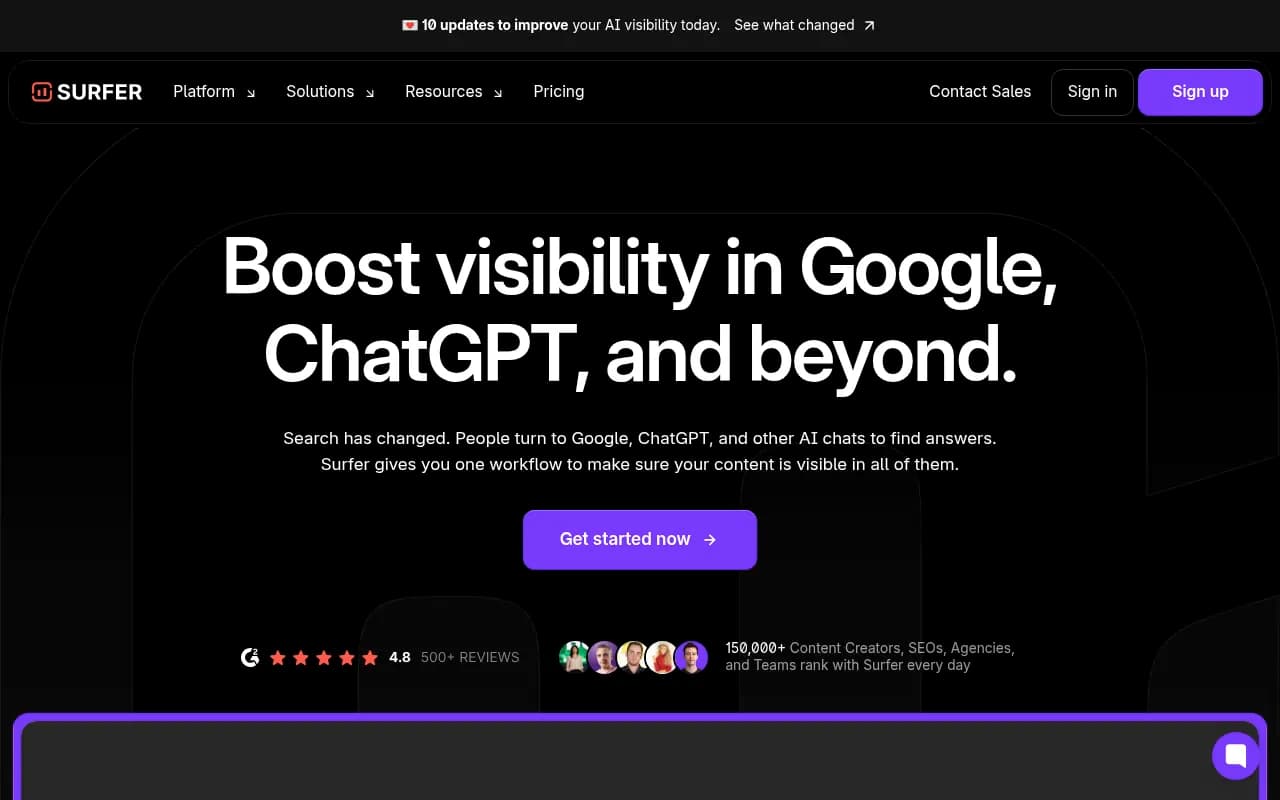
Its Content Editor gives you real-time NLP scoring as you write, comparing your draft against the top-ranking pages for a given keyword. The AI writing features can generate full drafts or outlines, and the Topical Map feature helps you plan content clusters systematically.
What Surfer doesn't do is track AI citations. It's built for traditional search optimization — getting ranked in Google's blue links — and while that still matters enormously, it won't tell you whether ChatGPT or Perplexity is citing your pages. If that's a priority, you'd need to pair Surfer with a dedicated GEO tracking tool.
Pricing starts around $89/month for the Essential plan.
Best for: Teams that need strong on-page SEO optimization and AI-assisted writing, and are comfortable handling AI citation tracking separately.
3. Clearscope
Clearscope is the premium option for content optimization. Its reports are genuinely excellent — clean, data-rich, and built around NLP term analysis that helps writers understand what a piece of content needs to cover to rank.
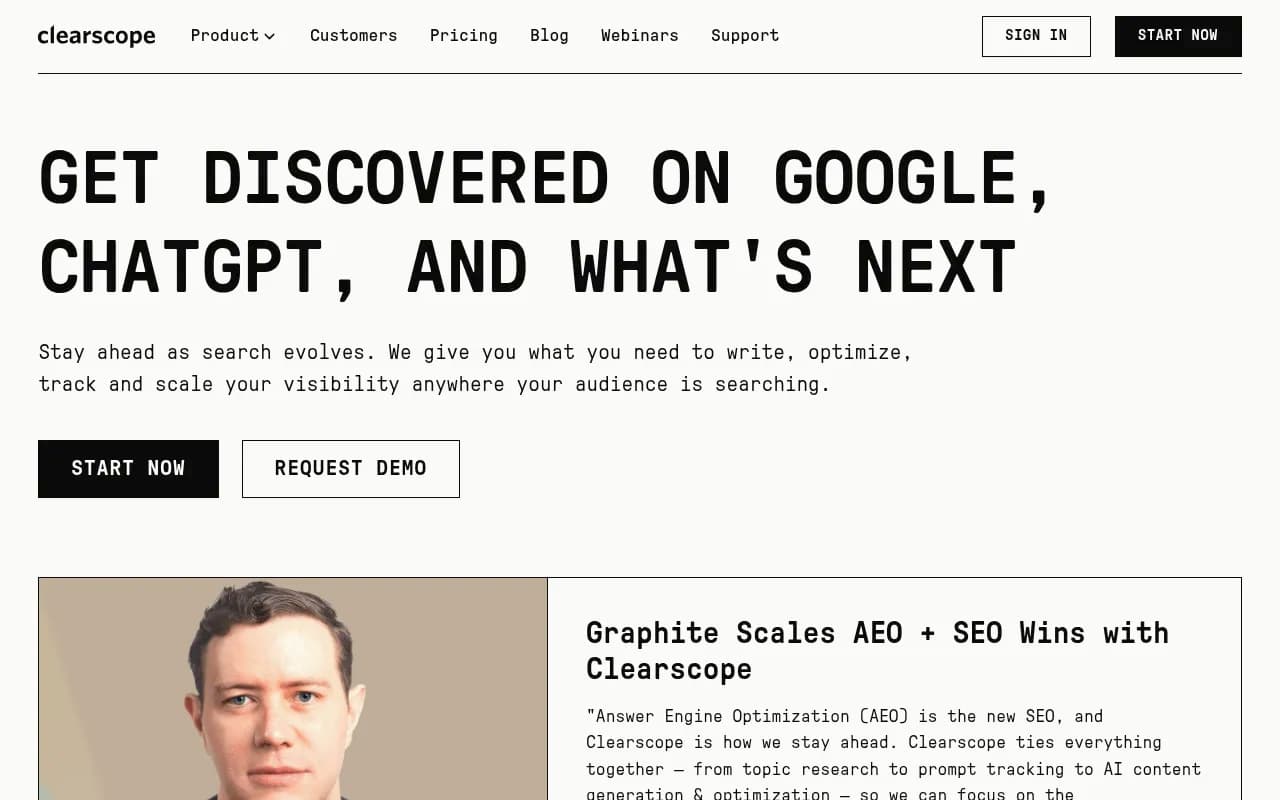
The platform integrates with Google Docs and WordPress, which makes it easy to use within existing workflows. Content teams at larger brands tend to love it because the reports are easy to hand to writers without a lot of explanation.
Like Surfer, Clearscope is focused on traditional search. There's no AI citation tracking, no GEO-specific features, and no content generation in the traditional sense (it guides optimization, not creation). It's also expensive — plans start around $170/month and scale up quickly.
Best for: Enterprise content teams that need high-quality optimization reports and are willing to pay for polish.
4. Frase
Frase sits at the intersection of content research and AI writing. You give it a topic or keyword, and it pulls together the top-ranking pages, extracts the key questions being asked, and generates a content brief or full draft.
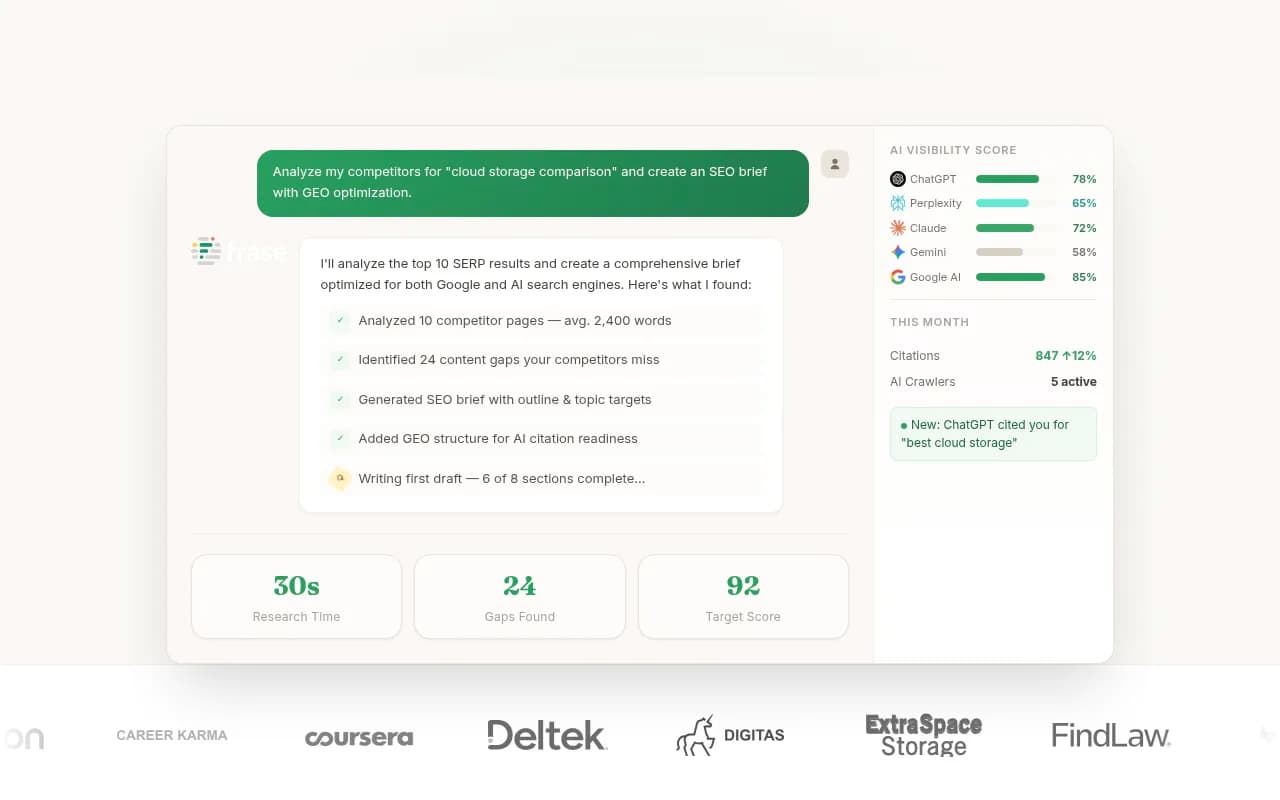
The research layer is genuinely useful — it's faster than doing manual SERP analysis, and the question extraction helps writers cover the right angles. The AI writing quality is decent, though not exceptional.
Frase doesn't track AI citations either, but it's one of the more affordable options in this space (plans start around $45/month), which makes it attractive for smaller teams or agencies managing many clients.
Best for: Content teams that need fast research and brief generation at a reasonable price, without needing AI visibility tracking.
5. MarketMuse
MarketMuse takes a different angle: it analyzes your entire content library against your competitors' and tells you where your topical authority is weak, what to write next, and how to prioritize.
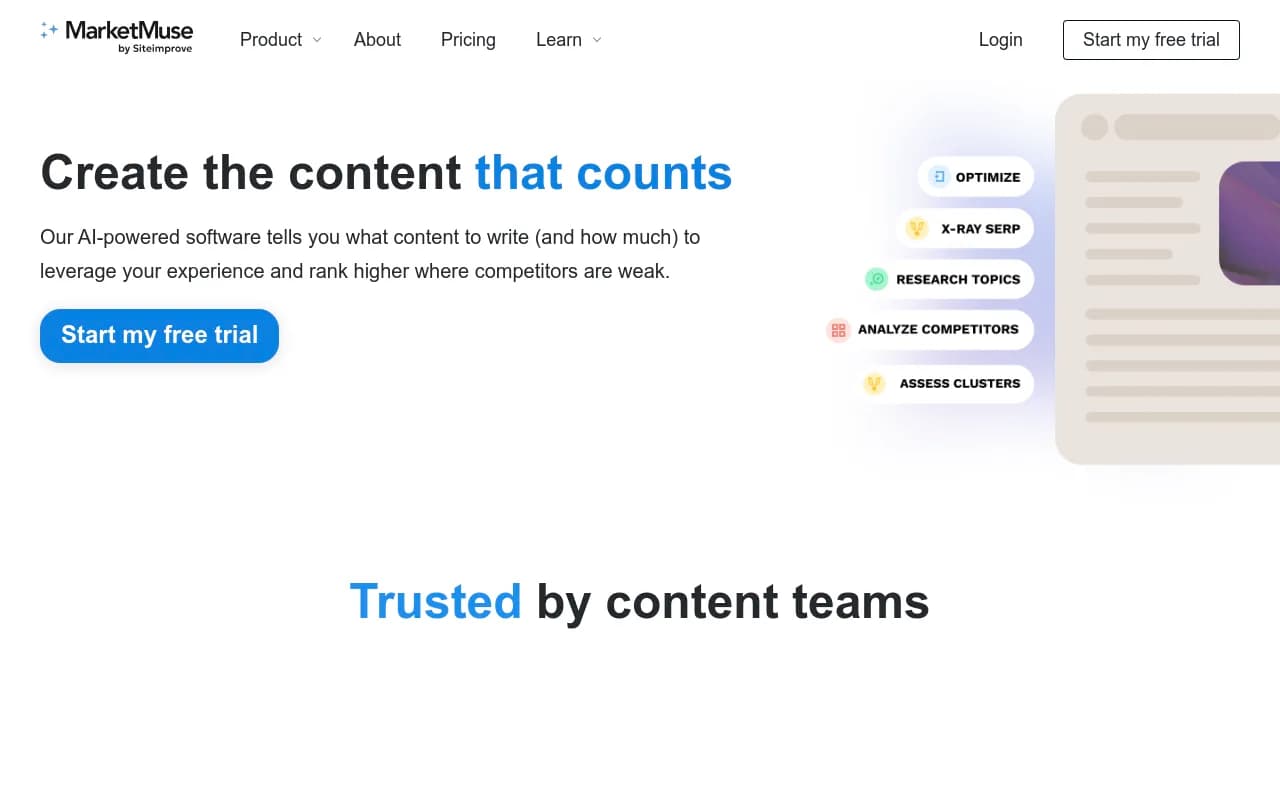
The Content Score and Topic Model features are genuinely sophisticated. Rather than just optimizing individual pages, MarketMuse helps you think about content strategy at the site level — which topics you own, which you're thin on, and where a competitor has a structural advantage.
It's added some AI writing features, but the core value is still the strategic layer. No AI citation tracking, and it's one of the pricier options in this list (plans start around $149/month, with serious enterprise pricing above that).
Best for: Content strategists at mid-size to large brands who need to make decisions about where to invest content resources, not just how to optimize individual pages.
6. Writesonic
Writesonic has evolved from a basic AI writing tool into something closer to a full GEO platform. It now includes AI search visibility tracking alongside its content generation features.
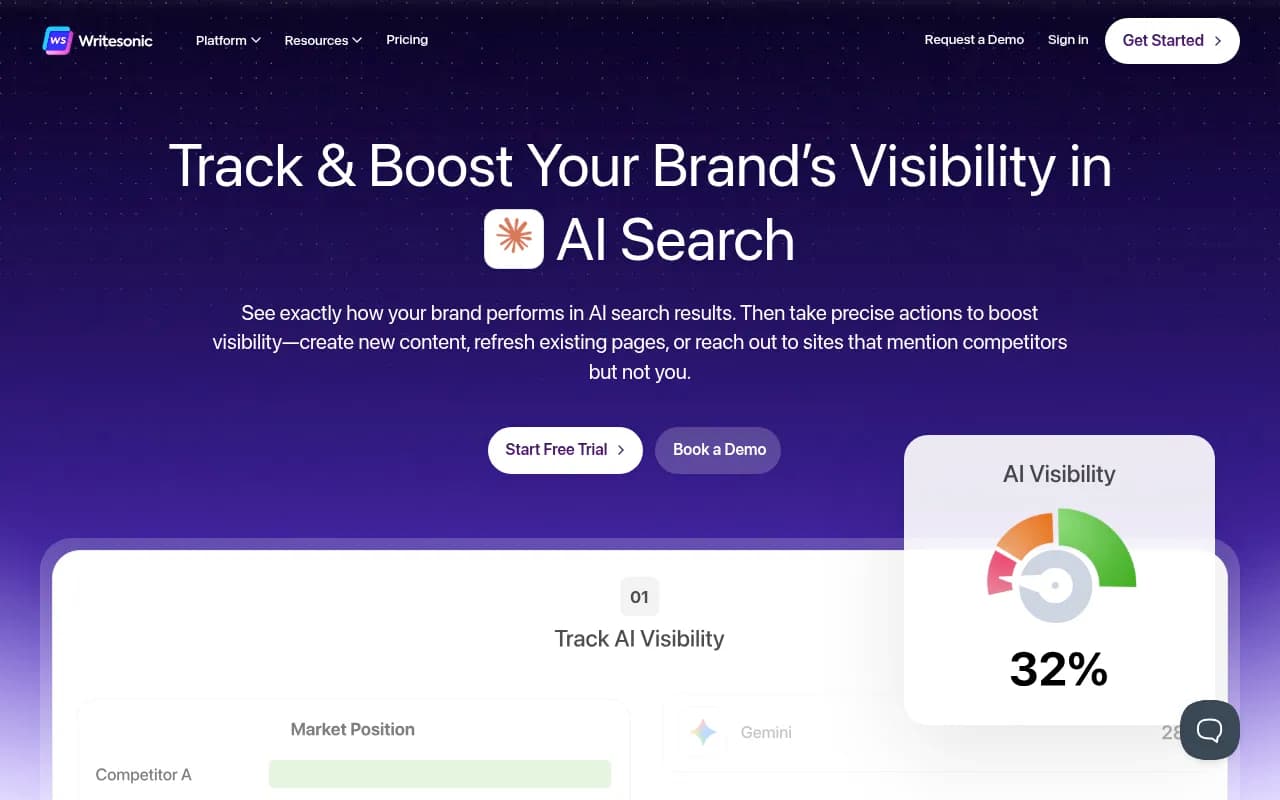
The AI Article Writer generates long-form content, and the platform has added features for monitoring brand mentions in AI responses. It's not as deep as Promptwatch or AirOps on the tracking side, but for teams that want content generation and basic AI visibility in one tool at a lower price point, it's worth a look.
Pricing is accessible, with plans starting well below $100/month.
Best for: Teams that want AI writing plus basic AI visibility tracking, without the complexity or cost of a full GEO platform.
7. Relixir
Relixir is a newer entrant that's built specifically around the GEO use case — tracking AI citations and generating content designed to improve them.
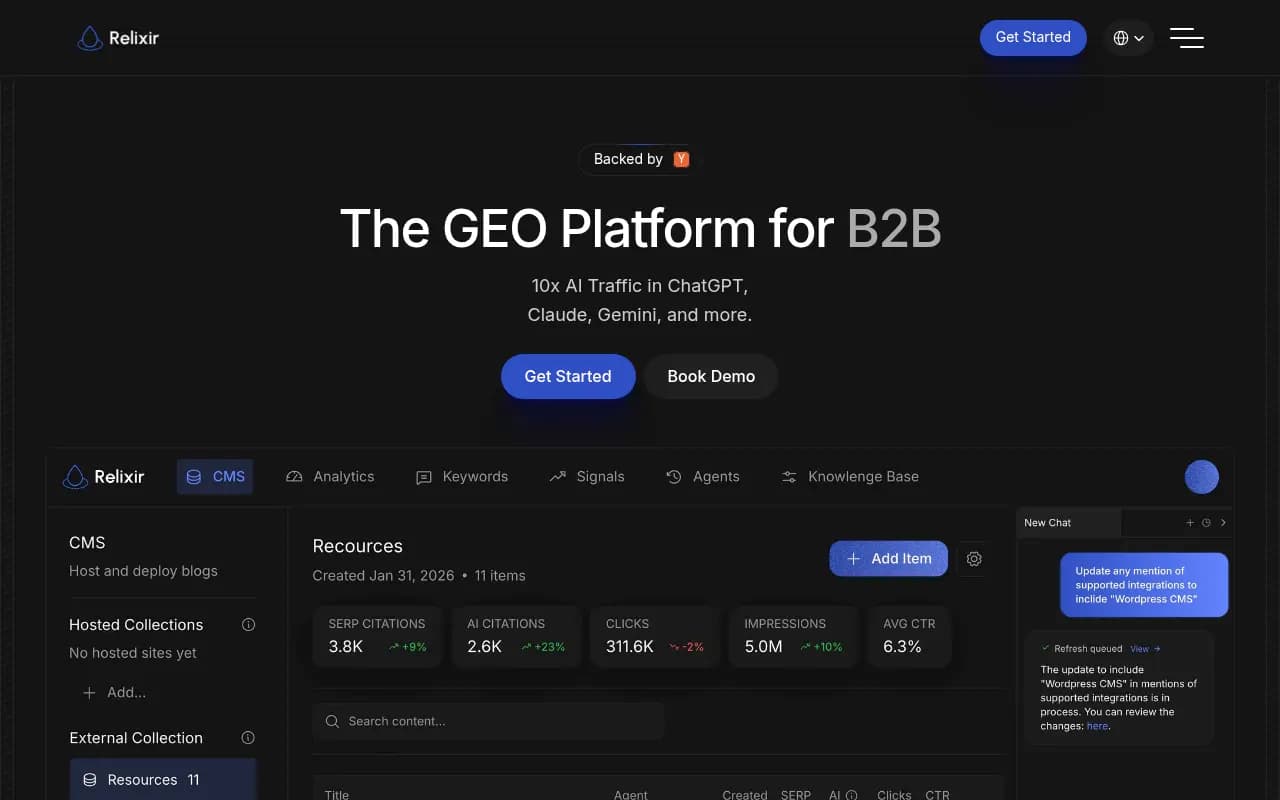
The platform monitors how your brand appears in AI-generated answers, identifies gaps, and helps you create content to fill them. It's more focused than AirOps and less feature-heavy, which some teams will find refreshing.
Worth evaluating if you want a purpose-built GEO tool without the broader workflow automation that AirOps bundles in.
Best for: Teams specifically focused on GEO who don't need the broader content workflow features AirOps provides.
8. SearchAtlas LLM Visibility
SearchAtlas has built out a substantial AI SEO feature set, including LLM visibility tracking and content optimization tools.

The platform can monitor your brand across AI search engines, identify content gaps, and generate optimized content. It's positioned as an all-in-one SEO and GEO platform, which means it covers more ground than some of the more focused tools here — but also means it's a bigger platform to learn.
Best for: SEO teams that want a single platform covering both traditional SEO and AI visibility, and are comfortable with a more complex toolset.
9. Averi AI
Averi AI is built specifically for content teams and takes a workflow-first approach. It focuses on making the content production process faster and more consistent, with AI assistance throughout.
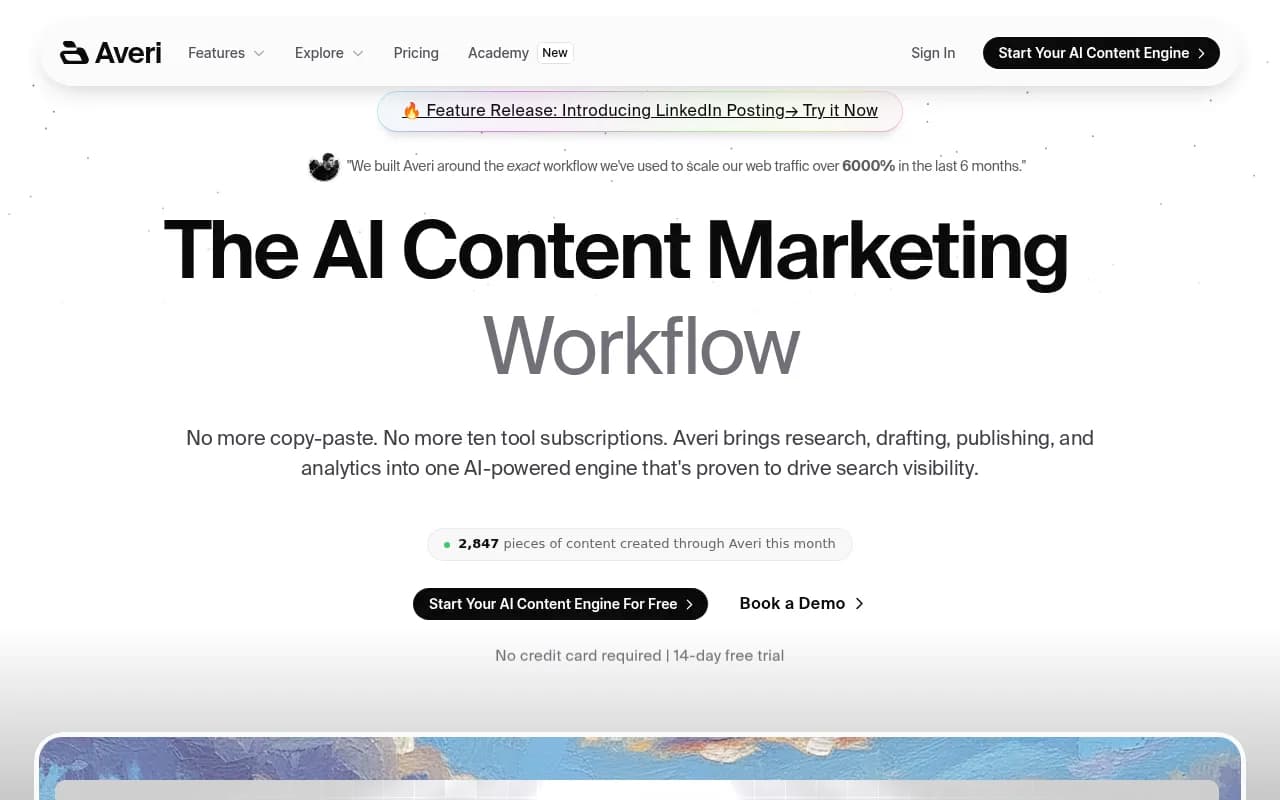
It's less focused on AI citation tracking and more on content quality and production speed. For teams where the bottleneck is writing and editing rather than visibility strategy, it's a strong option.
Best for: Content teams where production speed and quality consistency are the primary problems, and AI citation tracking is a secondary concern.
How these platforms compare
| Platform | Content generation | AI citation tracking | Traditional SEO | Starting price | Best for |
|---|---|---|---|---|---|
| Promptwatch | Yes (Content Agents) | Yes (10 models, crawler logs) | Partial | $99/mo | Full-cycle GEO + content |
| AirOps | Yes (Power Agents, Grids) | Yes (ChatGPT + others) | No | Free / Contact | Content production at scale |
| Surfer SEO | Yes (AI writing) | No | Yes | $89/mo | On-page SEO optimization |
| Clearscope | Guidance only | No | Yes | $170/mo | Premium content optimization |
| Frase | Yes (briefs + drafts) | No | Partial | $45/mo | Fast research + briefs |
| MarketMuse | Partial | No | Yes | $149/mo | Content strategy at site level |
| Writesonic | Yes | Basic | No | <$100/mo | AI writing + basic GEO |
| Relixir | Yes | Yes | No | Contact | Purpose-built GEO |
| SearchAtlas | Yes | Yes | Yes | Contact | All-in-one SEO + GEO |
| Averi AI | Yes | No | No | Contact | Content team workflows |
The monitoring-only trap
One thing worth naming directly: a lot of tools in this space will show you that you're not being cited in AI responses. That's useful information. But if the tool stops there, you're left figuring out what to do about it yourself.
The more valuable question is: what content do I need to create, and does the platform help me create it?
AirOps answers that question with its Power Agents and Grids. Promptwatch answers it with Content Agents driven by real gap analysis. A few others on this list — Relixir, SearchAtlas — are moving in that direction.
The monitoring-only tools (and there are many) are fine as a starting point, but they're not a complete solution. If you're evaluating alternatives to AirOps, the key question to ask any vendor is: "After you show me the gap, what do you help me do about it?"
Which alternative should you choose?
It depends on what's actually slowing you down.
If the problem is that you don't know which content to create to improve AI visibility, and you want a platform that handles the full cycle from gap analysis to published article to citation tracking, Promptwatch is the strongest option. The crawler logs alone are worth it for teams that have been publishing content and wondering why AI engines aren't picking it up.
If you're primarily an SEO team optimizing for traditional search and want to add AI visibility as a secondary capability, Surfer SEO or SearchAtlas are reasonable starting points.
If budget is the main constraint and you need basic AI writing plus some visibility monitoring, Writesonic covers a lot of ground at a lower price.
If content strategy at the site level is the gap — you have writers but no clear plan for what to write — MarketMuse is still one of the best tools for that specific job.
The worst outcome is picking a monitoring-only tool, watching your dashboard show you gaps, and having no clear path to fixing them. Whatever you choose, make sure it has an answer to "what do I do next?"