Key takeaways
- Ahrefs Brand Radar is a genuinely useful AI visibility tool for teams already in the Ahrefs ecosystem, with a database of 263M+ monthly prompts and solid brand benchmarking features.
- Its main limitation is that it's primarily a monitoring tool -- it shows you where you stand but offers limited help with fixing the gaps or generating content that ranks in AI search.
- AI traffic estimates in Ahrefs are still maturing; the methodology differs from dedicated GEO platforms that track real user-facing AI responses rather than API outputs.
- For teams that need to act on AI visibility data -- not just observe it -- dedicated GEO platforms cover ground that Brand Radar doesn't.
- The right choice depends on your team's existing stack, budget, and whether you need monitoring only or a full optimization loop.
Ahrefs has been the backbone of SEO workflows for years. Backlink analysis, keyword research, site audits -- it's hard to argue with the depth of data. So when Ahrefs launched Brand Radar and started rolling out AI traffic estimates, a lot of marketers had the same reaction: "Great, one less tool to buy."
That reaction is understandable. It's also worth examining more carefully.
Brand Radar is real, it's growing fast (reportedly adding $1M in ARR every two weeks according to a Reddit AMA from Ahrefs CMO Tim Soulo), and it has genuine use cases. But AI search visibility is a different discipline from traditional SEO, and the gaps in Ahrefs' current offering matter -- especially if you're trying to do more than just monitor.
Here's an honest breakdown of what Ahrefs brings to the table in 2026, and where you'll still need dedicated tools.
What Ahrefs Brand Radar actually does
Brand Radar is Ahrefs' answer to the question: "Is my brand showing up in AI-generated answers?" It pulls from a database of 263M+ monthly prompts and lets you track how your brand, your competitors, and your core topics appear across AI search environments.
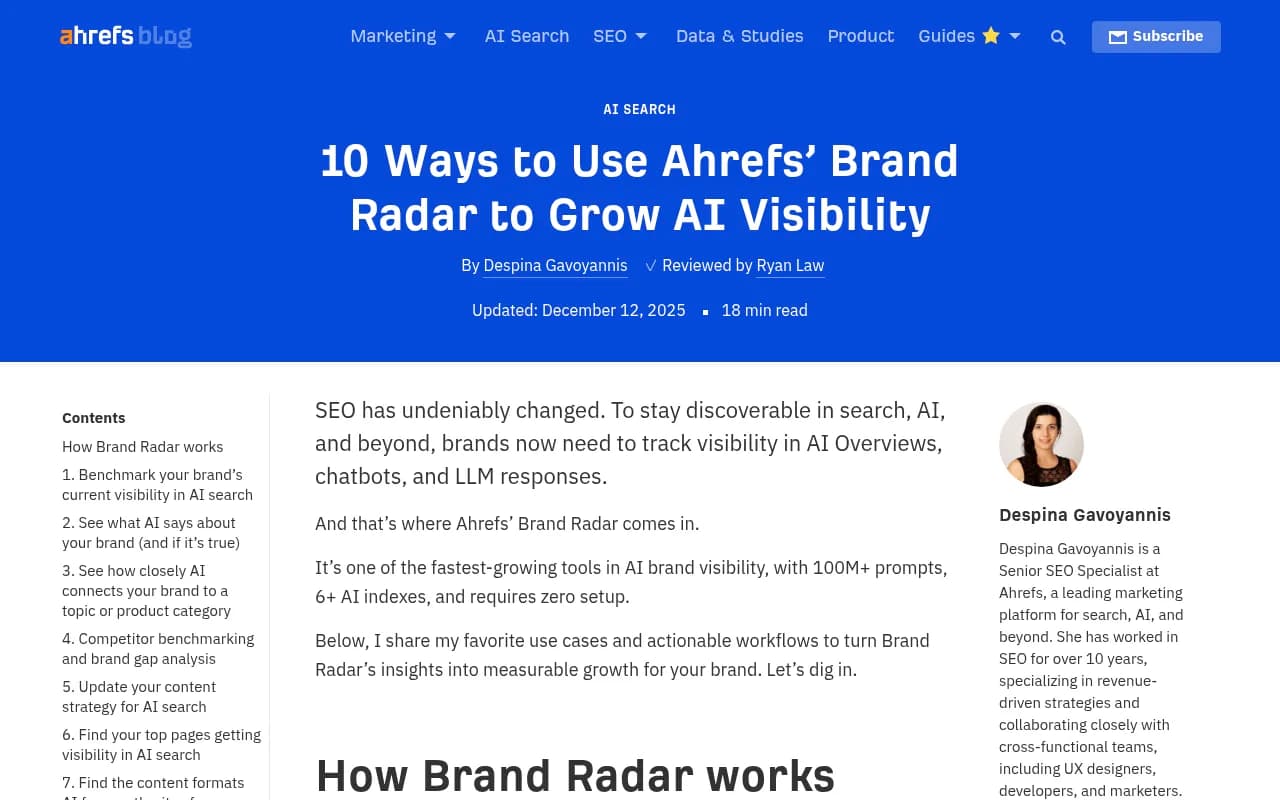
The core use cases Ahrefs themselves outline include:
- Benchmarking your brand's current AI visibility score against competitors
- Seeing what AI models actually say about your brand (and whether it's accurate)
- Analyzing which content formats AI tends to cite for your topic -- statistics posts, listicles, expert guides, etc.
- Finding which of your pages are getting cited in AI responses
- Identifying brand mentions and links across the web that influence AI recommendations
- Tracking brand demand trends over time
That's a solid list. For an SEO team that already lives in Ahrefs and wants a first look at AI visibility without adding another platform, Brand Radar is a reasonable starting point.
The prompt database is the biggest asset. 263M+ monthly prompts is a large corpus, and it gives Brand Radar genuine breadth for discovery work -- finding which topics and questions your brand should be showing up for, even if it currently isn't.
Where Brand Radar runs into limits
The honest assessment from teams who've tested Brand Radar extensively is that it's better at showing you the problem than helping you solve it.
A few specific gaps worth knowing about:
Fixed prompts, not real user behavior
Brand Radar's monitoring is based on a predefined prompt database. That's useful for scale, but it doesn't capture the full picture of how real users actually query AI tools. User-facing AI responses -- what someone sees in ChatGPT's interface, for example -- can differ from what you'd get through an API. Platforms that track real user-facing behavior catch nuances that API-based monitoring misses.
No AI crawler logs
If you want to know whether AI crawlers are actually visiting your site, which pages they're reading, how often they return, and whether they're encountering errors -- Brand Radar doesn't surface that. This is a meaningful gap for technical teams trying to understand why certain pages aren't getting cited.
Limited content optimization workflow
Brand Radar can tell you that a competitor is visible for prompts you're not. What it can't do is help you create content to close that gap. There's no content brief generation, no AI-assisted writing grounded in prompt data, no workflow that takes you from "here's the gap" to "here's the article that fills it."
No Reddit or YouTube tracking
A lot of AI recommendations are influenced by third-party sources -- Reddit threads, YouTube videos, review sites. Brand Radar doesn't surface these, which means you're missing a significant part of the picture when it comes to understanding why AI models recommend what they recommend.
No ChatGPT Shopping or entity tracking
For e-commerce brands or any company that wants to appear in ChatGPT's product recommendations, Brand Radar doesn't track shopping carousels or entity mentions specifically.
AI traffic estimates: useful but still maturing
Ahrefs has also been building out AI traffic estimates -- trying to quantify how much traffic is actually coming from AI search engines rather than traditional Google results.
This is genuinely hard to measure. AI search doesn't always produce clickable citations. Users might get an answer without ever visiting a website. And when they do click through, the referral attribution is often murky.
Ahrefs' approach leans on its existing traffic estimation methodology, which is strong for traditional search but is still being adapted for AI search behavior. The estimates are useful for directional understanding -- "AI search is sending us roughly this much traffic" -- but teams doing serious revenue attribution from AI search will want more granular data than Brand Radar currently provides.
How it compares to dedicated GEO platforms
The GEO tool market has expanded significantly in 2026. Here's a quick comparison of how Ahrefs Brand Radar stacks up against some of the dedicated platforms:
| Feature | Ahrefs Brand Radar | Dedicated GEO tools |
|---|---|---|
| Prompt database size | 263M+ monthly prompts | Varies (some smaller, some comparable) |
| LLM coverage | Multiple AI engines | Typically 8-12 models |
| Real user-facing tracking | Limited (API-based) | Yes (user interface tracking) |
| AI crawler logs | No | Yes (on advanced plans) |
| Content gap analysis | Basic | Full gap analysis with briefs |
| AI content generation | No | Yes (some platforms) |
| Reddit/YouTube tracking | No | Yes (select platforms) |
| ChatGPT Shopping tracking | No | Yes (select platforms) |
| Traffic attribution | Basic | Revenue-level attribution |
| Pricing | Bundled with Ahrefs plans | $99-$579/mo standalone |
| Best for | Existing Ahrefs enterprise users | Teams prioritizing AI visibility |
The core difference isn't data volume -- it's the action loop. Brand Radar is a monitoring dashboard. Dedicated GEO platforms are increasingly built around the full cycle: find the gap, create content to fill it, track whether the content gets cited.
Promptwatch is a good example of what this looks like in practice. It tracks 10 AI models including ChatGPT, Perplexity, Google AI Overviews, Claude, Gemini, and others, and the platform is built around moving from visibility data to actual content creation and citation tracking.

Profound is another platform that's specifically built for AEO teams, with features like prompt volume data and agent analytics that go deeper than Brand Radar's current offering.
Who should stick with Brand Radar
Brand Radar makes the most sense for:
- Teams already on Ahrefs Enterprise who want AI visibility data without adding another vendor
- SEO teams doing initial benchmarking -- "where do we stand in AI search?" -- before committing to a dedicated GEO workflow
- Brands in less competitive categories where broad monitoring is enough and deep optimization isn't yet urgent
- Agencies that need a quick AI visibility snapshot to include in client reports alongside traditional SEO data
If your primary goal is discovery and benchmarking, and you're already paying for Ahrefs, Brand Radar is worth using. It's not a throwaway feature.
Who needs more than Brand Radar
The case for a dedicated GEO tool gets stronger when:
- You need to understand why you're not being cited, not just that you're not being cited
- You want to create content specifically engineered to appear in AI responses
- You're tracking AI-driven revenue and need proper attribution
- Your category is competitive in AI search and competitors are actively optimizing
- You need AI crawler log data to diagnose technical visibility issues
- You want to track offsite citations -- Reddit, YouTube, third-party listicles -- that influence AI recommendations
For these use cases, tools built specifically around GEO workflows cover ground that Brand Radar doesn't reach.
Otterly.AI is a more affordable entry point for teams that need basic AI monitoring beyond what Ahrefs offers.

SE Ranking has also built out AI visibility features that integrate with its traditional rank tracking, which can work well for teams that want a middle ground.
For enterprise teams with serious GEO programs, platforms like Profound and Promptwatch are the ones most commonly appearing in 2026 comparisons.
The AI traffic measurement problem
One thing worth addressing directly: nobody has perfectly solved AI traffic attribution yet. This isn't a knock on Ahrefs specifically -- it's a structural challenge across the industry.
When someone gets an answer from ChatGPT and doesn't click through, that's invisible to most analytics tools. When they do click, the referral might show up as direct traffic or as a generic AI referral without page-level detail. Google Search Console helps with AI Overview click data, but it doesn't cover third-party AI engines.
Ahrefs is working on this, and its existing traffic estimation infrastructure gives it a head start on some competitors. But for now, teams that need reliable AI traffic attribution are using a combination of tools: their analytics platform, Google Search Console for AI Overview data, and a dedicated GEO platform for LLM-specific tracking.
Practical recommendations for 2026
If you're figuring out how to structure your AI visibility stack, here's a reasonable approach:
Start with Brand Radar if you're already on Ahrefs. Use it to benchmark your current AI visibility, identify which competitors are outperforming you, and get a sense of which content formats AI tends to cite in your category. This costs you nothing extra if you're on an enterprise plan.
Add a dedicated GEO tool when you're ready to act on the data. The gap between "knowing you're invisible" and "doing something about it" is where dedicated platforms earn their keep. Look for tools that offer content gap analysis, crawler log access, and some form of content brief or generation workflow.
Don't skip the offsite picture. AI recommendations are heavily influenced by third-party sources. Whatever tools you use, make sure you have visibility into which Reddit threads, YouTube videos, and external listicles are shaping AI responses in your category.
Track attribution separately for now. Until AI traffic attribution matures, use a combination of Google Search Console, your analytics platform, and your GEO tool's attribution features. No single tool has a complete picture yet.
The bottom line
Ahrefs Brand Radar is a legitimate AI visibility tool, not a marketing checkbox. The 263M+ prompt database is real, the benchmarking features are useful, and for teams already in the Ahrefs ecosystem, it's a sensible starting point.
But it's a monitoring tool at its core. It shows you the gap; it doesn't help you close it. For teams that need to move from visibility data to content creation to citation tracking -- the full GEO optimization loop -- Brand Radar is a starting point, not a destination.
The good news is that the dedicated GEO tool market has matured enough in 2026 that there are solid options at multiple price points. The question isn't whether to care about AI search visibility. It's which combination of tools gives your team the data and the workflow to actually improve it.