Key takeaways
- Pricing for both vendors has shifted during 2026, and third-party sources conflict. Get a written quote and confirm which plan structure is current before you compare anything.
- Ask how prompts are collected (real interface versus API), because answers and citations can differ between the two.
- Check the gating: Scrunch's Core tier lists limited query fan-out, and API access at both vendors appears to be Enterprise-only.
- Ask what happens after the dashboard: does the tool help you fix gaps, or only report them?
- Use cheaper alternatives as negotiation leverage. Several platforms start under $100 a month.
Why a sales call needs a script
AI visibility platforms are young, the pricing pages change, and demos are built to show the best-case dashboard. Most of the sales-call advice on the web is written for sellers, not buyers. Discovery frameworks like the ones in Consensus's guide to discovery questions work just as well flipped around. The rep wants to learn what hurts and what it is worth to you. You should be doing the same thing in reverse: find out where the product stops.
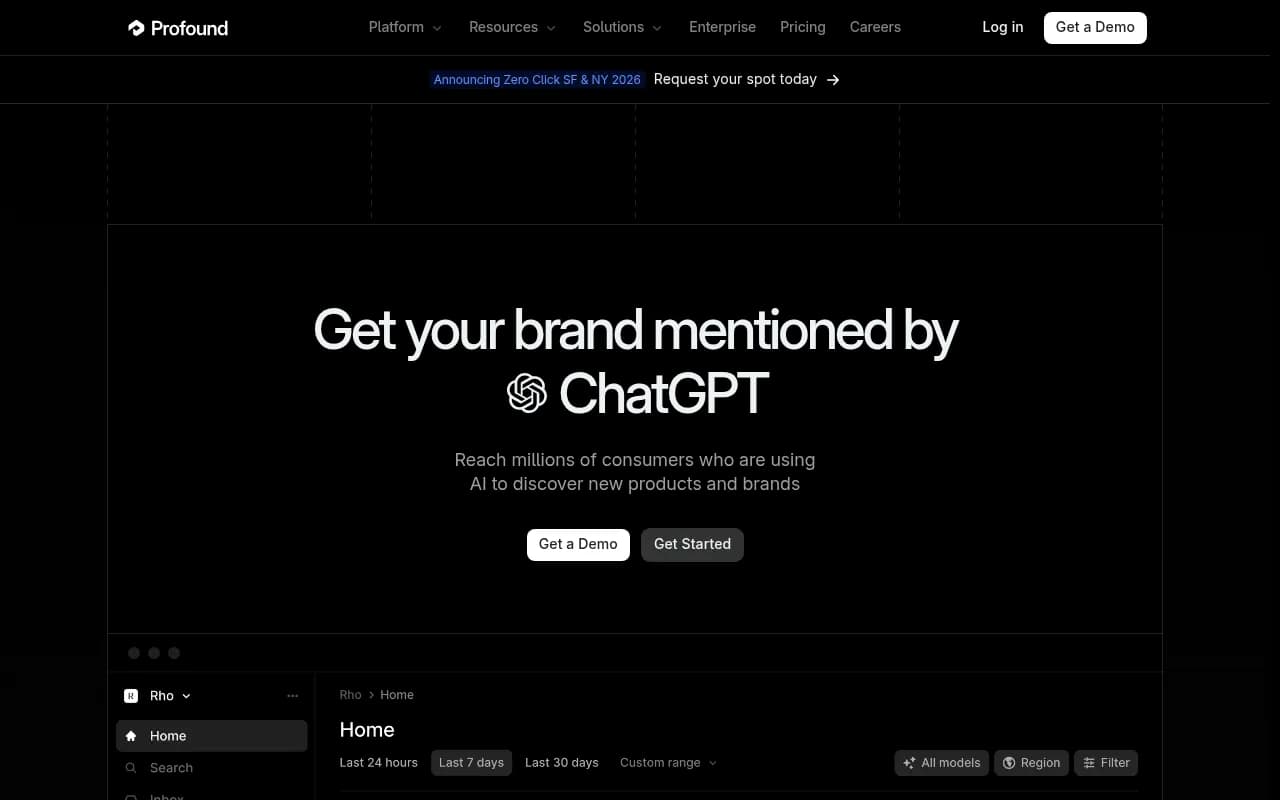
The questions below are built for two vendors in particular. Profound positions itself as an "AI Marketer" platform, with a free trial and custom-priced Enterprise. Scrunch lists a public Core plan and custom Enterprise. A few of the questions would apply to any vendor in the category, and I have said so where that is the case.

One caveat before we start. Some details here come from third-party reviews, not vendor pages, and they disagree with each other. I have flagged those. Verify everything against the live pricing page and the written quote.
What the vendors publish today
| Item | Profound | Scrunch |
|---|---|---|
| Public entry point | Free Trial (50 prompts, 7 days, ChatGPT, Gemini, AI Overviews) | Core at $250/mo |
| Paid tiers | Custom Enterprise; agencies reportedly $99/mo plus $399/mo per client workspace | Core $250/mo, reported $500/mo tier, custom Enterprise |
| Prompts | Trial prompts are a fixed industry set, not customizable | Core: 125 unique prompts, 5,000 responses/mo |
| Fan-outs | Ask the rep | Core lists "Query Fan-out: Limited" |
| API access | Enterprise only, per third-party review | Enterprise only, per third-party review |
| Seats | Unlimited on Trial | Extra seats reportedly $25/mo each or $75/mo for five |
Treat the table as a starting hypothesis. Profound's plan lineup has reportedly changed more than once this year, and one Reddit post still quotes old Starter and Growth tiers that look like a mix-up with agency pricing. For Scrunch, a GenerateMore review lists different prompt counts than the official page. The official page wins, but ask which structure applies to you.
Question 1: What exactly is in my quote, and what is the plan structure today?
Start here, because everything else depends on it. Ask the rep to send the plan name, prompt count, response count, platforms, countries, personas, seats and renewal price in one document.
Responses matter more than prompts. At Scrunch, responses are prompts multiplied by platforms, so 125 prompts across 4 platforms is 500 responses per full run. If you want daily runs, that budget disappears fast. Ask the rep to show the arithmetic for your exact setup.
For Profound, ask which tier you are actually being quoted. If the answer is vague, assume the plan lineup is in flux and get the price in writing.
Question 2: How do you collect answers, from the real interface or from APIs?
This one is not sourced from vendor material, so it is a question rather than a claim. It still matters more than most buyers realize. What a user sees in ChatGPT, Google AI Overviews or Perplexity can differ from what the underlying model returns through an API, including the citations. If a vendor samples through APIs, your "visibility score" may describe a product no customer is using.
Ask both reps directly. Then ask how many times each prompt is sampled per day, because a single run is noisy.
Question 3: How do you handle different citation behavior per engine?
Promptwatch Data's average sources per response report shows how different the engines are. ChatGPT cites about 5 sources per web-search answer, Google AI Overviews about 10, and Perplexity almost exactly 10 every day. Copilot swung from under 2 to nearly 17 sources per response before settling at the low end. The ChatGPT figure covers only messages where web search was triggered.
Why does this matter for a purchase? A tool that normalizes everything into one score can hide that a 5-source engine and a 10-source engine behave differently. Ask how the platform separates real movement from sampling noise, and whether it reports citation rank per engine.
Question 4: Do you capture real query fan-outs or synthesize them?
Fan-outs are the web searches an AI runs behind a single answer. They show what the model actually looked for, which is the closest thing to keyword data this channel has. Promptwatch's ChatGPT query fan-out data shows how unstable they are. Average fan-outs per response fell from 2.15 in early December to about 1.84 by early March, then returned in April at 1.0 per response after a gap in the data. Average query length dropped from about 117 characters to about 53.
That makes three follow-ups worth asking:
- Are fan-outs captured from real responses, or generated by a model that guesses what the AI would search?
- How often does the vendor re-baseline when ChatGPT changes behavior?
- What does "Limited" mean on the Scrunch Core tier? A number, a cap, or a delayed feed?
If you want to see what real fan-outs look like before you sit through a demo, the research from Promptwatch Data on how ChatGPT uses fan-outs is a decent primer.
Question 5: Which of the features I need are locked behind Enterprise?
Both vendors appear to reserve API access for Enterprise, according to third-party reviews. Scrunch also scales platforms and countries by tier: reportedly 4 platforms on Core and 9 with unlimited countries on Enterprise. Profound's Enterprise covers ChatGPT, Perplexity, Google AI Mode, Gemini, Copilot, DeepSeek, Claude, AI Overviews and Exa Search.
Make a list of what you need in year one: engines, countries, languages, API or MCP access, exports, white-label reports, SSO. Then have each rep mark every item as included, add-on or Enterprise-only. A table like that takes ten minutes to fill in and saves months of regret.
Question 6: What happens after the dashboard shows a gap?
Profound's own positioning has moved toward "AI Marketer," so this is a fair thing to press on. Ask both reps to walk through one concrete case, start to finish: the tool finds that a competitor is cited for a prompt you care about, and then what? Does the product draft content, suggest page changes, publish to your CMS, and check whether the change worked? Or does it hand you a chart?
This is where the category splits. Some platforms stop at monitoring. Others, like Promptwatch, pair tracking with content gap analysis, a Content Agent that writes and publishes to Webflow, Framer or WordPress, and page-level tracking afterwards. I would want both vendors to show me a published, tracked example, not a slide.

Question 7: Can you show me crawler and traffic data, not only mentions?
Mentions in an AI answer are not revenue. Ask whether the tool can show AI crawler activity on your site (which bots visited, which pages, what errors) and whether it attributes visits and conversions from AI platforms. This is the difference between knowing you are invisible and knowing why.
If the answer is "you can connect your analytics," ask who does the joining. Also ask whether crawler logs are verified by IP, since user agents are easy to spoof. For context on how fast crawler mix changes, see Promptwatch Data's AI crawler traffic report, which tracks weekly verified requests from June 8 to September 6, 2026.
Question 8: What are the contract terms, really?
The research behind this guide could not verify contract length, auto-renewal, overage pricing, data retention or SOC 2 status from vendor sources. So treat these as your questions, not my claims:
- Monthly or annual commitment, and what is the discount for annual?
- What happens when I exceed my response allowance? Throttling, overage fees, or a forced upgrade?
- Do prices rise at renewal?
- If I leave, can I export every prompt, response and citation, and how long is the data kept?
- What security certifications do you hold, and can I see the report?
The Profound free Trial is a useful warning here. It has no history, exports, API or support, so you cannot test the retention or export story on it. Ask for a proper paid pilot.
Question 9: What changed in the company recently, and what is on the roadmap?
One GenerateMore review title mentions a Sitecore acquisition of Scrunch. I could not verify that. Confirm it yourself before the call, and if it is true, ask what it means for pricing, roadmap, support and your contract. Acquisitions change product priorities, and you want that answer in writing before you sign a year-long deal.
For either vendor, ask what shipped in the last quarter and what is promised for the next. Ask for customer references in your industry and size band, and ask what those customers do with the data weekly. Borrowing a question from sales coaching: "Where is this deal most likely to die, and why?" Ask the rep the buyer version of it. Where do customers churn, and why?
Question 10: What would you do if I showed you a cheaper quote?
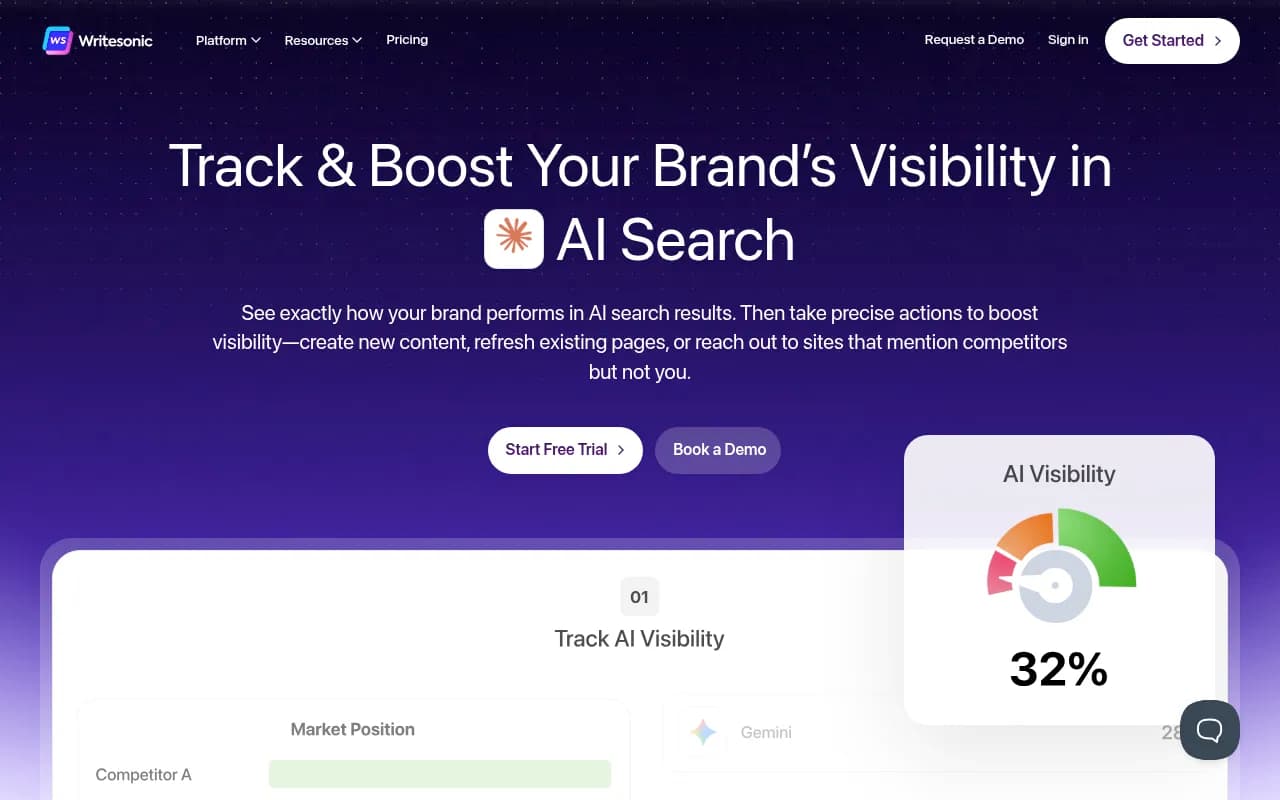
You are not bluffing. The category has real cheaper options. Based on the same review, Promptwatch starts at $95/mo for 50 prompts, 6,000 responses, 500 agent credits and MCP/API on every plan, with $245 for 150 prompts and $579 for 350 prompts. Otterly starts at $29/mo for 15 prompts, with a $189 plan for 100 prompts. Superlines is reported at EUR 79/mo with MCP on the entry plan, and Writesonic at $79/mo for 50 prompts.
| Alternative | Entry price | What you get at entry |
|---|---|---|
| Promptwatch | $95/mo | 50 prompts, 6,000 responses, all models, 500 agent credits, MCP and API |
| Otterly.AI | $29/mo | 15 prompts |
| Writesonic | $79/mo | 50 prompts |
| Superlines | EUR 79/mo | MCP on entry plan |

Prices move, so confirm at each vendor's pricing page (Promptwatch's is at promptwatch.com/pricing). The point is that API and MCP access appearing on a $95 plan makes an Enterprise-only gate look expensive, and a rep who knows that will usually find some flexibility.
A simple scoring sheet
Take the answers into a shared sheet and score each vendor 0 to 2 per row. A rep who dodges a question gets a zero.
| Area | Question | Profound | Scrunch |
|---|---|---|---|
| Pricing | Written quote and current plan structure | ||
| Data | Real UI versus API collection | ||
| Data | Per-engine citation handling | ||
| Data | Real versus synthesized fan-outs | ||
| Access | Enterprise-only features | ||
| Action | Fix, publish and re-measure workflow | ||
| Impact | Crawler logs and AI traffic attribution | ||
| Contract | Term, overages, export, security | ||
| Company | Roadmap, ownership, references | ||
| Leverage | Response to competing quotes |
Running the process
Book the demos back to back so the differences are fresh. Send the same list of prompts to each rep ahead of time, and ask them to run it live instead of showing a prepared account. Keep one person on notes and one on questions. Afterwards, ask for a trial or paid pilot of 30 days with your own prompts, so you can compare against what you see manually in ChatGPT and AI Overviews.
If you want to widen the shortlist, the GEO software directory at bestgeosoftware.com lists the rest of the category. And if you would rather have a team run the whole evaluation and the optimization work afterwards, 1001 SEO Media helps brands with GEO and AI search strategy.
Bottom line
You are not trying to catch the rep out. You are trying to find where each product ends. Ask for the quote in writing, ask how the data is collected, ask what "limited" means, and ask what happens after the chart. The vendor that answers those four cleanly is usually the one worth the contract.