eesel AI Review 2026
Generates blog posts and content using your own documents, wikis, and brand materials as context. Helps teams maintain consistent voice and accurate information at scale.
Key takeaways
- eesel AI is a full customer service AI platform, not just a chatbot — it covers autonomous agents, agent copilots, ticket triage, internal knowledge chat, and embeddable website widgets
- Claims an 81% autonomous resolution rate across its customer base and $124M in cumulative savings, with 70M tickets and chat sessions processed
- Integrates natively with Zendesk, Freshdesk, Intercom, Gorgias, HelpScout, Slack, Microsoft Teams, Confluence, Google Docs, and Shopify
- Pricing starts at $239/month (Team) and $639/month (Business) on annual billing — mid-market positioning, not cheap but not enterprise-only
- Best fit for customer service teams of 5-100 agents running on established helpdesks who want to automate repetitive ticket volume without rebuilding their stack
- Not a good fit for teams needing deep CRM integration, complex multi-step workflows, or developer-first API customization
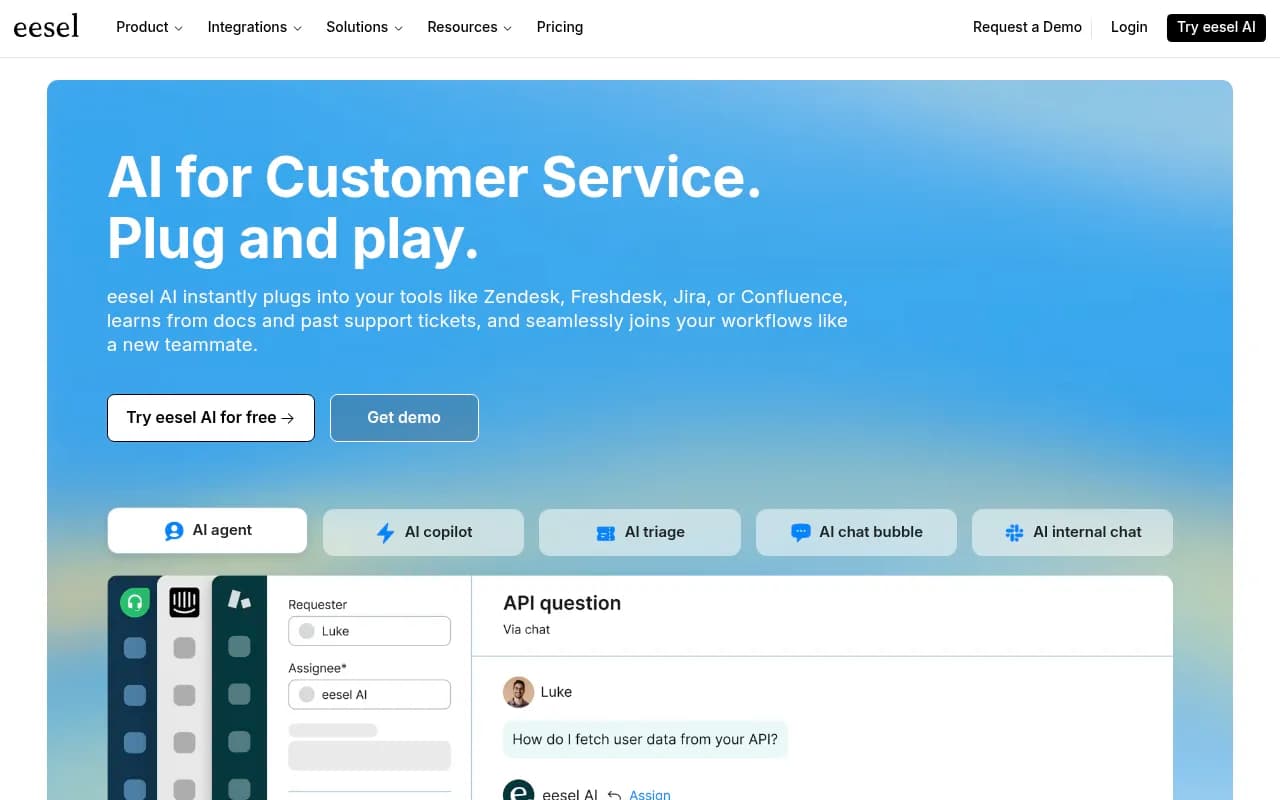
eesel AI is a customer service automation platform built around a simple premise: your support team already has the knowledge, the tone, and the processes — the AI just needs to learn them and get to work. The product trains on your existing tickets, help center articles, macros, and documentation, then deploys as an autonomous agent, a draft-reply copilot, a triage bot, or an embeddable chat widget. It's been adopted by more than 1,000 customer service teams, and the company claims 70 million tickets and chat sessions processed to date.
The target audience is squarely mid-market: companies with real support volume, established helpdesks, and agents who are drowning in repetitive tickets. Think a 20-person SaaS support team on Zendesk handling 3,000 tickets a month, or an e-commerce brand on Freshdesk dealing with order status and return questions at scale. eesel AI isn't trying to replace your entire CX stack — it slots into what you already have.
The company appears to have been building in this space for a few years, with the product maturing considerably. The current website positions it as "the #1 AI Agents for CX," which is a bold claim in a crowded market that includes Intercom Fin, Zendesk AI, Freshdesk Freddy, and a dozen well-funded startups. What eesel AI has going for it is flexibility: it works across helpdesks rather than being locked to one, and it's noticeably more customizable than native AI features baked into platforms like Intercom.
Key features
AI agent (autonomous ticket resolution)
The flagship product. eesel AI's agent learns from your past support replies, help center content, macros, and any uploaded documentation, then handles incoming tickets end-to-end without human involvement. The claimed average autonomous resolution rate is 81%, which is high — though that figure will vary significantly by industry and ticket complexity.
- Learns tone and style from historical replies, not just knowledge base articles
- Handles escalation logic: you define when and how it hands off to a human agent
- Sandbox testing lets you run the bot against past tickets before going live, so you can measure performance and fix gaps without risking live customer interactions
- Works across email, live chat, help desk forms, and social channels
AI copilot (draft reply assistant)
For teams not ready to go fully autonomous, the copilot mode sits inside your helpdesk and generates draft replies for agents to review and send. This is genuinely useful for onboarding — new agents can lean on the AI to understand how your team responds, and experienced agents get a first draft that's usually 80% of the way there.
- Integrates directly into Zendesk and Freshdesk agent views
- Pulls from the same knowledge sources as the autonomous agent
- Particularly useful for complex or sensitive tickets where you want a human in the loop
AI triage
Separate from the agent, the triage product handles the organizational work: tagging tickets, routing them to the right team, closing spam, and handling "thank you" replies that clog up helpdesk queues. You configure behavior in plain text prompts rather than complex rule builders, which lowers the setup barrier considerably.
- Fully customizable via natural language instructions
- Can auto-close tickets based on content (spam, resolved, no-reply-needed)
- Sandbox testing available here too
AI internal chat
This is eesel AI's internal knowledge assistant — train it on Confluence, Google Docs, Notion, and other internal documentation, then let employees ask questions from inside Slack or Microsoft Teams. The Yellowdig case study on their site describes a new hire calling the bot their "best friend during onboarding," which rings true for this use case.
- Supports multiple bots for different teams (engineering, HR, sales, etc.)
- Browser extension available for querying from any page
- One-click integrations to common knowledge sources
AI chat bubble (website widget)
An embeddable chat widget for websites and apps. Trains on your website content, PDFs, Shopify product catalog, and other sources. Can be configured for pure support or for sales-assist use cases — the product page mentions "AI sales rep" functionality where it integrates with your product catalog to provide concierge-style recommendations.
- Customizable appearance and behavior
- Escalation to human agents when needed
- Works with Shopify out of the box for e-commerce teams
Sandbox testing and simulation
This deserves its own mention because it's genuinely differentiating. Before deploying any bot to live traffic, you can run it against a batch of historical tickets and see how it would have performed. You get a performance score, can identify gaps, and iterate before anything touches a real customer. Most competing tools either skip this entirely or offer it only on enterprise plans.
Multi-source knowledge ingestion
eesel AI can pull from a wide range of sources simultaneously: Zendesk help center, Freshdesk knowledge base, Confluence, Google Docs, Notion, uploaded PDFs, CSVs, website URLs, and Shopify catalogs. The Ecosa CTO quote on their site specifically calls out the ability to link CSVs, Zendesk, and Google Docs together — useful for teams whose documentation is scattered across multiple systems.
Security and compliance
The platform is GDPR and CCPA compliant, offers EU data residency, encrypts data at rest and in transit, and contractually guarantees that neither eesel nor its subprocessors (including OpenAI) use customer data for model training. Enterprise options include zero chat log retention and self-hosted setups.
Who is it for
The clearest fit is a customer service team of 10-100 agents running on Zendesk, Freshdesk, or a similar helpdesk, dealing with high volumes of repetitive questions. Think SaaS companies handling billing and feature questions, e-commerce brands managing order status and returns, or fintech companies fielding account queries. The Global Pay testimonial mentions 80% time savings on onboarding and fast answer retrieval — that's a fintech use case where speed and accuracy matter more than creative problem-solving.
Smaller teams (5-15 agents) can also get real value, particularly from the copilot and triage features. If you're a 10-person support team and half your tickets are "where's my order" or "how do I reset my password," automating those frees up your team for the tickets that actually need human judgment. The $239/month Team plan is accessible at that scale if the automation delivers even modest time savings.
The internal chat product has a slightly different audience: operations, HR, and engineering teams at companies with large, scattered internal documentation. If your Confluence is a mess and new hires spend their first two weeks asking the same questions, an AI that can surface answers from that documentation is genuinely useful.
Who should not use eesel AI: teams that need deep CRM integration (Salesforce, HubSpot) as a primary workflow, companies with highly regulated industries requiring strict audit trails and compliance beyond GDPR/CCPA, or developers looking for a fully API-first platform to build custom AI workflows. eesel AI is a product for support operators, not engineers.
Integrations and ecosystem
The integration list is one of eesel AI's genuine strengths. On the helpdesk side: Zendesk, Freshdesk, Intercom, Gorgias, HelpScout, Front, and others. Knowledge sources: Confluence, Google Docs, Notion, Guru, uploaded PDFs and CSVs, website scraping, Shopify. Communication: Slack, Microsoft Teams, Discord. The company claims "one click" setup for most of these, and based on customer testimonials, the setup experience is genuinely fast.
There's a browser extension that lets you query your internal AI from any page, which is a nice touch for teams that work across many tools. An API is available, though eesel AI doesn't lead with developer documentation — it's clearly positioned as a no-code/low-code product for support operators.
Import and export capabilities exist for knowledge sources (CSVs, PDFs), and the sandbox testing feature effectively lets you export performance data before going live. There's no native Zapier integration mentioned prominently, which is a gap for teams that want to connect eesel AI to other workflow automation tools.
Pricing and value
eesel AI publishes two main tiers on annual billing:
- Team: $239/month (listed as $299/month monthly) — described as "for teams starting with AI"
- Business: $639/month (listed as $799/month monthly) — described as "for teams ready to scale"
There's a free trial available (no credit card required based on the "Try for free" CTA), and enterprise/custom pricing is available for larger deployments.
The pricing is mid-market. At $239/month, you're paying roughly what you'd pay for 2-3 seats of a premium helpdesk tool. If the 81% autonomous resolution claim holds even partially for your ticket volume, the ROI math works quickly — the company claims a 2-month payback period on average. That's plausible for teams with 500+ tickets/month where even a 50% automation rate saves significant agent hours.
Compared to native AI features in Zendesk (Zendesk AI starts at around $50/agent/month on top of existing plans) or Intercom Fin (usage-based, can get expensive at scale), eesel AI's flat-rate pricing is easier to budget. The trade-off is that native integrations from Zendesk or Intercom are deeper by definition — eesel AI is working via API and webhooks, not as a first-party feature.
Strengths and limitations
What eesel AI does well:
- Helpdesk-agnostic deployment is the biggest differentiator. Most AI support tools are tied to a single platform (Intercom Fin only works in Intercom, Zendesk AI only in Zendesk). eesel AI works across all of them, which matters for teams that use multiple helpdesks or are considering switching.
- Sandbox testing before live deployment is genuinely rare at this price point and reduces the risk of a bad rollout considerably.
- Multi-source knowledge ingestion handles the reality that most companies' documentation is scattered — Confluence here, Google Docs there, a CSV someone made two years ago. eesel AI pulls it all together without requiring you to consolidate first.
- The internal chat product is a solid secondary use case that many competitors ignore. Getting value from both customer-facing and internal use cases on one platform is a real efficiency win.
- Customer testimonials are specific and credible — named individuals with job titles from real companies, citing concrete outcomes like "80% time savings" and "81% autonomous resolution."
Honest limitations:
- Pricing transparency is incomplete. The website shows Team and Business tiers but doesn't specify what's included at each level (number of agents, ticket volume, features). You have to start a trial or contact sales to understand the limits, which is frustrating for buyers doing initial research.
- No native Salesforce or HubSpot CRM integration is mentioned, which is a gap for teams where customer data lives in a CRM rather than a helpdesk. Competitors like Intercom have deeper CRM connectivity.
- The product is clearly built for support operators, not developers. If you want to build custom workflows, integrate with unusual data sources, or extend the platform programmatically, the API documentation and developer experience aren't a priority. Tools like Botpress or custom LangChain implementations would serve that use case better.
- No mention of voice or phone support — if your support operation includes a call center component, eesel AI doesn't cover it.
Bottom line
eesel AI is a solid, practical choice for customer service teams that want to automate ticket resolution without ripping out their existing helpdesk stack. The combination of autonomous agent, copilot, triage, and internal chat in one platform — all working across Zendesk, Freshdesk, Intercom, and others — gives it real flexibility that single-platform AI tools can't match. The sandbox testing feature alone is worth the evaluation for teams nervous about deploying AI to live customers.
Best use case in one sentence: a 20-50 agent support team on Zendesk or Freshdesk handling high volumes of repetitive tickets who want to automate 60-80% of their queue without switching helpdesks or hiring more agents.
Tags:
Frequently asked questions
What is eesel AI?
How much does eesel AI cost?
Which helpdesks does eesel AI integrate with?
Is eesel AI only for large customer service teams?
How does eesel AI learn to respond like my team?
Can I test eesel AI before deploying it to live customers?
Similar and alternative tools to eesel AI