ElevenLabs Review 2026
Generates realistic voiceovers and audio content from text using AI, perfect for video marketing, podcasts, and multimedia campaigns.
Summary
- Best for: Content creators, enterprises, and developers who need production-quality AI voices that actually sound human -- not robotic text-to-speech. If you're making audiobooks, podcasts, video content, or deploying voice agents for customer service, ElevenLabs is the current gold standard.
- Standout strength: Voice quality. ElevenLabs voices have emotional range, natural pacing, and subtle inflections that competitors (Google Cloud TTS, Amazon Polly, Microsoft Azure Speech) can't match. The difference is immediately obvious when you hear them side by side.
- Key limitation: Pricing can add up fast for high-volume use cases. The free tier is generous for testing (10,000 characters/month), but serious production work requires paid plans starting at $5/month. Enterprise customers with millions of characters per month will need custom pricing.
- Who should skip it: If you just need basic robotic voiceovers for internal training videos or simple notifications, cheaper alternatives like Google Cloud TTS will do the job. ElevenLabs is overkill (and overpriced) for use cases where voice quality doesn't matter.
ElevenLabs launched in 2022 and quickly became the go-to AI voice platform for anyone who cares about audio quality. Founded by ex-Google and Palantir engineers Piotr Dabkowski and Mati Staniszewski, the company raised $500M in a Series D at an $11B valuation in early 2026 -- a signal that the market sees AI voice as critical infrastructure, not a novelty feature. The platform is used by Disney, Nvidia, Cisco, Revolut, Meta, Chess.com, and thousands of content creators who need voices that don't sound like a GPS navigation system.
What makes ElevenLabs different is simple: the voices sound real. Not "pretty good for AI" real -- actually convincing. You can hear emotion, emphasis, sarcasm, hesitation. The platform supports 70+ languages with the same quality, which is rare. Most competitors degrade noticeably outside English.
The company has expanded beyond text-to-speech into a full audio AI platform. You can now generate music, sound effects, transcribe audio with their Scribe model (98% accuracy, better than Whisper), clone voices, deploy conversational agents, and even create videos. It's positioning itself as the end-to-end platform for anything audio-related in AI.
Text to Speech (the core product)
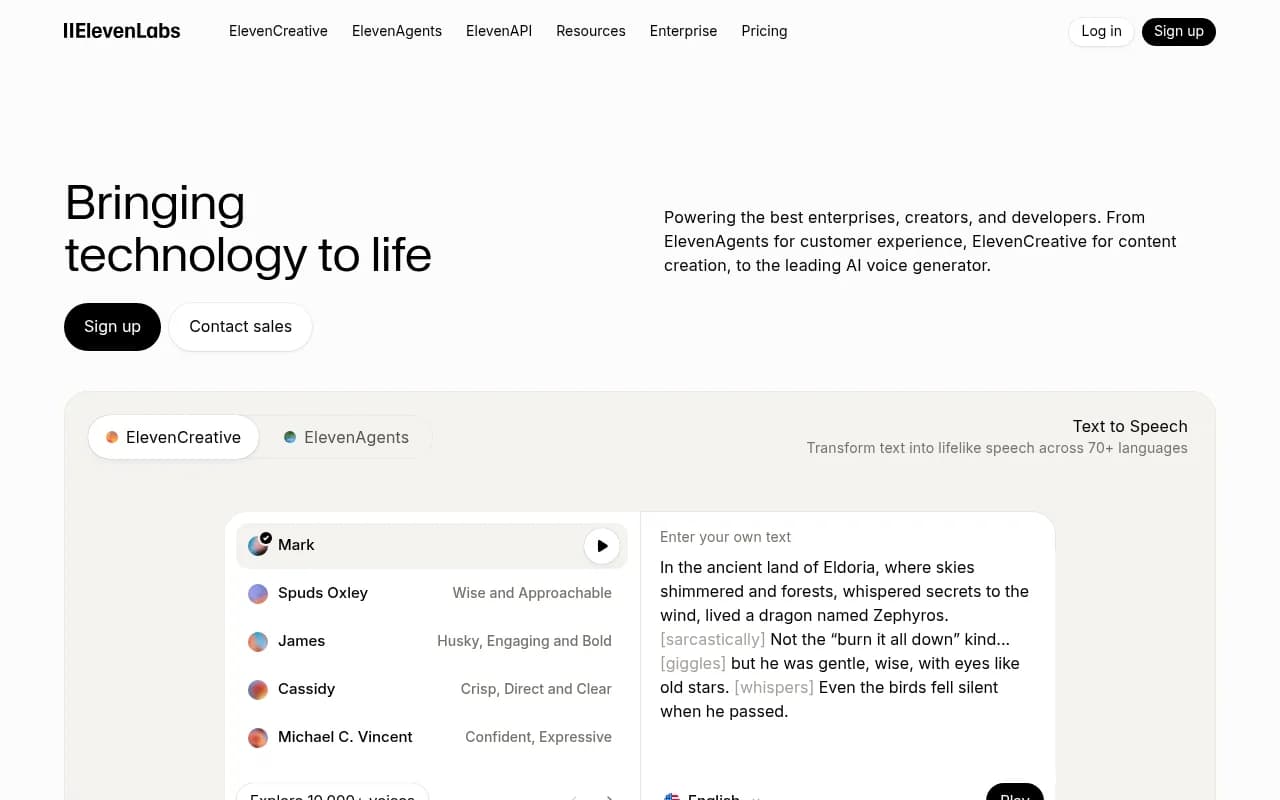
This is what ElevenLabs is known for. You paste text, pick a voice, and get an audio file that sounds like a real person recorded it. The quality gap between ElevenLabs and competitors like Google Cloud TTS, Amazon Polly, or Microsoft Azure Speech is massive. Those services sound robotic and flat. ElevenLabs voices have personality.
You get three model options depending on your use case:
- Eleven Multilingual v2: The most consistent, lifelike model. Best for long-form content like audiobooks, narration, or anything where you need the voice to stay stable across hours of audio. Supports 29+ languages.
- Eleven Flash v2.5: Ultra-low latency (75ms). Built for real-time conversational use cases like voice agents, live chat, or interactive applications. Slightly less expressive than Multilingual but still leagues ahead of competitors.
- Eleven v3: The most expressive model. Released in mid-2025, this one handles emotion, sarcasm, whispering, shouting -- the full range of human speech. It's the model you use when you need a voice that can actually act.
The platform includes 10,000+ pre-made voices in the Voice Library. You can filter by accent, age, gender, use case (narration, conversational, characters). If you don't find what you need, you can clone a voice (upload 1-5 minutes of audio and the AI replicates it) or design a voice from a text prompt ("warm, authoritative female voice with a slight British accent").
Voice cloning is shockingly good. Upload a few minutes of clean audio and the clone captures tone, cadence, and subtle quirks. Professional voice actors use this to scale their work -- record once, generate variations forever. The ethical guardrails are strict: you need consent to clone someone's voice, and ElevenLabs watermarks all generated audio for provenance tracking.
The editor includes advanced controls most competitors lack:
- Inline SSML tags: Add pauses, emphasis, pitch shifts, speed changes directly in the text. Example: "[sarcastically] Oh great, another meeting" or "[whispers] Don't wake the baby."
- Pronunciation library: Save custom pronunciations for brand names, technical terms, or foreign words the AI mispronounces.
- Timeline editing: Adjust pacing, re-generate specific sentences, splice in different takes. It's closer to a DAW than a simple TTS tool.
ElevenAgents (conversational AI platform)
Launched in late 2025, this is ElevenLabs' answer to voice agent platforms like Vapi, Retell AI, and Bland AI. You can build, deploy, and monitor AI agents that handle phone calls, live chat, email, and WhatsApp. The agents use ElevenLabs' voices (so they sound human) and integrate with your CRM, helpdesk, or internal systems.
Key features:
- Omnichannel deployment: Same agent works across phone, chat, email, WhatsApp. Most competitors force you to build separate flows for each channel.
- Workflow builder: Visual editor for conversation flows with branching logic, API calls, database lookups, and conditional actions. You can handle complex scenarios like "check order status, offer refund if eligible, escalate to human if customer is angry."
- Analytics dashboard: Track success rates, conversation length, escalation rates, sentiment scores. See where agents are failing and optimize flows over time.
- Guardrails: Set behavioral rules to prevent agents from going off-script, sharing sensitive data, or making unauthorized decisions. Compliance-focused companies (healthcare, finance) need this.
- Testing sandbox: Simulate conversations before deploying to production. Catch edge cases and weird responses before customers encounter them.
The latency is impressive -- 75ms response time using Eleven Flash. That's fast enough for natural conversation without awkward pauses. Competitors like Vapi and Retell AI are in the same ballpark, but ElevenLabs has the voice quality advantage.
Real-world use cases: Deliveroo uses ElevenAgents for rider and restaurant support. Meesho (Indian e-commerce) handles multilingual customer service at scale. Cars24 runs India's largest voice-driven car retail operation on the platform. These aren't toy demos -- they're production systems handling millions of interactions.
Music and Sound Effects
Eleven Music (launched August 2025) generates studio-quality music from text prompts. You describe the genre, mood, structure, and it outputs a full track with vocals or instrumental. The model is trained on licensed data, so it's safe for commercial use (unlike some competitors that scraped copyrighted music and got sued).
You can specify length, BPM, key, and even reference specific artists or songs for style matching. The output quality is legitimately good -- not "good for AI" but actually usable in professional projects. Content creators use it for YouTube videos, podcasts, and ads. Game developers use it for background music.
Sound Effects works the same way: describe what you need ("footsteps on gravel, distant thunder, coffee machine brewing") and the AI generates it. You can also browse a library of pre-made effects. This is useful for video editors, game developers, and podcasters who need custom audio but don't want to pay for stock libraries or hire a sound designer.
Speech to Text (Scribe)
Scribe v2 (released January 2026) is ElevenLabs' transcription model. It claims 98% accuracy, which independent tests confirm is better than OpenAI Whisper, AssemblyAI, and Deepgram. The model supports speaker diarization (identifies who said what), character-level timestamps, and 32 languages.
Pricing is competitive: $0.10 per hour of audio, which is cheaper than most competitors. The API is fast (real-time transcription available) and integrates easily with existing workflows. Use cases: podcast transcription, meeting notes, call center analytics, accessibility (live captions).
The real-time version (Scribe v2 Realtime) is built for live transcription with minimal latency. It's what powers the conversational agents in ElevenAgents.
Image and Video Generation
ElevenLabs recently added image and video generation to the platform. You can create images from text prompts or edit existing images. For video, they integrate with leading models like Google Veo, OpenAI Sora, Wan, Kling, and Seedance. You describe what you want, pick a model, and generate video clips.
This is newer and less mature than the voice features. The quality is good but not better than using Midjourney or Runway directly. The advantage is convenience -- you can generate a video, add voiceover, music, and sound effects all in one platform instead of juggling multiple tools.
Who is ElevenLabs for?
Content creators (YouTubers, podcasters, audiobook producers): If you're making audio or video content and need professional voiceovers, ElevenLabs is the obvious choice. The voice quality is miles ahead of competitors, and the editor makes it easy to tweak pacing and emphasis. Audiobook producers use it to narrate entire books in hours instead of days. YouTubers use it for multilingual versions of their videos.
Marketing teams and agencies: If you're producing video ads, explainer videos, or multilingual campaigns, ElevenLabs saves massive time and budget. Instead of hiring voice actors for every language and revision, you generate voiceovers on demand. The voice cloning feature is popular with agencies -- clone the client's CEO or brand spokesperson once, then generate unlimited variations.
Enterprises with customer service operations: Companies like Deliveroo, Meesho, and Deutsche Telekom use ElevenAgents to automate phone support, live chat, and email. The agents sound human, handle complex workflows, and scale infinitely. This is a direct replacement for traditional IVR systems and offshore call centers.
Developers building voice-enabled apps: The API is well-documented, supports multiple SDKs (Python, JavaScript, Go), and has low latency. If you're building a voice assistant, conversational AI, or any app that needs to speak, ElevenLabs is the best voice engine available. The pricing is usage-based, so you only pay for what you use.
Game developers and filmmakers: Voice cloning and character voice generation are huge for games and animation. Instead of recording hundreds of lines with voice actors, you clone the actor's voice and generate variations. The Eleven v3 model handles emotion and acting, so the voices don't sound flat.
Who should NOT use ElevenLabs: If you need basic robotic TTS for internal tools, notifications, or accessibility features where quality doesn't matter, Google Cloud TTS or Amazon Polly are cheaper. If you're on a tight budget and generating millions of characters per month, the costs add up fast. If you need real-time voice synthesis for a high-traffic consumer app, you'll need enterprise pricing and custom infrastructure.
Integrations and ecosystem
ElevenLabs integrates with:
- Google Search Console, Slack, Zapier: For workflow automation
- Twilio, Cisco Webex: For telephony and video conferencing
- CRMs and helpdesks: Salesforce, Zendesk, Intercom (via API)
- Video editing tools: Adobe Premiere, Final Cut Pro (export audio files)
- Developer tools: REST API, Python SDK, JavaScript SDK, Go SDK, WebSocket API for real-time streaming
The API is the main integration point. It's RESTful, well-documented, and includes code examples for common use cases. Rate limits are generous on paid plans. Enterprise customers get dedicated support and custom SLAs.
There's a browser extension for Chrome that lets you generate voiceovers directly from web pages. Useful for quickly testing voices or generating audio from articles.
No official mobile app yet, but the web app is mobile-responsive.
Pricing and value
ElevenLabs uses a credit-based system. Every service (TTS, music, transcription, agents) consumes credits. The cost varies by model and quality settings.
Free tier: 10,000 characters/month (~5-10 minutes of audio). Basic voices, 128 kbps audio, no commercial use. Good for testing but not production.
Starter ($5/month): 30,000 characters/month, commercial use allowed, higher quality audio (192 kbps), voice cloning (1 custom voice).
Creator ($11/month): 100,000 characters/month, 3 custom voices, access to all models including Eleven v3.
Pro ($99/month): 500,000 characters/month, 10 custom voices, priority support, higher rate limits.
Enterprise (custom pricing): Unlimited characters, dedicated infrastructure, custom SLAs, white-glove support. Required for high-volume use cases (millions of characters/month).
For ElevenAgents, pricing is separate and based on usage (minutes of conversation). Starts around $0.10-0.15 per minute depending on volume.
How this compares to competitors:
- Google Cloud TTS: $4 per 1 million characters (way cheaper but much lower quality)
- Amazon Polly: $4 per 1 million characters (same story)
- Microsoft Azure Speech: $15 per 1 million characters (better quality than Google/Amazon but still robotic)
- Play.ht: $19/month for 100,000 characters (similar quality, slightly cheaper)
- Murf.ai: $29/month for 120,000 characters (good quality but less natural than ElevenLabs)
ElevenLabs is more expensive than basic TTS services but cheaper than hiring voice actors. For high-quality use cases, it's the best value. For low-quality use cases, it's overpriced.
Strengths
- Voice quality is unmatched: The voices sound genuinely human. Competitors sound robotic by comparison. This is the main reason to use ElevenLabs.
- Multilingual support is excellent: 70+ languages with consistent quality. Most competitors degrade outside English.
- Voice cloning is shockingly good: Upload a few minutes of audio and the clone is nearly indistinguishable from the original.
- Low latency for real-time use cases: 75ms response time with Eleven Flash. Fast enough for conversational agents and live applications.
- Comprehensive platform: TTS, music, SFX, transcription, agents, video -- all in one place. You don't need to juggle multiple tools.
- Strong ethical guardrails: Consent required for voice cloning, audio watermarking for provenance, active content moderation. They take safety seriously.
Limitations
- Pricing adds up for high-volume use: If you're generating millions of characters per month, the costs get steep. Enterprise pricing is required, and you'll need to negotiate.
- Music and video features are newer and less mature: The voice features are world-class, but music and video generation aren't better than standalone tools like Suno or Runway. They're convenient but not best-in-class.
- No offline mode: Everything runs in the cloud. If you need on-premise deployment for security or compliance, you'll need an enterprise contract.
- Voice cloning requires clean audio: If your source audio is noisy or low-quality, the clone will be mediocre. You need good input to get good output.
Bottom line
ElevenLabs is the best AI voice platform available in 2026. If you need voices that sound human -- for audiobooks, podcasts, video content, marketing campaigns, or customer service automation -- this is the tool to use. The quality gap between ElevenLabs and competitors is massive and immediately obvious.
The platform has expanded beyond TTS into a full audio AI suite (music, SFX, transcription, agents, video), which makes it a one-stop shop for content creators and enterprises. The pricing is higher than basic TTS services, but you're paying for quality. For professional use cases where voice quality matters, it's worth every dollar.
Best use case in one sentence: Generating production-quality voiceovers at scale for content creators, marketers, and enterprises who need voices that sound genuinely human, not robotic.
Tags:
Similar and alternative tools to ElevenLabs