Key takeaways
- Promptwatch and ContentMonk are solving fundamentally different problems. Promptwatch is an AI search visibility platform (think: how does your brand appear in ChatGPT, Perplexity, Claude?). ContentMonk is a content operations platform built to scale Google SEO content production.
- If your team is asking "why aren't we showing up in AI answers?" -- that's Promptwatch's territory. If you're asking "how do we publish more SEO blog posts faster?" -- ContentMonk is the answer.
- Promptwatch's content generation is engineered specifically to earn AI citations, grounded in 880M+ real citation data points. ContentMonk's AI writing is optimized for SERP rankings and brand voice consistency.
- ContentMonk is cheaper to start ($59-69/mo per seat vs Promptwatch's $99/mo entry), but the two tools aren't really competing for the same budget line.
- Promptwatch is the only tool here that monitors AI crawlers, tracks prompt volumes, analyzes competitor visibility in LLMs, and closes the loop with traffic attribution from AI search.
- For most marketing teams in 2026, the real question isn't which one to pick -- it's whether you've started treating AI search as a separate channel from Google SEO yet.
Overview
Promptwatch

Promptwatch is an end-to-end AI search visibility platform used by 6,700+ brands and agencies. The core idea is simple but the execution goes deep: it tracks how your brand appears across 10 AI models (ChatGPT, Claude, Perplexity, Gemini, Grok, DeepSeek, Copilot, Meta AI, Mistral, and Google AI Overviews), then helps you actually do something about it. That last part is what separates it from most competitors in the GEO/AEO space, which tend to stop at showing you a dashboard.
The platform runs what it calls an "action loop" -- find the prompts where competitors are visible but you're not, generate content designed to fill those gaps, then track whether AI models start citing your new pages. It's one of the few tools in this category that connects content creation directly to AI citation outcomes.
ContentMonk
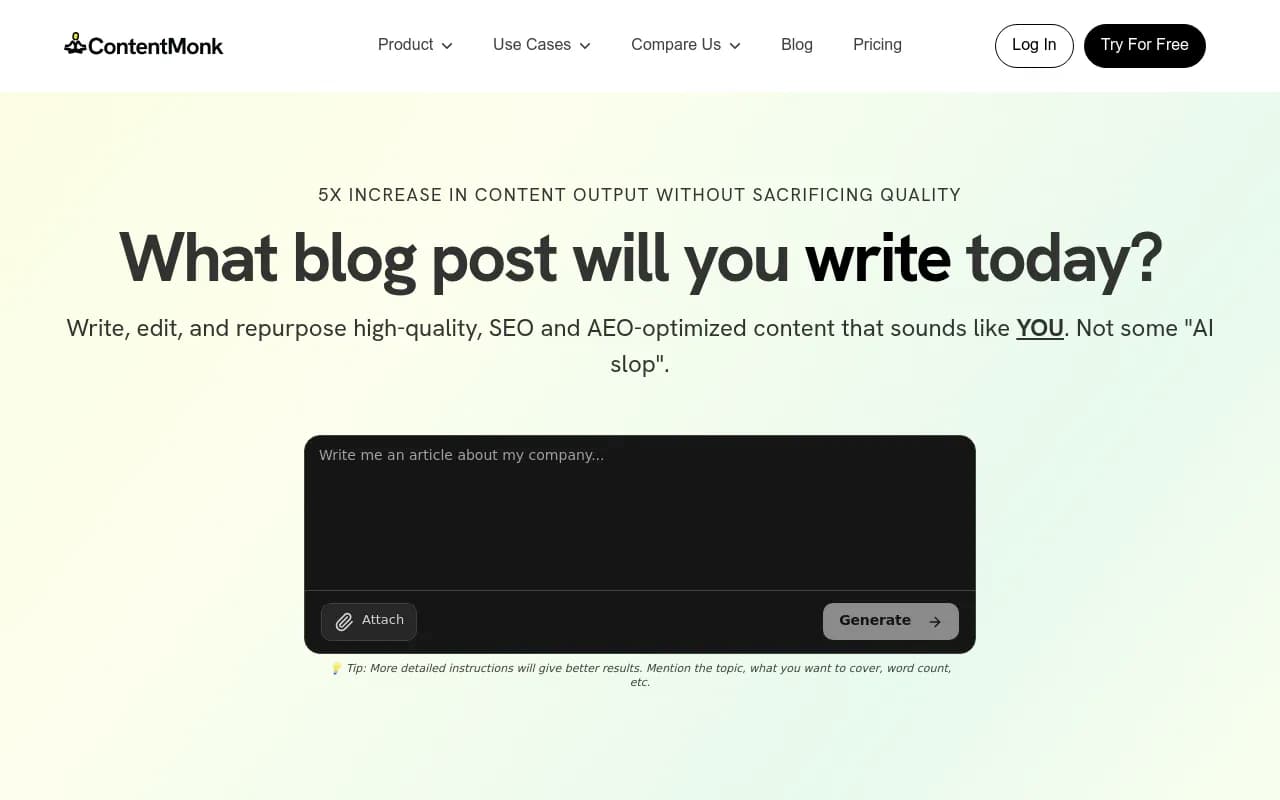
ContentMonk is an AI-powered content operations platform aimed at marketing teams, agencies, and freelancers who need to produce SEO content at scale. It combines automated SERP research, knowledge base management, AI writing with brand voice preservation, and content repurposing into a single workflow. The pitch is essentially "publish 5x more content without 5x the headcount."
It's a solid tool for teams running a traditional content marketing operation -- keyword research, content briefs, AI drafts, editorial review, publish. ContentMonk doesn't touch AI search monitoring or GEO optimization at all. Its world is Google search rankings, not ChatGPT citations.
Side-by-side comparison
| Feature | Promptwatch | ContentMonk |
|---|---|---|
| Primary use case | AI search visibility & optimization | SEO content creation & operations |
| AI model monitoring | 10 models (ChatGPT, Claude, Perplexity, Gemini, Grok, etc.) | None |
| Content generation | Yes -- AI-citation-optimized articles, listicles, comparisons | Yes -- SERP-optimized blog posts, repurposed content |
| Citation tracking | Yes (880M+ citations analyzed) | No |
| Answer gap analysis | Yes | No |
| SERP research | No | Yes (automated) |
| Brand voice preservation | No | Yes |
| Competitor visibility tracking | Yes (LLM heatmaps) | No |
| AI crawler logs | Yes | No |
| Prompt volume & difficulty scoring | Yes | No |
| Reddit & YouTube insights | Yes | No |
| ChatGPT Shopping tracking | Yes | No |
| Knowledge base management | No | Yes |
| Content repurposing | No | Yes |
| Traffic attribution (AI search) | Yes (GSC, snippet, server logs) | No |
| Free trial | 7 days | 14 days |
| Starting price | $99/mo | ~$59-69/mo per seat |
| Target user | SEO/marketing teams, agencies focused on AI search | Content teams, agencies focused on Google SEO |
Head-to-head feature deep-dive
AI search monitoring
This is where the comparison becomes one-sided fast. Promptwatch was built from the ground up to monitor AI search engines. It tracks brand mentions, citations, and visibility scores across 10 models simultaneously. You can see exactly which prompts trigger mentions of your brand vs competitors, which pages AI models are citing, and how that changes over time.
ContentMonk has no AI search monitoring capabilities. It doesn't track ChatGPT, Perplexity, Claude, or any other LLM. If your goal is understanding your AI search presence, ContentMonk simply isn't in this conversation.
Verdict: Promptwatch, by a wide margin. ContentMonk doesn't compete here.
Content generation
Both tools generate content with AI, but the intent behind that content is completely different.
Promptwatch's content generation is grounded in citation data. When it writes an article, it's working from real data on what topics AI models are currently citing, what angles competitors are using, and what gaps exist in your content. The output is designed to earn citations from ChatGPT, Perplexity, and similar engines -- not just rank in Google.
ContentMonk's AI writing is built around SERP data. It researches what's currently ranking on Google, builds a content brief from that, and generates a draft that matches your brand voice. The brand voice preservation is genuinely useful for teams that have struggled with AI content sounding generic. ContentMonk also handles content repurposing -- turning a blog post into social snippets, newsletters, etc. -- which Promptwatch doesn't do at all.
| Content feature | Promptwatch | ContentMonk |
|---|---|---|
| Grounded in citation data | Yes | No |
| Grounded in SERP data | No | Yes |
| Brand voice preservation | No | Yes |
| Content repurposing | No | Yes |
| Articles per month (entry plan) | 5 (Essential) | Varies by plan |
| Content types | Articles, listicles, comparisons | Blog posts, social, newsletters |
| Optimized for | AI citation | Google rankings |
Verdict: Depends entirely on your goal. For AI search visibility, Promptwatch's content generation is purpose-built. For Google SEO at scale with brand consistency, ContentMonk wins.
Competitive intelligence
Promptwatch's competitor analysis is built specifically for AI search. You can see a heatmap of which competitors are winning visibility across different LLMs, which prompts they're appearing for that you're not, and what content is driving their citations. This is genuinely useful for understanding why a competitor keeps showing up in ChatGPT answers about your category.
ContentMonk's competitive angle is more traditional -- it looks at what's ranking on Google and helps you create content that competes with those pages. There's no LLM-specific competitor tracking.
Verdict: Promptwatch for AI search competitive intelligence. ContentMonk for traditional SERP competitive analysis.
Workflow and content operations
ContentMonk is the stronger tool for managing a content production pipeline. It has knowledge base management (so your AI writing stays accurate and on-brand), editorial workflows, and repurposing features that let you get more mileage from each piece of content. For a content team publishing 20+ pieces a month, that operational infrastructure matters.
Promptwatch's workflow is more focused: identify gaps, generate targeted content, track results. It's not trying to be a full content management system. You'd still need a CMS or editorial workflow tool alongside it.
Verdict: ContentMonk for content operations and volume. Promptwatch for targeted, AI-visibility-driven content.
Analytics and attribution
Promptwatch's analytics go several layers deep. Beyond visibility scores, you get page-level citation tracking (which specific pages are being cited, by which models, how often), AI crawler logs (which AI bots are hitting your site and what they're reading), prompt volume estimates, and traffic attribution that connects AI search visibility to actual website visits and conversions.
ContentMonk's analytics are focused on content performance in traditional search -- rankings, traffic from Google, content ROI. It doesn't have AI-specific attribution.
Verdict: Promptwatch for AI search analytics. ContentMonk for traditional content performance tracking.
Pricing
Both tools offer free trials, but their pricing structures reflect their different audiences.
Pricing comparison
| Plan | Promptwatch | ContentMonk |
|---|---|---|
| Entry/Pro | $99/mo (Essential: 1 site, 50 prompts, 5 articles) | ~$59-69/mo per seat |
| Mid-tier | $249/mo (Professional: 2 sites, 150 prompts, 15 articles, crawler logs) | Custom (volume-based) |
| Upper tier | $579/mo (Business: 5 sites, 350 prompts, 30 articles) | Custom |
| Agency/Enterprise | Custom pricing | Custom pricing |
| Free trial | 7 days | 14 days |
| Annual discount | Yes | Likely (not confirmed) |
ContentMonk's per-seat pricing makes it more accessible for individual writers or small teams. Promptwatch's pricing is per-site and per-prompt, which makes more sense for its use case -- you're buying monitoring coverage and content generation capacity, not individual user seats.
For a team of 3 content writers using ContentMonk, you're looking at roughly $180-210/mo. For a brand monitoring 2 sites with Promptwatch, you're at $249/mo. The comparison isn't apples-to-apples because the tools do different things, but the price gap is smaller than it first appears when you account for what each plan actually covers.
Pros and cons
Promptwatch
Pros:
- The only platform in this comparison that actually monitors AI search engines (ChatGPT, Claude, Perplexity, Gemini, and 6 more)
- Content generation is grounded in real citation data, not generic SEO signals
- Answer gap analysis shows exactly which prompts you're missing vs competitors
- AI crawler logs are a genuinely rare feature -- most tools don't have this
- Traffic attribution closes the loop between AI visibility and actual revenue
- Reddit and YouTube insights surface influence channels most tools ignore
- ChatGPT Shopping tracking for e-commerce brands
Cons:
- No brand voice preservation or knowledge base management
- No content repurposing features
- 7-day trial is shorter than ContentMonk's 14 days
- Higher entry price than ContentMonk
- Doesn't help with traditional Google SEO content production
ContentMonk
Pros:
- Strong brand voice preservation -- AI content that actually sounds like you
- Automated SERP research reduces manual keyword research time
- Content repurposing extends the value of each piece
- Knowledge base management keeps AI writing accurate
- More accessible per-seat pricing for small teams
- 14-day free trial gives more time to evaluate
- Good fit for high-volume content production workflows
Cons:
- Zero AI search monitoring capabilities
- No citation tracking, prompt analysis, or GEO/AEO features
- No competitor visibility tracking in LLMs
- Content is optimized for Google, not AI model citation
- No traffic attribution from AI search engines
- Doesn't address the growing share of search happening in ChatGPT, Perplexity, etc.
Who should pick which tool
Pick Promptwatch if:
- You're asking why competitors keep showing up in ChatGPT or Perplexity answers about your category
- Your marketing team has started treating AI search as a separate channel from Google SEO
- You want to track brand mentions across 10 AI models simultaneously
- You need content that's specifically engineered to earn AI citations, not just rank in Google
- You're running an agency managing AI visibility for multiple client brands
- You want to understand which AI crawlers are hitting your site and what they're reading
- You need to connect AI search visibility to actual traffic and revenue
Pick ContentMonk if:
- Your primary goal is scaling Google SEO content production
- You have a content team that needs to publish more without hiring more writers
- Brand voice consistency is a real problem -- your AI content sounds generic
- You need content repurposing to get more from each piece
- You're managing a traditional content marketing operation with editorial workflows
- Budget is a constraint and per-seat pricing works better for your team structure
Consider using both if:
Your team is running parallel tracks -- a traditional Google SEO content program and an emerging AI search visibility program. ContentMonk handles the Google content pipeline; Promptwatch handles AI search monitoring and optimization. They don't overlap much, so there's no redundancy to worry about.
Final verdict
These two tools aren't really competing. Promptwatch owns the AI search visibility space -- monitoring, citation analysis, gap identification, and content generation designed to earn AI citations. ContentMonk owns the traditional SEO content operations space -- SERP research, brand voice, repurposing, and high-volume publishing workflows.
The choice comes down to which search channel matters more to your team right now. If you're still primarily focused on Google rankings and content volume, ContentMonk is a solid, practical tool. If you've recognized that a growing share of your potential customers are getting answers from ChatGPT, Perplexity, and Gemini instead of clicking Google results, Promptwatch is the platform built to address that shift.
In 2026, most forward-looking marketing teams need both -- but if you can only pick one, pick based on where your traffic actually comes from and where you want it to come from next.