Key takeaways
- Goodie AI is a solid AI visibility tracker, but it stops at reporting — it won't help you create the content needed to improve your rankings.
- Content teams need platforms that close the loop: find the gap, generate the article, track the result.
- The best Goodie AI alternatives in 2026 combine monitoring with actual content generation, briefs, or optimization workflows.
- Platforms like Promptwatch, ContentMonk, Jasper, Content at Scale, and Relixir each serve different team sizes and use cases.
- If AI search visibility is the goal (not just traditional SEO), the monitoring layer matters as much as the writing layer.
Goodie AI has earned its reputation as a clean, enterprise-grade tool for tracking how brands appear in AI search engines. It covers the major LLMs, gives you sentiment data, and presents everything in a dashboard that won't make your head spin. For pure monitoring, it's genuinely good.
But here's the problem most content teams run into: knowing you're invisible doesn't make you visible. Goodie AI tells you where you're missing. It doesn't help you fix it.
If your team's job is to actually produce content — articles, briefs, comparison pages, listicles — you need something that goes further. The tools below do exactly that. Some are full GEO platforms with built-in content generation. Others are AI writing engines with enough SEO and visibility context to make the output useful. All of them give content teams something Goodie AI doesn't: a path from insight to published page.
What to look for in a Goodie AI alternative
Before diving into the list, it's worth being clear about what "generates articles, not just reports" actually means in practice.
A monitoring-only tool will show you a dashboard with your brand's mention rate across ChatGPT, Perplexity, and Gemini. That's useful. But the next question is always: "So what do I write?" If the tool can't answer that, you're back to guessing.
The platforms worth switching to (or adding) should do at least one of the following:
- Identify specific content gaps — the exact prompts and topics where competitors appear and you don't
- Generate full articles or content briefs grounded in real prompt data
- Show you which pages are being cited by AI models and why
- Track whether new content you publish actually improves your AI visibility over time
With that in mind, here's how the top alternatives stack up.
Comparison table
| Platform | AI visibility tracking | Content generation | Content briefs | Best for |
|---|---|---|---|---|
| Promptwatch | Yes (10 LLMs) | Yes (AI Content Agents) | Yes | Marketing/SEO teams wanting full GEO loop |
| ContentMonk | Yes | Yes (articles + repurposing) | Yes | Teams needing multi-format output |
| Jasper | Limited | Yes (long-form, brand voice) | Yes | Brand-controlled content at scale |
| Content at Scale | Limited | Yes (long-form SEO) | Yes | High-volume blog/SEO content |
| Relixir | Yes | Yes | Yes | Startups and mid-market GEO |
1. Promptwatch — the full loop, not just the data
Promptwatch is the most direct answer to the core complaint about Goodie AI. Where Goodie AI stops at "here's your visibility score," Promptwatch keeps going.

The platform tracks how your brand appears across 10 AI models — ChatGPT, Perplexity, Claude, Gemini, Grok, DeepSeek, Copilot, Meta AI, Google AI Overviews, and Google AI Mode. That's already competitive with Goodie AI on the monitoring side. But the real difference is what happens after the data comes in.
Promptwatch's Answer Gap Analysis shows you the specific prompts where competitors are getting cited and you're not. Not vague topic clusters — the actual questions AI models are answering without referencing your site. From there, Content Agents generate articles, listicles, comparisons, and briefs built around those gaps. The content is grounded in real prompt volumes, citation data, competitor analysis, and brand guidelines you upload yourself.
Then the loop closes: page-level tracking shows which of your published pages are being cited, by which models, and how often. Agent analytics shows the timeline from publish to crawl to citation. You can see whether the content you created is actually working.
For content teams that are tired of getting reports and then being left to figure out the rest themselves, this is the most complete workflow available. Pricing starts at $99/month for the Essential plan (1 site, 50 prompts, 5 articles) and goes up to $249/month for Professional, which adds crawler logs, city/state tracking, and 15 articles per month.
One thing worth noting: Promptwatch also tracks AI crawler logs in real time, so you can see when ChatGPT or Perplexity's crawlers are hitting your site, which pages they're reading, and whether they're encountering errors. Most tools in this space don't offer this at all.
2. ContentMonk — built specifically for AEO content output
ContentMonk sits in an interesting position: it's explicitly designed for Answer Engine Optimization, and it leans hard into content production rather than just monitoring.
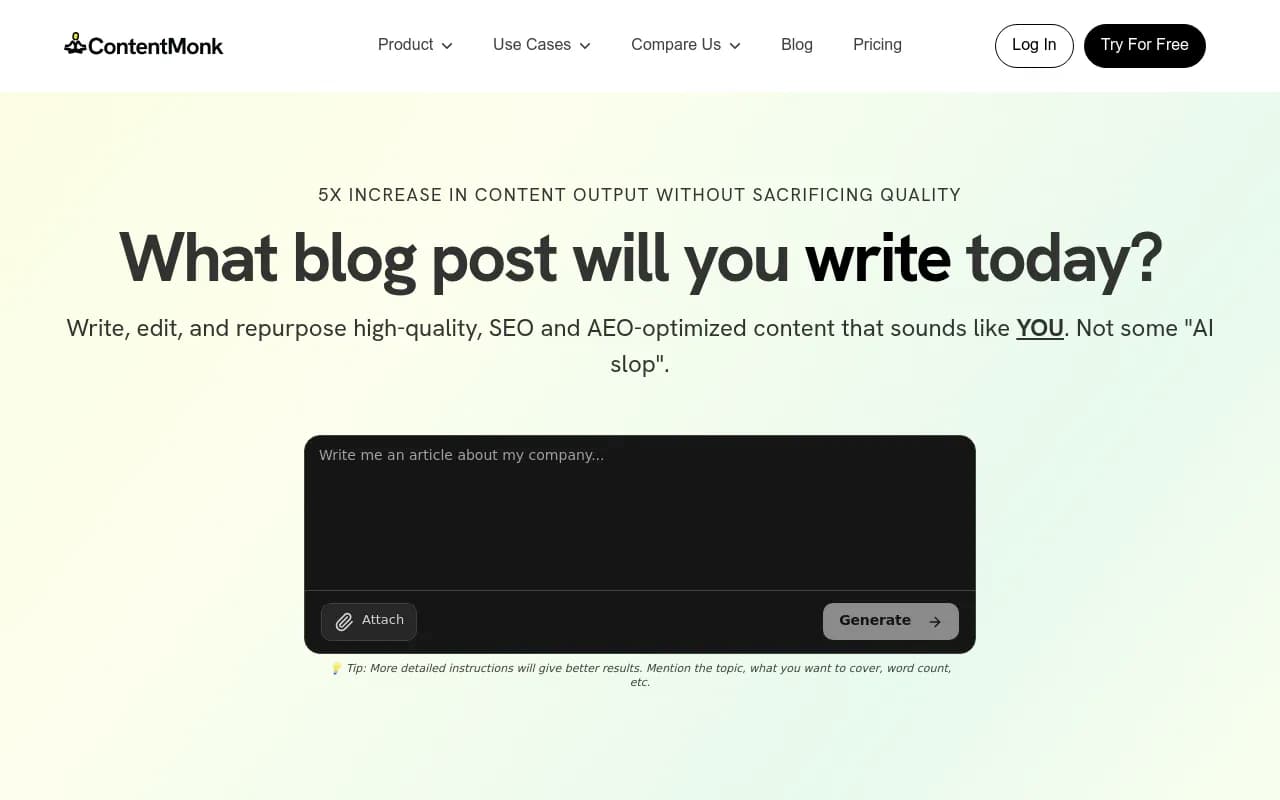
The platform generates articles and then repurposes them into LinkedIn posts, newsletters, ebooks, and Reddit content in a couple of clicks. For content teams managing multiple channels, that multiplier effect matters. You're not just getting a blog post — you're getting a full content package from a single brief.
ContentMonk also does visibility tracking across AI search engines, so it's not purely a writing tool. The monitoring layer is less deep than Promptwatch or Goodie AI, but it's enough to give context to the content you're creating.
Where ContentMonk really shines is speed and format variety. If your team needs to publish a lot of content across a lot of places, and you want that content to be optimized for AI citation rather than just traditional SEO, ContentMonk is worth a close look.
3. Jasper — brand-controlled content at scale
Jasper has been around long enough to have gone through several identity shifts. In 2026, it's settled into a clear lane: enterprise-grade AI content generation with strong brand voice controls.
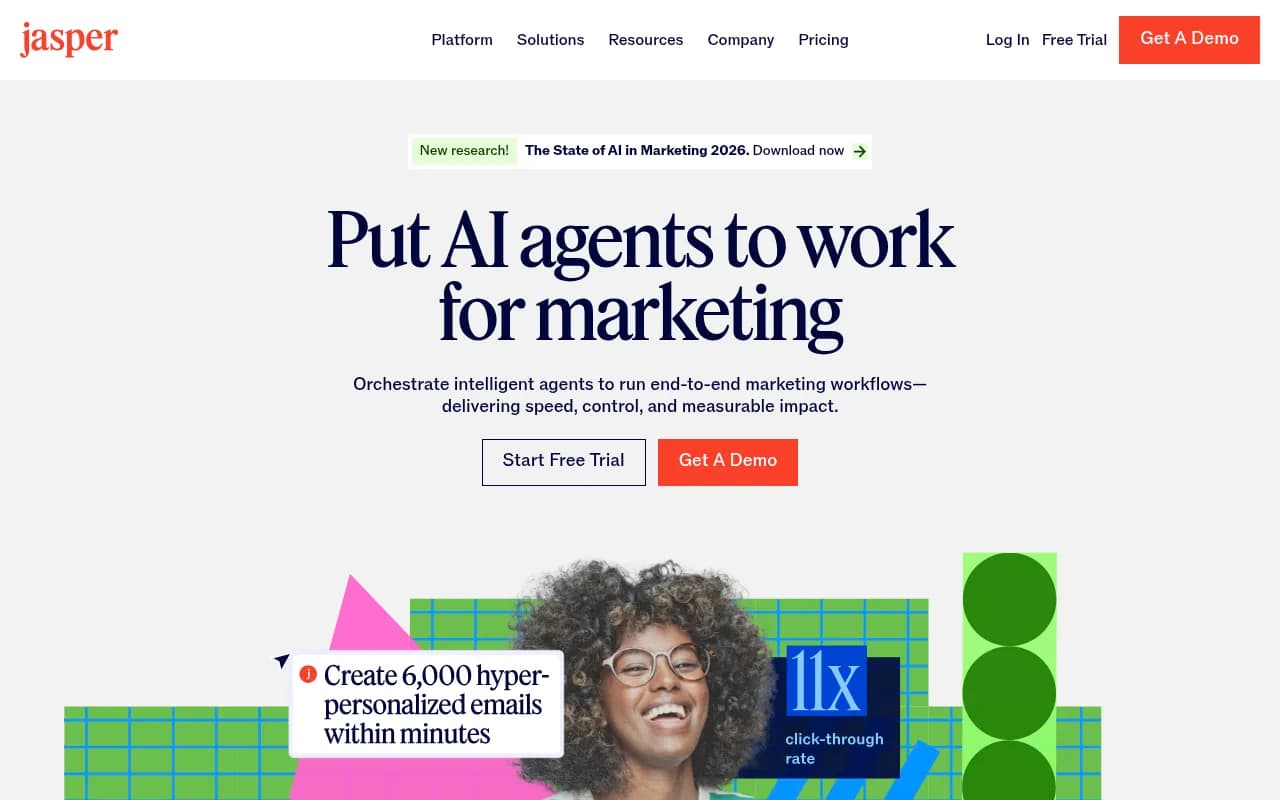
It's not a GEO platform. Jasper won't tell you which prompts you're missing in ChatGPT, and it doesn't track AI citations. But for content teams that already know what they need to write — because they've done the gap analysis elsewhere — Jasper is one of the most capable tools for actually producing that content at scale.
The brand voice training is genuinely good. You can feed it your style guide, past content, and tone preferences, and the output stays consistent across writers and campaigns. For larger teams where brand consistency is a real operational challenge, that's not a small thing.
Jasper pairs well with a monitoring tool like Promptwatch or Goodie AI. Use one to find the gaps, use Jasper to fill them. It's a two-tool workflow, but it works cleanly.
Pricing starts around $39/month for individuals and scales up for teams. There's a free trial.
4. Content at Scale — high-volume SEO content with AI detection bypass
Content at Scale takes a different approach. It's built for teams that need a lot of content, fast, and want that content to pass AI detection tools (which matters for some publishers and agencies).

The platform generates long-form articles — typically 2,000 to 3,000 words — from a keyword, a URL, a YouTube video, a podcast, or a document. The output is more research-grounded than most AI writers, which makes it more useful for SEO-focused content teams.
In 2026, Content at Scale has also started integrating more B2B intent data, which helps prioritize which topics to write about based on what your target audience is actually searching for. It's not AI visibility tracking in the GEO sense, but it's a step toward connecting content production to real demand signals.
For agencies or in-house teams running high-volume content programs — think 50+ articles per month — Content at Scale is one of the more efficient options available. It won't replace a dedicated GEO monitoring tool, but it handles the production side well.
5. Relixir — GEO platform with content generation built in
Relixir is a newer entrant that's worth attention specifically because it combines AI visibility monitoring with content generation in a single platform, similar to Promptwatch but aimed more squarely at startups and mid-market companies.
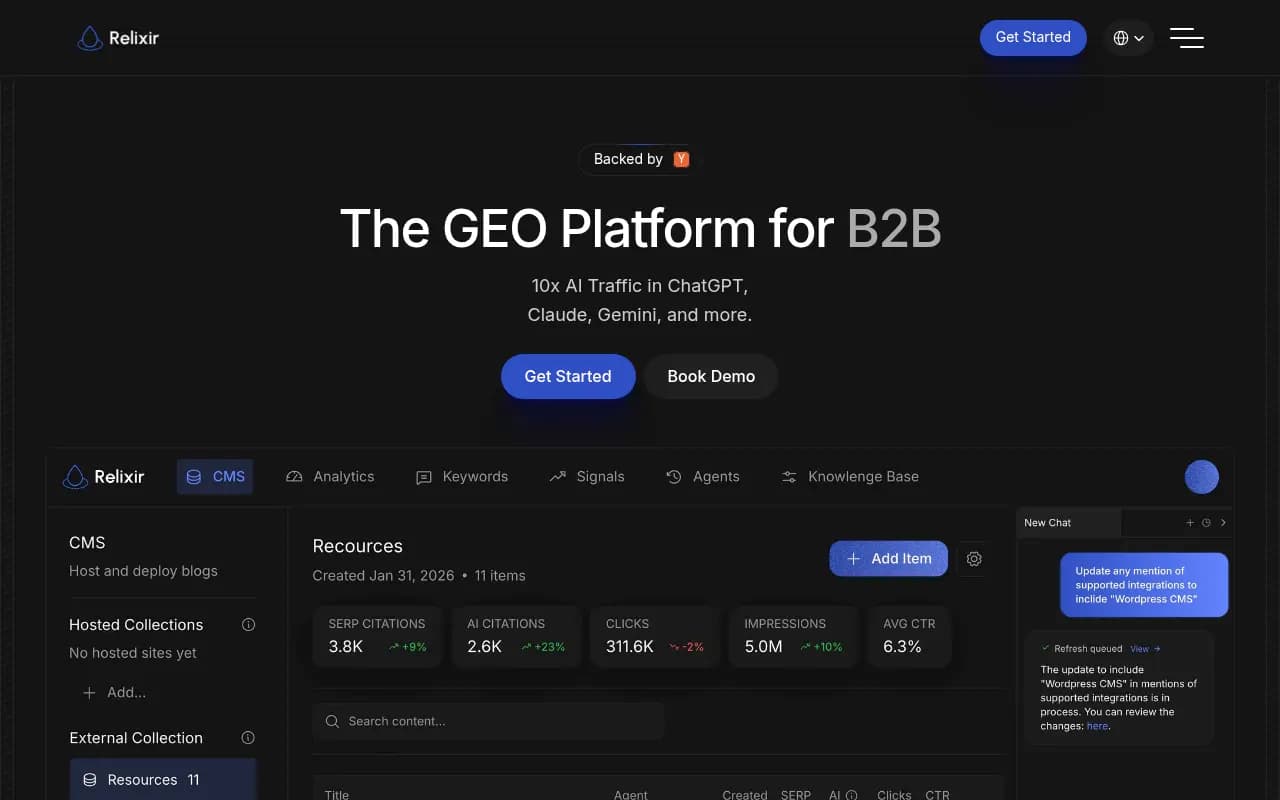
The platform tracks how your brand appears in AI search responses, identifies gaps, and then helps you generate content to close those gaps. It's a more compact version of the full GEO loop — less data depth than Promptwatch, but also less complexity, which suits smaller teams.
If you're a startup that's just starting to think about AI search visibility and you want a tool that handles both the monitoring and the content side without requiring a lot of setup, Relixir is a reasonable starting point.
What most teams get wrong about switching from Goodie AI
The temptation when switching tools is to look for a direct replacement — something that does everything Goodie AI does, plus more. That's a reasonable goal, but it misses a more important question: what's the actual workflow you're trying to build?
If your content team's job is to improve AI search visibility, the workflow looks like this:
- Find out which prompts and topics you're not appearing for
- Understand why (missing content? wrong format? no citations from trusted sources?)
- Create content that addresses those gaps
- Publish it, then track whether AI models start citing it
Goodie AI handles step one reasonably well. It doesn't touch steps two, three, or four. The tools above fill different parts of that gap — some handle all four steps, some specialize in three and four.
The right choice depends on where your team is actually stuck. If you have good monitoring but no content production capacity, Jasper or Content at Scale might be the move. If you want to replace Goodie AI entirely with something that does more, Promptwatch or ContentMonk are the stronger options.
A note on Reddit and YouTube as AI citation sources
One thing that often surprises content teams: AI models don't just cite brand websites. They cite Reddit threads, YouTube videos, and third-party review pages constantly. If your GEO strategy only focuses on your own site, you're missing a significant chunk of the citation landscape.
This is worth keeping in mind when evaluating tools. Platforms that track offsite citations — including which Reddit posts and YouTube videos are driving AI recommendations in your category — give you a much fuller picture of where you actually need to show up.

The Reddit thread above is a good example of the kind of organic discussion that AI models frequently pull from when answering questions about tools and software. If your brand isn't mentioned in those conversations, no amount of on-site content will fully compensate.
Final take
Goodie AI is a fine monitoring tool. If all you need is a dashboard showing your brand's AI visibility, it does that job. But content teams need more than a dashboard — they need a path from "we're invisible" to "we published something that fixed it."
The five platforms above each offer that path in different ways. Promptwatch covers the full loop from gap analysis to content generation to citation tracking. ContentMonk specializes in multi-format AEO content. Jasper handles brand-controlled writing at scale. Content at Scale is built for high-volume SEO production. Relixir gives startups a simpler entry point into the GEO workflow.
Pick based on where your team is actually stuck, not just which tool has the longest feature list.