Battlecard by Northr Review 2026
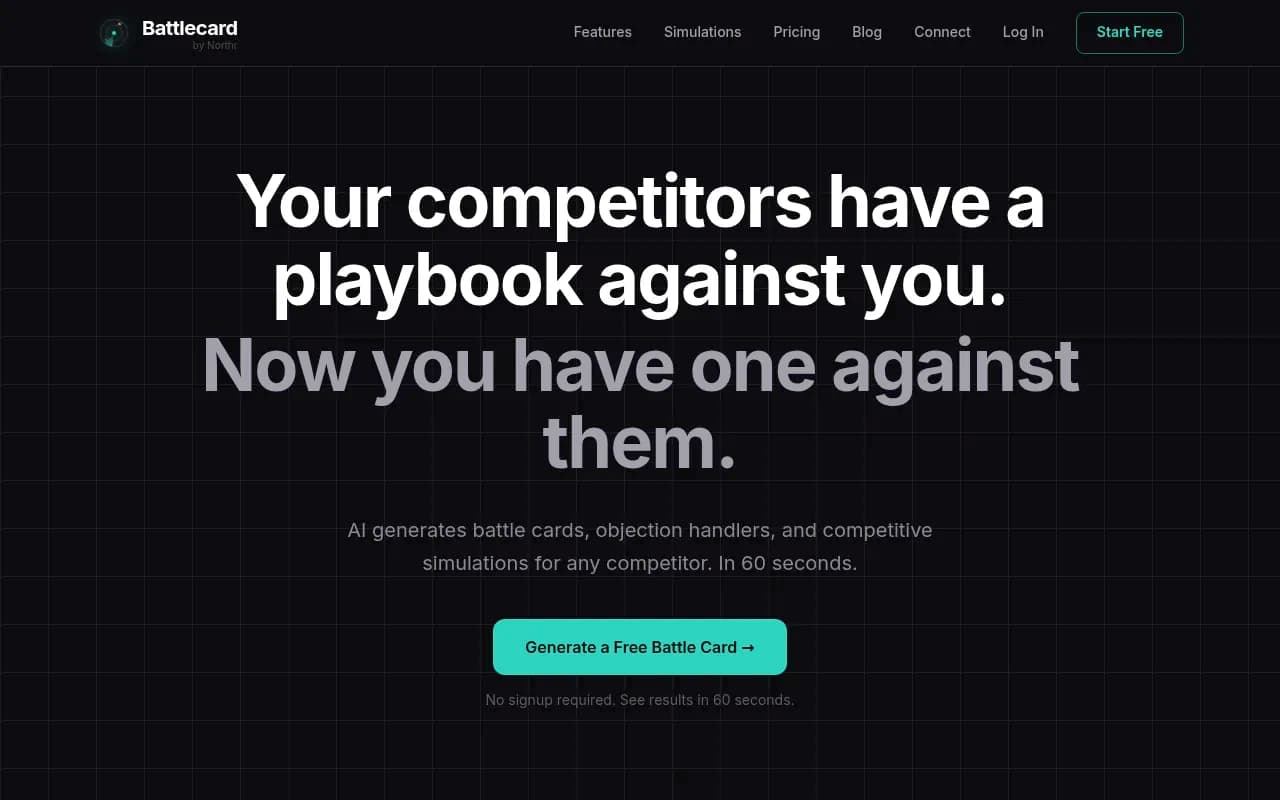
Battlecard by Northr generates AI-powered competitive battle cards, objection handlers, and sales simulations for any competitor in under 60 seconds. Built for sales teams who need real competitive intelligence without enterprise price tags.
Key takeaways
- Battlecard generates AI-powered competitive battle cards, objection handlers, and pricing comparisons for any competitor in about 60 seconds -- no complex setup required
- The AI sales simulation feature is genuinely differentiated: reps can practice live objection handling against a realistic AI buyer persona before real calls
- Free tier gives you one competitor battle card with no credit card required, making it easy to evaluate before committing
- Pricing tops out at $149/mo for teams, which is dramatically cheaper than enterprise competitive intelligence tools like Crayon or Klue
- The tool is best suited for small-to-mid-size sales teams; larger organizations with complex competitive programs may find the customization and CRM integration options limited
Battlecard is a product from Northr, a small software company building AI tools for sales teams. The core pitch is simple: most sales reps go into competitive deals underprepared, cobbling together intelligence from Google searches, LinkedIn, and half-remembered conversations with colleagues. Battlecard tries to replace that mess with a structured, AI-generated competitive playbook that's ready in under a minute.
The founder, Ivo, frames it directly on the homepage: "95% of sales teams can't afford the tools that the Fortune 500 takes for granted." That's a fair read of the market. Tools like Crayon and Klue -- the established players in competitive intelligence -- run into the tens of thousands of dollars per year, putting them out of reach for most startups and mid-market companies. Battlecard's entry point is $0, and even the top tier is $149/month. That positioning is the whole story.
The target audience is sales reps and sales managers at companies that are actively competing against known rivals but don't have a dedicated competitive intelligence function. Think a 20-person SaaS startup going up against HubSpot, or a mid-market software vendor whose reps keep losing deals to Salesforce without knowing exactly why.
Key features
AI-generated battle cards
The core product. You describe your business, name a competitor, and the AI produces a structured battle card covering: an overview of the competitor's market position, their strengths and weaknesses, how to position against them, specific objection rebuttals, and a pricing comparison. The demo on the homepage shows a Salesforce battle card that's genuinely detailed -- it cites specific numbers (23% CRM market share, 40-60% user adoption rates, 8-12% annual price escalations) and includes ready-to-use talking points. The quality of the output depends heavily on how well-documented the competitor is publicly, but for major players in established categories, the results are solid. For niche or newer competitors, the AI will have less to work with.
Objection handlers
Each battle card includes pre-written rebuttals for the most common objections a rep will face when competing against that specific rival. These aren't generic ("our product is better because...") -- they're framed around the competitor's known weaknesses. The Salesforce example shows rebuttals for "Salesforce is the industry standard," "we've already invested too much to switch," and "HubSpot can't handle our enterprise complexity." Each rebuttal is a paragraph or two with a specific counter-argument. This is the kind of content that normally takes a sales enablement manager days to write.
AI sales simulations
This is the feature that sets Battlecard apart from basic battle card generators. After generating a battle card, reps can run a simulated sales call where an AI plays the role of a realistic buyer persona. The simulation shown on the site features "Sarah Chen, VP Revenue Operations at TechFlow Solutions" -- a 500-person company evaluating CRM options. The AI buyer raises real objections, pushes back on claims, and responds dynamically to what the rep says. After the session, the rep gets a score (out of 100) and detailed coaching feedback: what they did well, what they missed, and specific moments in the conversation where they could have used a prepared rebuttal but didn't. This is a meaningful capability. Most sales training tools either offer static content or require a human coach. An AI that can simulate a skeptical VP of RevOps and then debrief you on your performance is genuinely useful for rep onboarding and ongoing practice.
Pricing intelligence
Each battle card includes a pricing comparison section that breaks down the competitor's pricing tiers, typical total cost of ownership, and a comparison to your product. The Salesforce example goes beyond list price to estimate real-world costs including add-ons and implementation, which is where the actual competitive conversation happens. This kind of analysis is hard to find in one place and usually requires a sales rep to piece it together from G2 reviews and Reddit threads.
PDF export and sharing
Battle cards can be exported as branded PDFs and shared with the team. This is a basic but important feature -- the output needs to be usable in the real world, not just inside a web app. The Team plan adds a shared battle card library so the whole team is working from the same intelligence.
Team analytics dashboard (Team plan)
The $149/mo Team tier adds a dashboard showing how the team is using battle cards and simulations. This gives sales managers visibility into which competitors reps are practicing against, how scores are trending, and where coaching gaps exist. It's a light version of what you'd get from a full sales enablement platform, but for a team that doesn't have one, it fills a real gap.
No-signup free tier
You can generate a single competitor battle card without creating an account. This is a smart product decision -- it removes all friction from the evaluation process and lets the output quality speak for itself. The free tier is genuinely functional, not a crippled demo.
Who is it for
Battlecard's sweet spot is early-to-mid-stage SaaS companies with active sales teams competing in crowded markets. Think a Series A or B startup with 5-25 sales reps going up against established players. These teams are losing deals to competitors they don't fully understand, and they don't have the budget or headcount for a dedicated competitive intelligence function. A sales manager at this stage can set up Battlecard in an afternoon and have their whole team practicing simulations by the end of the week.
It's also a good fit for individual account executives who want to self-serve competitive prep before important deals. The no-signup free tier means a rep can generate a battle card for a specific competitor the night before a big call without waiting for enablement to produce something. That kind of on-demand access to competitive intelligence is genuinely valuable in fast-moving sales cycles.
Sales enablement managers at slightly larger companies (50-200 reps) could use Battlecard to accelerate their battle card production. Writing a thorough battle card manually takes hours; using Battlecard as a first draft that gets refined and approved is a reasonable workflow. The PDF export and shared library features support this use case.
Who should probably look elsewhere: enterprise sales organizations with complex, highly customized competitive programs. If you need deep CRM integration, custom data sources, win/loss interview analysis, or competitive intelligence that pulls from proprietary data (customer interviews, internal deal notes), Battlecard's AI-generated output won't be sufficient. Tools like Crayon or Klue are built for that use case, even if they cost significantly more. Similarly, companies in highly regulated or niche industries where the AI has limited public data to draw from may find the battle card quality inconsistent.
Integrations and ecosystem
Battlecard's integration story is thin at the current stage. The Team plan mentions "custom integrations" as a feature, but the site doesn't specify which CRMs or sales tools are supported. There's no mention of native Salesforce, HubSpot, or Outreach integrations on the public pricing page, which is a notable gap for a sales tool -- reps typically want competitive intelligence surfaced inside the tools they're already using, not in a separate app.
There's no public API documented on the site. The primary sharing mechanism is PDF export, which works but is a manual process. A Slack integration or a browser extension that surfaces battle cards inside a CRM would significantly improve the workflow.
The product is web-based with no mobile app mentioned. Given that sales reps often prep for calls on the go, a mobile-friendly experience or app would be a useful addition.
Pricing and value
Battlecard's pricing is structured across four tiers:
- Free: $0, one competitor battle card, AI-generated positioning, objection handling, and pricing comparison. No credit card required.
- Starter: $49/mo, three competitors per month, five AI sales simulations, full battle cards, PDF export, email support.
- Pro: $99/mo, unlimited competitors, unlimited simulations, PDF export and sharing, AI sales coach, priority support.
- Team: $149/mo, everything in Pro plus team analytics dashboard, shared battle card library, custom integrations, dedicated success manager, SSO and SAML.
The value proposition at the Pro tier is strong. $99/month for unlimited battle cards and simulations is a fraction of what Crayon ($2,000+/mo) or Klue ($1,500+/mo) charge, and those tools don't include AI sales simulations. Even compared to lighter tools like Kompyte or Battlecard-adjacent features in Seismic or Highspot, the price-to-capability ratio is favorable.
The Starter tier's limit of three competitors per month feels restrictive for active sales teams. Most companies compete against more than three rivals, and the per-month framing means you can't build up a library without upgrading. The jump from Starter to Pro ($49 to $99) is reasonable given the unlimited access, and most teams that find value in the product will end up on Pro.
The free tier is genuinely useful for evaluation and occasional use, which is the right call for a product trying to grow through word of mouth.
Strengths and limitations
What it does well:
- The AI sales simulation feature is a real differentiator. The ability to practice objection handling against a dynamic AI buyer, then get scored and coached on specific moments in the conversation, is something most competitive intelligence tools don't offer at any price point.
- Speed and simplicity. Generating a usable battle card in 60 seconds with no account required removes every barrier to trying the product. The output quality for well-known competitors is genuinely good.
- Pricing. At $99/mo for unlimited use, Battlecard is accessible to teams that would otherwise have no competitive intelligence tooling at all. The "90% cheaper than incumbents" claim on the site is accurate.
- The objection handler format is practical. The rebuttals are written in a way that reps can actually use in conversation, not abstract strategic advice.
Limitations:
- No CRM integration. Battle cards living in a separate web app means reps have to context-switch to access them. For a tool designed to help in the middle of a sales process, this is a meaningful friction point. Competitors like Crayon surface intelligence directly in Salesforce.
- AI-generated content has a ceiling. For niche competitors, newer companies, or markets with limited public data, the battle card quality will be lower. The tool doesn't appear to have a mechanism for reps to contribute their own deal intelligence to improve the output over time.
- Limited team collaboration features below the $149/mo Team tier. Shared libraries and analytics are gated at the top plan, which means smaller teams on Pro are each working somewhat independently.
- No mention of real-time competitive monitoring. Tools like Crayon and Klue track competitor website changes, pricing updates, and press releases automatically. Battlecard appears to generate intelligence on demand rather than continuously monitoring competitors, which means battle cards could go stale.
Bottom line
Battlecard is a well-executed tool for sales teams that need competitive intelligence but can't justify enterprise pricing. The AI simulation feature alone makes it worth evaluating -- practicing objection handling against a realistic AI buyer is something most sales teams have never had access to at this price point.
Best use case: a 10-50 person SaaS sales team competing in a crowded market that wants to get reps up to speed on competitive positioning quickly, without a dedicated competitive intelligence function or a five-figure annual software budget.
Tags:
Frequently asked questions
Similar and alternative tools to Battlecard by Northr