Key takeaways
- Goodie AI is an enterprise-focused AI visibility tracker with strong reporting, but it lacks content generation and optimization workflows -- meaning you see the problem but have to fix it elsewhere.
- The best alternatives in 2026 go beyond monitoring: platforms like Promptwatch and Writesonic GEO close the loop by helping you create content that actually gets cited.
- Pricing varies wildly -- from $29/month for basic monitoring to custom enterprise contracts. Know what you need before committing.
- If you're an agency or growth team, the platforms with crawler logs, prompt intelligence, and traffic attribution will deliver far more ROI than dashboards alone.
- Most tools track the same core engines (ChatGPT, Perplexity, Claude, Gemini, Copilot) -- the real differentiator is what they help you do with that data.
Why look beyond Goodie AI?
Goodie AI has earned its place in the enterprise GEO conversation. It tracks brand presence and sentiment across major AI engines, produces clean dashboards for leadership reporting, and handles the scale that larger marketing teams need. At roughly $495/month (with custom enterprise pricing above that), it's positioned squarely at mid-market and enterprise buyers.
But there's a real gap in what it offers. Goodie AI is fundamentally a monitoring and reporting tool. It tells you where you're visible and where you're not. What it doesn't do is help you fix the gaps -- no content generation, no answer gap analysis, no crawler logs showing which pages AI bots are actually reading. For teams that want to move from "we know we're invisible" to "we fixed it," that's a meaningful limitation.
The GEO platform market has also matured fast. In early 2025, most tools were basic trackers. By 2026, the leading platforms have built full optimization loops: find the gaps, generate the content, track the results. If you're paying enterprise prices, you should expect enterprise capabilities across the whole workflow.
Here's who Goodie AI's alternatives are best suited for, and how they compare.
The competitive landscape at a glance
Before diving into individual tools, here's how the main alternatives stack up on the dimensions that matter most for enterprise teams:
| Platform | Starting price | Content generation | Crawler logs | Prompt intelligence | Traffic attribution | Best for |
|---|---|---|---|---|---|---|
| Promptwatch | $99/mo | Yes (built-in AI writer) | Yes | Yes (volume + difficulty) | Yes (GSC, snippet, logs) | Full-stack GEO optimization |
| Profound | ~$99-399/mo | No | No | Advanced analytics | No | Analytics-heavy enterprise |
| Writesonic GEO | ~$199/mo | Yes | Yes (crawler insights) | Yes | Partial | Agencies, fast-moving teams |
| Otterly.AI | $29/mo | No | No | Basic | No | Budget monitoring |
| Scrunch AI | Custom | No | No | Yes (segmentation) | No | Deep enterprise analysis |
| Peec AI | €89/mo | No | No | Yes | No | Multi-language visibility |
| Conductor | Custom | Yes (SEO suite) | No | Partial | Yes (enterprise) | Large orgs with SEO stacks |
| Semrush | $99/mo+ | Partial | No | Basic | No | SEO-led teams |
The best Goodie AI alternatives in 2026
Promptwatch -- best for teams that want to actually fix their AI visibility
Promptwatch is the platform that comes up most often when enterprise teams outgrow monitoring-only tools. The core difference from Goodie AI (and most competitors) is that it's built around an action loop rather than a reporting loop.
Here's what that means in practice. Promptwatch's Answer Gap Analysis shows you the specific prompts where competitors are getting cited but you're not -- not just "you're missing here" but the exact content topics and angles your site needs to address. The built-in AI writing agent then generates articles, listicles, and comparisons grounded in real citation data from over 880 million citations analyzed. Then page-level tracking shows you whether the new content is actually getting picked up by AI models.
That cycle -- find gaps, generate content, track results -- is what separates it from Goodie AI's dashboard-and-report approach.
A few capabilities worth noting for enterprise buyers specifically: AI crawler logs show you in real time which pages ChatGPT, Claude, Perplexity, and others are crawling, how often they return, and what errors they hit. This is genuinely rare -- most competitors don't offer it at all. Prompt intelligence includes volume estimates and difficulty scores, so you're prioritizing the prompts worth winning rather than chasing everything. And traffic attribution connects AI visibility to actual revenue through GSC integration, a code snippet, or server log analysis.
It monitors 10 AI models (ChatGPT, Perplexity, Claude, Gemini, Grok, DeepSeek, Copilot, Meta AI, Mistral, Google AI Overviews and AI Mode), supports multi-language and multi-region tracking, and includes Reddit and YouTube source analysis -- a channel most platforms ignore entirely.
Pricing: $99/month (Essential, 1 site, 50 prompts), $249/month (Professional, 2 sites, 150 prompts, crawler logs), $579/month (Business, 5 sites, 350 prompts). Agency and enterprise pricing available. Free trial included.

Profound -- best for analytics-heavy enterprise teams
Profound is the other name that comes up consistently in enterprise GEO conversations. It takes a different philosophy from Promptwatch: it goes very deep on analytics and answer snapshots, with empirical captures of AI responses across 10+ engines, competitive modeling, and detailed alerts.
Where it falls short relative to Goodie AI alternatives that include optimization: there are no content tools. Profound will tell you precisely what's happening in AI search, but you're on your own to act on it. For large, regulated organizations where the analytics team and the content team are separate functions anyway, that's fine. For a marketing team that needs to move fast, it can feel like a bottleneck.
Pricing starts around $99-399/month for smaller plans, with custom enterprise contracts above that. No free trial.
Writesonic GEO -- best for agencies and fast-moving mid-market teams
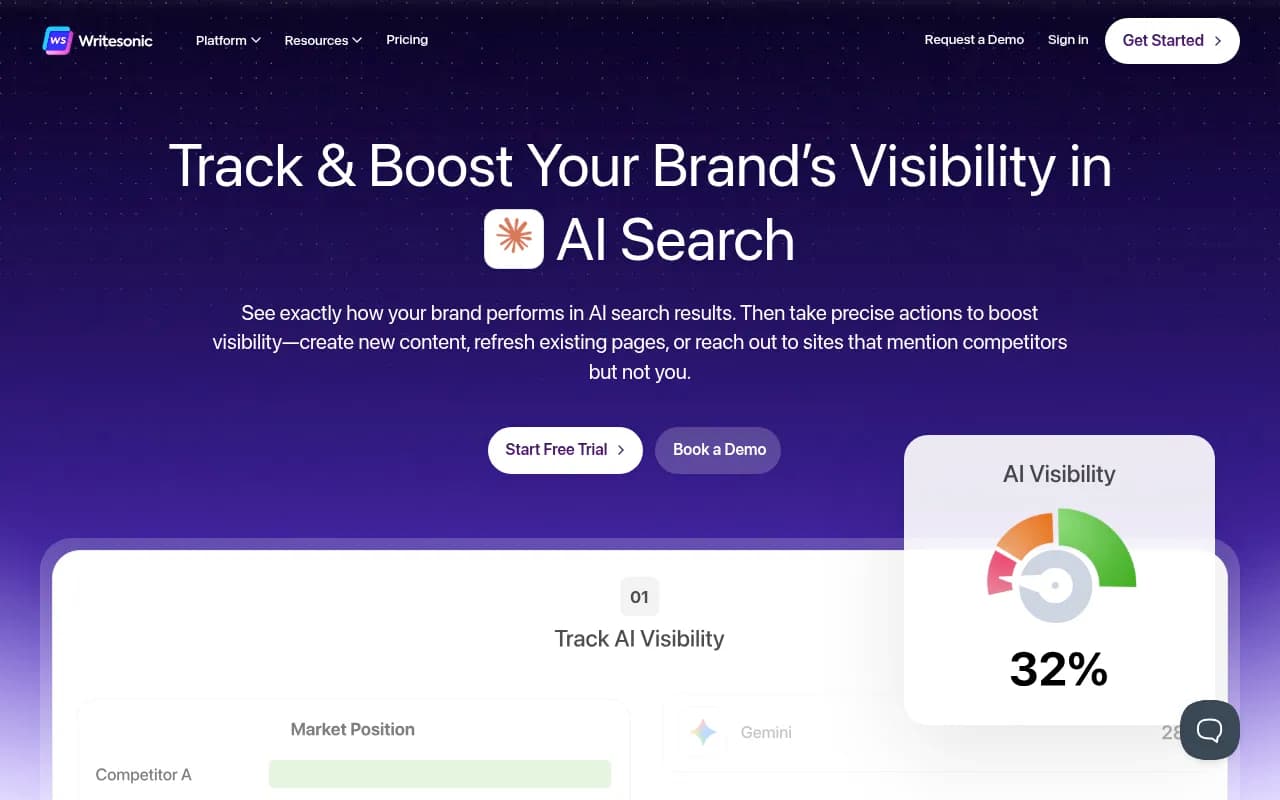
Writesonic has built a GEO module that sits alongside its existing content and SEO tools, which gives it a practical advantage: you can go from "we're invisible for this prompt" to "we published a page targeting it" without switching platforms.
The visibility tracking covers major AI engines with prompt-level and crawler insights. The content workflow is strong -- you can edit existing pages, create new content, and fix gaps all within the same interface. It's not as deep on the analytics side as Profound, and the crawler logs aren't as detailed as Promptwatch's, but for teams that prioritize speed of execution over analytical depth, it's a compelling option.
Pricing starts around $199/month for the GEO Professional plan.
Otterly.AI -- best for budget-conscious teams that just need monitoring
If you're not ready to invest in a full optimization platform and just need reliable tracking across the major AI engines, Otterly.AI is the most accessible entry point. It tracks ChatGPT, Google AI Overviews, Perplexity, Google AI Mode, Gemini, and Microsoft Copilot using API-based queries, with clean reporting and a 14-day trial.
The honest limitation: it's monitoring only. No content generation, no crawler logs, no traffic attribution. It's a good tool for understanding your current visibility baseline, but you'll hit its ceiling quickly if you want to improve that visibility rather than just measure it.
Starting at $29/month, it's the most affordable option on this list by a significant margin.

Scrunch AI -- best for deep enterprise segmentation
Scrunch AI sits at the other end of the spectrum from Otterly.AI. It's built for enterprise teams that need detailed segmentation, prompt-level analysis across all major engines, and SOC 2 Type II compliance. The analytics depth is impressive -- you can slice visibility data by product line, region, persona, and competitor in ways that most platforms don't support.
The gap is the same as Profound: no content generation, no optimization workflows. Scrunch shows you the picture in high resolution but doesn't help you paint a better one. Pricing is custom (demo required), which typically means it's positioned at larger budgets.
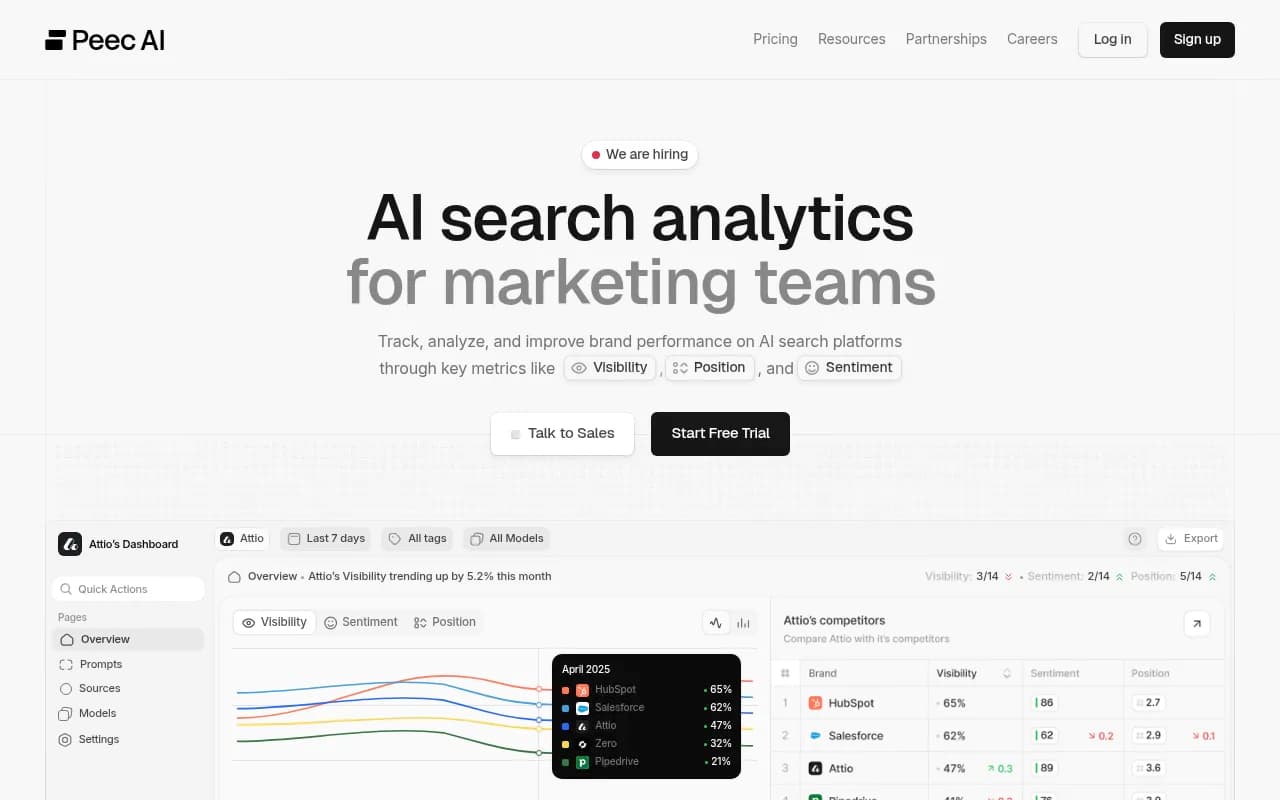
Peec AI -- best for multi-language and multi-region tracking
Peec AI has carved out a niche in international AI visibility tracking. If your brand operates across multiple languages and regions, and you need to understand how AI models respond to queries in French, German, Spanish, or other languages, Peec AI handles this better than most.
The platform covers the major AI engines with solid prompt-level analytics and a clean interface. Like most mid-tier tools, it doesn't have content generation capabilities, but it does offer enough prompt intelligence to help you prioritize where to focus.
Starting at €89/month with a free trial available.
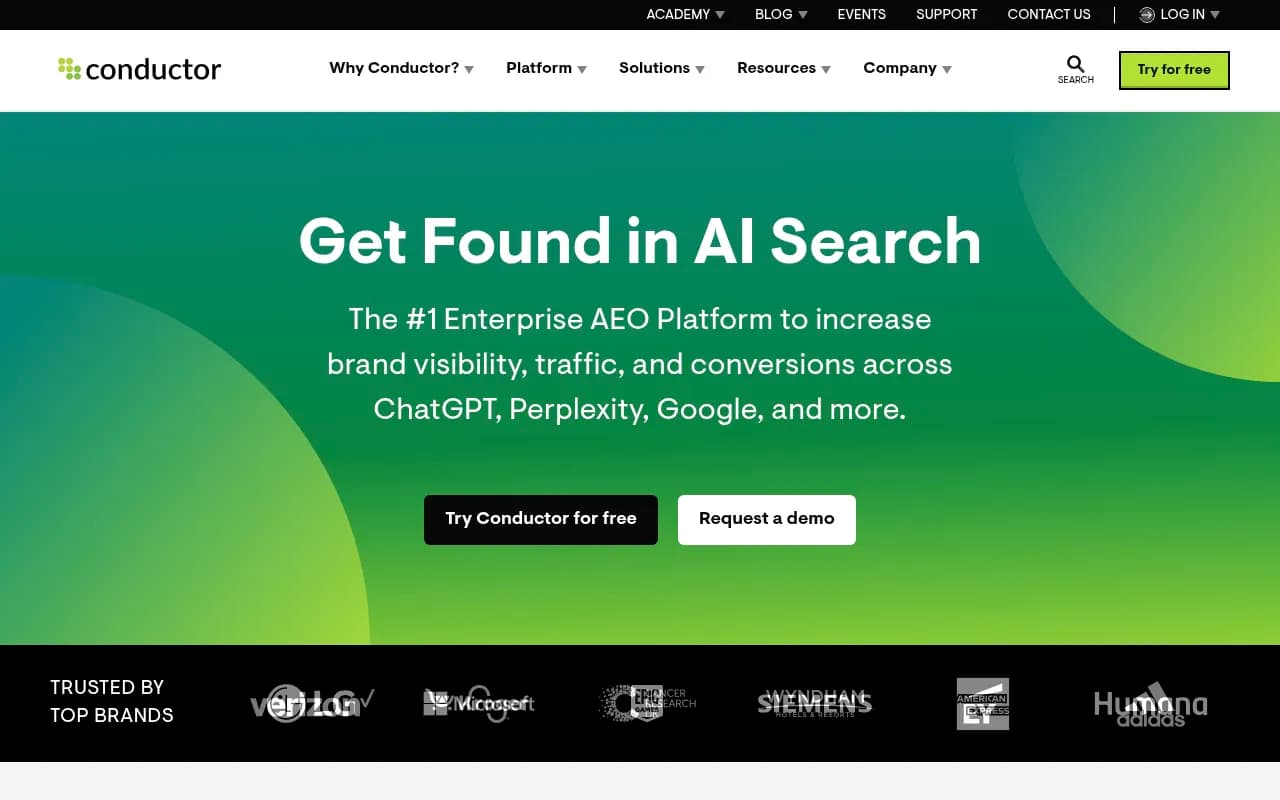
Conductor -- best for large organizations with existing SEO infrastructure
Conductor is an enterprise SEO platform that has added AI visibility as a layer on top of its existing content and SEO tools. For large organizations that already use Conductor for SEO, the AI visibility module integrates naturally into existing workflows, reporting structures, and BI stacks.
The trade-off is that AI visibility is a secondary feature rather than the core product. The depth of prompt tracking and citation analysis doesn't match dedicated GEO platforms. But if you're a large org with a complex SEO and content operation and you want AI visibility without adding another vendor, Conductor is worth evaluating.
Pricing is custom enterprise contracts.
Semrush -- best for SEO-led teams wanting AI visibility in a familiar tool
Semrush has added AI visibility tracking to its platform, and for teams already paying for Semrush, it's the path of least resistance. The AI visibility features sit alongside the keyword research, backlink analysis, and content tools that SEO teams already use daily.
The limitation is that Semrush uses fixed prompt sets rather than letting you define your own, which means you're tracking what Semrush thinks matters rather than the specific queries your customers are actually using. There's also no AI traffic attribution. For teams with custom prompt needs or who want to connect AI visibility to revenue, that's a real constraint.
What to look for when evaluating these platforms
Monitoring vs. optimization
This is the most important question to ask before buying anything. Monitoring platforms (Goodie AI, Otterly.AI, Profound, Scrunch, Peec AI) show you where you stand. Optimization platforms (Promptwatch, Writesonic GEO) help you improve where you stand. The price difference between them is often smaller than you'd expect, so it's worth being honest about whether you have the internal resources to act on monitoring data alone.
Prompt customization
Some platforms let you define any prompt you want to track. Others use fixed or semi-fixed prompt sets. If your customers use specific language, ask about specific products, or operate in a niche that generic prompts won't capture, you need a platform that lets you customize.
Traffic attribution
AI visibility is interesting. AI visibility connected to revenue is compelling. Very few platforms close that loop -- Promptwatch does it through GSC integration, a code snippet, and server log analysis. If you're making a business case for GEO investment, this capability matters.
Crawler log access
Understanding which pages AI bots are actually reading (and which they're ignoring or hitting errors on) is a fundamentally different kind of data from prompt tracking. It tells you about the technical layer of AI discoverability, not just the output layer. Promptwatch offers this; most competitors don't.
Reddit and YouTube tracking
AI models frequently cite Reddit threads and YouTube videos in their responses. If you're not monitoring these sources, you're missing a significant part of the picture. This is a capability that's easy to overlook when comparing feature lists but matters a lot in practice.
How to choose
The right platform depends on where you are in your GEO journey and what your team can actually execute on.
If you're just starting out and need a baseline understanding of your AI visibility, Otterly.AI at $29/month is a reasonable starting point. You'll outgrow it, but it's a low-risk way to get oriented.
If you're at the stage where you know you have visibility gaps and you want to fix them systematically, Promptwatch is the most complete option. The combination of answer gap analysis, built-in content generation, crawler logs, and traffic attribution means you're not just tracking the problem -- you're solving it.
If your organization is large, analytics-heavy, and has separate teams for data and content, Profound or Scrunch AI might fit better. They go very deep on the measurement side, and if your content team can act on that data independently, the lack of built-in optimization tools isn't a blocker.
For agencies managing multiple clients, Promptwatch's agency pricing and multi-site support make it the most practical choice. The ability to show clients not just where they're invisible but what you're doing to fix it -- and then show the results -- is a meaningful differentiator in client conversations.
Goodie AI is a reasonable tool for what it does. But in 2026, the platforms that help you act on data are worth more than the ones that just show it to you.