Key takeaways
- Authoritas AI Tracker is a solid entry point for combined AI and traditional search monitoring, but it has real gaps around content optimization, crawler insights, and actionability.
- Most alternatives fall into two camps: monitoring-only dashboards and full optimization platforms. Know which one you actually need before choosing.
- Promptwatch is the strongest all-around alternative if you want to go beyond tracking and actually improve your AI visibility -- it covers gap analysis, content generation, and traffic attribution in one place.
- Tools like Otterly.AI and Peec AI are cheaper options for teams that just need basic mention tracking across a few LLMs.
- Enterprise teams with complex needs should also look at Profound and Scrunch, though both carry higher price tags.
Authoritas has been a trusted name in traditional SEO for years. Their AI Tracker extension adds monitoring for AI search engines like ChatGPT and Perplexity on top of the existing rank tracking infrastructure. For teams already deep in the Authoritas ecosystem, that's convenient.
But convenience isn't the same as capability. If you're evaluating whether Authoritas AI Tracker is the right long-term choice -- or you're just starting to take AI visibility seriously -- it's worth understanding what else is out there.
This guide covers the strongest alternatives in 2026, what each one actually does well, and how to pick the right fit for your situation.

Why people look for alternatives to Authoritas AI Tracker
Authoritas AI Tracker does a decent job of showing you whether your brand appears in AI-generated responses. But several limitations come up repeatedly when teams try to scale their AI visibility work:
- It's primarily a monitoring tool. You can see where you appear (or don't), but there's no built-in path to fixing the gaps.
- The AI tracking feels bolted onto an existing SEO platform rather than built from the ground up for LLM visibility.
- Prompt coverage and LLM breadth are more limited compared to dedicated GEO platforms.
- There's no content generation, no crawler log analysis, and no traffic attribution tied to AI citations.
None of that makes it a bad tool. But if your goal is to actually improve your AI visibility -- not just measure it -- you'll likely hit a ceiling.
The best Authoritas AI Tracker alternatives in 2026
Promptwatch -- best for teams that want to act, not just monitor
Promptwatch is the most complete option on this list. Where most tools stop at showing you a visibility score, Promptwatch is built around a loop: find the gaps, create content to fill them, track the results.
The Answer Gap Analysis is genuinely useful -- it shows you the specific prompts where competitors are getting cited and you're not. That's not just a metric, it's a to-do list. The built-in AI writing agent then generates articles and comparisons grounded in real citation data from over 880 million citations analyzed. You're not writing generic blog posts; you're creating content that AI models are already looking for.
On the monitoring side, it covers 10 AI models including ChatGPT, Claude, Perplexity, Gemini, Grok, DeepSeek, and Google AI Overviews. The crawler logs feature -- which shows you exactly when and how AI bots are crawling your site -- is something most competitors don't offer at all. Traffic attribution closes the loop by connecting AI citations to actual website visits and revenue.
Pricing starts at $99/month for the Essential plan (1 site, 50 prompts, 5 articles), with Professional at $249/month and Business at $579/month. A free trial is available.

Otterly.AI -- best for budget-conscious teams getting started
Otterly.AI is one of the most affordable ways to start tracking AI visibility. It's consistently recommended for teams that want to dip their toes in without committing to an enterprise contract.
The interface is clean, setup is fast, and it covers the major LLMs. What it doesn't do is help you act on what you find. There's no content generation, no crawler logs, no traffic attribution. It's a monitoring dashboard, and a good one for the price -- just don't expect it to tell you what to do next.

Profound -- best for enterprise teams with deep pockets
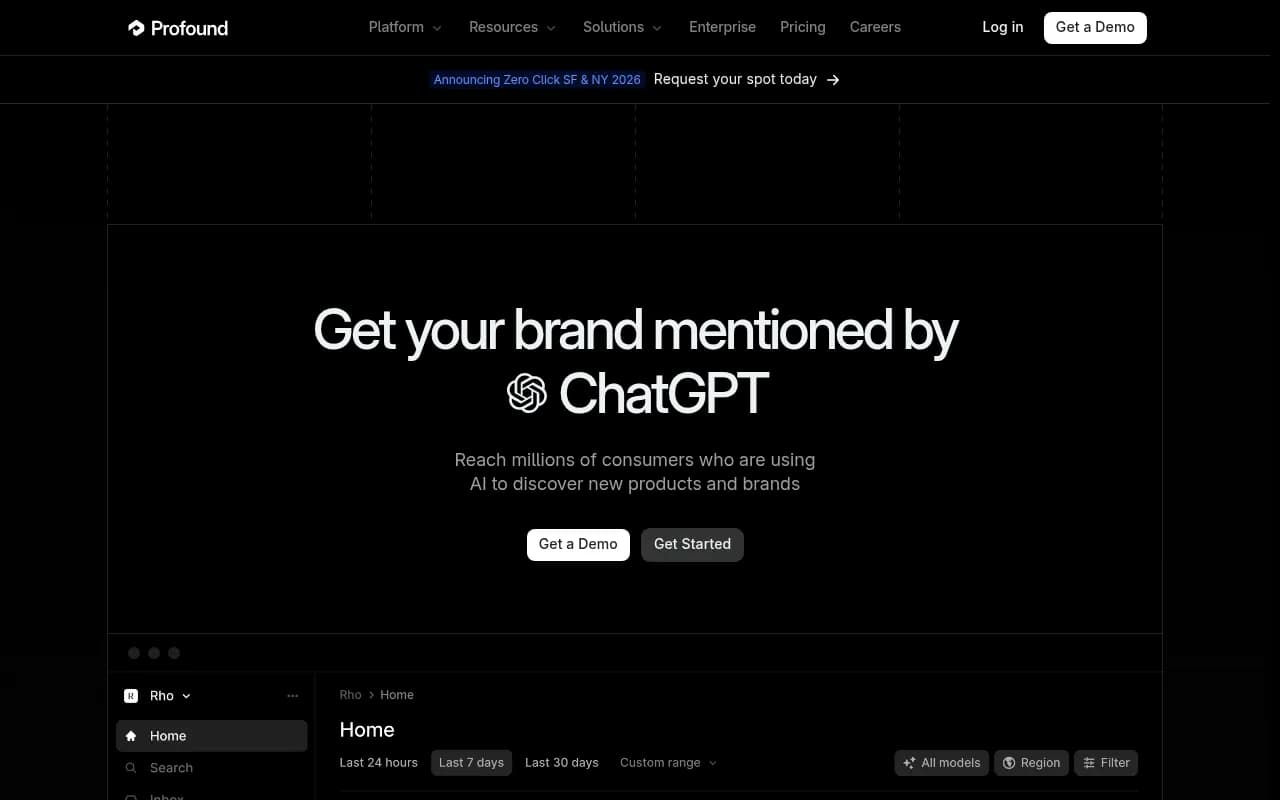
Profound is one of the more feature-rich platforms in the space. It tracks brand mentions, sentiment, and citations across major AI models, and the reporting is detailed enough for enterprise marketing teams.
The trade-off is cost. Profound sits at a higher price point than most alternatives, and some of the features that Promptwatch includes by default (like content generation and crawler logs) require additional configuration or aren't available at all. If budget isn't a constraint and you're primarily focused on monitoring and reporting, it's a strong choice.
Peec AI -- best for multilingual and multi-region tracking
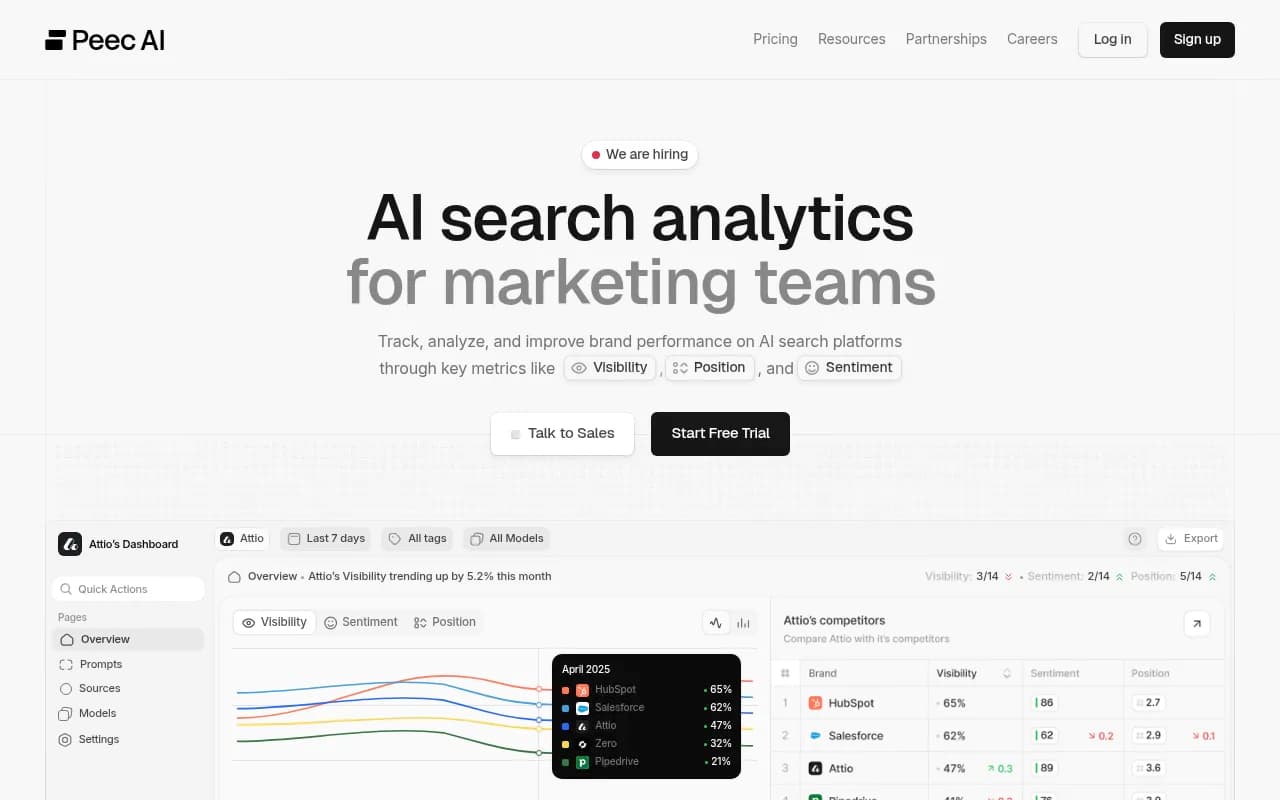
Peec AI has carved out a niche in multi-language AI visibility monitoring. If your brand operates across multiple countries and you need to track how AI models respond to queries in different languages, Peec AI handles that better than most.
Like Otterly.AI, it's primarily a monitoring tool. The prompt coverage is solid, and the interface makes it easy to compare visibility across regions. It doesn't have content generation or deep optimization features, but for international teams focused on measurement, it's worth a look.
Scrunch -- best for agencies managing multiple clients
Scrunch is built with agency workflows in mind. Multi-client dashboards, white-label reporting, and a clean interface for presenting AI visibility data to clients make it a practical choice for digital agencies.
The monitoring coverage is good, and the reporting features are more polished than many competitors. Where it falls short is on the optimization side -- like most tools in this list, it shows you the data but doesn't help you act on it. Promptwatch's agency tier is worth comparing directly if optimization matters to your clients.
SE Visible -- best for teams already using SE Ranking
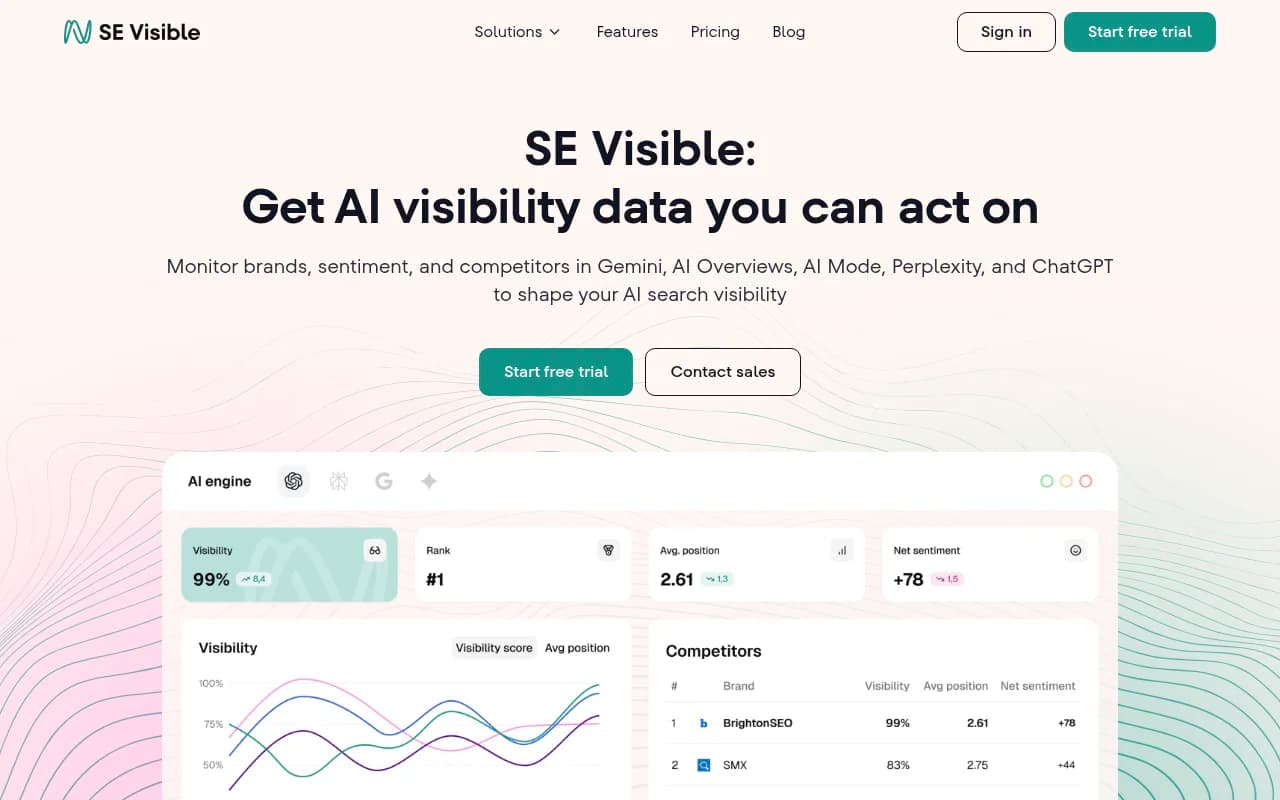
SE Visible is SE Ranking's dedicated AI visibility module. If your team already uses SE Ranking for traditional SEO, adding AI visibility tracking through SE Visible is a natural extension. The integration means you can see traditional rankings and AI visibility in the same dashboard, which reduces context-switching.
The AI tracking covers the main LLMs and includes sentiment analysis. It's not as deep as a dedicated GEO platform, but for teams who want a unified view without managing multiple tools, it's a practical option.
Ahrefs Brand Radar -- best for teams already in the Ahrefs ecosystem
Ahrefs Brand Radar brings AI brand monitoring into the Ahrefs platform. If you're already paying for Ahrefs and want basic AI visibility tracking without adding another subscription, it's a reasonable starting point.
The limitations are real though: prompts are fixed (you can't customize them to match how your customers actually search), and there's no AI traffic attribution. It's more of a feature add-on than a standalone AI visibility solution.
Semrush -- best for teams wanting traditional SEO + AI monitoring in one place
Semrush has added AI visibility tracking to its platform, which makes sense given how many marketing teams already use it for keyword research and rank tracking. The combined view of traditional search and AI visibility is genuinely useful for teams that want a single platform.
The AI monitoring uses fixed prompts, which limits how accurately it reflects your actual customers' queries. And like Ahrefs, it doesn't have the depth of a dedicated GEO platform. But if you're a Semrush user and want to start tracking AI visibility without adding another tool, it's worth exploring.
ZipTie -- best for deep analysis and custom reporting
ZipTie focuses on detailed analysis and reporting for AI visibility. It's particularly strong for teams that need to go deep on a specific set of prompts and understand exactly how AI models are responding -- including the nuances of sentiment and citation patterns.
The reporting is more granular than most tools, which makes it useful for SEO consultants and analysts who need to present detailed findings. It's less focused on ongoing optimization workflows.
LLMClicks -- best for detecting AI hallucinations about your brand
LLMClicks takes a different angle from most tools on this list. Rather than just counting mentions, it focuses on detecting when AI models are saying inaccurate things about your brand -- wrong pricing, invented features, misattributed claims.
This is a real problem that most visibility tools miss entirely. If your brand is being mentioned in AI responses but the information is wrong, that can actively hurt you. LLMClicks surfaces those inaccuracies so you can address them.
How the alternatives compare
| Tool | AI models covered | Content generation | Crawler logs | Traffic attribution | Best for |
|---|---|---|---|---|---|
| Promptwatch | 10 (ChatGPT, Claude, Perplexity, Gemini, Grok, DeepSeek, Copilot, Mistral, Meta AI, Google AIO) | Yes | Yes | Yes | Full optimization loop |
| Authoritas AI Tracker | Limited | No | No | No | Existing Authoritas users |
| Otterly.AI | Major LLMs | No | No | No | Budget monitoring |
| Profound | Major LLMs | No | No | Limited | Enterprise monitoring |
| Peec AI | Major LLMs + multi-language | No | No | No | International teams |
| Scrunch | Major LLMs | No | No | No | Agencies |
| SE Visible | Major LLMs | No | No | No | SE Ranking users |
| Ahrefs Brand Radar | Major LLMs | No | No | No | Ahrefs users |
| Semrush | Major LLMs (fixed prompts) | No | No | No | Semrush users |
| ZipTie | Major LLMs | No | No | No | Deep analysis |
| LLMClicks | ChatGPT, Perplexity | No | No | No | Hallucination detection |
What to look for when choosing an alternative
Monitoring vs. optimization
This is the most important distinction in the market right now. Most tools -- including Authoritas AI Tracker -- are monitoring dashboards. They show you where you appear and where you don't. That's useful, but it doesn't move the needle on its own.
Optimization platforms go further: they tell you what content to create, help you create it, and track whether it's working. If you're serious about improving your AI visibility (not just measuring it), you need a platform that supports the full loop.
Prompt customization
Fixed prompts are a significant limitation. The queries your customers actually type into ChatGPT or Perplexity are specific to your industry, your product category, and your competitors. A tool that only lets you track a generic set of prompts will give you an incomplete picture.
Look for platforms that let you define your own prompts -- ideally with volume estimates and difficulty scores so you can prioritize the ones worth winning.
LLM breadth
ChatGPT and Google AI Overviews get the most attention, but Perplexity, Claude, Gemini, Grok, and others are all driving real traffic and brand discovery. The more models a platform covers, the more complete your visibility picture.
Traffic attribution
Knowing you're cited in AI responses is one thing. Knowing that those citations are driving actual website visits and revenue is another. Traffic attribution -- whether through a code snippet, Google Search Console integration, or server log analysis -- is what separates a vanity metric from a business metric.
Crawler log analysis
AI crawlers like GPTBot (OpenAI) and ClaudeBot (Anthropic) visit your website to gather information for their models. Knowing which pages they're reading, how often they return, and whether they're hitting errors is genuinely useful for optimizing your AI visibility. Very few tools offer this -- it's one of the things that makes Promptwatch stand out.
Which alternative should you choose?
If you're coming from Authoritas and want a like-for-like replacement with better AI coverage, SE Visible or Otterly.AI are the easiest transitions. Both are monitoring-focused and relatively affordable.
If you're an agency managing multiple clients, Scrunch is worth a serious look for its reporting and multi-client workflows.
If you need multi-language or multi-region tracking, Peec AI is the specialist here.
If you're at an enterprise and budget isn't the primary concern, Profound has the depth and reporting for large-scale monitoring programs.
But if your goal is to actually improve your AI visibility -- to show up more often in ChatGPT, Claude, and Perplexity responses, and to connect that visibility to revenue -- Promptwatch is the most complete option available. The combination of gap analysis, AI content generation, crawler logs, and traffic attribution is something no other platform in this list offers end-to-end.
The monitoring-only tools will tell you that you're invisible. Promptwatch tells you why, and helps you fix it.